
Relying too much on one region for IT infrastructure or services can spell disaster for healthcare systems. When 70% of a region's internet traffic failed, hospitals faced severe challenges: patient care stalled, cybersecurity defenses weakened, and costs skyrocketed. This article dives into why geographic concentration creates vulnerabilities and what healthcare can do to protect itself.
Key Takeaways:
- Centralized Infrastructure Risks: Over-reliance on a single region or vendor can lead to widespread disruptions.
- Patient Safety Impact: Internet outages disrupt access to critical health data, delay treatments, and increase medical errors.
- Cybersecurity Gaps: Outages also reduce the ability to monitor for cyber threats, leaving systems exposed.
- Financial Burden: Downtime costs $5,600 per minute, with regulatory penalties adding to the strain.
- Solutions: Diversify IT networks, improve vendor risk management, and plan for disasters with backups and manual workarounds.
Healthcare organizations must act now to reduce their dependence on regional systems and build resilience against future disruptions.
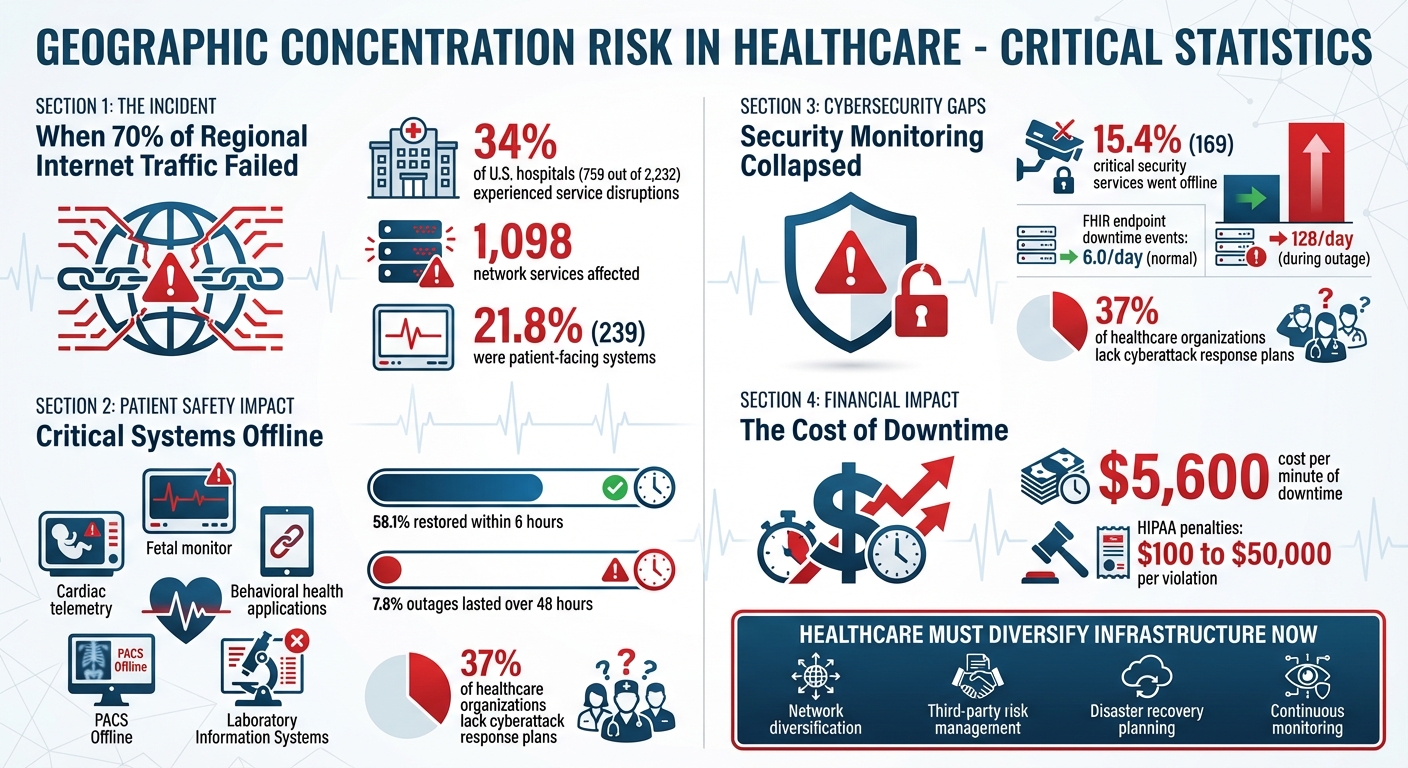
Impact of Geographic Concentration Risk on Healthcare: Key Statistics from the 70% Regional Internet Failure
The Problem: Risks of Geographic Concentration
Third-Party and Supply Chain Concentration
The healthcare sector's heavy reliance on a small pool of vendors creates a serious vulnerability. Third-party cyber risks have become one of the most disruptive threats facing the industry today[3]. When a single vendor fails, the ripple effects can be felt nationwide.
Take the CrowdStrike incident on July 19, 2024, as a prime example. A flawed software update for CrowdStrike's Falcon cybersecurity software caused widespread system crashes across the globe. In the United States alone, 759 out of 2,232 hospitals - 34% - experienced noticeable service disruptions[2]. The outage affected 1,098 network services, with 239 of those (21.8%) being patient-facing systems[2]. Fixing the issue required manual intervention on each impacted device, leading to downtimes that lasted from hours to days[2]. This incident highlights how vendor failures can extend beyond IT disruptions, exposing deeper vulnerabilities in geographically concentrated systems.
Challenges like staffing shortages, higher costs, compatibility problems with electronic health records (EHR) or practice management systems, and restrictive contracts[1] only make these regional breakdowns harder to address and more damaging.
How Regional Failures Disrupt Operations
In addition to vendor-specific risks, failures in regional infrastructure can wreak havoc on healthcare operations. When regional internet services go down, the consequences are both immediate and severe. Physicians can lose access to critical patient data, including medical histories, current health conditions, dietary restrictions, and test results - all essential for informed decision-making[4].
These failures also make it difficult for healthcare teams to collaborate across facilities. Tasks like consulting with off-site physicians, transferring medical records, or coordinating patient care become nearly impossible without functional digital systems[4]. As a result, treatment plans may falter, increasing the risk of medical errors[4]. Appointment delays grow as staff struggle with manual workarounds, and vital clinical information can be overlooked when systems are offline[4]. In an industry where timely, accurate information can save lives, these disruptions pose a direct threat to patient safety.
Impact of a 70% Regional Internet Failure on Healthcare
Patient Safety and Clinical Consequences
A regional internet failure can cause immediate and serious disruptions in healthcare services. Take the July 2024 CrowdStrike outage, for example. Critical patient-facing systems like fetal monitors, cardiac telemetry, behavioral health applications, Picture Archiving and Communications Systems (PACS), and Laboratory Information Systems (LIS) were suddenly offline across multiple facilities[2].
Without internet access, doctors were cut off from essential patient information - illness histories, current conditions, dietary needs, and test results. This lack of data made it harder to make safe, informed treatment decisions[4]. Delayed diagnoses could even result in fatalities[5]. Telehealth services, a lifeline for many patients, were also severely disrupted, leaving those who rely on virtual care with few alternatives[4]. While most hospitals managed to restore services within six hours (58.1%), a worrying 7.8% faced outages lasting over 48 hours[2]. Beyond the immediate impact on patient care, these disruptions also reveal troubling gaps in cybersecurity preparedness.
Cybersecurity Monitoring Gaps During Outages
Internet outages don’t just disrupt clinical care - they also cripple cybersecurity monitoring. During the CrowdStrike outage, 169 critical services (15.4%) went offline, including Security Information and Event Management (SIEM) and Security Operations Center (SOC) tools[2]. This left hospitals unable to detect threats in real-time. The number of FHIR endpoint downtime events surged from an average of 6.0 per day before the incident to 128 during the outage (P < .001)[2].
Dr. Jeffrey L. Tully from the Center for Healthcare Cybersecurity at UC San Diego explained: "To our knowledge, no federal, regional, state, commercial or trade association health care stakeholder or entity possesses the capability to assess in near–real time digital signals corresponding to the availability of national health care infrastructure technology."[6]
Alarmingly, 37% of healthcare organizations still lack a cyberattack incident response plan[7]. Without proper monitoring during an outage, cybersecurity teams are left in the dark, giving attackers an open window to exploit vulnerabilities. These gaps not only jeopardize patient care but also lead to significant financial and regulatory challenges.
Regulatory and Financial Consequences
The financial toll of regional internet failures on healthcare facilities is staggering. Downtime costs an estimated $5,600 per minute[4]. For instance, in November 2022, a 10,000-bed hospital faced a certificate issue that shut down systems, forcing vaccine refrigerators to be recalibrated and spoiled contents to be discarded - a costly setback[5].
HIPAA violations add another layer of financial strain, with penalties ranging from $100 to $50,000 per infraction, depending on severity[4].
Greg Davis, CEO of Bigleaf Networks, summed it up: "Internet downtime in healthcare facilities can have a significant financial impact. The cost of HIPAA breaches can be substantial, with penalties ranging from $100 to $50,000 per violation, depending on the severity. Additionally, considering the estimated cost of downtime at $5,600 per minute, even a brief internet outage can result in substantial financial losses due to disrupted operations, delayed patient care, and potential data breaches. The cumulative effect of these costs can be detrimental to the financial stability of healthcare organizations."[4]
For rural health clinics, the situation is even more dire. These facilities already face lower Medicare reimbursement rates for telehealth services, and outages only add to their financial burden[8].
sbb-itb-535baee
Solutions: How to Reduce Geographic Concentration Risk
Diversify Network and Infrastructure Dependencies
Healthcare organizations need to take a close look at the geographic concentration of their IT infrastructure to uncover any weak points. The first step? Taking stock of all IT resources. From there, working with IT professionals and vendors can help craft specific strategies to minimize the risk of a regional outage disrupting operations.
In addition to diversifying networks, it's equally important to address risks tied to third-party dependencies.
Improve Third-Party Risk Management
Concentrated infrastructure brings significant risks, and improving third-party management is a key step in addressing them. Geography plays a major role in third-party risk. Studies reveal that healthcare outcomes in the U.S. vary widely by region, with a 2.1-fold difference in risk-adjusted mortality rates between top- and bottom-decile hospitals. For patient safety, the gap is even starker - an average 10.2-fold difference between the best and worst performers [9].
When evaluating regional service providers, consider challenges like workforce availability, infrastructure quality, and disparities in regional health outcomes. Tools like Censinet RiskOps™ integrate geographic data into third-party risk assessments, offering features like rapid security questionnaires and continuous monitoring to pinpoint vulnerabilities tied to specific regions. Censinet AI™ further streamlines this process by automatically identifying integration details and potential fourth-party risks.
Create Healthcare-Specific Disaster Recovery Plans
To prepare for regional outages, your disaster recovery plan should directly address geographic concentration risks. TXOne Networks highlights the importance of incorporating cyber incidents into your Business Continuity Plan (BCP) alongside other major disasters [10]. This means setting clear emergency operation policies, ensuring redundancy or backups for critical systems and data, and establishing alternative ways to access backups [10].
"A comprehensive BCP should include strategies to minimize chaos and business impact in the event of a cyber incident, along with rapid recovery solutions." [10]
Backup plans should cover everything from patient data to essential system software and configurations. For complex healthcare IT systems with multiple vendors, collaborate with those vendors to confirm that all backups are thoroughly tested and verified [10]. Additionally, plan for manual operations and inter-facility support to handle emergencies effectively [10].
Establish Continuous Monitoring and Governance
Ongoing monitoring is crucial for identifying and addressing risks tied to geographic concentration before they escalate. Censinet RiskOps™ acts as a centralized hub for risk management, aggregating real-time data across your vendor ecosystem. Its advanced routing and orchestration features ensure that critical insights are directed to the right stakeholders for timely action.
With Censinet AI™, you can automate key steps in the risk assessment process while maintaining human oversight. Configurable rules and review processes allow risk teams to stay in control, ensuring automation supports decision-making rather than replacing it. This approach makes it possible to scale risk management efforts, tackling complex third-party and enterprise risks with greater efficiency and accuracy.
Conclusion: Building Resilience Against Geographic Concentration Risks
The 70% regional internet failure revealed a glaring weakness in healthcare: relying too heavily on infrastructure concentrated in one location can lead to major disruptions. This kind of dependency risks halting patient care, weakening cybersecurity defenses, and causing operational chaos. When a single area experiences an outage, organizations with limited network diversification can face immediate setbacks - ranging from inaccessible medical records to interrupted telehealth services. This situation highlights the pressing need for forward-thinking recovery strategies.
Healthcare must shift from reacting to crises to building resilience ahead of time. As discussed earlier, geographic concentration poses risks that demand prompt action. To address this, healthcare organizations should diversify their IT systems, include geographic factors in third-party risk evaluations, and create disaster recovery plans tailored to regional outages. Tools like Censinet AI™ can streamline risk assessment processes, allowing organizations to scale their efforts without compromising safety or accuracy.
"AI and machine learning methods were seen as prominent techniques for reducing supply chain disruptions in healthcare; these tools can help the quick recovery and anticipation of future pandemics." - ScienceDirect [11]
Technology is a cornerstone of resilience. Artificial intelligence, blockchain, and IoT technologies empower healthcare providers to predict disruptions, ensure transparent communication, and respond quickly to evolving challenges [11].
To counter the risks discussed, continuous vigilance and thoughtful planning are essential. Organizations that prioritize infrastructure diversification, embrace advanced digital tools, and maintain operational flexibility will be better equipped to handle future crises - safeguarding both patient care and overall operational stability.
FAQs
What steps can healthcare organizations take to reduce the risk of IT network disruptions?
Healthcare organizations can reduce IT network disruptions by embracing a multi-cloud strategy, which helps prevent dependency on a single provider. This approach ensures that services remain accessible even if one provider faces issues. Another key step is geographically distributing data centers, so critical systems stay up and running even if an outage affects one specific region.
To maintain uninterrupted access to essential services, organizations should also set up redundant internet connections. This creates a backup option to keep systems online if one connection fails. Furthermore, conducting thorough third-party risk assessments is crucial. These evaluations help uncover vulnerabilities in vendors and partners, allowing healthcare providers to address any weak spots before they cause problems.
By taking these steps, healthcare organizations can create a more reliable and robust IT infrastructure designed to meet their specific challenges.
What financial risks do healthcare facilities face during internet outages?
When healthcare facilities experience internet outages, the financial impact can be staggering - averaging around $7,500 per minute. These costs arise from a mix of issues, including lost revenue from delayed or missed billing, higher labor expenses due to manual workarounds, and even potential fines for regulatory non-compliance.
However, the consequences go beyond the immediate financial strain. Outages can also jeopardize patient safety, which can tarnish the facility's reputation and lead to long-term financial challenges. To mitigate these risks, it's crucial for healthcare organizations to invest in solid disaster recovery plans and implement network redundancy strategies. These measures can help reduce both operational disruptions and financial losses.
How can regional internet outages affect patient care and safety in healthcare?
Regional internet outages can throw a wrench into healthcare operations, cutting off access to critical systems like electronic health records (EHRs), telemedicine platforms, and other digital tools that are essential for managing patient care. When these systems go offline, it can lead to delays in diagnoses, treatments, and even emergency interventions, putting patient safety at risk.
On top of that, outages can disrupt communication between healthcare providers, slowing down workflows and increasing the chance of medical errors. The situation tends to hit harder in rural or underserved areas, where digital services often play a key role in filling gaps in care delivery. Tackling these challenges head-on is essential to ensure patient safety and keep healthcare services running smoothly.
Related Blog Posts
- When Multi-AZ Isn't Enough: What the AWS US-EAST-1 Failure Taught Us About True Resilience
- 7 Hours Down, Millions Affected: Inside the AWS Outage That Broke Healthcare's Digital Backbone
- Why Your "Highly Available" Healthcare Cloud Architecture Failed on October 20, 2025
- The 30-40% Problem: Why Healthcare's Over-Reliance on US-EAST-1 Is a Patient Safety Risk
