
Healthcare apps are prime targets for cyberattacks due to their sensitive data and critical role in patient care. With the average healthcare data breach costing $7.13 million, organizations must prioritize effective cybersecurity training. This article explores three training methods tailored to healthcare apps: compliance-focused, risk-based role-specific, and platform-integrated training.
Key Takeaways:
- Compliance-focused training addresses HIPAA and regulatory requirements but often lacks depth for real-world threats.
- Risk-based role-specific training customizes content for roles like developers or clinicians, improving engagement and reducing vulnerabilities.
- Platform-integrated training embeds guidance into daily workflows, offering real-time, actionable education.
Each method has strengths and limitations. A hybrid approach combining these strategies ensures comprehensive coverage, better engagement, and measurable improvements in security practices.
Quick Tip: Start with compliance training to meet legal obligations, then layer in role-specific and platform-integrated methods for targeted risk reduction.
1. Compliance-Focused Training
Compliance-focused training zeroes in on regulations like HIPAA and HITECH, which set the rules for protecting patient data in healthcare apps. This type of training ensures that developers, security teams, and product managers fully understand the legal requirements around handling Protected Health Information (PHI). These include encryption, access controls, breach reporting deadlines, and audit logging practices [2][7][9]. The goal is to translate these compliance rules into concrete design choices, such as defining covered entities, setting up necessary agreements, and implementing safeguards like multi-factor authentication (MFA), session timeouts, and device encryption for both mobile and web platforms [2][7].
Training Scope
The training covers both technical and administrative safeguards required by regulations. The technical side includes basics like encryption (both at rest and in transit), role-based access controls, secure authentication, and audit logging. On the administrative side, it addresses risk analysis, incident response planning, and vendor management [2][7][9]. For healthcare apps, the training also dives into API-specific risks, drawing on ONC API privacy and security guidance. Topics include OAuth 2.0 authentication, consent management, and secure third-party app registration standards [2][7]. Additionally, HHS/OCR guidance emphasizes the importance of ongoing workforce training on HIPAA Security Rule requirements, the latest cyber-attack trends, and effective incident response strategies [9].
Relevance to Healthcare Apps
Compliance training becomes more impactful when it incorporates real-world scenarios tailored to healthcare apps instead of sticking to generic policy overviews. For mobile apps, for example, training might include strategies for protecting PHI on lost or stolen devices through measures like device encryption, remote wiping, and secure session management [2][4]. For patient portals and clinician-facing tools, the focus might shift to strong authentication methods, MFA, privacy-by-design principles for features like messaging and telehealth, and phishing-resistant account recovery mechanisms [2][4][6]. Federal API guidelines also stress the importance of training on secure API usage, managing permissions, and handling electronic PHI (ePHI). This includes understanding OAuth scopes, adhering to the "minimum necessary" principle, and ensuring proper patient consent [7]. Increasingly, security awareness training is recognized as just as important as technical controls, given the significant role human error plays in security breaches [2][4].
Effectiveness in Reducing Vulnerabilities
This type of training addresses vulnerabilities caused by gaps in controls or failure to follow policies. Examples include insufficient risk assessments for new app releases, weak access controls, missing audit logs, unencrypted PHI in mobile or cloud environments, and poor incident response practices [2][7][9]. Data from HHS/OCR breach reports shows that many large-scale breaches stem from issues like lost or stolen devices, hacking, and unauthorized access - all of which are closely tied to workforce behavior and lapses in policy enforcement [9]. By directly connecting regulatory requirements to specific security practices - such as implementing TLS for HIPAA-compliant encryption and ensuring robust PHI storage encryption - compliance training can significantly lower both security risks and regulatory exposure [8][9].
The most effective training methods are short, frequent, and context-driven. These can include micro-learning sessions, scenario-based workshops, and tabletop exercises, rather than relying solely on annual training sessions that often feel like a formality [6][11]. This foundation in compliance paves the way for more targeted, risk-focused training strategies in the evolving landscape of healthcare cybersecurity.
2. Risk-Based Role-Specific Training
Risk-based role-specific training takes a more tailored approach to security awareness, focusing on the specific risks and responsibilities tied to each team member's role. Instead of delivering a generic HIPAA training session to everyone once a year, this method acknowledges that developers, security engineers, clinicians, and vendor managers face unique challenges when working with healthcare apps. For instance, a front-desk employee may need to focus on phishing awareness and secure device handling, while a mobile app developer would benefit from learning secure coding practices, API authentication methods, and encryption techniques [6][2]. By making training directly relevant to each role, it becomes more practical and engaging, leading to measurable improvements in reducing vulnerabilities.
Training Scope
This training model organizes content into three core dimensions: role, risk, and lifecycle.
- By Role: Training is customized for different groups. App developers, for example, focus on secure coding, API security, and static code analysis. Security engineers tackle vulnerability scanning, triage, and remediation. Clinical and operations staff learn about secure app usage, phishing detection, and device security. Vendor risk managers are trained on third-party app assessments and contract security requirements [2][4][6].
- By Risk: The training zeroes in on high-risk areas, such as PHI flows through login screens and APIs, common attack methods like credential theft, and mobile device risks like lost devices or insecure networks [2][4][5].
- By Lifecycle: The content spans the app lifecycle, from secure design and development to pre-production testing with tools like OWASP ZAP and Burp Suite, deployment hardening, and post-deployment monitoring and incident response [2][8].
To keep the training actionable and relevant, organizations often structure it into 60–90 day cycles with short, focused micro-lessons. These lessons address high-risk behaviors identified through recent assessments or incidents, ensuring the training adapts to evolving threats and challenges [6].
Relevance to Healthcare Apps
The training becomes far more impactful when it ties directly to real-world scenarios in healthcare app usage. For developers, this might involve exercises like securely storing PHI on mobile devices, using AES-256 encryption for data at rest, implementing TLS for data in transit, designing APIs with OAuth 2.0, or building authentication systems that meet HIPAA standards [2][3][7].
For clinicians and administrative staff, the focus shifts to scenarios such as securely handling e-prescriptions, managing remote patient monitoring data, and ensuring secure app access across clinics, home offices, or shared devices. Policies like remote wipe for lost devices also play a critical role [2][4][5]. Tools like Censinet RiskOps™ can enhance training by integrating risk data from third-party app assessments and PHI exposure mapping, making it even more relevant to the specific apps and vendors staff interact with.
Effectiveness in Reducing Vulnerabilities
This targeted training approach delivers tangible results by addressing the behaviors and practices that often lead to security gaps. For example, when developers are trained on secure encryption libraries, API authentication standards, and static code analysis, organizations report fewer vulnerabilities like weak encryption, unsafe data storage, and authentication bypasses in production apps [2][3].
Similarly, security and IT teams equipped with skills in scanning internet-facing portals, applying patches promptly, and enforcing device security are better prepared to close technical gaps and minimize damage from compromised devices [2][4][8]. On the front lines, training staff to recognize phishing attempts and handle data securely reduces the chances of attackers gaining access through social engineering - a common entry point in healthcare breaches. By tracking metrics like phishing click rates, vulnerability remediation times, and configuration errors, organizations can clearly demonstrate how role-specific training leads to fewer incidents and lower overall risk.
3. Platform-Integrated Training (e.g., Censinet RiskOps™)
Platform-integrated training takes security education a step further by weaving it directly into the tools and workflows that teams use daily. In healthcare, platforms like Censinet RiskOps™ embed real-time guidance into tasks such as vendor assessments, vulnerability reviews, and handling PHI (Protected Health Information) incidents. This means users learn best practices while actively managing risks, closing the gap between theoretical policies and practical application. The result? Vulnerabilities are addressed as they arise, not after the fact.
Training Scope
This method provides comprehensive, contextual guidance tailored to real-world scenarios in healthcare. For example, as teams assess vendors or applications involving PHI and ePHI, they receive immediate tips on regulatory alignment. When configuring apps or approving third-party connections, staff see prompts for secure practices like enabling multi-factor authentication, encrypting devices, securing APIs, and hardening mobile apps.
The platform also supports secure software development lifecycle (SDLC) practices by embedding checklists for code reviews, static analysis, and timely vulnerability patching. When incidents occur - like a lost mobile device or API misuse - staff are guided through step-by-step response playbooks. Even human-factor risks, such as phishing or weak password practices, are addressed through micro-lessons that pop up during sensitive workflows or after simulated phishing tests. This seamless integration ensures training adapts to the unique challenges of healthcare applications.
Relevance to Healthcare Apps
Integrated training adds a practical dimension to compliance and role-specific education by tying lessons to live workflows. It’s designed to address the specific risks of different app types and data sensitivities. For instance, EHR-integrated mobile apps, telehealth platforms, patient portals, and medical device companion apps trigger context-specific guidance on handling PHI, managing clinical workflows, or complying with FDA regulations.
Prebuilt templates and questionnaires tailored to healthcare scenarios help analysts grasp best practices while evaluating vendors. Real-world examples, like breaches caused by unsecured mobile devices or weak API authentication, highlight the consequences of poor security and demonstrate how integrated policies can mitigate risks. By connecting training to clinical operations and patient safety, teams understand that insecure apps can disrupt care, expose sensitive data, or compromise medical decisions - not just lead to regulatory fines.
Effectiveness in Reducing Vulnerabilities
This approach delivers measurable improvements by linking training to operational outcomes. Organizations can track metrics such as the frequency and severity of app-related incidents before and after deploying platform-integrated training. Logs can reveal whether the time taken to detect and remediate vulnerabilities has shortened, while better risk assessments can be seen in fewer incomplete questionnaires, misclassified risks, or unjustified policy exceptions.
Behavioral changes are another key indicator. For example, targeted in-platform content can help reduce phishing click rates, misconfigurations, and device security violations. Considering that only 5% of U.S. healthcare employees receive monthly cybersecurity training [10], embedding continuous education into workflows can significantly boost readiness. A real-world example: Tower Health was able to shift resources from training to core risk assessments after implementing Censinet RiskOps™ [1]. This demonstrates how integrating training into daily operations can both enhance security and optimize resource allocation.
sbb-itb-535baee
Strengths and Weaknesses of Each Approach
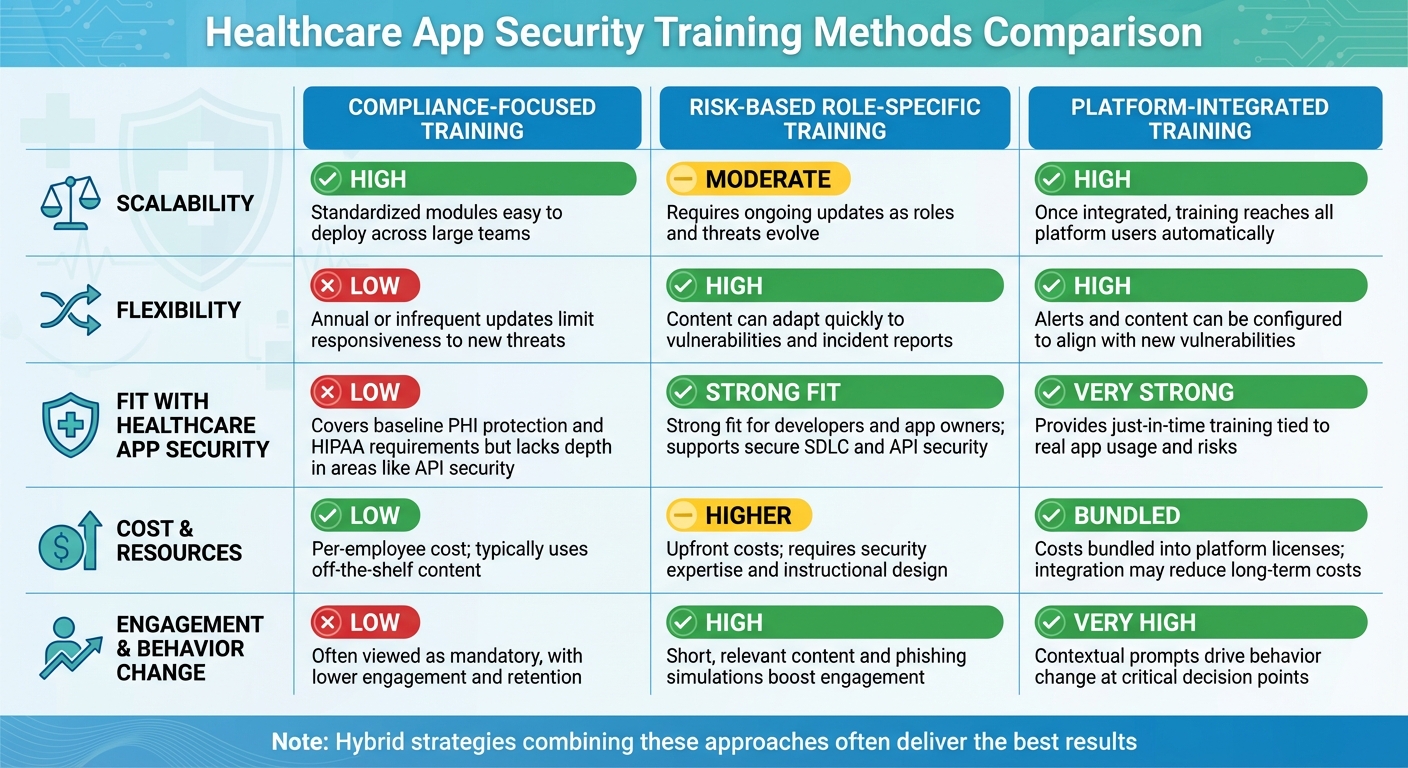
Healthcare App Security Training Methods Comparison: Compliance vs Risk-Based vs Platform-Integrated
Each training method has its own set of advantages and challenges, allowing organizations to align their strategies with security needs, budgets, and operational realities. Here’s a closer look at the pros and cons of each approach.
Compliance-focused training is widely used across large health systems because it provides standardized HIPAA and HHS modules. This ensures regulatory requirements are met and basic risk controls are in place. However, the downside is its focus on minimum required controls, which often leaves out real-world threats. The content is typically generic and delivered annually or semi-annually, which research shows isn't very effective for driving lasting behavior changes. This can lead to a "check-the-box" mindset, where teams meet quotas without applying lessons to daily tasks like vulnerability management or secure coding. These limitations highlight the need for a more dynamic, hybrid training model to address healthcare app vulnerabilities effectively.
Risk-based, role-specific training is designed to address actual risks by tailoring content to specific job functions. For instance, developers receive secure coding guidance, while clinicians are trained on secure app usage. This targeted approach improves engagement and encourages secure behaviors. Using a 90-day training cycle with simulated phishing exercises can further enhance effectiveness. However, this method requires significant expertise and effort to design and maintain. For organizations managing multiple apps, facilities, and vendors, keeping content tailored yet consistent can be a logistical challenge. Smaller practices, in particular, may lack the specialized staff needed to develop and implement these modules, leading to incomplete adoption that focuses only on high-risk roles.
Platform-integrated training offers real-time, context-aware content embedded directly into the tools staff use daily. This immediate application of knowledge helps improve retention and supports better risk-based decision-making. Integrated reporting allows leaders to track training effectiveness through metrics like reduced third-party risk scores and faster mitigation timelines. The drawback? This approach relies heavily on platform adoption. Staff who don’t frequently interact with the platform may miss out unless additional channels are provided. Poorly designed integrations can also disrupt workflows, such as vendor onboarding, by creating excessive notifications.
Here’s a side-by-side comparison of these training models:
| Factor | Compliance-Focused | Risk-Based Role-Specific | Platform-Integrated |
|---|---|---|---|
| Scalability | High - standardized modules are easy to deploy across large teams | Moderate - requires ongoing updates as roles and threats evolve | High - once integrated, training reaches all platform users automatically |
| Flexibility | Low - annual or infrequent updates limit responsiveness to new threats | High - content can adapt quickly to vulnerabilities and incident reports | High - alerts and content can be configured to align with new vulnerabilities |
| Fit with Healthcare App Security | Covers baseline PHI protection and HIPAA requirements but lacks depth in areas like API security | Strong fit for developers and app owners; supports secure SDLC and API security | Very strong - provides just-in-time training tied to real app usage and risks |
| Cost & Resources | Low per-employee cost; typically uses off-the-shelf content | Higher upfront costs; requires security expertise and instructional design | Costs are bundled into platform licenses; integration may reduce long-term costs |
| Engagement & Behavior Change | Low - often viewed as mandatory, with lower engagement and retention | High - short, relevant content and phishing simulations boost engagement | Very high - contextual prompts drive behavior change at critical decision points |
For practical use, hybrid strategies often deliver the best results. Large health systems might start with compliance training to meet regulatory requirements, then add risk-based modules for high-impact roles like front-desk staff, billing teams, and developers. Platform-integrated training can be layered in where tools like Censinet RiskOps™ are broadly implemented. Smaller practices, on the other hand, may begin with compliance training and a few targeted role-specific modules - such as phishing awareness for front-desk staff and secure data handling for billing teams - expanding as resources grow. Linking training outcomes to measurable metrics, like phishing click-through rates or patching timelines, can help validate the effectiveness of these strategies.
Conclusion
Before selecting a training approach, take stock of your current programs. Compliance-focused training serves as the foundational requirement - every U.S. healthcare organization must adhere to the HIPAA Security Rule's administrative safeguards. The Office for Civil Rights (OCR) frequently identifies inadequate training as a factor in breach investigations, emphasizing the need for this baseline. It ensures that all staff are equipped with essential knowledge about protecting PHI, reporting breaches, and securely using mobile apps and EHRs. However, compliance training alone isn’t enough to defend against targeted threats like phishing or API vulnerabilities, which are responsible for most incidents.
To address these risks, organizations should build on compliance requirements with more targeted methods. Risk-based, role-specific training focuses on the unique challenges faced by different roles, such as developers, clinicians, IT teams, and front-line staff. Implementing a 90-day training cycle that includes phishing simulations and bite-sized lessons has been shown to effectively change behaviors and reduce the likelihood of breaches. Although this approach demands greater effort in design and regular updates, the benefits - such as reduced phishing click rates, quicker vulnerability fixes, and fewer user-related errors - make it a worthwhile investment for mid-to-large healthcare systems managing complex tech environments.
Going a step further, platform-integrated training embeds learning directly into daily workflows, offering real-time, actionable guidance. This method ensures that training translates into immediate, practical action. For example, Terry Grogan, CISO at Tower Health, highlighted how using Censinet RiskOps allowed three team members to return to their primary roles while enabling the team to conduct more risk assessments with fewer resources. This kind of efficiency demonstrates the value of integrating training tools into everyday tasks.
A comprehensive strategy combines these approaches into a three-tiered plan: mandatory compliance training, quarterly risk-based modules, and platform-integrated microlearning. Start by confirming that all staff have completed HIPAA and security awareness training within the past year. Then, introduce phishing simulations for all employees and secure coding lessons for developers. Finally, layer in embedded guidance within critical workflows, such as vendor onboarding or app deployment. To measure success, track both activity metrics (like training completion rates and quiz scores) and outcome metrics (such as phishing click rates, time to fix vulnerabilities, and incident frequency). These data points will help you refine your program over time.
FAQs
What are the best practices for implementing a hybrid training approach to enhance app security in healthcare?
To put a hybrid training program into practice for app security in healthcare, blending in-person workshops with virtual learning is key. This combination offers flexibility while covering all the bases. Hands-on activities, like simulations and live drills, are great for building real-world skills, while online modules and webinars deliver the foundational knowledge employees can revisit anytime.
Keeping the training up-to-date through regular assessments is crucial, as it ensures the material stays aligned with new and evolving threats. Customizing the program to tackle healthcare-specific challenges - like safeguarding patient data and managing clinical applications - keeps the focus sharp. Promoting continuous learning and using tools that simplify risk management can help healthcare organizations stay prepared in a constantly shifting security landscape.
How does platform-integrated training improve healthcare app security?
Platform-integrated training boosts the security of healthcare apps by streamlining risk assessments, minimizing vulnerabilities, and increasing team efficiency. This method allows teams to manage more assessments with fewer resources, creating a more efficient and scalable way to handle risks.
By embedding training directly into a platform, healthcare organizations encourage ongoing learning and better prepare teams to tackle risks involving patient data, clinical applications, and medical devices. This approach not only strengthens security measures but also helps meet regulatory requirements while safeguarding sensitive information.
Why is role-specific training essential for securing healthcare applications?
Role-specific training plays a key role in preparing team members to tackle the specific security challenges that come with their roles. It ensures they understand the threats they might face, the secure practices they should follow, and the compliance standards they need to meet. This knowledge empowers them to spot and address potential risks effectively.
By tailoring training to individual roles, organizations can cut down on mistakes, boost the security of healthcare applications, and safeguard sensitive patient information, including PHI. In a high-stakes field like healthcare, equipping every team member with the right tools and understanding is essential to reducing vulnerabilities.
