
ISO 27001 Risk Assessment: Quantitative Techniques
Post Summary
Healthcare organizations face unique cybersecurity challenges that directly impact patient safety. ISO 27001 provides a structured framework for managing these risks, and quantitative risk assessment techniques can help translate risks into measurable, actionable data. Here's what you need to know:
- ISO 27001 Overview: A global standard for Information Security Management Systems (ISMS), it emphasizes a documented, repeatable, and traceable risk assessment process.
- Quantitative vs. Qualitative: Quantitative assessments assign measurable values to risks (e.g., financial impact, likelihood), offering clearer insights than qualitative methods.
- Key Metrics: Metrics like Single Loss Expectancy (SLE), Annualized Rate of Occurrence (ARO), and Annualized Loss Expectancy (ALE) help healthcare organizations evaluate risks in financial terms.
- Healthcare-Specific Risks: Examples include ransomware attacks, medical device vulnerabilities, and third-party vendor security threats, all of which can be assessed using quantitative techniques.
- ISO 27001 and HIPAA: These frameworks complement each other, with ISO 27001 providing a system for managing risks that aligns with many HIPAA requirements.
Quantitative methods not only improve risk clarity but also support better decision-making and compliance with ISO 27001 standards, especially in complex healthcare environments.
ISO 27001 Risk Assessment and Treatment - A Practical Guide
sbb-itb-535baee
Foundations of Quantitative Risk Assessment in ISO 27001
ISO 27001 Clause 6.1.2 emphasizes the need for a risk assessment methodology that is documented, repeatable, and traceable [3][5]. For healthcare organizations, this means moving away from gut-feeling assessments and adopting a structured process that delivers consistent and auditable results.
Core Quantitative Metrics
Quantitative risk assessment translates threats into monetary terms using key metrics:
| Metric | What It Measures | Healthcare Example |
|---|---|---|
| Single Loss Expectancy (SLE) | The financial impact of a single risk event | Cost of 4 hours of EHR downtime or a single OCR fine |
| Annualized Rate of Occurrence (ARO) | The likelihood of a risk occurring in a year | 0.5 (e.g., a medical device malfunction happening once every two years) |
| Annualized Loss Expectancy (ALE) | The expected yearly financial impact (SLE × ARO) | Budget justification for ransomware defenses |
Among these, ALE stands out for its practical value. It gives leadership a tangible figure to compare against the costs of implementing security controls. These metrics allow healthcare leaders to base cybersecurity decisions on clear, financial data.
Data Sources for Healthcare Risk Quantification
Healthcare organizations have access to several reliable data sources to quantify risks effectively. For example:
- Incident response logs help estimate threat frequency (ARO).
- Billing and revenue records provide data for calculating operational disruption costs (SLE).
- OCR regulatory bulletins offer benchmarks for potential fines [4][7].
- Vulnerability scan results and patch management records assist in estimating the frequency of threat events, especially for legacy medical devices. Compensating controls like network segmentation are often necessary for these systems [2].
Consider this scenario: a hospital’s analysis might reveal a 10% annual likelihood of a ransomware attack, with potential losses ranging from $5M to $20M [7]. These varied data inputs form the foundation for risk quantification, though achieving precision is not without its challenges.
Challenges and Limitations
Despite the availability of data, accurately quantifying risks is no easy task. One major hurdle is data scarcity. Many healthcare organizations lack the structured incident data needed to create precise risk models. This gap can lead to a false sense of accuracy when metrics like ALE are presented as definitive.
"A risk assessment that mirrors your actual threat landscape... produces an ISMS that genuinely protects your business. A generic one copied from a template produces audit findings and, worse, unaddressed vulnerabilities." - GRCTrail [6]
The complexity of interconnected systems and scattered data sources - ranging from vulnerability scanners to compliance spreadsheets - makes it difficult to isolate variables and consolidate information into a unified view. A practical workaround is to explicitly document your assumptions. ISO 27001 auditors don’t expect flawless data but do require a clear, defensible rationale behind every score [3][4]. Even with imperfect data, well-documented assumptions lead to better decisions than vague, qualitative ratings.
Applying Quantitative Techniques in ISO 27001 Risk Assessments

ISO 27001 Quantitative Risk Assessment Workflow for Healthcare
ISO 27001 Risk Assessment Workflow, Step by Step
The ISO 27001 risk assessment process breaks down into a structured sequence: identify assets, map threats and vulnerabilities to those assets, and analyze the likelihood and impact of each risk. For healthcare organizations, this process requires a detailed asset inventory that goes far beyond just electronic protected health information (ePHI). It should also account for medical devices running outdated operating systems, research data, employee records, and operational systems like building automation. While existing HIPAA risk assessments provide a starting point, they need to be expanded to include all relevant assets.
This phase generally takes 4–6 weeks and results in three essential outputs: a formal risk methodology, a complete asset inventory, and a risk treatment plan [1]. Every control listed - or omitted - in your Statement of Applicability (SoA) must directly tie back to a specific identified risk. As noted by a compliance guide:
"The ISO 27001 risk assessment is the engine that drives the rest of your information security management system." - Security Compliance Guide [3]
Once risks are identified, the next step is quantifying them by evaluating both their likelihood and their full impact.
Calculating Likelihood and Impact
After identifying assets and potential threats, you’ll need to quantify likelihood using metrics like Annualized Rate of Occurrence (ARO) and assess impact by considering the total cost of an event. For example, if your incident logs reveal three credential-based attacks in the past five years, the ARO would be 0.6. When calculating impact, consider not just IT recovery costs but also clinical downtime, regulatory penalties, and patient safety.
To make these metrics actionable, use a tiered impact scale like the one below:
| Level | Financial Impact | Operational Downtime | Patient Safety |
|---|---|---|---|
| 1 – Negligible | <$10,000 | Minutes | Minimal impact |
| 2 – Minor | $10,000–$50,000 | Hours | Limited/local impact |
| 3 – Moderate | $50,000–$250,000 | Days | Notable/moderate impact |
| 4 – Major | $250,000–$1,000,000 | Weeks | Significant/potential risk |
| 5 – Severe | >$1,000,000 | Months | Severe/direct patient harm |
One key consideration: access controls must balance security with clinical needs. For example, overly restrictive controls might delay patient care, which is why "break-glass" procedures exist to allow emergency access. When assessing the impact of a control failure, include the potential disruption caused by overly rigid security measures [1]. Each score should be supported by a clear, written explanation to ensure audit readiness.
Hybrid Approaches for Practical Compliance
While quantitative methods offer precision, healthcare organizations often face data limitations that make a fully quantitative approach challenging. Many lack the historical incident data necessary for comprehensive quantitative models. In these cases, a hybrid approach - combining qualitative scoring with selective quantitative analysis - can be both practical and compliant with ISO 27001 Clause 6.1.2. This clause mandates a documented and repeatable methodology but doesn’t require a specific formula [5].
A tiered model works well here: use a qualitative 5×5 risk matrix to screen risks broadly, then apply quantitative techniques like Annualized Loss Expectancy (ALE) or the FAIR model to high-priority risks or significant investments [6][7]. For instance, before committing $200,000 to a network segmentation project aimed at isolating legacy medical devices, a quantitative cost–benefit analysis can help determine if the ALE of a breach on those devices justifies the expense. This hybrid approach keeps the process manageable while ensuring financial rigor where it matters most.
The success of a hybrid model under audit hinges on thorough documentation. Every score - whether qualitative or quantitative - must include a written explanation. For example, a note like "Likelihood rated 4 based on three similar industry incidents in the last 12 months" carries far more weight than an unexplained number in a spreadsheet [6].
Key Quantitative Techniques for Healthcare Risk Assessment
ALE-Based Analysis
Annualized Loss Expectancy (ALE) helps translate cyber risks into financial terms, making it easier to guide decision-making. The formula used is: ALE = Single Loss Expectancy (SLE) × Annualized Rate of Occurrence (ARO). For instance, consider a hospital assessing ransomware risk. If there's a 10% annual chance of an attack with potential losses ranging from $5,000,000 to $20,000,000, the mid-range ALE would be approximately $1,250,000 per year [7].
This kind of financial clarity is far more actionable than simply labeling risks as "High" on a heat map. For healthcare organizations, ALE should account for more than IT recovery expenses. Factors like revenue lost during clinical downtime, HIPAA penalty risks, and potential legal fees often overshadow the direct costs of the incident. Using ALE ensures decisions about controls are backed by precise financial reasoning, aligning with ISO 27001's structured approach to risk management in healthcare.
Scenario-Based Quantitative Analysis
Scenario-based analysis is ideal for modeling complex, interconnected risks. This method involves crafting a detailed scenario around a specific threat, such as a ransomware attack that disrupts your electronic health records (EHR), delays surgeries, and forces patient diversions. From there, you quantify the impacts across all affected areas.
"Healthcare-specific risk scenarios - ransomware during active care, medical device vulnerabilities, and supply chain compromises - demand specialized assessment methodologies beyond standard business impact frameworks." - ISO 27001 for Healthcare Organizations [2]
Take an EHR ransomware attack as an example. Before implementing controls, the risk might score 20/25 (Likelihood 4 × Impact 5). However, after deploying measures like endpoint detection and response (EDR) and maintaining offline backups, the residual risk could drop to 10. This measurable improvement is exactly the kind of before-and-after modeling ISO 27001 auditors look for in risk treatment plans. Adapting these models to healthcare-specific needs ensures they address patient safety concerns along with financial and regulatory implications, reinforcing ISO 27001’s role in safeguarding both data and care delivery.
Here’s a breakdown of common healthcare scenarios and how they’re evaluated:
| Scenario | Key Impact Drivers | Quantitative Metric |
|---|---|---|
| Ransomware on EHR | Downtime, canceled procedures, patient diversions | Revenue loss per hour of downtime [7] |
| Medical Device Compromise | Patient safety, regulatory fines, litigation | Cost per affected device/patient record [2] |
| Third-Party Risk Management | Supply chain disruption, data exfiltration | Breach notification and legal costs [7] |
| Credential Compromise | Unauthorized PHI access, HIPAA penalties | Regulatory fine magnitude per violation [7] |
Cost-Benefit Analysis for Risk Treatment
Cost-benefit analysis (CBA) builds on quantitative methods by directly comparing the cost of a control to the financial benefit of risk reduction. For example, if a $200,000 network segmentation project reduces the ALE of a medical device breach from $1,500,000 to $400,000, the annual benefit is $1,100,000 - making it a worthwhile investment.
CBA is particularly critical for high-risk but budget-sensitive assets in healthcare. Whether implementing multi-factor authentication (MFA) for clinical systems or adding advanced monitoring for PHI databases, CBA forces a clear comparison between implementation costs and risk reduction value [7][3]. This approach not only ensures financially sound decisions but also creates an auditable record. Such documentation strengthens the ISO 27001 Statement of Applicability, showing that your risk treatment strategies are based on careful, data-driven evaluation rather than reactive measures.
Using Censinet for ISO 27001 Quantitative Risk Assessment
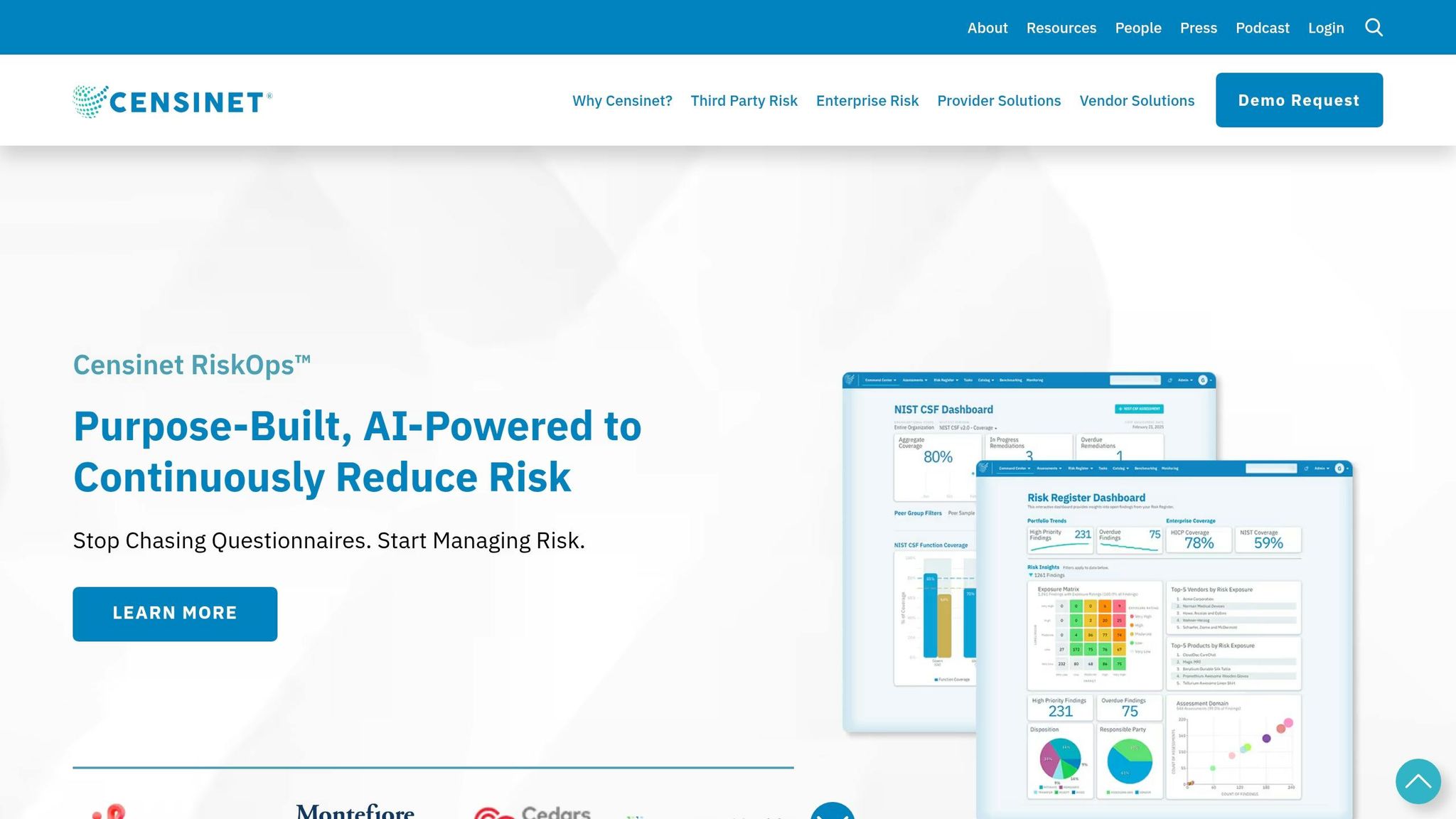
Censinet offers a powerful solution for healthcare organizations tackling the complexities of ISO 27001 risk assessments. By leveraging quantitative techniques like ALE, scenario modeling, and cost–benefit analysis, the platform ensures that healthcare providers have access to reliable and up-to-date vendor data. This is where Censinet RiskOps™ becomes a game-changer, simplifying the process and improving outcomes.
Automating Quantitative Risk Analysis with Censinet
With Censinet RiskOps™, healthcare organizations can automate and streamline their risk assessments. The platform continuously updates residual risk ratings in real time as vendor data evolves [8]. This means risk teams can monitor risks across their entire third-party ecosystem with HIPAA-compliant vendor risk management without delay.
The Digital Risk Catalog™, which includes data on over 50,000 pre-assessed vendors and products, provides a solid foundation for scoring likelihood and impact [8]. This eliminates the need for manual data collection, saving significant time during the initial stages of an ISO 27001 assessment. Vendors are categorized based on key factors like PHI exposure, clinical impact, and business impact - essential elements in a healthcare risk model [8]. Additionally, automated Risk Flags highlight vulnerabilities and missing documentation, such as Business Associate Agreements, directly feeding into ALE likelihood calculations [8].
Collaborative Risk Management and Continuous Monitoring
ISO 27001 requires risk assessments to be repeatable and well-documented. Censinet ensures this with delta-based reassessments that can be completed in under a day. The platform also automatically generates Corrective Action Plans (CAPs) with a full audit trail, ensuring continuous compliance [8]. When issues arise, CAPs are routed to the appropriate stakeholders for resolution, and every action is meticulously tracked, aligning with the audit requirements of ISO 27001 Clause 6.1.2 [8].
Censinet also allows healthcare organizations to benchmark their risk posture against over 100 provider and payer facilities within the Censinet Risk Network [8]. This benchmarking helps justify investments in controls while offering insights into how an organization compares to its peers.
Using Censinet AI to Improve Risk Management
Censinet AI™ takes risk management to the next level by speeding up the assessment process. Vendors can complete security questionnaires in seconds, while the AI summarizes evidence, flags exposures to fourth parties, and drafts detailed risk summary reports [8]. Risk teams can set customized rules and review thresholds, allowing automation to handle routine tasks while analysts focus on decisions that require specialized clinical or regulatory expertise. This "human-in-the-loop" approach ensures the process remains efficient without compromising the level of detail and accuracy that ISO 27001 demands.
Conclusion and Key Takeaways
Benefits of Quantitative Risk Assessment
Quantitative risk assessment offers healthcare security teams a practical way to communicate about risk in a clear, unified manner. Unlike qualitative methods, it provides a standardized "language" that resonates with executives, auditors, and clinical staff alike. For example, when a risk score of 20 out of 25 is presented to a board, the urgency is immediately understood - no extra explanation required.
Organizations that establish a structured risk methodology can cut their ISO 27001 certification timeline by about 30% [3]. This is significant, considering enterprise certification programs often cost between $40,000 and $90,000 [3]. Beyond compliance benefits, quantitative methods allow healthcare providers to directly evaluate risks to patient safety alongside financial and reputational concerns. For instance, scenarios like ransomware interrupting patient care or unpatched medical devices on clinical networks transform risk management from a bureaucratic task into a strategy focused on protecting patients [2].
These measurable advantages set the stage for actionable changes healthcare organizations can implement.
Next Steps for Healthcare Organizations
To leverage these advantages, start by defining your risk assessment methodology before identifying risks. This step is critical, as ISO 27001 Clause 6.1.2 mandates that your assessments align with pre-documented rules [3]. Establish your likelihood and impact scales, agree on a scoring formula, and determine acceptance thresholds as a team.
Next, assign a specific individual owner to each identified risk - not a team or department. Generic ownership is a frequent audit finding [3]. Additionally, schedule quarterly reviews for your top 10 risks rather than relying solely on an annual assessment. This ensures your Information Security Management System (ISMS) stays relevant as threats evolve. By maintaining regular updates and assigning clear ownership, your ISMS can effectively adapt to the shifting threat landscape. These practices, aligned with ISO 27001 standards, help safeguard both patient data and care delivery.
For healthcare organizations aiming to streamline this process without increasing staffing, tools like Censinet RiskOps™ offer automation, pre-assessed vendor data, and audit-ready documentation. This makes ISO 27001-compliant quantitative risk assessments achievable for organizations of any size.
FAQs
How do I estimate ARO and SLE with limited incident data?
When you're working with limited data, calculating Single Loss Expectancy (SLE) requires focusing on the potential financial impacts. Consider factors like fines, recovery expenses, and downtime. To keep things consistent, you can use tiered ranges, such as:
- Under $10,000
- $10,000–$100,000
- $100,000–$1,000,000
- Over $1,000,000
This approach helps standardize your estimates and provides a clearer picture of potential losses.
For Annual Rate of Occurrence (ARO), you can rely on threat intelligence and time-based probability scales. For example:
- Rare: Occurs once every 10+ years
- Unlikely: Happens every 5–10 years
- Likely: Happens annually or more frequently
Tools like Censinet RiskOps™ make this process more manageable. Even if historical data is sparse, this platform streamlines risk assessments and ongoing monitoring, offering a practical solution for estimating risks effectively.
What costs should healthcare include when calculating ALE for ransomware or downtime?
When healthcare organizations calculate Annualized Loss Expectancy (ALE) for threats like ransomware or downtime, it’s crucial to consider a range of costs. These include:
- Direct costs: Expenses such as software and hardware replacements and labor for restoring systems.
- Lost revenue: The financial impact of downtime, which can disrupt operations.
- Incident response costs: This covers forensics, legal fees, and potential regulatory fines.
- Indirect costs: Factors like reduced productivity and the diversion of patients to other facilities.
Tools like Censinet RiskOps™ streamline these calculations, helping organizations centralize risk assessments and better quantify enterprise risks.
How does Censinet RiskOps™ keep ISO 27001 risk ratings audit-ready over time?
Censinet RiskOps™ simplifies maintaining ISO 27001 risk ratings by swapping out manual spreadsheets for a centralized platform that enables continuous monitoring and real-time data updates. It automates vendor risk assessments, ensures critical documents like audit reports and incident records are always current, and connects identified risks directly to your organization's goals. With visual dashboards and automated insights, leadership can easily showcase compliance, keeping your risk posture strong and audit-ready at all times.

