
ISO 42001 is the first global standard for managing AI systems responsibly, especially in healthcare. It provides a structured framework to ensure AI tools are safe, ethical, and compliant with regulations like the EU AI Act and U.S. standards such as HIPAA. This standard is crucial for managing risks related to patient safety, data privacy, and clinical decision-making.
Key Takeaways:
- What It Covers: AI lifecycle governance (design, deployment, monitoring, retirement), risk assessments, and human oversight.
- Why It Matters: Aligns with 78% of EU AI Act requirements and supports compliance with FDA and HIPAA guidelines.
- Certification Process: A 6-phase process taking 9–15 months, focusing on creating an AI Management System (AIMS).
- Core Principles: Transparency, explainability, privacy, reliability, and bias reduction in AI systems.
- Cost: Implementation ranges from $50,000 to $150,000, with audit fees between $10,000 and $25,000.
ISO 42001 is not just about compliance - it’s a roadmap for integrating AI safely into healthcare, ensuring ethical practices, and meeting regulatory demands. Early adopters like Viz.ai and Qualifacts demonstrate how it can improve safety, trust, and efficiency in clinical AI systems.
ISO 42001 Requirements and Healthcare AI Use Cases
Scope of ISO 42001 in Healthcare
ISO 42001 applies to organizations involved in developing, providing, or using AI systems, covering a wide range of healthcare scenarios. Whether it’s a hospital employing an FDA-cleared diagnostic AI, a SaaS company offering an LLM-based clinical assistant, or an insurer using algorithms for fraud detection, they all fall under the standard’s purview [4].
"The standard applies to any organization that develops, provides, or uses AI systems - which in 2026 is most of them." - Lorikeet Security [4]
Healthcare AI risks don’t just affect one group - they ripple across the ecosystem, from developers to end users in clinical settings. ISO 42001 creates a unified governance framework to address third-party risk. The next section explores how the standard manages AI throughout its lifecycle in healthcare.
AI System Lifecycle Governance
ISO 42001 outlines governance across seven lifecycle stages: Inception, Design and Development, Verification and Validation, Deployment, Operation and Monitoring, Re-evaluation, and Retirement. Each stage requires specific controls to ensure safety and accountability.
Here’s how these stages align with healthcare scenarios and the relevant Annex A controls:
| Lifecycle Stage | Healthcare Example | Relevant Annex A Control |
|---|---|---|
| Inception | Identifying the need for an ER triage AI | A.8.1 (Information for interested parties) |
| Design & Development | Training a model on diverse patient datasets | A.7.2 (Data for development) |
| Verification & Validation | Testing a diagnostic tool for demographic bias | A.6.2.4 (Verification & Validation) |
| Deployment | Releasing a radiology AI into clinical workflow | A.6.2.5 (Deployment plan) |
| Operation & Monitoring | Monitoring model drift in clinical accuracy | A.10.2 (Re-evaluation) |
| Retirement | Decommissioning a model while securing residual PHI | A.5.2 (Information disclosure) |
For example, by mid-2026, Microsoft incorporated its Dragon Copilot (Radiologist) and Microsoft Copilot Health tools within its ISO 42001 certification. These tools undergo regular independent audits to ensure they meet the standard’s requirements for responsible AI practices and risk management throughout their lifecycle [3]. These lifecycle controls are foundational for precise risk management and safeguards, which we’ll discuss next.
Risk Management and Human Oversight in Clinical AI
ISO 42001 goes beyond lifecycle controls by requiring robust risk assessments and human oversight mechanisms. Two types of assessments are mandatory:
- Baseline AI Risk Assessment (Clause 6.1.2): Focuses on operational and technical risks that could impact the organization.
- AI System Impact Assessment (AIIA) (Clause 6.1.4): Evaluates broader risks to patients, communities, and society. This includes issues like diagnostic bias or threats to patient autonomy.
"AIIAs help organizations maintain responsible AI governance... [they] are specifically designed to assess risks to individuals' privacy and data protection rights." - AWS Security Blog [1]
For high-risk clinical applications, AIIAs are non-negotiable. Conducting structured workshops with diverse stakeholders (lasting 60–90 minutes) can help identify potential blind spots.
Human oversight is another critical aspect. Annex A.9 mandates that clinical AI systems include a documented override or "switch off" mechanism. This ensures clinicians can step in when AI outputs appear unreliable, keeping the ultimate decision-making authority firmly in human hands.
sbb-itb-535baee
What ISO 42001 Means for Healthcare Compliance
ISO 42001 Certification Process for Healthcare AI Organizations
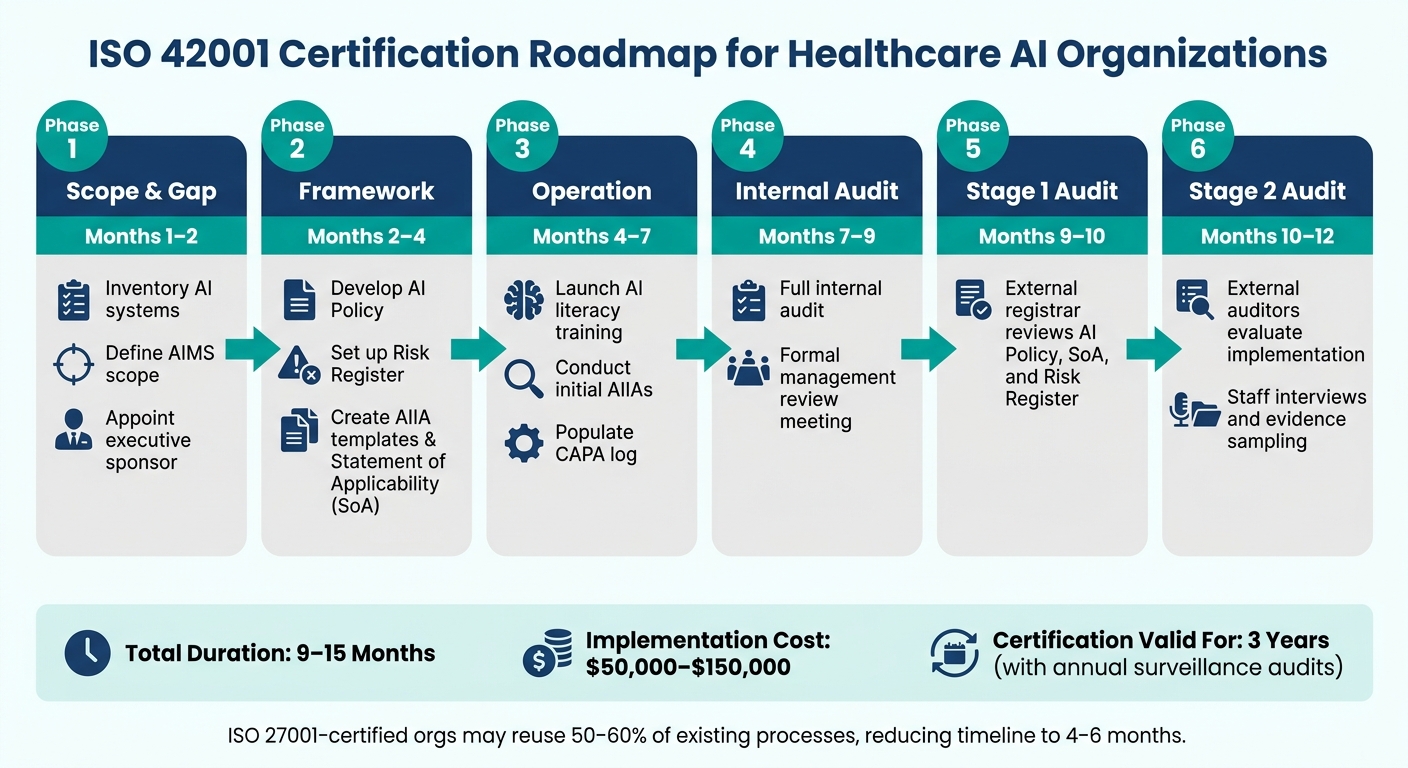
ISO 42001 Certification Process for Healthcare AI: 6-Phase Roadmap
Earning ISO 42001 certification demonstrates a commitment to ethical and safe AI practices, ensuring healthcare organizations align with compliance standards through verified and auditable processes. For many, on-demand cyber risk management provides the necessary support to maintain these rigorous standards.
Steps to ISO 42001 Certification
The path to ISO 42001 certification involves six well-defined phases and typically takes 9 to 15 months for U.S. healthcare organizations [4].
| Phase | Timeline | Key Activities |
|---|---|---|
| 1: Scope & Gap | Months 1–2 | Inventory AI systems, define AIMS scope, and appoint an executive sponsor. |
| 2: Framework | Months 2–4 | Develop an AI Policy, set up a Risk Register, and create AIIA templates and the Statement of Applicability (SoA). |
| 3: Operation | Months 4–7 | Launch literacy training, conduct initial AIIAs, and populate the CAPA log. |
| 4: Internal Audit | Months 7–9 | Perform a full internal audit and hold a formal management review meeting. |
| 5: Stage 1 Audit | Months 9–10 | External registrar reviews key documents, including the AI Policy, SoA, and Risk Register. |
| 6: Stage 2 Audit | Months 10–12 | External auditors evaluate implementation through staff interviews and evidence sampling. |
Starting small - for instance, focusing on one high-impact AI system like a medical device diagnostic imaging tool or a clinical decision-support chatbot - can simplify the initial certification process. This approach lays the groundwork for expanding the certification scope during future recertifications.
A well-functioning AI Management System (AIMS) is the backbone of this entire process.
Building an AI Management System (AIMS)
An effective AIMS is more than a collection of policy documents; it’s a dynamic governance system that must be actively used and demonstrated during audits. ISO 42001 uses the Annex SL High-Level Structure (Clauses 4–10), the same framework found in ISO 27001 and ISO 9001. For organizations already certified under ISO 27001, this overlap allows for reusing 50–60% of existing processes, which can significantly ease implementation efforts [5].
The Statement of Applicability (SoA) is the cornerstone of your AIMS. This document maps all 39 Annex A control objectives of ISO 42001, determining their relevance and providing justifications along with evidence. Consider it your compliance roadmap. Additionally, a CAPA (Corrective and Preventive Action) log with 8–15 documented near-misses or process improvements is required before the Stage 1 audit [4].
"The standard is not satisfied by writing policy documents; it is satisfied by operating the policy long enough that an auditor can see the wear marks." - Lorikeet Security [4]
Once your AIMS is operational, the focus shifts to maintaining compliance and fostering continuous improvement.
Maintaining Certification and Continuous Improvement
ISO 42001 certification is valid for three years, but it requires regular upkeep. Surveillance audits are conducted in the first and second years to confirm ongoing compliance, and a full recertification audit is performed in the third year [4]. When selecting a certification body, ensure they are accredited for ISO 42001 by a recognized national authority such as ANAB (ANSI National Accreditation Board) in the U.S. [4].
The "Check" phase - which includes internal audits and management reviews - is where many organizations falter. Neglecting these steps is one of the leading causes of failed certification attempts [4]. Effective maintenance also involves monitoring AI systems for issues like model drift, bias shifts, and human override rates. As regulations evolve, such as the FDA’s updated guidance or the EU AI Act's enforcement deadline for high-risk systems in August 2026, your AIMS must keep pace [4].
"Certification is not a one-time event but an ongoing process." - LRQA [2]
How to Implement ISO 42001 in U.S. Healthcare AI Programs
Once timelines and audits are in place, the next step is integrating ISO 42001 into clinical workflows, vendor agreements, and compliance frameworks. These strategies build on the certification process outlined earlier, ensuring alignment between governance practices and regulatory expectations.
Governance Structures for AI Compliance
Clause 5 emphasizes the need for strong executive involvement in AI governance. Start by appointing an AI Officer and creating a cross-functional AI Governance Committee. This group should include stakeholders from Legal, IT, Clinical Operations, and Compliance. Their responsibilities include managing the AI Risk Register, reviewing AI Impact Assessment (AIIA) findings, and ensuring timely resolution of any issues. Below is a table mapping ISO 42001 clauses to key governance artifacts:
| ISO 42001 Clause | Governance Requirement | Key Artifact |
|---|---|---|
| Clause 5.1 | Leadership Commitment | Signed AI Policy & Resource Allocation |
| Clause 5.3 | Roles & Responsibilities | AI Governance Committee Charter |
| Clause 6.1.2 | AI Risk Assessment | AI Risk Register & Treatment Plan |
| Clause 6.1.4 | AI Impact Assessment | Documented AIIA Reports (per system) |
| Clause 7.2 | Competence | AI Literacy Training Records |
| Clause 9.2 | Internal Audit | Independent Audit Report |
| Annex A.10 | Third-Party Relationships | Supplier AI Risk Assessments |
Hosting AIIA workshops is another critical step. These workshops bring together diverse perspectives to address issues like bias, fairness, and unintended consequences - areas auditors will scrutinize closely [4].
"Agentic AI workflows are becoming central to how we deliver clinical value at Viz.ai, and this certification reflects how we have operationalized responsible AI across the company." - Tom Vaknin, Chief Information Security Officer, Viz.ai [6]
In May 2026, Viz.ai, based in San Francisco, became one of the first healthcare companies to achieve ISO 42001 certification. Their CISO, Tom Vaknin, led the process, which validated governance across AI systems used in 2,000 hospitals. This success highlights how structured oversight and lifecycle controls can scale effectively [6].
Third-Party AI Risk Management
Healthcare AI programs often rely on external vendors for tools like diagnostic models, EHR-integrated algorithms, or language model APIs. Annex A.10 of ISO 42001 requires organizations to manage third-party AI risk across the supply chain. This involves clear role allocation between AI providers and users.
By late 2025, over 50% of enterprise vendor security questionnaires included AI governance as a standard requirement [4].
"By the back half of 2025, 'show us your AI governance' had become a standard line item in enterprise vendor questionnaires - and a credible answer was either an ISO 42001 cert or a roadmap to one." - Lorikeet Security [4]
To manage third-party risks effectively, organizations should:
- Collect AI security questionnaires from vendors.
- Review responsible AI policies.
- Document responsibilities for data quality, monitoring, and incident reporting.
Your Statement of Applicability (SoA) should clearly outline which Annex A.10 controls apply to each vendor. Additionally, keep an eye on unauthorized or embedded vendor features that bypass procurement processes.
How Censinet Supports ISO 42001 Implementation
Maintaining ongoing compliance with ISO 42001 can be challenging, especially for healthcare organizations. Censinet offers tools to simplify these processes and close potential gaps.
The "Check" phase of ISO 42001, which involves internal audits, management reviews, and evidence collection, is where many organizations falter. Manually tracking vendor assessments, AIIA findings, and CAPA logs in spreadsheets often leads to errors that auditors may flag.
Censinet RiskOps™ helps by centralizing AI governance tasks. The platform routes key findings to the appropriate stakeholders, such as members of the AI Governance Committee, ensuring issues are addressed promptly. Its audit trails meet Clause 9 requirements, making compliance efforts more efficient.
Censinet also speeds up third-party risk assessments with AI-powered tools. Vendors can complete security questionnaires quickly, while the system summarizes evidence and generates risk reports. This approach supports the due diligence required under Annex A.10. Importantly, Censinet maintains human oversight, allowing risk teams to tailor automation to their needs. For organizations juggling numerous AI vendors, this balance ensures compliance without compromising safety or operational efficiency.
The Impact of ISO 42001 on Healthcare AI
Building Trust and Meeting Regulatory Requirements
ISO 42001 plays a key role in ensuring accountability through its rigorous governance framework. This includes documented roles, risk assessments, and ongoing monitoring, all of which are subject to independent verification. In healthcare, where trust is paramount, this level of scrutiny helps patients and clinicians feel confident that AI tools are both safe and transparent.
"ISO 42001 documentation directly addresses these questions. Organizations that implement the standard create a clear narrative for regulators: 'We have a systematic management approach to AI governance, not ad-hoc controls.'" - Paul Goldman, CEO, iTmethods / BioCompute [10]
From a regulatory perspective, ISO 42001 aligns with U.S. standards like HIPAA and FDA guidance for AI/ML-based Software as a Medical Device (SaMD). Its Clause 8 controls also ensure compliance with 21 CFR Part 11, which governs electronic records, audit trails, and change control - critical areas in clinical and pharmaceutical environments. Organizations adopting this standard have reported a 35% drop in AI-related audit findings [10]. This framework not only strengthens compliance but also supports advancements in responsible AI practices.
Supporting Responsible AI Growth
ISO 42001 provides a structured approach to managing AI throughout its lifecycle, enabling safer integration of AI into core clinical operations. The standard mandates controls for detecting model drift, assessing algorithmic bias, and maintaining human oversight in clinical decision-making.
A notable example is Viz.ai, which achieved ISO/IEC 42001 certification in May 2026 after an independent audit. This accomplishment underscored its leadership in safe AI implementation, earning it the #1 spot in the 2026 Black Book AI Clinical Decision Support survey. The company excelled in categories like Security, Privacy & Governance, and Regulatory Readiness [6].
Cost and Efficiency Gains from Structured AI Governance
ISO 42001 doesn’t just enhance safety and trust - it also brings operational efficiencies. By standardizing governance processes, organizations can cut down on repetitive risk assessments, streamline vendor evaluations, and speed up the integration of new AI tools into clinical workflows. For example, organizations have reported a 20% faster deployment time for new AI systems [10].
One standout case is Qualifacts, which became the first EHR provider to achieve ISO 42001 certification in February 2026. Spearheaded by VP of Product Compliance Hope Winkowski and Senior Director of Information Security Chad Strange, Qualifacts significantly improved procurement efficiency. Instead of spending weeks on questionnaires, the team now shares their ISO audit report, drastically reducing response times.
"Instead of spending a week answering questionnaires, we can hand over the ISO report. It speeds everything up." - Nicholas Chepesiuk, Product Leader, Qualifacts [8]
For organizations already certified under ISO 27001, the transition to ISO 42001 is relatively smooth. About 50–60% of existing management system processes can be reused, thanks to the shared Annex SL structure. This can shorten the certification timeline to just 4–6 months, making it a more manageable process [9]. For mid-sized healthcare organizations, implementation costs typically range from $50,000 to $150,000, with external audit fees between $10,000 and $25,000 [10].
Conclusion
ISO 42001 goes beyond being just a certification - it's a management framework designed to bring order, accountability, and clarity to how healthcare organizations manage AI. It addresses everything from AI system lifecycle controls and impact assessments to managing third-party risks (often through automated security questionnaires) and ensuring continuous improvement.
For U.S. healthcare organizations, certain aspects deserve special attention. First, start small. Focusing on a single clinical product line or a high-priority AI system, instead of tackling your entire AI portfolio, provides a practical path to achieving a successful first audit. Second, while ISO 42001 may share some overlap with ISO 27001, it’s not a simple add-on. The standard introduces distinct requirements, particularly around AI Impact Assessments (AIIAs) and lifecycle governance, which demand focused effort and resources [9][7].
Looking ahead, the EU AI Act’s mandatory conformity assessments for high-risk AI systems kick in by August 2026. Interestingly, a well-developed ISO 42001 program aligns with about 78% of the operational framework required by this legislation [4]. Even for organizations that operate exclusively in the U.S., procurement demands are pressing - AI governance is now a staple in enterprise vendor questionnaires [4].
Industry leaders emphasize the importance of embracing ISO 42001 for more than just compliance:
"ISO 42001 is not just a routine compliance exercise - it sets a higher standard for transparency and maturity. Early adopters do it because they want to lead with maturity and transparency." - Mike DeKock, Founder, MJD Advisors [8]
The organizations that stand to gain the most are those that treat ISO 42001 as a dynamic program. This means maintaining an active CAPA log, offering regular AI literacy training, and hosting structured AIIA workshops. These steps not only align with the standard but also help mitigate risks in clinical AI effectively. Treating ISO 42001 as an ongoing initiative is key to managing AI risks over the long term.
FAQs
Do we need ISO 42001 if we already follow HIPAA and FDA guidance?
HIPAA and FDA guidelines play a crucial role in safeguarding patient privacy and ensuring the safety of medical devices. However, they fall short when it comes to addressing risks unique to AI, such as bias or lack of transparency. This is where ISO 42001 steps in - it provides a certifiable framework designed to manage the entire AI lifecycle. By adopting this standard, healthcare organizations can not only align with HIPAA's privacy protections but also tackle the evolving challenges posed by AI technologies.
Additionally, tools like Censinet RiskOps simplify the process of assessing and managing AI-related risks, helping organizations maintain security and compliance while navigating the complexities of AI systems.
Which AI systems should we certify first in a hospital or health tech company?
ISO 42001 certification focuses on the management system for your entire AI portfolio, rather than individual models or products. To get started, create a detailed inventory of all AI systems your organization develops, provides, or uses.
Pay extra attention to systems that carry greater risks. These might include AI handling protected health information, influencing clinical decisions, or impacting patient safety.
To make the process smoother, tools like Censinet RiskOps can help. They simplify risk assessments and provide a clear view of risks across clinical applications, medical devices, and third-party AI tools.
What evidence do auditors expect to see for AI risk, impact, and human oversight?
Auditors want to see clear evidence that your AI Management System is properly established, functioning, and trackable. This means you need to provide:
- A centralized AI inventory that connects each system to its owner, purpose, data categories, and risk classification.
- Documentation showcasing consistent methods for risk and impact assessments.
Additionally, when it comes to human oversight, you’ll need to outline specific roles, responsibilities, and workflows. For example, this could include requiring a physician to review AI-generated outputs in scenarios where decisions carry significant risks. This ensures that critical choices are always guided by human judgment.
