
A vendor risk dashboard helps organizations monitor and manage third-party risks by consolidating metrics into a single view. This is especially critical in healthcare, where vendor failures can impact patient safety and regulatory compliance. The article compares Censinet RiskOps™, a healthcare-specific platform, with standard vendor risk dashboards, highlighting their strengths and limitations. Here's what you need to know:
- Censinet RiskOps™ focuses on healthcare needs, linking vendor risks to patient safety, PHI, and clinical operations. It offers tailored metrics, healthcare-specific automation, and AI features for faster, more accurate assessments.
- Standard dashboards work across industries, using generic scoring systems and automation. While flexible, they often require customization to meet healthcare’s complex requirements.
Quick Comparison
| Feature/Metric | Censinet RiskOps™ | Standard Dashboards |
|---|---|---|
| Risk Scoring | Tailored to healthcare (PHI, clinical risks) | Generic scoring (numeric/letter grades) |
| Healthcare Metrics | Tracks PHI, medical devices, clinical ops | Limited or missing |
| Automation & AI | Advanced AI for healthcare assessments | Basic automation |
| Visualization | Healthcare-focused views | Generalized heatmaps |
Conclusion: Healthcare organizations benefit most from tools like Censinet RiskOps™, which address their specific challenges. Standard dashboards may suit industries with less regulated and critical environments.
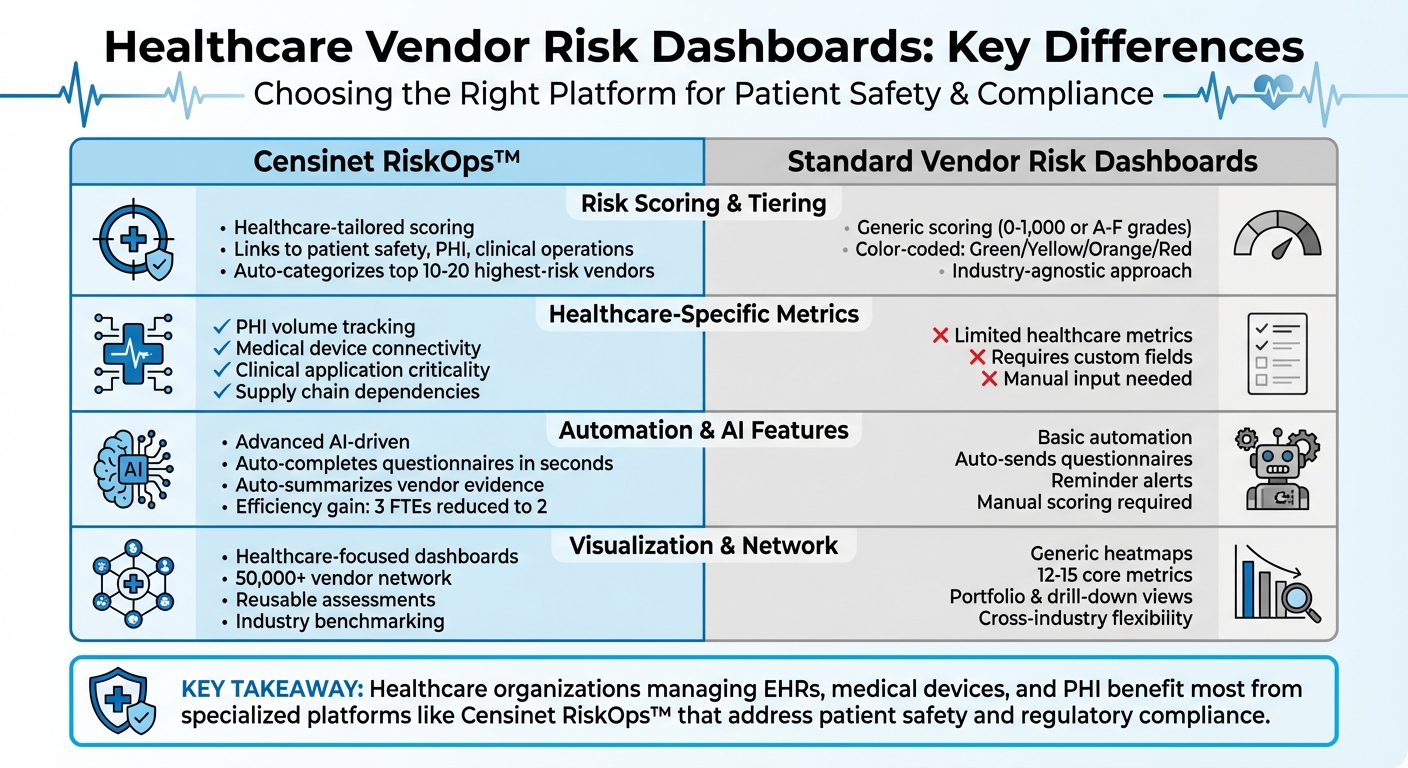
Censinet RiskOps vs Standard Vendor Risk Dashboards Comparison
1. Censinet RiskOps™
Risk Scoring and Tiering
Censinet RiskOps™ brings a healthcare-focused approach to risk scoring, directly linking vendor risks to patient safety, clinical operations, and exposure of protected health information (PHI). Unlike generic risk tools that treat all breaches the same, RiskOps evaluates risks using factors tailored to healthcare, such as PHI volume, the criticality of clinical applications, medical device connectivity, and adherence to regulations. This allows healthcare organizations to zero in on vendors that pose the most serious threats to patient care and compliance, rather than just flagging IT security issues.
The platform automatically categorizes vendors into risk tiers as assessment data is processed, highlighting the top 10–20 highest-risk vendors on its dashboards. This prioritization enables security and compliance teams to focus their efforts where they are needed most. By leveraging these detailed risk scores, the system tracks metrics that directly influence healthcare delivery.
Healthcare-Specific Metrics
RiskOps dashboards are designed with healthcare in mind, tracking key metrics like PHI volume, the importance of clinical applications, medical device connectivity, supply chain dependencies, and compliance with multiple frameworks. These metrics are essential for healthcare organizations managing vendors involved with critical systems such as EHRs, imaging platforms, lab systems, and medical devices.
Additionally, the platform provides insights into operational and patient safety risks alongside cybersecurity scores. This gives executives, clinical leaders, and supply chain managers a comprehensive view of how vendor performance impacts the continuity of care. By integrating these metrics into procurement strategies, contract discussions, and ongoing vendor management, organizations can make informed decisions that align with their operational goals.
Automation and AI Features
RiskOps takes efficiency to the next level with automation that simplifies risk assessments. The platform automates the delivery, collection, and scoring of healthcare-specific questionnaires that address areas like HIPAA, HITECH, medical device security, and cloud services. Once vendors submit their responses, the system calculates risk scores and flags high-risk findings for remediation. According to Terry Grogan, CISO at Tower Health, RiskOps "allowed 3 FTEs to go back to their real jobs! Now we do a lot more risk assessments with only 2 FTEs required" [1].
The platform’s AI capabilities further speed up the assessment process by enabling vendors to complete security questionnaires in seconds. It can also summarize vendor evidence and documentation automatically and generate risk summary reports based on all collected data. This blend of automation and human oversight reduces the time needed to evaluate and onboard new vendors without sacrificing thoroughness.
Visualization and Usability
RiskOps dashboards offer clear visualizations of vendor risk distribution, unresolved remediation items, and performance benchmarks compared to industry standards. Brian Sterud, CIO at Faith Regional Health, highlights the value of this feature, stating, "Benchmarking against industry standards helps us advocate for the right resources and ensures we are leading where it matters" [1].
The platform operates as a cloud-based risk exchange, connecting healthcare organizations with over 50,000 vendors. This network allows for shared, reusable assessments, minimizing repetitive work and speeding up the contracting process. Vendors complete assessments once and share their results across multiple healthcare delivery organizations (HDOs), while organizations gain access to standardized, healthcare-specific risk data that integrates seamlessly into decision-making tools.
2. Standard Vendor Risk Dashboards
Standard vendor risk dashboards take a broader approach to assessing risk, offering features that are not specific to any one industry, such as healthcare.
Risk Scoring and Tiering
These dashboards often use scoring systems like numeric scales (0–1,000) or letter grades (A–F) to evaluate vendor risk. To make these scores easy to interpret, they’re color-coded: green for low risk, yellow for medium, orange for high, and red for critical risk. Thresholds help define the risk levels - for example, a score of 800–1,000 might indicate low risk, while anything below 390 could signal a critical risk.
Some dashboards go beyond static scores by including metrics like security score velocity, which can highlight risk trends over time. This allows organizations to detect escalating risks earlier. These platforms typically offer two key views: a portfolio overview that shows the risk distribution across all vendors and a detailed drill-down into individual vendor profiles for more in-depth analysis.
To make this process even more efficient, automation tools are often integrated into these dashboards.
Automation and AI Features
Most standard dashboards come with basic automation features designed to save time and reduce manual effort. These include tools for automatically sending out questionnaires, setting reminders, and triggering alerts when risk thresholds are breached. While automation handles routine tasks, many organizations still rely on manual processes for more nuanced scoring and analysis.
Visualization and Usability
Visualization tools play a key role in making data understandable for different audiences. Standard dashboards typically provide executives with a high-level portfolio view while offering risk managers detailed insights into vendor-specific data. Research involving over 150 vendor risk management implementations revealed that successful dashboards often follow a clear, hierarchical structure. This structure includes areas like portfolio management, assessment and monitoring, compliance tracking, collaboration tools, and reporting [2].
Interestingly, the most effective dashboards focus on just 12–15 core metrics. Overloading dashboards with excessive metrics can create unnecessary noise, making it harder to make informed decisions [2]. By keeping things focused, these tools help organizations stay on top of vendor risks without getting bogged down.
sbb-itb-535baee
Advantages and Disadvantages
When it comes to managing vendor risks, the choice between healthcare-specific dashboards and generic risk management platforms involves some clear trade-offs. Each has its own strengths and limitations, which can significantly impact an organization’s ability to address risks effectively.
Healthcare-specific platforms, like Censinet RiskOps™, are designed to meet the unique demands of the healthcare industry. These platforms offer risk scoring that factors in critical elements such as patient data, clinical records, and vulnerabilities in medical devices - areas that generic dashboards often overlook. By providing insights tailored to healthcare’s intricate needs, they directly support patient safety and compliance with regulations. Another advantage is the use of AI-driven automation, which simplifies and speeds up risk assessments, reducing the need for extensive manpower. As CISO Terry Grogan explains:
"Censinet RiskOps allowed 3 FTEs to go back to their real jobs! Now we do a lot more risk assessments with only 2 FTEs required" [1].
On the other hand, standard dashboards are built for broader, cross-industry use and are often easier to implement for organizations that deal with diverse vendor portfolios. However, these generic platforms don’t account for healthcare-specific concerns like patient safety or the protection of PHI (Protected Health Information). While they do offer basic automation for tasks like distributing questionnaires and sending alerts, they typically require more manual effort to analyze risks in depth. Additionally, their ability to detect emerging risks lacks the specialized context that healthcare organizations need.
Here’s a closer look at how the two approaches compare:
| Feature/Metric | Censinet RiskOps™ | Standard Vendor Risk Dashboards |
|---|---|---|
| Risk Scoring and Tiering | Tailored to healthcare, addressing patient data, clinical records, and medical devices; informed by a network of over 50,000 healthcare vendors | Generic scoring systems (e.g., numeric scales or letter grades); not specialized for healthcare regulations |
| Healthcare-Specific Metrics | Tracks patient data, clinical records, medical devices, and supply chain comprehensively | Limited or missing; often requires custom fields and manual input |
| Automation and AI Features | Advanced AI for validating evidence, completing questionnaires quickly, and generating automated risk reports | Basic automation for sending questionnaires, reminders, and alerts; limited AI functionality |
| Visualization and Usability | Offers portfolio views by clinical criticality (e.g., EHR, imaging, pharmacy) with a healthcare-focused interface | Generalized heat maps and risk charts; less aligned with clinical workflows |
The key trade-off boils down to specialization versus flexibility. Healthcare-focused dashboards provide highly relevant, actionable insights for healthcare organizations but may require more effort to implement and are less useful outside the healthcare sector. In contrast, standard dashboards are more versatile across industries but need significant customization to address the specific demands of healthcare, such as PHI protection and patient safety.
Conclusion
Selecting the right vendor risk dashboard has a direct impact on patient safety, regulatory compliance, and how efficiently healthcare organizations operate. When comparing healthcare-specific platforms to standard dashboards, one thing becomes clear: the unique challenges of the healthcare industry demand tools designed specifically to address its risks.
There’s a noticeable difference between the two options. Generic dashboards, while versatile, often fall short in providing the specialized metrics healthcare organizations need. Tracking PHI protection, identifying medical device vulnerabilities, and managing clinical application risks are not built into these tools. Instead, organizations are forced to spend time and resources customizing these platforms - time that could be better spent addressing risks directly. As Intermountain Health's Sr. Director of GRC pointed out, healthcare requires solutions tailored to its specific needs [1].
This is where Censinet RiskOps™ stands out. It combines risk scoring with healthcare-focused metrics, such as PHI protection and clinical application risks, while incorporating insights from over 50,000 healthcare vendors. By leveraging AI-driven automation, the platform streamlines vendor risk management and prioritizes patient safety, ensuring that healthcare organizations are equipped to handle their unique challenges effectively.
FAQs
What makes Censinet RiskOps™ the ideal choice for managing healthcare vendor risks?
Censinet RiskOps™ is purpose-built for healthcare organizations, delivering solutions that make vendor risk management easier and more efficient. By automating both third-party and enterprise risk assessments, it cuts down on manual tasks and simplifies processes, freeing up time and resources.
The platform offers continuous risk monitoring, real-time comparisons with industry standards, and tools for collaboration to improve risk management strategies. With a strong emphasis on enhancing compliance, strengthening decision-making, and safeguarding patient data, Censinet RiskOps™ empowers healthcare organizations to proactively address cybersecurity and operational risks.
How does Censinet RiskOps™ make vendor risk assessments more efficient?
Censinet RiskOps™ improves how vendor risk assessments are handled by cutting down on tedious manual tasks and automating much of the process. This means organizations can complete more assessments using fewer resources, saving both time and energy.
By simplifying workflows and reducing the reliance on lengthy manual questionnaires, the platform lets healthcare organizations zero in on the most pressing risks. This way, they can make quicker, more informed decisions. It’s all about helping teams manage vendor risks more efficiently and effectively.
What unique healthcare-specific metrics does Censinet RiskOps™ monitor that standard dashboards often miss?
Censinet RiskOps™ zeroes in on healthcare-specific risks that often slip through the cracks of standard dashboards. It evaluates areas like patient data, protected health information (PHI), clinical applications, medical devices, and supply chains - all critical components in the healthcare sector. By focusing on these areas, the platform empowers healthcare organizations to identify vulnerabilities early and maintain compliance with industry regulations.
This specialized strategy aligns with the complex needs of healthcare settings, helping organizations make smarter decisions while protecting sensitive information and ensuring smooth operations.
