
NIST CSF vs. Other IoT Risk Frameworks
Post Summary
Managing IoT risks is complex, especially with healthcare supply chain security challenges growing. The NIST Cybersecurity Framework (CSF) 2.0 offers a flexible structure to tackle these challenges, focusing on outcomes like governance and supply chain risk management. It’s particularly effective for healthcare, where IoT devices interact with critical systems. But how does it compare to other frameworks like IEC 62443, ISO/IEC 27001, and ETSI EN 303 645?
Here’s a quick breakdown:
- NIST CSF 2.0: Focuses on risk management and governance across sectors, including healthcare. Its new "Govern" function addresses vendor and supply chain risks.
- IEC 62443: Designed for industrial IoT, offering detailed technical requirements for OT environments.
- ISO/IEC 27001: A certifiable standard emphasizing governance and risk treatment, ideal for vendor oversight.
- ETSI EN 303 645: Targets consumer IoT security but lacks enterprise-level supply chain guidance.
Quick Comparison
| Framework | Purpose | Target Environment | Depth of Guidance | Supply Chain Focus |
|---|---|---|---|---|
| NIST CSF 2.0 | Risk management & governance | All sectors (IT & OT) | Outcome-focused | High |
| IEC 62443 | Industrial IoT security | Industrial/OT environments | Highly prescriptive | Very High |
| ISO/IEC 27001 | Governance & risk management | Enterprise-wide | Process-oriented | Moderate |
| ETSI EN 303 645 | Consumer IoT security | Smart home, wearables | Device-level provisions | Low |
For healthcare, NIST CSF 2.0 is a strong starting point, offering a structured way to manage IoT risks while aligning with compliance requirements like HIPAA. Layering it with other frameworks can provide added depth and focus where needed.
Understanding NIST Cybersecurity Framework (CSF) 2.0: A Comprehensive Guide
sbb-itb-535baee
NIST Cybersecurity Framework (CSF) for IoT: An Overview
Initially developed for critical infrastructure, the NIST Cybersecurity Framework (CSF) has expanded to support organizations of all sizes. This makes it especially relevant for those deploying IoT devices, whether in hospital networks or manufacturing facilities [5]. This broader applicability reflects the unique vulnerabilities associated with IoT systems, as highlighted earlier.
The Five Core Functions of NIST CSF
The framework breaks down cybersecurity activities into five core functions, each tailored to address challenges often encountered in IoT environments:
- Identify - Keep an inventory of all IoT assets and evaluate their risk levels.
- Protect - Apply safeguards, such as hardware roots of trust, particularly for devices with limited capabilities.
- Detect - Monitor for unusual activity or subtle anomalies.
- Respond - Handle vulnerabilities and share information during incidents.
- Recover - Restore IoT services and build resilience following disruptions [2].
Michael Fagan from NIST explains:
"IoT devices and systems of constrained or highly distributed architectures may face challenges implementing common technical (e.g., cybersecurity state awareness) and non-technical (e.g., documentation) cybersecurity measures." [2]
The framework’s flexible, outcome-oriented design emphasizes goals rather than prescribing specific technical solutions. This structure forms the foundation for the updates introduced in NIST CSF 2.0, which further refine its approach to IoT.
What NIST CSF 2.0 Adds for IoT
CSF 2.0 builds on the original framework by adding a governance layer, which is key for managing IoT supply chain risks. The most notable change is the introduction of a sixth function: Govern (GV). This new function helps organizations shape their strategies and oversee supply chain risk management [4]. Within this function, the framework includes 10 detailed subcategories (GV.SC-01 through GV.SC-10) to guide tasks such as evaluating IoT device manufacturers, communicating security expectations to vendors, and preparing for supplier-related incidents [5].
As noted in the framework:
"The CSF can help an organization become a smart acquirer and supplier of technology products and services." [3]
CSF 2.0 also aligns with resources like the IoT Cybersecurity Capabilities Baseline and the Guide to Operational Technology (OT) Security (SP 800-82 Rev. 3). These references give IoT professionals actionable tools. For procurement teams, this means they can now request Secure Software Development Framework (SSDF) attestations from IoT vendors as part of the buying process - a practical step to mitigate supply chain risks.
How Other IoT Risk Frameworks Compare to NIST CSF
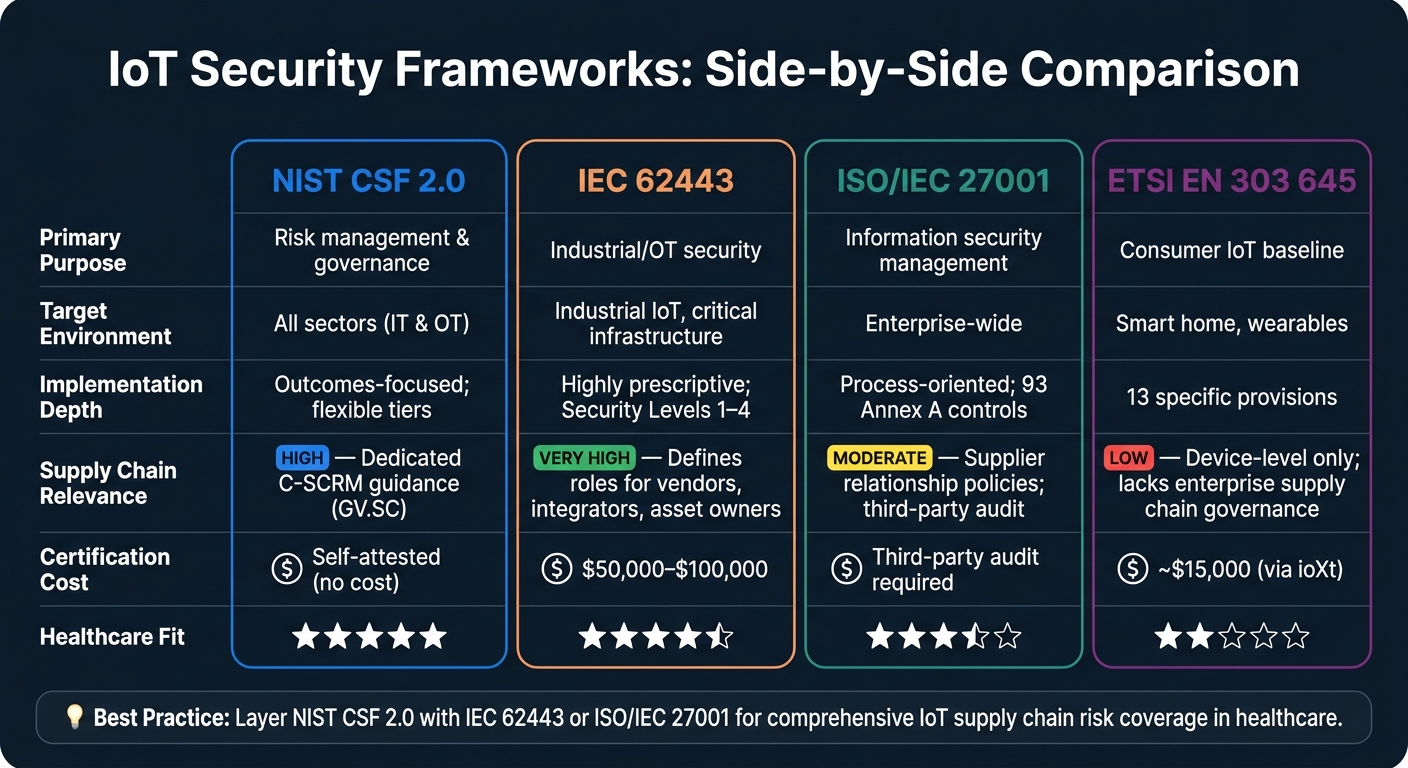
NIST CSF 2.0 vs. IoT Security Frameworks: Supply Chain Risk Comparison
NIST CSF 2.0 is often regarded as a cornerstone for managing IoT risks. However, other frameworks like IEC 62443, ISO/IEC 27001, and ETSI EN 303 645 offer alternative approaches. Each has unique strengths and focuses, making it essential for organizations to understand how they differ from NIST CSF, especially when addressing IoT supply chain risks.
IEC 62443: Security for Industrial IoT
IEC 62443 is tailored for Operational Technology (OT) and industrial automation systems. While NIST CSF emphasizes overarching outcomes, IEC 62443 provides a detailed, prescriptive framework based on a zones and conduits model. This method segments networks by security levels, ranging from SL 1 (basic protection) to SL 4 (protection against advanced threats like state-sponsored attacks).
In addition, IEC 62443 clearly defines roles within the supply chain - Asset Owners (e.g., hospitals), System Integrators (e.g., medical device installers), and Product Suppliers (e.g., manufacturers) - to enhance accountability [7] [8]. However, its implementation can be costly, with certification expenses between $50,000 and $100,000, and integrating legacy systems adds further complexity [7].
"NIST CSF is typically the better front door for building and communicating a program; IEC 62443 is typically the better backbone for defining technical OT requirements and supplier expectations." - Frenos [10]
Next, let’s shift focus to a framework centered on governance and risk management.
ISO/IEC 27001: Governance and Risk Treatment
ISO/IEC 27001 takes a management-driven approach to security, built around the Plan-Do-Check-Act (PDCA) cycle. It includes 93 controls in Annex A, emphasizing governance, policies, and continuous improvement [8]. Unlike the voluntary, self-attested nature of NIST CSF, ISO/IEC 27001 is a certifiable standard that requires third-party audits. This makes it particularly effective for validating third-party risk assessments, as organizations can mandate certification from suppliers as a procurement condition [1].
For IoT supply chains, ISO/IEC 27001 complements NIST CSF 2.0 by offering a formalized approach to vendor oversight. However, attempting certification without addressing basic vulnerabilities first can result in failed audits [7].
While these frameworks focus on industrial systems and governance, ETSI EN 303 645 targets consumer IoT security.
ETSI EN 303 645: Baseline Security for Consumer IoT
ETSI EN 303 645 outlines 13 technical requirements for consumer IoT devices, addressing issues like default passwords. This became a critical focus after the 2016 Mirai Botnet attack, which exploited default credentials to compromise over 300,000 devices, causing widespread disruptions [7]. Certification through programs like ioXt is relatively affordable, costing around $15,000 [7].
Although it’s accessible, ETSI EN 303 645 primarily focuses on product-level security. It doesn’t cover enterprise-level supply chain governance, complex system interactions, or the broader organizational oversight provided by NIST CSF 2.0’s Govern function. This limits its usefulness for organizations managing comprehensive IoT supply chain risks [7] [8].
Framework Comparison for IoT Supply Chain Risk
Effectively managing IoT supply chain risks in healthcare requires a clear understanding of how different frameworks approach the problem. Each framework tackles specific aspects of supply chain risk, and knowing these distinctions can help organizations make smarter decisions about allocating resources and budget.
The biggest difference lies in how broad or specific these frameworks are. NIST CSF 2.0 focuses on what outcomes to achieve, leaving the "how" up to you. In contrast, IEC 62443 dives into precise technical requirements, even demanding evidence like protocol fuzzing tests. ISO/IEC 27001 strikes a balance, offering a process-driven and certifiable structure without delving into operational technology (OT) specifics. Meanwhile, ETSI EN 303 645 is the most narrowly tailored, targeting only consumer-grade devices with 13 baseline provisions.
When it comes to supply chain risk, these differences become even more pronounced. NIST CSF 2.0 includes a dedicated category, GV.SC, for Cybersecurity Supply Chain Risk Management (C-SCRM). This helps organizations define and communicate security needs to suppliers [11][9]. On the other hand, IEC 62443 provides in-depth guidance on assigning responsibilities across the supply chain - whether you're an asset owner, system integrator, or product supplier. However, its certification costs can make it less accessible for smaller businesses [7].
Framework Comparison Table
| Framework | Primary Purpose | Target Environment | Implementation Depth | Supply Chain Relevance |
|---|---|---|---|---|
| NIST CSF 2.0 | Risk management & governance | All sectors (IT & OT) | Outcomes-focused; flexible tiers | High - Includes dedicated C-SCRM guidance (GV.SC) |
| IEC 62443 | Industrial/OT security | Industrial IoT, critical infrastructure | Highly prescriptive; Security Levels 1–4 | Very High - Defines roles for vendors, integrators, and asset owners |
| ISO/IEC 27001 | Information security management | Enterprise-wide | Process-oriented; ISMS with 93 Annex A controls | Moderate - Focus on supplier relationship policies; requires third-party audit |
| ETSI EN 303 645 | Consumer IoT baseline | Smart home, wearables | 13 specific provisions | Low - Focused on device-level security; lacks enterprise supply chain governance |
A growing trend that complements these frameworks is the use of Software Bill of Materials (SBOMs) to improve supply chain visibility. SBOMs, formatted using standards like CycloneDX or SPDX, are becoming a key procurement tool. They allow organizations to see exactly what components are inside every IoT device they purchase [12]. The Cybersecurity and Infrastructure Security Agency (CISA) has already defined minimum SBOM elements to enhance transparency for critical infrastructure, and SBOMs are quickly becoming a universal requirement in IoT procurement [12].
"The procurement desk is now the first security control. Standards define what must be delivered; regulation ensures accountability." - CyberSec Magazine [12]
Choosing the Right Framework for Healthcare IoT
Key Factors in Framework Selection
Not every framework is a perfect fit for every organization, especially in healthcare. Three practical considerations often guide the decision: the complexity of integrating diverse IoT devices, effective vendor management, and meeting regulatory compliance requirements.
Healthcare delivery organizations (HDOs) juggle an array of clinical IoT devices along with traditional IT systems. This setup demands a framework that can seamlessly bridge these two environments. The numbers tell the story: over 1,300 vendor connections are typical for HDOs, and nearly 98% of them have experienced breaches involving at least one vendor. Such exposure makes strong supplier oversight a critical need [6]. Regulatory compliance adds another layer, with recent guidance from the Department of Health and Human Services (HHS) explicitly pointing to the NIST Cybersecurity Framework (CSF) as a benchmark. In fact, a January 2025 Notice of Proposed Rulemaking (NPRM) from the HHS Office for Civil Rights (OCR) aligns proposed minimum standards with the NIST CSF [1]. This regulatory push underscores the importance of choosing a framework like NIST CSF that aligns with healthcare's unique challenges.
Why NIST CSF Fits Healthcare IoT
NIST CSF 2.0 offers a flexible, outcome-driven approach that works well for the complex needs of healthcare IoT. Its design focuses on managing diverse medical device ecosystems without imposing rigid controls. Instead, it emphasizes defining clear goals, making it an excellent fit for healthcare organizations.
The framework’s Govern function, introduced in CSF 2.0, is particularly relevant for tackling supply chain risks. It centralizes Cybersecurity Supply Chain Risk Management (C-SCRM) and provides actionable subcategories for vendor oversight. For instance, GV.SC-04 helps organizations classify suppliers by their importance and assess fourth-party risks, while GV.SC-05 ensures cybersecurity requirements and "right-to-audit" clauses are embedded in vendor contracts [5]. These guidelines directly influence procurement and contracting strategies, making them highly practical.
| NIST CSF 2.0 Function | Role in Healthcare IoT Supply Chain Risk |
|---|---|
| Govern (GV) | Establishes strategies, policies, and roles for managing third-party IoT risks |
| Identify (ID) | Tracks IoT assets and flags vulnerabilities in the supply chain |
| Protect (PR) | Implements access controls and safeguards for IoT data security |
| Detect (DE) | Monitors vendor systems for anomalies or potential threats |
| Respond (RS) | Coordinates incident response efforts with suppliers |
| Recover (RC) | Restores operations and manages communication after incidents |
The Govern function directly addresses the vendor oversight challenges that healthcare organizations face. NIST CSF also acts as a unifying framework, allowing HDOs to map HIPAA requirements into a single risk management structure. From there, organizations can incorporate additional standards like ISO 27001 for international certifications or NIST 800-53 for more detailed controls [1].
"Healthcare organizations use CSF alongside Health Insurance Portability and Accountability Act (HIPAA) to strengthen their security programs." - SaltyCloud Research Team [1]
Platforms such as Censinet RiskOps™ are specifically tailored to the healthcare sector. These tools streamline third-party risk assessments, manage medical device and supply chain risks, and help organizations benchmark their cybersecurity posture. All of this aligns with the structured, outcome-focused risk management approach that NIST CSF 2.0 promotes. Considering that 60% of healthcare organizations report gaps in their third-party vendor risk management programs [6], adopting a platform designed for healthcare workflows can significantly improve operations.
Conclusion and Key Takeaways
No single framework can address every aspect of IoT security, but NIST CSF 2.0 stands out as a practical starting point for healthcare organizations. Its outcome-based approach accommodates the wide variety of medical IoT devices without imposing rigid, cookie-cutter controls. Other frameworks, such as IEC 62443, ISO/IEC 27001, and ETSI EN 303 645, complement NIST CSF by addressing specific needs like industrial OT environments, certification requirements, and consumer device standards.
One of NIST CSF's biggest strengths in healthcare is its ability to act as a unifying framework. It helps organizations integrate HIPAA compliance, FDA guidelines, and supply chain risk management into a single, cohesive program - eliminating the need to manage these areas separately. This is especially critical as supply chain vulnerabilities grow. The 2025 Verizon Data Breach Investigations Report noted a 100% year-over-year increase in supply chain-related breaches, with over 35% of all breaches in 2025 linked to third-party intrusions [13]. Given this heightened risk, the GV.SC supply chain governance category in CSF 2.0 has become indispensable for mitigating these threats.
For an effective strategy, healthcare organizations should layer frameworks. Use NIST CSF 2.0 to guide overall strategy and communicate risks to leadership, while leveraging ISO/IEC 27001 for certification or NIST 800-53 for detailed technical controls. It's also worth noting that organizations certified to ISO/IEC 27001 must complete the transition audit to the 2022 version by July 31, 2026 [1]. For managing third-party IoT risks at scale, tools like the Censinet RiskOps™ platform can simplify vendor assessments and streamline supply chain risk management, aligning with NIST CSF 2.0 principles.
FAQs
When should a healthcare organization use NIST CSF 2.0 vs. IEC 62443 for IoT?
Healthcare organizations can benefit from using NIST CSF 2.0 as it provides a flexible, high-level framework designed to address overall cybersecurity governance and enterprise-wide risk management. This framework aligns with industry best practices and complies with HIPAA requirements, making it an effective choice for managing cybersecurity at a strategic level.
On the other hand, IEC 62443 focuses on detailed, technical controls tailored specifically for operational technology (OT) and industrial control systems. Its precision makes it ideal for securing the unique challenges of OT environments.
Many organizations find value in combining both approaches: leveraging NIST CSF for overarching cybersecurity strategies while applying IEC 62443 to address the specific needs of OT security. This dual approach ensures comprehensive coverage across different aspects of their security landscape.
How do I apply CSF 2.0’s Govern (GV) function to IoT vendor contracts?
To align IoT vendor contracts with the NIST CSF 2.0 Govern (GV) function, incorporate cybersecurity supply chain risk management (C-SCRM) into your procurement and legal workflows. Within the GV.SC category, specify security requirements for suppliers, clearly document roles and responsibilities in contracts, and establish protocols for reporting and responding to incidents. Make sure contracts also require ongoing monitoring, regular audits, and updates to service-level agreements to address evolving risks and threats.
What should we require from IoT vendors (e.g., SBOMs or SSDF attestations)?
When collaborating with IoT vendors, it's crucial to define security requirements based on how critical the device is and the potential risks if it’s compromised. Ask vendors to provide documentation showing they follow secure software development practices, such as those outlined in the NIST Secure Software Development Framework (SSDF). Also, confirm that they address essential cybersecurity features, including vulnerability management, secure updates, and configuration documentation, as specified in NIST IR 8259. Platforms like Censinet RiskOps™ can help streamline the process by simplifying assessments and tracking compliance.

