
I’d start with three fixes: map every card-data path, remove unnecessary connections, and enforce MFA for payment-system access. Your payment app is only part of the picture - portals, call recordings, logs, and vendors can also expose card data.
Here’s the checklist I’d use:
- Limit access: Separate payment systems from other networks, test those boundaries, and remove stale accounts.
- Check vendors: Confirm PCI compliance for the service you use and document who handles each control.
- Secure applications: Patch or replace unsafe software and monitor payment-page scripts and changes.
- Check detection and response: Keep logs for 12 months, with three months immediately available, and test the response plan at least annually.
My rule: <u>Don’t close a finding until testing confirms the fix works.</u> Give each gap an owner and deadline, protect patient care during changes, and reassess scope after material changes. PCI DSS and HIPAA are separate obligations - a payment incident may require action under both.
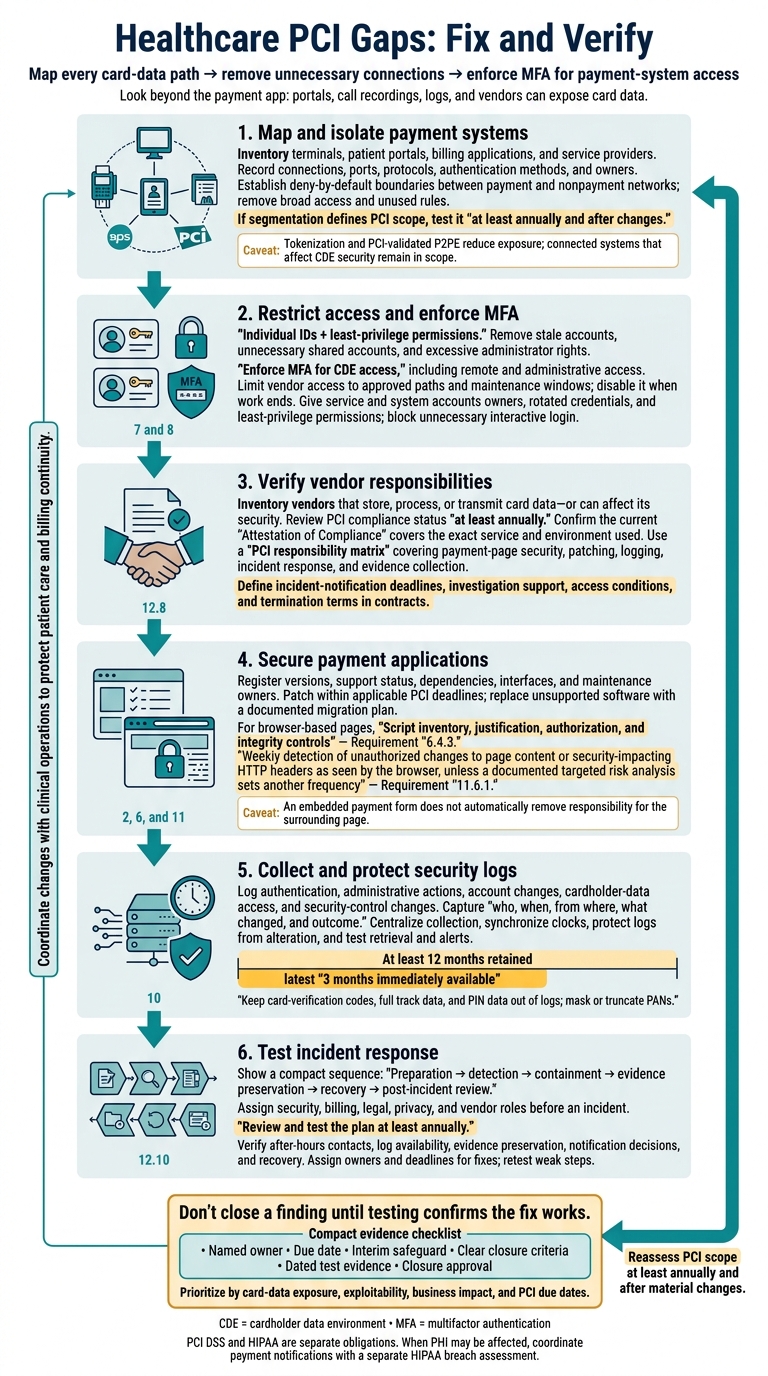
Healthcare PCI Gaps: Fix and Verify
Limit Network Connections and Payment System Access
Separate Payment Systems From Clinical and Office Networks
Start with a connection inventory for terminals, patient portals, billing applications, and service providers. Record each connection’s ports, protocols, authentication method, and owner. Then set deny-by-default boundaries between payment and nonpayment networks. Remove broad access and unused rules, and isolate the CDE with VLANs, firewalls, ACLs, private links, or microsegmentation.[1][2][4]
If segmentation defines PCI scope, test it at least annually and after changes. Confirm that out-of-scope networks cannot reach the CDE, and keep test results and remediation records. Tokenization and PCI-validated P2PE reduce exposure, but connected systems that affect CDE security remain in scope.[5][7][8][3][1]
Coordinate changes with billing, clinical IT, and clinical engineering. Before expanding access, use a planned maintenance window to validate authorization, refunds, portal transactions, interfaces, and downtime procedures. Confirm that the changes preserve segmentation and approved payment flows. Assign every exception an owner, business reason, expiration date, and review date.[2][6]
Restrict User Access and Enforce MFA
Under Requirements 7 and 8, give each user an individual ID and least-privilege permissions. Remove unnecessary shared accounts, stale contractor access, and excessive administrator rights. Limit vendor support to approved paths and maintenance windows, and disable access when the work ends. Enforce MFA for CDE access, including remote and administrative access. A VPN password alone isn't enough. Document and authorize any MFA exceptions, and set a time limit.[9][10][5][11]
Review who can reach payment systems with billing, IT, and HR owners. Match active accounts against employment and contractor records, verify account removals, and test sample login paths for VPN, payment-administration, and vendor-support access. Keep signoffs, removal tickets, and test results.[9][10]
Review service and system accounts separately, and block unnecessary interactive login. These accounts still need owners, rotated credentials, and least-privilege permissions.[9][10]
With internal access restricted, move on to vendor paths and payment applications to check the next layer of exposure.
sbb-itb-535baee
Navigating PCI Compliance at Scale: Managing Service Providers & Assurance
Address Vendor and Payment Application Risks
After locking down internal access, check third-party connections and applications for payment-data exposure. Failures in either can expand the CDE and give attackers more paths into payment systems.
Verify Vendor PCI Responsibilities and Compliance
Unclear vendor duties can leave payment systems exposed. Under Requirement 12.8, inventory every third party that stores, processes, or transmits card data - or can affect its security. Record each vendor’s scope, data flows, access paths, and business and technical owners. Review PCI compliance status at least annually. Confirm that the current Attestation of Compliance covers the exact service and environment you use; a parent-company compliance claim isn’t enough [14][18][20].
Use a PCI responsibility matrix to document shared duties for payment-page security, patching, logging, incident response, and evidence collection. Contracts should define incident-notification deadlines, investigation support, vendor-access conditions, and access termination terms [18][20]. Assign one vendor-risk owner to track overdue evidence and remediation.
Document these duties before reviewing application risk. Vendor control failures often start when no one knows who owns a task.
Patch or Replace Unsafe Payment Applications
Unsupported software, insecure interfaces, and unmonitored script changes can expose payment data to attack. Keep a payment-application register that records versions, support status, dependencies, exposed interfaces, and maintenance owners. Prioritize internet-facing systems, default credentials, insecure APIs, and endpoints that can’t be isolated.
Under Requirements 2, 6, and 11, apply patches within the applicable PCI deadlines and replace unsupported software using a documented migration plan. Assign application and infrastructure owners to schedule changes around billing cycles, backed by tested backups and rollback procedures [16][17].
For applicable browser-based payment pages, Requirement 6.4.3 requires script inventory, justification, authorization, and integrity controls. Requirement 11.6.1 requires weekly detection of unauthorized changes to page content or security-impacting HTTP headers as seen by the browser, unless a documented targeted risk analysis sets another frequency. Assign a payment-page owner to review alerts. An embedded payment form doesn’t automatically remove responsibility for the surrounding page [12][15][17][19].
Close findings only after independent verification of versions, scans, integrations, and alerting. Document the evidence and residual risk before approval [16][17].
Close Logging and Incident Response Gaps
After fixing access and application issues, check that your team can detect, preserve evidence from, and contain payment incidents. Weak logs and an untested response plan can turn a contained event into a long, costly breach. If attackers reach payment systems, logging and response determine how fast you spot the incident, contain it, and assess its impact. Assign security, billing, legal, privacy, and vendor roles before an incident occurs.
Collect, Protect, and Review Payment Security Logs
Under Requirement 10, log successful and failed authentication, administrative actions, account changes, cardholder-data access, and security-control changes. Each log should show who acted, when, from where, what changed, and whether the action succeeded.[21]
Inventory log sources across payment applications, databases, identity systems, firewalls, and relevant vendor systems. Centralize collection, synchronize clocks, limit log access, and protect retained copies from alteration. Set alerts for logging disablement and attempts to delete logs.
Keep audit history for at least 12 months, with the latest three months immediately available for analysis.[21] Assign reviewers who are accountable for the work, document review procedures, and record alert investigations and escalation decisions. Test archived-log retrieval and alert delivery.
Keep card-verification codes, full track data, and PIN data out of logs. Mask or truncate primary account numbers (PANs), and check log output after application upgrades.
Test the Payment-Data Incident Response Plan
Once logs are centralized, test whether your team can use them to contain an incident. Under Requirement 12.10, define preparation, detection, containment, evidence preservation, recovery, and post-incident review for payment systems.
List response contacts for security, billing, legal, privacy, acquirers, processors, and service providers. Include steps for payment-page tampering alerts and unexpected cardholder data exposure: preserve relevant evidence, isolate affected components without destroying evidence, assess exposure, and coordinate remediation.[9] Document who can authorize isolation and how billing will continue during an outage.
Review and test the plan at least annually with billing, security, privacy, legal, and relevant vendors. Verify after-hours contacts, log availability, evidence preservation, notification decisions, and recovery.[22] Assign owners and deadlines for fixes, then retest weak steps. To streamline this process, teams can use automated security questionnaires to quickly verify vendor compliance and response capabilities. When PHI may be affected, coordinate payment notifications with a separate HIPAA breach assessment.
Conclusion: Prioritize Fixes and Verify Results
Use the findings above to prioritize fixes based on card-data exposure, exploitability, business impact, and PCI due dates. Address direct CDE paths first, then excessive access, vendor failures, unsafe applications, and weak detection and response. PCI DSS v4.0.1 requirements are already mandatory.[13][23]
Assign each finding a named owner, due date, interim safeguard, and clear closure criteria. Remove unnecessary network paths and stale access promptly. Coordinate changes with clinical operations to keep patient care available. Escalate overdue high-risk findings instead of quietly extending deadlines.
Close a finding only when test evidence confirms the fix works. Keep dated test results, configuration records, vendor compliance evidence, and closure approvals. Track remaining exposure and overdue fixes - not just completed tickets.
Reassess PCI scope at least annually and after material changes, including new vendor connections, payment integrations, or network redesigns.[8] Keep unresolved risks visible until controls are verified or an authorized decision-maker accepts the residual risk.
FAQs
Does outsourcing payments eliminate our PCI responsibilities?
No. Outsourcing payment processing doesn’t remove your PCI responsibilities. Healthcare organizations still own their security and compliance obligations, even when a third-party vendor processes cardholder data.
You must verify each vendor’s PCI DSS compliance and check its technical and operational controls. A contract alone isn’t enough. Review evidence of the vendor’s security practices, assess its controls, and manage the risks tied to shared connections.
How can we test segmentation without disrupting patient care?
Start with passive discovery tools like NetFlow or SPAN to map traffic and identify legitimate clinical workflows without interacting with fragile medical devices. Run new segmentation policies in monitor-only mode for 30 to 90 days before enforcing them. This lets you check that they won’t block required communication between clinical systems.
Schedule hands-on maintenance or active scanning during low-activity windows so you don’t interrupt care teams.
When does a payment breach also trigger HIPAA obligations?
A payment breach triggers HIPAA obligations when the affected systems or data involve electronic protected health information (ePHI). When billing and clinical platforms connect, a breach can expose both protected health information (PHI) and cardholder data. Access to PHI without permission requires organizations to follow HIPAA breach notification protocols and security safeguards.
Censinet RiskOps™ helps manage this overlap by mapping payment and clinical systems to PCI DSS and HIPAA controls within a central risk management framework.
