
If your downtime plan lives in one binder and your cyber, vendor, and clinical teams work in separate lanes, your hospital is not ready.
I see the article’s main point as simple: business continuity fails when it sits apart from cybersecurity, IT, vendor risk, compliance, and patient care teams. In healthcare, that gap shows up fast during ransomware, cloud EHR outages, and vendor failures. The result is longer downtime, more manual work, more error risk, and more pressure on revenue and HIPAA duties.
A few facts make the case fast:
- Healthcare logged 249 ransomware complaints in the FBI’s 2023 data, more than any other U.S. critical infrastructure sector.
- U.S. healthcare ransomware downtime has cost about $1.9 million per day on average in tracked losses.
- Cyberattacks drive 48.8% of reported EHR downtime incidents.
- Only 22% of healthcare organizations hit by ransomware recovered within 7 days.
So the fix is not “write a better binder.” The fix is to run continuity as one shared model across:
- cyber
- IT
- vendor risk
- clinical operations
- compliance
- finance
- supply chain
That means I would focus on a few direct moves:
- Map which clinical and revenue services matter most
- Rank systems by patient-safety impact, not just server order
- Track third-party vendor risk and fourth-party dependencies
- Set shared RTO/RPO targets with clinical input
- Test full downtime care workflows, not just IT failover
- Review the same resilience data in one governance group
Here’s the short version:
| Issue | What goes wrong | What to do instead |
|---|---|---|
| Siloed continuity | Teams respond out of sync | Use one command path and one governance group |
| Paper-only downtime plans | Care continues, but errors and backlog grow | Add recovery order, reconciliation steps, and role ownership |
| Hidden vendor links | One outside outage spreads across care and billing | Map third-party and fourth-party dependencies |
| IT-led recovery only | Technical restore order misses patient-safety needs | Restore medication, orders, and results first when needed |
| Separate testing | Drills look fine but fail under pressure | Run joint cyber, clinical, IT, and vendor outage exercises |
Bottom line: I’d treat continuity as a daily health system function, not a side program. That is the article’s core message, and everything else supports that point.
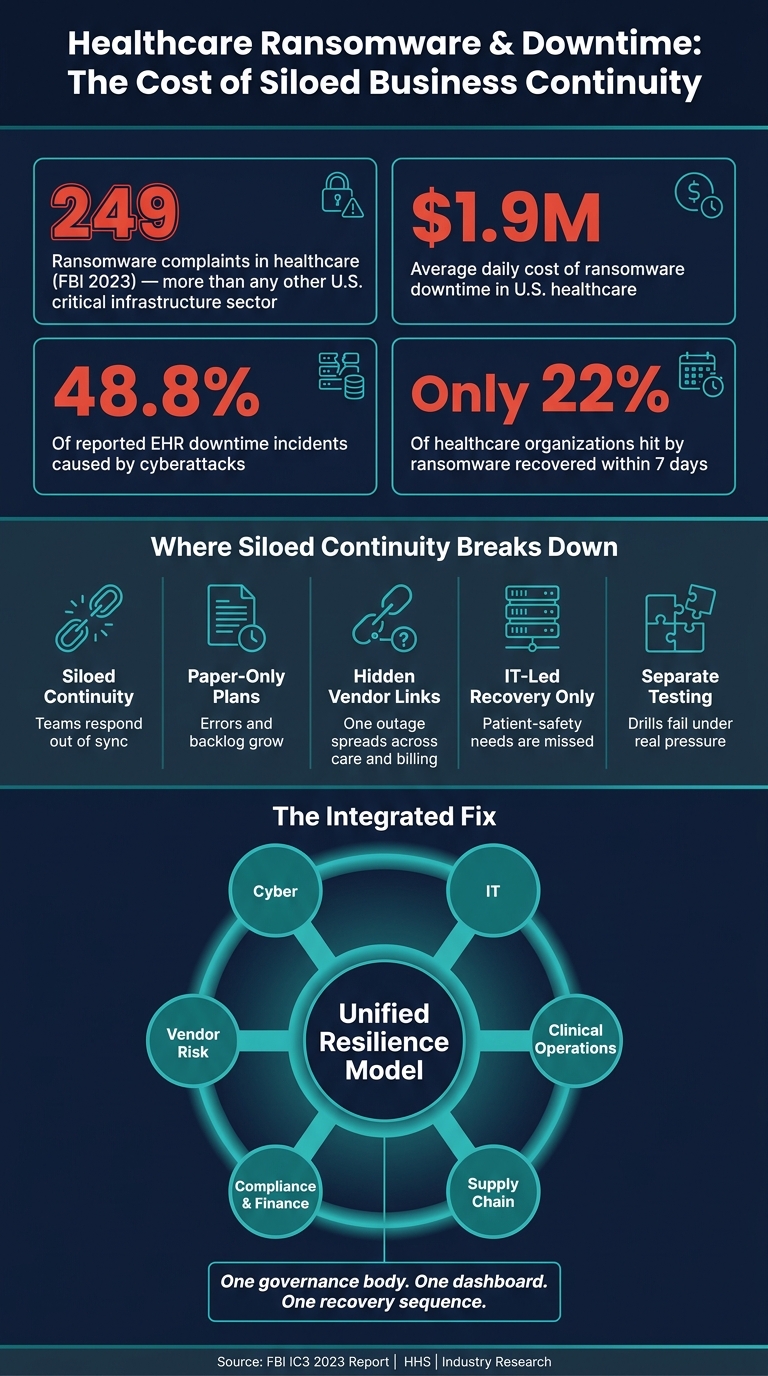
Healthcare Ransomware & Downtime: The Cost of Siloed Business Continuity
How siloed business continuity fails during real healthcare disruptions
Ransomware attacks on clinical systems and recovery priorities
In 2021, a ransomware attack on a large health system with 4 hospitals and 19 outpatient sites took down the EHR, imaging, and telemedicine at the same time. Clinicians had to switch to paper charts, ambulances were diverted, and the disruption lasted 4 weeks. Nearly 150,000 patient records were affected.[2]
That kind of event shows where siloed continuity plans break down. Many plans stop at “use paper” and don’t spell out what comes back first or whether backups have been checked in advance. Then, when the pressure is on, teams are left making hard calls on the fly.
In a hospital, recovery order can't be treated like a generic IT task. Medication safety has to come first, followed by orders and results, and then administrative systems. If that sequence isn't set ahead of time, people end up deciding during the crisis.
This isn't a rare edge case either. Cyberattacks now account for nearly 48.8% of reported EHR downtime incidents.[3] That changes the planning baseline. Recovery plans need to assume a cyber event, not just a routine outage.
The same issue shows up when the disruption starts outside the hospital.
Critical vendor outages and hidden third-party dependencies
A vendor outage can hit just as hard as an internal failure. If a cloud EHR or lab interface vendor goes down, diagnostics slow, claims stall, and staff get pushed into manual workarounds almost immediately. Care is affected fast. So is revenue.
The harder part is what many health systems don't see clearly: upstream dependencies. A hospital may know its direct vendor, but not the cloud, networking, or analytics providers behind that vendor. That's where fourth-party risk enters the picture, and it's often left off the map.
HHS has specifically flagged managed service provider and supply-chain compromise as a significant threat.[4] So continuity planning can't stop at naming a vendor in a spreadsheet. It needs to cover:
- Vendor criticality
- SLA recovery commitments
- Fallback procedures
EHR downtime brings the same weakness into day-to-day operations.
EHR downtime events that expose gaps in operations and compliance
Paper workflows help, but they're only a bridge. In high-acuity settings, paper orders and handwritten medication records can increase error risk. Manual documentation also puts more strain on staff, and recovery doesn't end when systems come back online. Every paper order, result, and note has to be re-entered and verified carefully.
There’s also the compliance side. Paper charts weaken access control and can increase HIPAA exposure. Reporting to CMS or state agencies can slip if downtime records are incomplete. What looks like a short-term workaround can turn into a documentation mess later.
That’s why downtime planning can’t sit with one team alone. Clinical operations, pharmacy, HIM, IT security, and compliance all need to follow the same playbook.
These failures all point in the same direction: recovery doesn't work when each function stays in its own lane.
| Dimension | Siloed Business Continuity | Integrated Cyber-Resilience |
|---|---|---|
| Visibility | EHR treated as isolated; lab, imaging, pharmacy, and vendor dependencies omitted | Full asset and dependency mapping across clinical workflows, third-party, and fourth-party services |
| Governance | BC sits apart from cyber, vendor risk, and clinical leadership | Unified governance across cyber, BC, vendor risk, IT, clinical ops, and compliance |
| Recovery Prioritization | Server-first recovery; no clinical sequence or reconciliation plan | Recovery sequence driven by patient-safety impact and regulatory obligations |
| Patient-Safety Impact | More medication errors, missed documentation, and uneven downtime practice | Structured downtime procedures with defined reconciliation steps and coordinated clinical oversight |
| Likely Downtime Outcomes | Longer disruption, poor paper-workflow execution, reconciliation problems, and possible findings | Shorter, more controlled downtime, consistent procedures, clear event documentation, and demonstrable compliance with resilience expectations |
The answer is one operating model that connects continuity, cyber, vendor risk, IT, and clinical recovery.
sbb-itb-535baee
What an integrated continuity model looks like
Unified governance across continuity, cyber, TPRM, IT, and clinical operations
After ransomware, vendor outages, and EHR downtime, the issue isn't whether a continuity program exists. It's whether the organization runs continuity as one operating model.
That means a clear shift in how the work is owned. Continuity can't sit in a binder with one team while cyber, vendor risk, IT, and clinical operations each run their own process. It has to become a shared function across all of them.
A practical way to do that is to stand up a Unified Risk & Resilience Committee that includes the CISO, CMIO, CNIO, COO, compliance, supply chain, and finance leaders. This group owns the enterprise resilience strategy, sets risk appetite for downtime and vendor disruption, and reviews integrated dashboards at least quarterly. The goal is simple: one dashboard and one decision path for resilience priorities.
HICS should serve as the single command structure for cyberattacks and prolonged IT outages. If a ransomware event or EHR outage hits, the response should be structured and organization-wide, not split into separate tracks in IT and clinical operations.
Criticality classification is where governance starts to affect day-to-day choices. If every system and vendor is tagged as life-critical, mission-critical, or business-critical based on direct clinical impact, including patient safety consequences, recovery priorities stop turning into guesswork.
- Life-critical systems need recovery in minutes to hours.
- Mission-critical systems can usually wait 4–24 hours.
- Business-critical systems can wait 24–72 hours or longer.
That classification shapes where redundancy dollars go and what gets restored first.
Of course, that setup only holds up if all critical services are assessed with the same criteria.
Shared assessments, business impact analysis, and recovery planning
An integrated BIA looks at clinical harm, financial loss, and regulatory exposure in one model. It should measure the effect on ED throughput, medication safety, diagnostics, scheduling, revenue, and reporting obligations at 1, 4, 24, and 72 hours. For example, radiology PACS downtime can affect about $350,000 per day in net revenue for a mid-size health system.[1]
Dependency mapping is what keeps the BIA honest. In plain terms, it means charting the full service chain. Not just that a health system uses an EHR, but which databases, network segments, cloud environments, identity services, and third-party APIs that EHR depends on. When teams map full service chains, they can spot single points of failure, especially shared cloud and identity dependencies.
RTOs and RPOs should come out of joint workshops with IT, security, clinical leaders, and operations in the room together. They shouldn't be handed down by IT as technical settings. Each critical service should also have three named owners:
- a business owner
- a clinical owner
- a technical owner
Testing should follow that same logic. Annual exercises need to test real clinical downtime workflows, not just server failover. Findings from each exercise should feed back into the risk register and trigger updates to plans, playbooks, and vendor contracts.[1]
Those scores should then drive recovery targets and test plans.
How Censinet RiskOps™ connects cyber, vendor, and continuity data
Censinet RiskOps™ brings cyber, third-party, and continuity data into one view. The platform shows vendor security posture, continuity attributes such as RTO and criticality classification, and clinical dependency data in a single dashboard.
So when vendor risk shifts or DR gaps show up, teams can see it right away. Automated assessments and standardized questionnaires also cut down the manual work needed to keep vendor continuity data current. That matters when health systems are juggling a large number of vendor relationships.
The result is that continuity, cyber, and vendor teams stay aligned around the same data. From there, leaders can track resilience using the same information they already use to manage risk.
Tools, governance models, and metrics to break the trap
Governance models healthcare leaders can adopt now
Start with the model that fits your current maturity level and clinical complexity. The goal isn't to pick the most sophisticated setup on paper. It's to make business continuity part of one resilience system, not a side function that operates on its own.
| Governance model | Strengths | Limitations | Implementation complexity |
|---|---|---|---|
| Business continuity management embedded in enterprise risk management (ERM) | Aligns continuity with enterprise risk appetite; makes resilience board-visible; strong when paired with clinical risk owners and moderate third-party coverage through ERM scope | Can become too broad without clear operational ownership | Medium |
| Third-party risk management (TPRM)-led resilience committee | Deep vendor and supply chain focus; strong for cloud-hosted EHR and outsourced services; high third-party coverage; effective with clinical participation | May lack enterprise scope beyond vendor risk | Low-to-medium if TPRM is already mature |
| GRC-centered cyber-resilience council | Harmonizes NIST CSF, HITRUST, and policy frameworks; strong regulatory alignment; medium-to-high clinical impact with clinical representation; moderate third-party coverage through security and TPRM coordination | Needs clinical leaders actively involved to drive patient-safety priorities | Medium |
| Clinical operations steering group | Directly ties recovery decisions to patient safety and care workflow; very high clinical impact focus; medium third-party coverage | High complexity; requires sustained engagement from busy clinical leaders | High |
Whichever model you choose, it only works if it leads to clear ownership, defined thresholds, and actual recovery decisions. Every option still needs a formal charter, decision rights, and an executive sponsor.
Risk metrics that reveal continuity weaknesses
Once governance is in place, the next step is simple: measure where continuity still fails. Metrics turn meetings into action. More importantly, these six metrics show whether continuity is still trapped in silos. Think of them as warning signs of integration failure, not just boxes on a dashboard.
Critical vendor concentration shows what share of mission-critical services, such as EHR hosting, imaging, lab, pharmacy, and revenue cycle, depend on one vendor or one cloud provider. If that number is high, a single outage can hit several care functions at once.
Unsupported downtime workflows shows how many high-impact clinical processes, like ED triage, medication administration, and OR scheduling, do not have a tested and documented fallback process. That gap can hurt fast. In one EHR downtime study, laboratory testing results were delayed by an average of 62% compared with normal operation.[6] That's the kind of delay that turns a paper gap into an operational problem.
Backup and recovery performance compares the actual RTO and RPO reached during DR tests with the targets set for systems such as EHR, PACS, LIS, ADT, and pharmacy. If test results miss the target, that shortfall becomes a risk during a live event.
Cross-functional exercise frequency tracks how often IT, security, clinical leadership, TPRM, and business continuity teams run joint scenarios together. Separate drills may look busy, but they don't show how the full system responds under pressure.
Unresolved high-risk findings measures open critical issues from assessments, audits, and incident postmortems that have a direct effect on continuity. Aging data matters here because an old gap left open is still a gap.
Time to restore mission-critical services tracks both median and worst-case restoration times for services such as ED registration, order entry, and radiology after a real incident or a test. That's often where the difference between plan and practice becomes painfully obvious.
These metrics should be tracked over time and tied to set thresholds. Review them in governance meetings, and assign an owner to each gap so issues don't just sit in a report.
How Censinet AI™ improves speed and oversight
Automation helps because continuity data shifts all the time, and manual tracking gets old fast.
Censinet AI™ speeds up the information-heavy work: completing vendor security and resilience questionnaires, including common third-party risk assessment questions, summarizing large sets of documents such as business continuity plans, DR test reports, and SOC 2 reports into concise risk-focused insights, and generating standardized risk reports that map findings to continuity metrics like vendor concentration and backup performance.
Censinet AI also handles the coordination layer. It sends key assessment findings and remediation tasks to the right GRC stakeholders automatically. Risk teams set the rules and review process, so automation supports decisions instead of making them on its own. That means continuity, cyber, and vendor data stay current across clinical, cyber, and vendor teams, while governance committees spend less time chasing updates and more time making calls.
| Censinet capability | Continuity outcome |
|---|---|
| Censinet AI™ questionnaire acceleration | Faster vendor resilience assessments; shorter time to identify continuity gaps |
| Censinet AI™ evidence summarization | Clearer visibility into DR readiness, backup gaps, and missing downtime procedures |
| Censinet AI™ risk reporting | Continuity metrics mapped to vendor criticality and service dependencies |
| Censinet AI routing and orchestration | Right findings reach the right GRC and clinical stakeholders without manual follow-up |
| Human review | Automation scales without removing accountability from risk and clinical leaders |
Healthcare Business Resilience: Maintaining Patient Care During Disruption | Security in Practice
Conclusion: A practical path to unified operational resilience
Business continuity can't sit off to the side and still protect care delivery. When only 22% of healthcare organizations hit by ransomware recovered in seven days or less,[7] the problem isn't limited to IT. It spills into clinical workflows, vendor performance, revenue, and compliance.[5]
The next move is simple in concept, but it takes discipline. Start with the clinical and revenue services your organization can't afford to lose, then map the dependencies behind them. From there, run integrated business impact analyses that bring clinical leaders, cybersecurity, vendor risk, and compliance into the same room. Tie that work straight to the ransomware, vendor outage, and EHR downtime scenarios covered earlier. Those are the moments that expose missing dependencies and recovery steps that look fine on paper but break under stress.
That effort also needs shared governance and regular testing. Use one cross-functional governance body with clear decision rights and a common risk taxonomy so detection, response, and patient care stay aligned. Testing should match that same cross-functional setup, not isolated department drills that never show whether the full resilience model can hold up when pressure hits.
To keep the model current, teams need a single source of truth. Censinet RiskOps™ centralizes cyber, vendor, and continuity data so the same data informs vendor risk and recovery priority. Censinet AI™ helps keep assessments and remediation current.
Business continuity works only when it becomes an operating capability built into how the organization manages cyber risk, vendor relationships, and clinical operations every day.
FAQs
Why is business continuity not enough on its own?
Business continuity, by itself, isn't enough when it sits in its own lane. In healthcare, resilience is an organization-wide issue shaped by connected clinical care, vendor dependencies, and day-to-day operating systems.
When continuity planning stands alone, teams can miss key risks. That can lead to blind spots, split-up responses, failure models that don't match what happens in practice, and too little clinical context. For continuity to work, it needs to connect with incident command, emergency preparedness, and vendor risk so those efforts support patient safety together.
What should hospitals restore first during downtime?
Hospitals should base restoration on patient care, not on IT systems for their own sake.
The right order should come from the criticality rankings in enterprise risk assessments. In plain terms, restore the services tied most closely to life-or-death decisions first.
That usually means bringing back:
- emergency care
- the ICU
- surgery
- pharmacy
- laboratory
- imaging
- ambulatory care
- telehealth
The idea is simple: get the parts of care delivery back online before anything less urgent.
How can we find hidden vendor and fourth-party risks?
Move past periodic, paper-based questionnaires. Use a proactive, layered approach instead.
Keep a living inventory that links clinical services to vendors, upstream cloud providers, subcontractors, and embedded services. On top of that, require vendors to disclose their key partners and dependencies.
It also helps to map technical and operational dependencies, not just vendor names on a spreadsheet. That way, you can see how one weak link might affect patient care, internal systems, or day-to-day work.
You can also use automated tools to pull critical details from vendor documentation. Then add continuous monitoring, threat intelligence, and cross-functional scenario planning with clinical and IT teams.
That mix gives you a much clearer view of third-party risk as it changes over time.
