
Rural hospitals need the same GRC coverage as large hospitals, but the work has to fit small teams. About 60 million people in the U.S. rely on rural care, and more than $15 million in HIPAA fines were issued between 2024 and 2025, with missing or weak risk analysis cited again and again.
Here’s the short version:
- The standard should stay the same.
- The work model should change.
- Central teams should handle the heavy work.
- Local teams should handle site-specific tasks.
- Risk acceptance should be documented, not assumed.
In plain terms, I’d boil the article down to this:
- Rural hospitals often miss out on enterprise GRC because they have lean IT staff, older devices, and too much manual work
- The biggest gaps usually show up in risk assessments, vendor risk management, remediation, and reporting
- A better model uses a minimum control baseline, shared policies, clear ownership, and central vendor oversight
- Local sites should not be writing policy from scratch or chasing every vendor by hand
- Leaders need simple reporting on things like MFA, patching, network segmentation, vendor risk, and training completion
What matters most: keep one enterprise GRC model across every hospital, but make local execution lighter so small teams can keep up without losing sight of HIPAA, HITECH, NIST CSF 2.0, and HHS CPGs.
A simple way to think about it: centralize governance, simplify local work, and document every gap that cannot be fixed right away.
UnHack (the News): Rural Hospital Security and the HIPAA Audit Mirage with George Pappas
sbb-itb-535baee
Problem: enterprise GRC models do not fit small teams
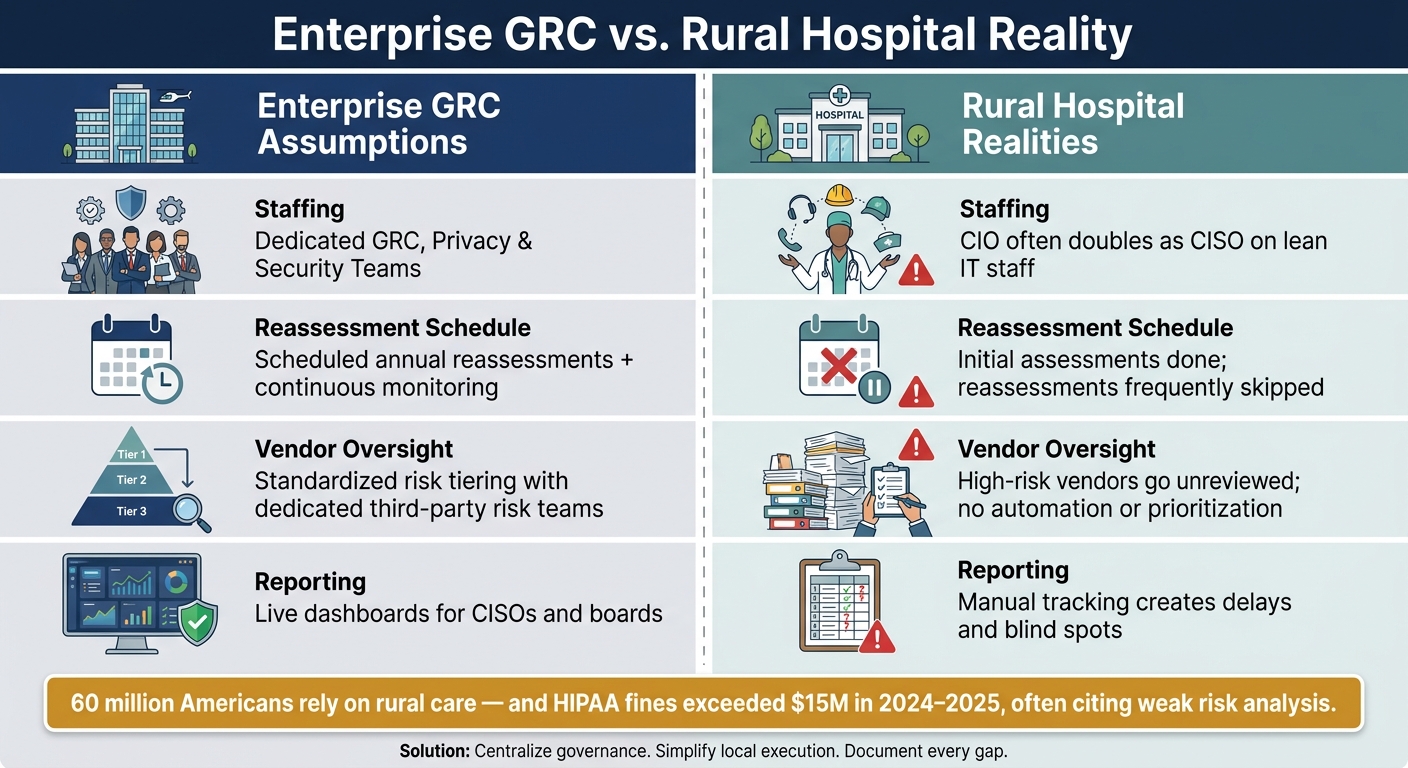
Enterprise GRC vs. Rural Hospital Reality: Bridging the Gap
Enterprise GRC programs assume a level of staffing, automation, and review rhythm that many rural hospitals simply don't have. When that setup meets a lean team, the program stops feeling like protection and starts feeling like extra work. The baseline does not change. The operating model does.
| GRC Dimension | Enterprise GRC Assumptions | Rural Hospital Realities |
|---|---|---|
| Staffing | Dedicated GRC, privacy, and security teams | Lean IT teams where the CIO often also serves as the CISO [1] |
| Reassessment Schedule | Scheduled annual reassessments with continuous monitoring | Initial assessments are performed, but reassessments are often skipped [1] |
| Vendor Oversight | Standardized risk tiering with dedicated third-party risk teams | High-risk vendors go unreviewed without automation or prioritization [1] |
| Reporting | Live dashboards for CISOs and boards | Manual tracking that creates delays and blind spots in risk oversight [1] |
These aren't small process hiccups. They create real blind spots across vendor oversight, reassessment, and reporting.
Where standard workflows break down
Comprehensive third-party risk management is often one of the first places things start to slip. Many rural hospitals depend on manual questionnaires that are hard to keep current and easy to push aside when staff are stretched thin. And without risk tiering, teams can't sort vendors fast enough to focus on the ones that matter most [1].
Evidence collection adds another layer of strain. When teams rely on spreadsheets and manual follow-up, assessments turn into one-time projects instead of a steady program. Work gets done, but it doesn't always build into a clear, current view of risk [1].
How the gap affects compliance and cyber resilience
The reporting gap is where this gets serious. As Brian Sterud, CIO and CISO at Faith Regional Health Services, put it:
"One of the biggest takeaways has been clearly defining risk acceptance. In the past, stakeholders didn't always realize that by not funding security initiatives, they were implicitly accepting risk." [1]
That quote gets to the heart of the issue. If boards and local leaders can't see risk in plain terms, they can't make sound funding calls. And when funding choices happen in the dark, rural hospitals have a harder time keeping coverage in place, responding fast, and recovering cleanly after an incident.
The gap between enterprise GRC expectations and rural hospital conditions creates both a compliance problem and a cybersecurity risk. The answer isn't piling more work onto local teams. It's a lighter model that pulls the hardest parts into a central function.
Solution: build a right-sized operating model for rural GRC
The answer isn’t a weaker program that cuts corners. It’s a centralized model that keeps local work simple, consistent, and defensible. Put the hard coordination work in the center, and leave rural teams with the tasks that have to happen on-site. That setup also lays the groundwork for cleaner vendor oversight and reporting in the next step.
Use tiered risk assessments and a minimum control baseline
Not every control has the same urgency for a rural hospital. A practical place to start is to scope assessments around what matters most: ePHI systems, critical clinical applications, medical devices, and key third-party vendors. From there, a minimum control baseline gives small teams a clear starting point.
The HHS Cybersecurity Performance Goals (CPGs) fit this setup well. They focus on the most common healthcare attack patterns while staying achievable for resource-constrained teams [2]. High-impact controls like MFA, patch management, backups, and incident response aren’t optional, no matter the size of the organization. But they can be put in place in a way that works for a lean team.
Instead of piling on manual work, use automated templates, pre-contracting vendor review, longitudinal monitoring, and automated remediation tracking. That’s a far better path than relying on manual questionnaires, post-contracting review, and once-a-year reassessments.
A right-sized baseline only works if every control has a clear owner and a simple path to action.
Centralize policies, shared controls, and ownership mapping
One of the fastest ways to cut local burden is to stop asking rural sites to write policy from scratch. A shared control library mapped to HIPAA and NIST CSF 2.0, written in plain language, gives small teams something they can use without a lot of translation.
Ownership also needs to be crystal clear. Central IT should own shared controls such as MFA, vulnerability scanning, and incident response. The rural site should own local execution, including patch windows, device placement, and on-site enforcement.
| GRC Activity | Ownership Level | Primary Responsibility |
|---|---|---|
| Policy Management | Centralized | Maintain shared library mapped to HIPAA/NIST CSF 2.0 |
| Vendor Risk (TPRM) | Centralized | Automate assessments, reminders, and contract vetting |
| Asset Inventory | Local | Continuous tracking of medical devices and IoT on-site |
| Risk Analysis | Shared | Central provides the framework; Local provides site data |
| Remediation | Local | Execute patching, MFA enrollment, and physical security |
| Exception Handling | Shared | Local identifies gaps; Central approves risk acceptance |
When ownership is clear, remediation and exception handling move faster, with less second-guessing at the local level.
Simplify remediation and exception handling
Constrained teams don’t fail because they’re careless. They fail because remediation processes create too much administrative drag. Standardized remediation plans with pre-set, realistic due dates take away a lot of that friction. When a finding shows up, the team already knows the response window and what “done” looks like.
Exception handling should work the same way. If a legacy medical device can’t be patched or segmented because of manufacturer limits, that isn’t a failure. It’s a documented risk decision. The key is to record it clearly: what the limit is, what compensating controls are in place, whether a migration plan is needed, and who approved the risk acceptance. Documented exceptions are defensible. Undocumented gaps are not.
Standardized remediation timelines and exception criteria keep rural sites inside the same governance model while producing cleaner risk reporting for system leaders. That consistency makes the next step easier: reducing local workload for vendor risk and board reporting.
Solution: reduce local workload for vendor risk and reporting
Once remediation is standardized, the next choke points are usually vendor risk and reporting. For lean rural teams, those two jobs can eat up hours fast. Vendor reviews still involve too much manual back-and-forth, and reporting often turns into a local spreadsheet project nobody has time for.
Standardize third-party risk for vendor-heavy rural hospitals
Rural hospitals depend on a long list of vendors for clinical systems, medical devices, and IT services. That reliance makes vendor risk management a must. But sending manual questionnaires to every vendor simply doesn’t scale for small local teams.
A better model is to shift the heavy lifting to the center. Central teams can pre-screen vendors, assign risk tiers based on ePHI access, remote connectivity, or support for critical clinical operations, and keep the results in a shared catalog. Local rural sites then inherit those pre-screened vendors and approved risk tiers instead of starting from scratch each time.
Pre-contract enforcement also matters. If the assessment has to be done before a contract is signed, security reviews are far less likely to get skipped.
Brian Sterud, CIO/CISO at Faith Regional Health Services - a rural Nebraska health system - described the impact:
"The ability to have vendors already in the catalog and automate follow-ups has been super important. We now have a system that enforces accountability and ensures vendor compliance before contracts are signed." [1]
Here’s what changes when enterprise support replaces an ad hoc local process:
| Feature | Ad Hoc Rural Vendor Review | Enterprise-Supported Workflow |
|---|---|---|
| Assessment | Manual, spreadsheet-based questionnaires | Automated platform with pre-filled vendor data |
| Consistency | Inconsistent; often skipped for small vendors | Standardized based on risk tier and data access |
| Updates | Rarely performed after initial onboarding | Ongoing visibility with automated triggers |
| Contract Timing | Security reviews often happen after signing | Assessment completion is a prerequisite for contracts |
That same central approach should make reporting easier too.
Build reporting that boards and local leaders can both use
Once vendor risk is centralized, reporting can stick to a small set of shared metrics instead of forcing each rural site to build its own dashboard. That’s where many teams get stuck. The issue isn’t prettier charts. It’s getting to faster funding, clearer accountability, and defensible risk acceptance.
A site-level view across key risk areas gives system leadership a quick read on where each facility stands, without custom reporting for every location. For example:
| Facility Name | Identity | Endpoint | Network | Vendor Risk | Training |
|---|---|---|---|---|---|
| Rural Site A | MFA Active | 95% Patched | Segmented | 2 High Risk | 100% Complete |
| Rural Site B | MFA Pending | 80% Patched | Flat Network | 5 High Risk | 85% Complete |
| Critical Access C | MFA Active | 98% Patched | Segmented | 0 High Risk | 92% Complete |
Sterud said it changed the conversation:
"Censinet has helped us make risk visible... leaders often did not realize that by not funding security initiatives, they were implicitly accepting risk." [1]
How Censinet supports low-overhead execution
One platform can support this model by bringing vendor review, shared controls, and multi-site reporting together in one place. Censinet RiskOps™ combines enterprise and third-party risk workflows, shared controls, policy references, and multi-facility reporting in a single platform [1]. That lets rural sites use the same workflows as the rest of the health system with less local work.
Censinet Connect™ also supports shared vendor assessments by letting vendors respond once and share those results across the network, which cuts redundant work for both the hospital and the vendor [1].
Conclusion: a clear roadmap for extending enterprise GRC to every hospital
Rural hospitals aren’t special cases that should sit outside enterprise GRC. Every site needs to be part of the same model. The aim isn’t weaker governance. It’s a lighter way to run the same standard.
The best path is one enterprise model with lighter local execution: centralized governance, local execution, and documented risk acceptance. That setup keeps rural hospitals inside the same framework as the rest of the health system without burying small teams in paperwork.
But this only works when leaders can see risk clearly enough to fund it and take ownership of it. Benchmarking against industry standards gives smaller sites a clearer case for resources. It also turns risk acceptance into a direct decision instead of something that happens by default.
Smaller sites don’t get a free pass anymore. When rural hospitals follow the same GRC model as the rest of the system, the whole health system is stronger - cybersecurity improves, compliance stands up under scrutiny, and patient safety is protected across every site in the network.
One enterprise GRC model, sized for constrained teams, helps protect every site.
FAQs
How can rural hospitals adopt enterprise GRC without adding headcount?
Rural hospitals can extend enterprise GRC without adding headcount by leaning on automation and a central platform. Censinet RiskOps™ helps automate vendor risk assessments and cuts down repetitive documentation work, so small teams can handle more without getting buried in admin tasks.
Censinet AI™ can speed up security questionnaires, summarize vendor evidence, and give teams real-time risk visibility in one dashboard. That means limited staff can stay focused on top priorities while still supporting defensible, audit-ready compliance.
What controls should rural hospitals prioritize first?
Start with a full vendor inventory and a risk-tiering process. That gives rural hospitals a clear view of every third party with access to systems or data, so limited staff time and budget go to the vendors that matter most, especially those tied to high-risk, mission-critical clinical services.
Then put the core controls in place: multi-factor authentication, endpoint security, timely system updates, and clear roles and policies for access control and incident response.
Who should own risk decisions at rural hospital sites?
Risk decisions at rural hospitals should stay with hospital staff. Even if a hospital uses automation to save time, people still need to guide the big calls. That human oversight matters most when a choice could affect patient care, privacy, or day-to-day operations.
Governance also needs clear ownership. Risk owners should be assigned across IT, compliance, and procurement so specific people - not vague teams - are on the hook for managing issues. And risk acceptance should be stated plainly. If a hospital chooses not to fund a security effort, that can still mean accepting risk. That choice should be visible, documented, and reviewed by leadership.
