
Automated compliance monitoring in healthcare simplifies regulatory adherence by integrating real-time checks into daily operations. It replaces manual processes with continuous oversight, reducing risks and administrative workload. Here's why it matters:
- Real-Time Monitoring: Tracks compliance 24/7, flags issues instantly, and ensures audit readiness.
- Regulatory Updates: Keeps pace with evolving laws like HIPAA, HITECH, and state-specific rules.
- Vendor Risks: Actively assesses third-party security to prevent breaches.
- Cost Savings: Reduces compliance preparation time and minimizes penalties from non-compliance.
- AI Integration: Uses tools like behavior analytics and natural language processing to streamline workflows.
Organizations benefit from automation by saving time, reducing breach costs, and improving compliance management efficiency. Platforms like Censinet RiskOps™ provide tailored solutions for healthcare, handling PHI protection, vendor assessments, and risk tracking. Automation transforms compliance from a reactive burden to a proactive, integrated system that supports healthcare operations.
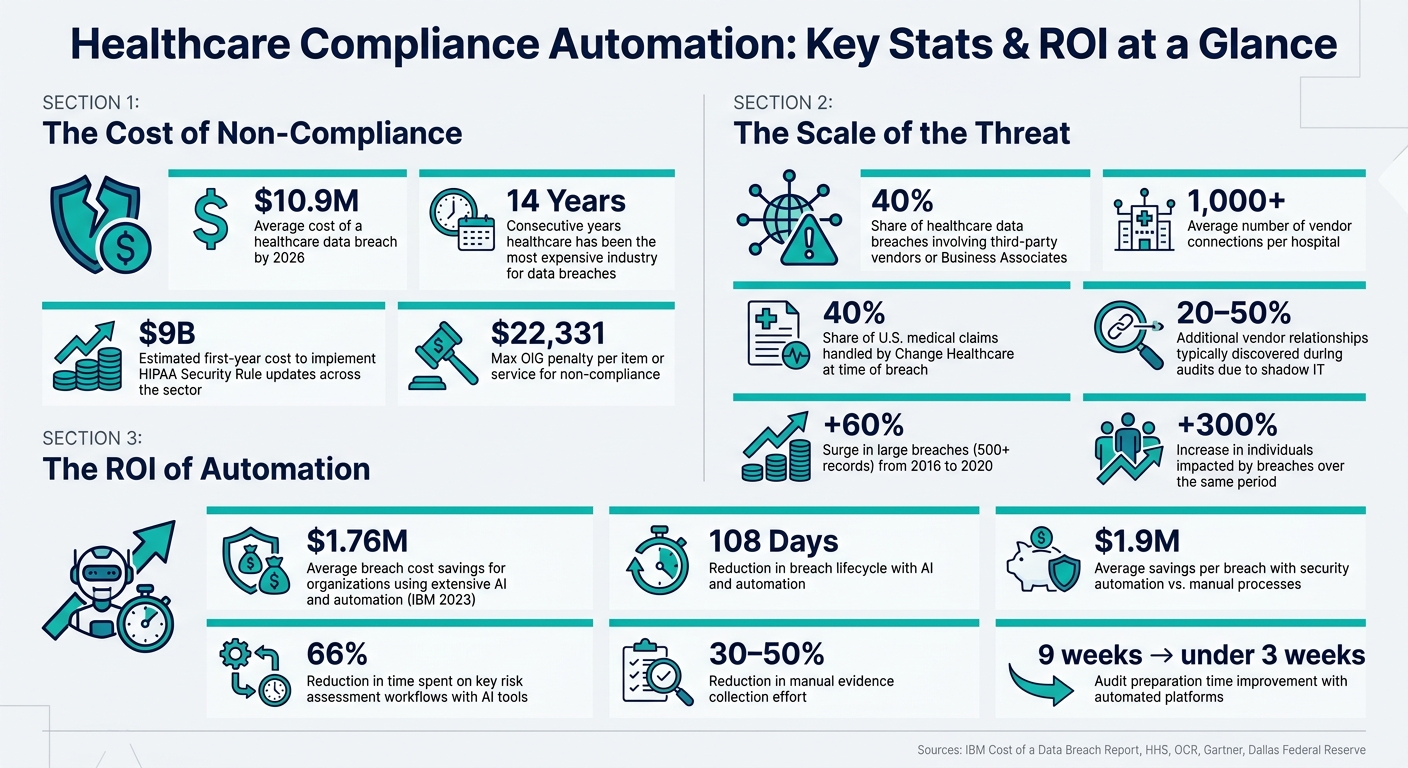
Healthcare Compliance Automation: Key Stats & ROI at a Glance
Regulatory and Risk Landscape for Healthcare Compliance
Key Compliance Regulations in Healthcare
Healthcare organizations in the U.S. operate under a web of regulations, and the stakes are higher than ever. For 14 years straight, healthcare has been the most expensive industry for data breaches, with the average breach projected to cost $10.9 million by 2026 [4][6]. Simply put, the cost of non-compliance far outweighs the expense of meeting regulatory standards.
The HIPAA Security Rule (45 CFR Part 164) now requires comprehensive safeguards - administrative, physical, and technical. Updates in 2026 removed the distinction between "addressable" and "required" safeguards, making measures like encryption and multi-factor authentication (MFA) mandatory [6]. The Department of Health and Human Services (HHS) estimated that implementing these updates across the healthcare sector would cost approximately $9 billion in the first year [6].
The HITECH Act expanded HIPAA's scope, holding Business Associates directly accountable and tightening rules around breach notifications. Similarly, 42 CFR Part 2, which governs substance use disorder (SUD) records, was updated in February 2026 to better align with HIPAA standards [6].
Another key pressure point is the Right of Access Initiative from the Office for Civil Rights (OCR). Providers must deliver patient records within 30 days of a request. For instance, Concentra settled for $112,500 in early 2026 after failing to provide a patient's Protected Health Information (PHI) for over a year despite repeated requests [6]. Adding to the complexity, states like California, New York, and Texas enforce their own stricter standards, which can go beyond federal requirements [4][5].
"Documentation often decides the outcome. Two organizations with the same gap can face very different results - the one that documented its risk analysis... can demonstrate good-faith compliance." - Bellator Cyber Security Guide [4]
These evolving regulations highlight the importance of robust risk management strategies.
Mapping Compliance to Risk Management Frameworks
Turning regulatory requirements into actionable safeguards often requires established frameworks. While regulations specify what to protect, frameworks explain how to do it. The NIST Cybersecurity Framework (CSF) and NIST Special Publication 800-66 Rev. 2 are widely used for translating HIPAA Security Rule mandates into practical, testable controls [4][7]. Although NIST guidelines are technically mandatory only for federal agencies, HHS recognizes them as the industry standard for securing electronic PHI (ePHI) [7].
For organizations juggling multiple compliance requirements, HITRUST offers a certifiable framework that consolidates HIPAA, NIST, and other standards into one unified control set. This approach allows organizations to meet various regulatory demands without running separate compliance programs for each.
OCR has been cracking down on organizations that lack a documented and ongoing risk analysis, treating its absence as evidence of negligence. A clear example is the Axia Women's Health settlement in April 2026: after a ransomware attack, OCR found not only inadequate security measures but also the absence of a comprehensive risk analysis at the time of the breach [6].
"Risk analysis is foundational, and must be understood in detail before OCR can issue meaningful guidance that specifically addresses safeguards and technologies that will best protect electronic health information." - HHS Office for Civil Rights [7]
Third-Party Risk and Vendor Compliance Challenges
A Business Associate Agreement (BAA) alone doesn’t cut it. HIPAA's Security Rule (§ 164.308(a)(1)(ii)(A)) requires covered entities to actively assess third-party vendor risk management practices, not just secure contractual commitments [8]. Alarmingly, around 40% of healthcare data breaches involve third-party vendors or Business Associates, and the average hospital is connected to more than 1,000 vendors [8][9].
The February 2024 ransomware attack on Change Healthcare is a cautionary tale. As a vendor handling 40% of U.S. medical claims, a breach in their legacy remote access system (which lacked MFA) exposed the PHI of nearly one-third of Americans. This incident caused hospital revenue to drop by as much as 17% in the weeks following the attack [9]. As the Dallas Federal Reserve observed in 2025:
"The Change Healthcare event demonstrated that a single third-party failure can generate systemic healthcare disruption at national scale. The lesson is not to improve vendor questionnaires. The lesson is that questionnaire-based programmes are insufficient for critical vendor relationships." [9]
The HITECH Act takes third-party risk even further, extending liability to vendors' subcontractors. The MOVEit breach from 2023–2024 made this clear - many healthcare organizations were exposed not because they directly used MOVEit, but because their vendors did [8]. Discovery efforts often reveal 20% to 50% more vendor relationships than initially estimated, largely due to shadow IT [10]. These hidden connections represent significant compliance vulnerabilities.
| Vendor Type | Risk Level | Primary Regulatory Obligation |
|---|---|---|
| EHR/Clinical Software | Critical | HIPAA BAA, NIST CSF |
| Medical Devices | Critical | FDA 21 CFR Part 820 |
| Cloud/SaaS | Critical | HIPAA BAA, SOC 2 |
| Billing/Revenue Cycle | High | HIPAA BAA, PCI DSS |
| Diagnostic Labs | High | HIPAA BAA, CLIA |
Automated compliance platforms can help tackle these challenges by continuously mapping controls to evolving frameworks, ensuring both regulatory and vendor risks are managed effectively.
sbb-itb-535baee
Core Capabilities of Automated Compliance Monitoring Tools
Core Functions of Compliance Monitoring Platforms
In today’s ever-changing regulatory landscape, healthcare organizations need constant vigilance to stay compliant. Modern compliance platforms have evolved far beyond just generating reports. They now offer real-time verification of security controls like encryption, access permissions, audit logging, and patch management. This shift to continuous control monitoring (CCM) has fundamentally transformed how compliance is managed, moving away from periodic checks to ongoing oversight.
With CCM, these platforms automatically test controls against frameworks such as HIPAA, HITRUST, and NIST CSF. For instance, if a new user gains elevated access to an EHR database without proper approval, the platform flags the issue immediately, creates a remediation ticket, assigns it to the appropriate person, and escalates if needed.
Another key feature is automated evidence collection. Instead of requiring staff to manually gather logs and screenshots for audits, these systems integrate with tools like Active Directory, Epic, Tenable, Qualys, and ServiceNow. They collect data on a set schedule, map it to specific regulatory requirements, and store it securely with timestamps in an unchangeable audit trail. Gartner highlights CCM as a cornerstone of modern Integrated Risk Management, underscoring the shift away from manual, one-off assessments [12].
Policy and control mapping ties everything together. A single control - like centralized logging - can fulfill multiple requirements simultaneously, such as HIPAA §164.308(a)(1), NIST CSF Detect (DE.CM), and HITRUST standards. Role-specific dashboards provide tailored insights for CISOs, compliance officers, and board members, helping organizations maintain a clear view of their compliance posture.
This foundation of continuous monitoring sets the stage for advanced AI capabilities that further enhance compliance oversight.
How AI and Machine Learning Improve Compliance Monitoring
AI has redefined what’s possible in compliance monitoring, going beyond traditional rule-based systems. Take user and entity behavior analytics (UEBA), for example. By using machine learning, UEBA establishes normal access patterns and flags unusual activity - like a billing clerk accessing oncology records during off-hours - as a high-priority alert.
Natural language processing (NLP) also plays a crucial role by streamlining the interpretation of regulatory updates and vendor responses. It can analyze free-text answers, highlight inconsistencies, and recommend relevant controls. AI-powered tools can even summarize vendor documentation and validate evidence for specific controls. Research shows that AI-driven risk assessment tools can cut time spent on key workflows by up to 66% [11]. Additionally, IBM's 2023 Cost of a Data Breach report found that organizations using extensive AI and automation saved $1.76 million on average in breach costs and reduced breach lifecycles by 108 days compared to those without these tools [13].
These AI advancements are especially impactful in healthcare, where the complexity of protecting PHI, managing clinical workflows, and overseeing third-party relationships demands tailored solutions.
Healthcare-Specific Solutions: Spotlight on Censinet RiskOps™
Platforms like Censinet RiskOps™ are designed specifically for healthcare, addressing challenges such as PHI protection, securing clinical applications, managing medical device risks, and handling an average of over 1,300 third-party relationships. This complexity makes it vital to effectively manage third-party risk across the entire ecosystem. Censinet RiskOps™ is purpose-built to meet these unique demands.
The platform manages the entire lifecycle of third-party risk, offering automated vendor assessments, real-time risk scoring, continuous monitoring, and collaborative remediation. Its Censinet AI™ layer speeds up assessments by allowing vendors to complete security questionnaires quickly, automatically summarizing evidence, and generating detailed risk reports. While automation handles much of the workload, the platform incorporates a human-in-the-loop model, ensuring risk teams maintain control through customizable review processes.
Censinet RiskOps™ also centralizes AI risk governance, providing real-time dashboards and stakeholder routing. For healthcare organizations juggling risks across PHI, clinical operations, medical devices, and supply chains, this tailored approach bridges the gap between simply identifying risks and actively resolving them.
| Capability | Traditional Approach | Censinet RiskOps™ |
|---|---|---|
| Vendor assessment process | Manual documentation review; days to weeks | AI-accelerated; up to 66% time reduction [11] |
| Risk tracking | Disconnected spreadsheets | Integrated Risk Register with real-time tracking |
| Compliance visibility | Point-in-time assessments | Continuous monitoring with incident alerts |
| AI governance | Ad hoc or absent | Centralized dashboard with stakeholder routing |
How to Build an Automated Compliance Monitoring Program
Step-by-Step Implementation Process
Creating an automated compliance monitoring program involves several interconnected steps. Start by assembling a cross-functional governance team that includes members from Compliance, Privacy, Security, IT, and Clinical Operations. Securing executive sponsorship early on is crucial for ensuring accountability and clear direction.
Next, identify where PHI and ePHI are stored - whether in EHRs, patient portals, billing systems, or with third-party vendors. Then, link each regulatory requirement (such as HIPAA, CMS rules, and state laws) to the corresponding business processes. This inventory of obligations serves as the backbone of your compliance program and helps guide automated systems that capture audit-ready evidence on an ongoing basis.
Here’s a breakdown of the core phases and their deliverables:
| Phase | Key Activities | Deliverables |
|---|---|---|
| Governance | Assemble the team; define the program scope | Compliance Charter; RACI Matrix |
| Mapping | Document PHI flows and regulatory links | Obligation Inventory; Data Map |
| Control Design | Develop preventive and detective controls | Control Library; SOPs |
| Automation | Integrate tools like GRC, EHR, and IAM | Automated Evidence Pipelines |
| Monitoring | Set thresholds; conduct regular checks | Real-time Dashboards; Exception Logs |
Before rolling out the program fully, pilot it with a high-impact process, such as access provisioning. This allows you to confirm that control thresholds are accurate and that alerts are routed to the right team members. Piloting minimizes risk and builds confidence in the system before scaling it organization-wide.
Once the pilot proves successful, the focus shifts to managing change and preparing staff for the new system.
Change Management and Staff Training
Technology alone won’t guarantee success - people play a critical role in the program's effectiveness. Staff may resist changes, especially when they’re already managing heavy workloads. To gain their support, position automation as a tool that reduces administrative burdens rather than adding layers of oversight.
Involve champions from clinical and administrative teams early in the process. These individuals can help identify workflow bottlenecks and advocate for the benefits of the new system. Instead of relying solely on lengthy annual training sessions, provide short, role-specific microlearning modules that are delivered when tasks are being performed. This ensures training is relevant and aligns with evolving regulatory requirements.
"Automation - done thoughtfully - can turn compliance from a reactive exercise into a continuous, auditable process built into daily operations." - Healthcare Compliance Pros [2]
It's equally important to define the limits of automation. For example, high-risk situations - like evaluating AI outputs using tools like Censinet Connect™ Copilot or handling emergency "break-the-glass" access - still require human decision-making.
With a well-executed plan and an engaged team, the benefits of automation - both financial and operational - become increasingly apparent.
Costs and ROI for U.S. Healthcare Organizations
The financial argument for automation is compelling when you consider the costs of non-compliance. For instance, the average healthcare data breach is projected to cost around $7.42 million per incident by 2025 [15]. Additionally, OIG penalties can reach $22,331 per item or service, and employing someone on an exclusion list could jeopardize Medicare and Medicaid reimbursements, which often make up 30% to 50% of a facility’s revenue [14].
Manual exclusion checks alone take up 15% to 20% of a compliance specialist’s monthly workload in mid-sized clinics. Automating these tasks - along with access reviews, policy attestations, and automated vendor risk assessments - saves time and reduces administrative strain.
Continuous monitoring transforms audit preparation from a frantic, last-minute effort into a seamless, automated process. By collecting timestamped evidence that aligns with specific controls, healthcare organizations can streamline compliance efforts and justify the investment in automation. For many U.S. healthcare facilities, the time and cost savings make automation a practical and effective choice.
How to Evaluate and Improve Automated Compliance Monitoring Tools
Key Criteria for Evaluating Monitoring Tools
When selecting a compliance monitoring platform, start by asking the right questions. A good tool should integrate effortlessly with your existing systems - think cloud environments, identity providers, endpoint tools, SIEM systems, and HR platforms. Ideally, it should offer 100+ pre-built integrations, so you can avoid the hassle of manual evidence uploads [16]. For healthcare organizations, the platform must align with HIPAA Security Rule requirements, such as logging ePHI access, conducting workforce access reviews, and tracking Business Associate Agreements and third-party risk. It should also connect technical checks (like enforcing MFA) to regulatory controls (such as HIPAA §164.312(b)), enabling compliance across multiple frameworks [16].
Another key consideration? Ensure your auditors accept the platform's audit-ready reports. Leading platforms in 2026 go beyond simple alerting by using advanced analytics to investigate issues, prioritize risks, and even suggest or automate remediation steps [16].
"The regulatory signal is consistent: point-in-time snapshots are insufficient." - Rajat Dangi, SecurityPulse AI [16]
Once you’ve chosen your platform, the next step is measuring its performance.
Metrics and KPIs to Measure Program Success
After implementation, assess your tool’s impact using these essential metrics:
| Metric Category | Key Performance Indicator | Success Benchmark |
|---|---|---|
| Audit Readiness | Audit preparation time | Reduced from ~9 weeks to under 3 weeks [16] |
| Automation Level | % of evidence sourced automatically | Over 80% of total controls [16] |
| Detection Speed | Control failure detection latency | Minutes or hours - not months [16] |
| Vulnerability Management | Time-to-patch for critical CVEs | Within SLA (e.g., under 48 hours) [16] |
| Access Control | Offboarding access revocation timing | Within SLA (e.g., 24 hours) [16] |
| Healthcare-Specific | ePHI access review frequency | Quarterly or near real-time [16] |
Organizations that leverage security automation save an average of $1.9 million per breach compared to those using manual processes [16].
Keeping Your Compliance Program Current
Compliance isn't a "set it and forget it" process. It needs to grow and adapt alongside regulatory changes and emerging technologies. This is where the concept of "living compliance" comes in - embedding regulatory rules directly into system workflows ensures enforcement happens automatically, rather than relying on manual oversight [3].
To stay ahead, subscribe to regulatory updates like the HHS Listserv or the OIG Work Plan. These signals can trigger internal reviews as new guidance emerges. When introducing new tools, run them in observation mode for 14 days to reduce false positives and build trust in the system [16]. Keep in mind that 10–15% of controls - such as tabletop exercises or policy acknowledgments - can’t be fully automated and will need separate tracking workflows.
As your program evolves, continue adding data sources, adjusting control thresholds, and verifying that your platform aligns with the latest framework versions, like NIST 800-53. This proactive approach prevents control drift and ensures your compliance program stays aligned with regulatory demands [1].
Conclusion: Moving Healthcare Compliance Forward with Automation
Healthcare compliance is becoming increasingly complex. From 2016 to 2020, large breaches involving 500 or more records surged by over 60%, while the number of individuals impacted skyrocketed by more than 300%. Relying on manual processes simply can't keep up with this level of risk. Regulators now demand more than just policies on paper or occasional audits - they expect continuous, active monitoring.
Automation is changing the game for compliance. By moving from reactive problem-solving to proactive, continuous oversight, healthcare organizations can address misconfigurations, vendor issues, and access control failures in minutes instead of months. This approach ensures critical systems remain operational, directly supporting patient care. When systems like EHRs, PACS, and telehealth platforms are secure and compliant, clinicians can focus on treating patients rather than dealing with preventable disruptions.
The financial benefits of automation are just as compelling. It reduces manual evidence collection by 30–50%, lowers the risk of costly breaches, and helps avoid enforcement penalties that can amount to millions. Over time, automation shifts compliance from being a financial drain to a valuable part of risk management.
For organizations with complex vendor networks, third-party risk automation is especially important. Many major healthcare breaches originate from business associates or supply chain partners. Solutions like Censinet RiskOps™ are designed to tackle this challenge. They streamline vendor assessments, foster collaborative remediation between healthcare providers and their partners, and centralize risk data across areas like PHI, clinical applications, medical devices, and supply chains. This includes addressing medical device security risks that can compromise patient safety. This unified view strengthens compliance efforts and simplifies risk management.
The way forward is clear: focus on the highest-risk systems and vendors first, assign clear ownership, track results, and expand from there. Automation doesn't replace human expertise - it enhances it by providing actionable insights and faster response capabilities. This evolution is essential for building resilient healthcare operations in today’s ever-changing threat environment.
FAQs
What should we automate first in healthcare compliance monitoring?
Start by reviewing your current compliance processes to pinpoint areas that pose the highest risk - especially those involving protected health information (PHI), access controls, and third-party vendor management. Prioritize automating evidence collection for these key areas to maintain real-time readiness and cut down on manual work. Tools like Censinet RiskOps™ can help simplify workflows, centralize your data, and turn compliance into an ongoing, proactive effort.
How do we prove automated evidence will satisfy a HIPAA audit?
To meet the demands of a HIPAA audit, organizations should rely on continuous, real-time monitoring. Tools like Censinet RiskOps™ streamline this process by centralizing documentation and producing audit-ready reports that align security controls with HIPAA requirements.
Here are some key approaches to consider:
- API integrations for real-time evidence: Use APIs to provide tamper-proof data, such as access logs, ensuring evidence is accurate and up-to-date.
- Traceability matrix: Map your security controls directly to HIPAA mandates, making it easier to demonstrate compliance during audits.
- Version-controlled repositories: Keep a well-organized, version-controlled repository to track updates and maintain compliance over time.
By implementing these strategies, organizations can simplify the audit process and ensure they meet HIPAA standards effectively.
How can we continuously monitor vendor compliance beyond questionnaires?
Relying solely on questionnaires to assess vendor risks can leave gaps in oversight. Instead, consider adopting automated, real-time monitoring solutions. For example, platforms like Censinet RiskOps™ can streamline the process by centralizing documentation, automating risk detection, and offering real-time dashboards that provide a clear view of vendor security.
Here are a few strategies to enhance your approach:
- Set up Key Risk Indicators (KRIs): These help track and measure potential risks effectively.
- Automate updates through procurement systems: This ensures your data stays current without constant manual input.
- Use delta-based reassessments: Focus on identifying new risks instead of revisiting old ones unnecessarily.
Additionally, automated alerts can notify you about missing agreements or changes in security posture, ensuring you maintain continuous oversight and reduce the chances of surprises.
