
Medical devices are essential for patient care but pose cybersecurity risks that can impact safety and operations. This guide explains how medical device risk platforms help manage these risks by automating assessments, ensuring compliance with FDA and ISO standards, and improving collaboration between IT, Risk, Cybersecurity, and BioMed teams.
Key Takeaways:
- Purpose: Medical device risk platforms identify, assess, and mitigate cybersecurity risks across the entire device lifecycle (design to decommissioning).
- Features: Automated risk assessments, SBOM management, continuous monitoring, and centralized documentation.
- Compliance: Simplifies adherence to FDA regulations (e.g., Section 524B) and ISO 14971 standards.
- Benefits: Improves device security, reduces manual tasks, and supports audit readiness.
These platforms address vulnerabilities in connected devices, such as outdated systems and weak encryption, ensuring hospitals can manage risks effectively while protecting patient safety and data integrity.
Cybersecurity in Medical Devices – What QA/RA Must Do Today
sbb-itb-535baee
Cybersecurity Risks in Medical Devices
Keeping medical devices secure from cyber threats is critical, particularly as these devices face unique challenges due to their connectivity, reliance on legacy systems, and use of third-party components. Unlike standard IT systems, medical devices often operate on outdated platforms, incorporate external software, and function within interconnected hospital networks. This interconnectedness means that a single vulnerability can ripple across the entire system. And these risks aren’t just hypothetical. As the FDA has highlighted:
Exploitation of known vulnerabilities or weak cybersecurity controls should be considered reasonably foreseeable failure modes for medical device systems[1].
Healthcare organizations must understand these vulnerabilities to safeguard their patients and networks effectively. Below, we dive into some of the most common and concerning weak points.
Common Vulnerabilities in Medical Devices
Medical devices face risks from multiple angles. Connectivity is a significant factor, with devices often relying on wireless networks, internet access, and portable media like USB drives or CDs. These connections, though essential, can open doors to cyber threats. Another key issue is the use of third-party software. Many devices integrate commercial, open-source, or off-the-shelf software, which can harbor hidden vulnerabilities. Past incidents, such as URGENT/11 and SweynTooth, have shown how flaws in these components can impact a wide range of devices across different medical fields.
Beyond these technical challenges, poor security practices exacerbate the risks. Insufficient authentication, weak encryption, and configuration errors leave devices exposed. Common missteps include weak passwords, lack of multi-factor authentication, and improper security settings. Over time, even initially secure devices can become vulnerable as threats evolve and controls weaken. Compounding the issue, manufacturers sometimes fail to disclose critical details about communication interfaces or neglect to provide clear instructions for secure updates and configurations.
How Cyber Threats Affect Patient Safety
These technical weaknesses don’t just threaten data - they can directly endanger lives. Cyberattacks on medical devices can disrupt care by rendering equipment inoperable, delaying treatments, or forcing hospitals to divert patients to other facilities. Ransomware attacks, in particular, have caused significant disruptions, leading to costly recoveries and increased mortality rates that jeopardize patient care.
The FDA has underscored the gravity of these risks:
Failure to maintain cybersecurity can result in compromised device functionality, loss of data (medical or personal) availability or integrity, or exposure of other connected devices or networks to security threats. This in turn may have the potential to result in patient illness, injury or death[7].
Attackers may also manipulate device data, leading to misdiagnoses or incorrect treatments. Additionally, compromised devices can act as entry points for broader cyberattacks, threatening entire hospital networks. This could result in stolen patient records or widespread operational disruptions. Given the interconnected nature of healthcare IT, a single weak link can jeopardize the safety and efficiency of the entire system. These risks highlight the urgent need for strong regulatory measures and proactive security strategies.
Regulatory Requirements for Medical Device Risk Management
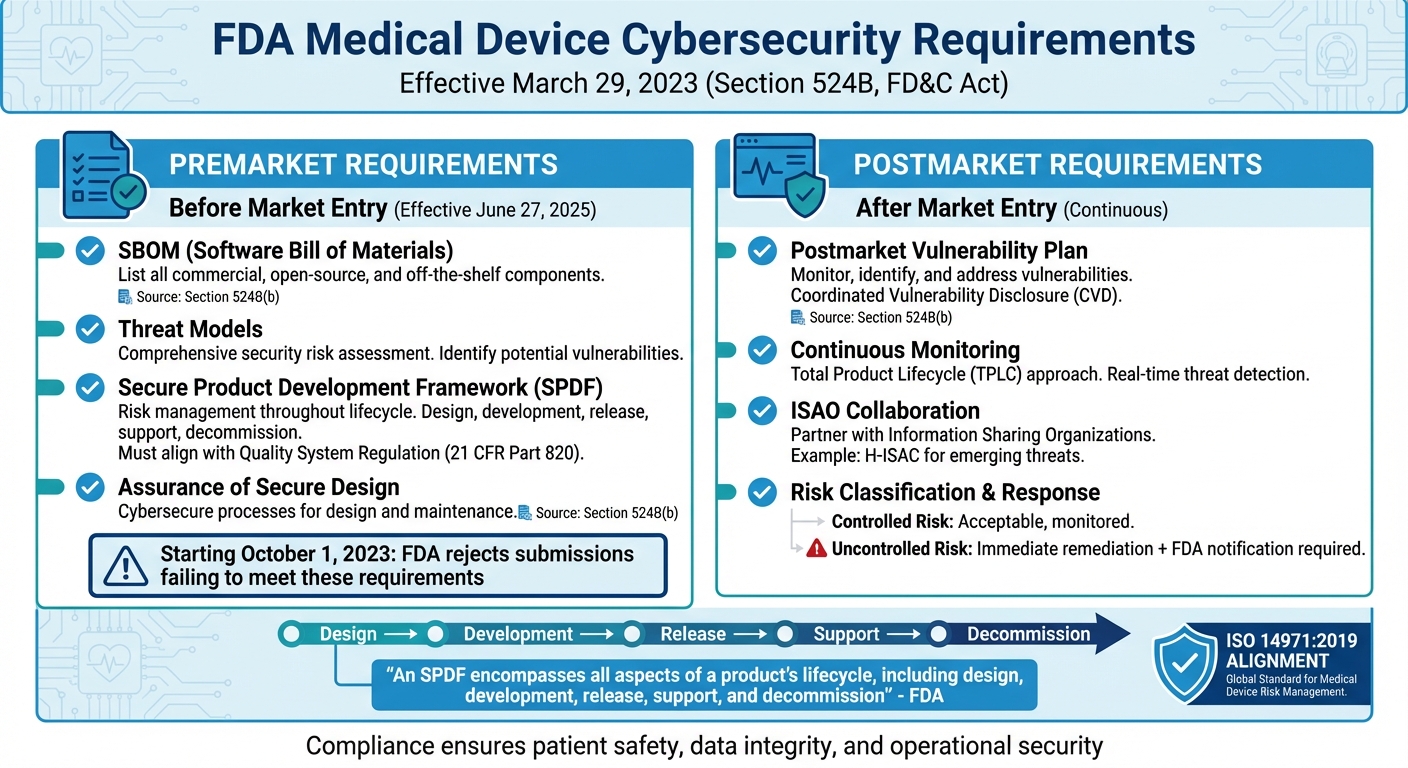
FDA Medical Device Cybersecurity Requirements: Premarket vs Postmarket Compliance
Medical device manufacturers and healthcare organizations are now required to integrate cybersecurity into the design of their devices. What was once a set of voluntary recommendations has evolved into enforceable legal mandates, with serious consequences for non-compliance. As highlighted by legal experts at Ropes & Gray LLP:
The government will be able to prosecute violations of FDA cybersecurity requirements criminally or to pursue injunctive relief against a company that is out of compliance [9].
FDA Guidelines for Medical Device Cybersecurity

The Consolidated Appropriations Act of 2023 introduced Section 524B of the FD&C Act, which took effect on March 29, 2023. This section requires manufacturers of "cyber devices" to include specific cybersecurity information in their premarket submissions [5]. Starting October 1, 2023, the FDA began rejecting submissions that fail to meet these requirements.
The FDA’s premarket guidance, effective June 27, 2025, outlines the necessary cybersecurity documentation [8] [10]. Among the key elements is the inclusion of a Software Bill of Materials (SBOM), which lists all commercial, open-source, and off-the-shelf software components. This transparency helps with tracking vulnerabilities [5]. Additionally, manufacturers must provide threat models, conduct security risk assessments, and develop a postmarket plan for managing vulnerabilities through coordinated vulnerability disclosure (CVD).
The FDA also recommends adopting a Secure Product Development Framework (SPDF), which focuses on managing risks, secure design, and thorough testing throughout the device's lifecycle [11]. As the FDA explains:
An SPDF encompasses all aspects of a product's lifecycle, including design, development, release, support, and decommission [11].
This framework must align with the Quality System Regulation (21 CFR Part 820), emphasizing cybersecurity as a key component of software validation and risk analysis.
For postmarket management, the FDA’s guidance on Postmarket Management of Cybersecurity in Medical Devices emphasizes proactive measures throughout the total product lifecycle (TPLC). This includes continuous monitoring, timely updates, and collaboration with Information Sharing and Analysis Organizations (ISAOs), such as H-ISAC, to stay informed about emerging threats [6] [7] [10]. The FDA differentiates between "Controlled Risk", which is acceptable, and "Uncontrolled Risk", which requires immediate remediation and notification to the agency [7].
| Regulatory Element | Requirement Detail | Statutory/Guidance Source |
|---|---|---|
| SBOM | List of commercial, open-source, and off-the-shelf components | Section 524B(b) [5] |
| Postmarket Plan | Plan to monitor, identify, and address vulnerabilities | Section 524B(b) [5] [8] |
| Assurance of Secure Design | Design and maintenance of "cybersecure" processes | Section 524B(b) [5] [6] |
| SPDF | Framework for security risk management and testing | FDA Premarket Guidance [8] [10] |
These premarket and postmarket requirements establish a foundation for aligning with global standards.
ISO 14971 and Risk Management for Medical Devices
In addition to FDA requirements, ISO 14971:2019 serves as a global standard for managing risks, including cybersecurity, throughout a medical device's lifecycle. Last reviewed in March 2025, this standard provides a structured approach to identifying hazards, assessing and controlling risks, and ensuring the effectiveness of these controls over time [12]. It specifically addresses cybersecurity alongside other risk areas like biocompatibility, electrical safety, and usability [12]. As stated in ISO 14971:
The risk management process described in ISO 14971 applies from initial conception of a medical device through its ultimate decommissioning and disposal [12].
This lifecycle approach aligns with the FDA’s expectation that cybersecurity is a continuous responsibility.
However, security risk management differs from traditional safety risk management. While ISO 14971 focuses on risks related to physical harm and property damage, security risk management addresses patient harm resulting from cyber threats, such as exploitable vulnerabilities and system-level attacks [7] [11]. For this reason, the FDA recommends conducting a separate security risk assessment in addition to the ISO 14971 safety risk assessment.
Healthcare organizations can strengthen their processes by integrating ISO 14971 with their Quality Management Systems (QMS), such as ISO 13485. The FDA has incorporated ISO 13485 into its Quality Management System Regulation (QMSR) [1] [12]. This integration streamlines operations and ensures consistency in managing risks. Establishing clear criteria for acceptable risk levels and implementing robust postmarket surveillance systems are essential for identifying and addressing critical medical device security risks as they arise [12].
Core Features of Medical Device Risk Platforms
Healthcare organizations are grappling with significant gaps in medical device security. In fact, medical device security ranks at the bottom across all ten best practice areas outlined in the Health Industry Cybersecurity Practices [4]. Risk platforms designed for lifecycle management aim to close this gap by bringing IT, Risk, Cybersecurity, and BioMed teams together under a shared framework. These platforms rely heavily on automation to simplify and speed up risk assessments.
Automated Risk Assessment and SBOM Analysis
These platforms excel at automating risk assessments by parsing both 2013 and 2019 MDS2 forms. This automation allows healthcare organizations to evaluate device security quickly - whether during procurement or throughout the device's lifecycle. By generating instant risk ratings and summary reports based on standardized security disclosures, these platforms provide a comprehensive view of threats across the Internet of Medical Things (IoMT).
One standout feature is the centralized digital inventory. This inventory consolidates all assessed devices, ranging from bedside monitors and radiology equipment to implantable IoMT devices. By eliminating fragmented vendor data spread across multiple systems, the platform ensures all device information is unified. This consolidation makes it easier to identify devices, classify them, understand their clinical uses, and evaluate their network requirements.
Advanced platforms go further by assigning risk indices that consider patient safety, data privacy, and potential service disruptions. They integrate tools like the Known Exploited Vulnerabilities (KEV) catalog and the Exploit Prediction Scoring System (EPSS). EPSS uses data science to predict which vulnerabilities are most likely to be exploited in the next 30 days [13]. This prioritization helps organizations focus on the most pressing threats, making remediation efforts more targeted and effective.
Continuous Monitoring and Incident Management
Risk platforms don't stop at initial assessments - they include continuous monitoring to protect devices throughout their lifecycle. These monitoring tools provide real-time alerts and detect anomalies at both the device and organizational levels. By identifying unusual activity that could indicate a compromise or malfunction, these platforms enable proactive threat detection, reducing the need for reactive responses.
Another key feature is the creation of automated Corrective Action Plans (CAPs). These plans assign vulnerabilities to the appropriate experts, such as BioMed staff, and track remediation progress. Additionally, the platforms continuously monitor devices containing electronic Protected Health Information (ePHI) and send automated alerts for device recalls. This ensures smooth collaboration between biomedical, clinical engineering, and IT security teams, keeping everyone aligned and informed.
Censinet RiskOps™: A Solution for Healthcare Organizations
Censinet RiskOps™ is designed specifically to meet the unique needs of healthcare organizations, offering a platform that unifies IT, Risk, Cybersecurity, and BioMed teams into a single, cohesive framework. This collaboration is critical, especially when considering that medical device security currently ranks lowest among the ten Health Industry Cybersecurity Practices areas [4].
At the heart of the platform is the Censinet Risk Network, a cloud-based risk exchange that connects over 100 provider and payer facilities [14]. Central to this network is the Digital Risk Catalog™, a comprehensive library of more than 50,000 vendors and products, each pre-assessed and risk-scored [14]. By eliminating manual data entry, the platform speeds up vendor evaluations and simplifies risk management processes.
Key Features of Censinet RiskOps™
Censinet RiskOps™ uses AI-driven tools to streamline third-party vendor risk management. Features like Assessor Agents and Connect Copilot automate workflows, making processes faster and more efficient [15]. One standout capability is the automated parsing of MDS2 forms, which extracts security details from manufacturer disclosures to ensure consistency and save time [4].
The platform also introduces 1-Click Sharing, allowing vendors to complete a standardized questionnaire once and share it with unlimited customers. For ongoing assessments, delta-based reassessments focus only on changes in questionnaire responses since the last review. This approach reduces review times to less than a day [14]. Additionally, Automated Corrective Action Plans (CAPs) integrate seamlessly with delta assessments and 1-Click Sharing, identifying security gaps, recommending fixes, and tracking progress across the entire device lifecycle [14].
Another key feature is the Cybersecurity Data Room™, which stores device risk history to support audits and enable quick responses to incidents. Device-specific dashboards provide real-time insights, helping organizations prioritize security efforts effectively.
| Feature | Benefit for Medical Device Risk |
|---|---|
| MDS2 Parsing | Extracts security capabilities directly from manufacturer disclosures [4]. |
| Digital Risk Catalog™ | Offers access to over 50,000 pre-assessed vendors and products [14]. |
| Automated CAPs | Identifies security gaps and tracks vendor remediation progress [14]. |
| Delta Reassessments | Reduces review times to under one day [14]. |
How Censinet Streamlines Risk Management
Censinet combines AI-powered automation with human expertise, enabling organizations to scale their risk assessments without sacrificing accuracy.
The platform's impact is evident in real-world use cases. Terry Grogan, CISO at Tower Health, shared that adopting Censinet RiskOps™ allowed the organization to reallocate three full-time employees (FTEs) to other tasks, while two FTEs handled a significantly higher volume of risk assessments [15]. Similarly, James Case, VP & CISO at Baptist Health, transitioned from spreadsheet-based risk management to a collaborative network, enabling the sharing of risk insights with a broader community of hospitals [15].
Censinet also ensures that remediation tasks are assigned to the right teams. For example, BioMed staff handle clinical equipment security, while IT and Cybersecurity teams address network-level threats [4]. This alignment keeps workflows efficient and ensures all teams stay on the same page throughout the device lifecycle.
"Healthcare is the most complex industry... You can't just take a tool and apply it to healthcare if it wasn't built specifically for healthcare."
– Matt Christensen, Sr. Director GRC, Intermountain Health [15]
The platform's RiskOps Command Center provides user-friendly visualizations that clearly communicate an organization's cyber risk posture. These insights help executive leadership and Boards of Directors make informed decisions, reinforcing a commitment to patient safety and compliance. By simplifying and aligning risk management efforts, Censinet RiskOps™ supports healthcare organizations in managing risks effectively across the entire device lifecycle.
Using Risk Platforms Across the Medical Device Lifecycle
Managing medical device security is a continuous process that spans from the design stage to the point of decommissioning. Risk platforms offer the tools and structure needed to address cybersecurity concerns at every stage, ensuring vulnerabilities are identified early and monitored throughout the device's lifespan.
Design and Development Phase
The FDA highlights threat modeling as a key strategy for improving both cybersecurity and physical safety in medical devices [3]. Risk platforms play a crucial role in this phase by integrating threat modeling into the design process. This helps identify vulnerabilities before production begins, ensuring compliance with cybersecurity and safety standards from the outset. This early focus is essential because:
Standard security controls can ensure some baseline security capabilities, but they fail to address the myriad of ways that medical devices are used, interface with the healthcare ecosystem, and most important, how security risks could result in unacceptable safety issues - MITRE [3].
These platforms also support manufacturers in meeting the requirements of section 524B of the FD&C Act and aligning with FDA Quality Management System guidelines for cyber devices [8]. By using standardized tools, they help define trust boundaries in the complex healthcare environment. The FDA emphasizes the importance of this approach:
these recommendations are intended to promote consistency, facilitate efficient premarket review, and help ensure that marketed medical devices are sufficiently resilient to cybersecurity threats - FDA [8].
With cybersecurity built into the design, the focus shifts to operational oversight during deployment.
Deployment and Operations Phase
Once a medical device is in clinical use, the responsibility for its cybersecurity moves from the manufacturer to the Healthcare Delivery Organization (HDO). Risk platforms facilitate this transition by centralizing key documentation, such as the Software Bill of Materials (SBOM), to ensure transparency and track vulnerabilities. The International Medical Device Regulators Forum (IMDRF) outlines four lifecycle phases for medical devices, each with distinct responsibilities for manufacturers and HDOs [2].
During this phase, risk platforms enable HDOs to perform regular assessments to determine whether a device's continued use is acceptable, especially as it approaches its End of Life (EOL). These platforms also foster collaboration between manufacturers and HDOs to address security gaps and manage updates:
Communication between the two parties is essential as the device moves through the lifecycle so that tasks are coordinated, and security gaps within the product are reduced - Health-ISAC [2].
As devices age, ongoing monitoring is essential to address new risks that might emerge.
Postmarket Surveillance and End-of-Life Management
When devices near the end of their lifecycle, risk platforms become even more critical for managing vulnerabilities and shifting security responsibilities. By maintaining SBOMs and detailed security documentation, these platforms support continuous monitoring of risks that may arise after the device enters the market. This transparency is especially important as manufacturers may reduce or stop support for older devices:
Healthcare Delivery Organizations should perform more regular risk assessments going into End of Life and End of Support to determine if they can accept the risk of continued use - Health-ISAC [2].
Risk platforms provide the framework for HDOs to carry out these assessments and make informed decisions about whether to continue using devices that may no longer receive active support. They also track the evolving cybersecurity responsibilities between manufacturers and HDOs during the device's active service and support phases.
Benefits and ROI of Medical Device Risk Platforms
The advantages of medical device risk platforms highlight why ongoing risk management is critical throughout the lifecycle of medical devices. These platforms don't just enhance operational workflows - they also reduce risks and ensure adherence to regulatory standards. Beyond avoiding compliance breaches, they offer financial benefits like saving staff time, optimizing asset usage, and improving capital planning. Experts agree: a forward-thinking, financially savvy approach to medical device security is no longer optional - it’s essential. Let’s dive into how these platforms deliver tangible benefits in efficiency, risk reduction, and compliance.
Efficiency Gains and Risk Reduction
Risk platforms significantly improve efficiency by automating tasks that would otherwise consume a large portion of biomedical and IT professionals' time. For example, biomedical staff spend about 40% of their time on low-value tasks like manually parsing MDS2 forms, locating devices, or researching vulnerabilities [19]. Platforms that automatically process both 2013 and 2019 Manufacturer Disclosure Statement for Medical Device Security (MDS2) forms can dramatically cut down on data entry work.
These platforms also tackle a major challenge in healthcare cybersecurity. According to data, medical device security ranks last among the ten Health Industry Cybersecurity Practices (HICP) areas in healthcare delivery organizations [4]. This is especially concerning given that modern hospitals often have more than 10 connected devices per patient bed [4]. Risk platforms centralize visibility and automate Corrective Action Plans (CAPs), making it easier to address vulnerabilities quickly. Tasks can be directly assigned to internal experts, such as BioMed staff, eliminating the communication gaps that often exist between IT, Risk, Cybersecurity, and BioMed teams.
Asset optimization is another major area where these platforms shine. The average utilization rate of clinical devices is only 42% [19], and healthcare systems frequently overspend on equipment by as much as 25% due to poor visibility and inefficient workflows [19]. By analyzing device utilization patterns, these platforms help hospitals identify underused rentals, overworked devices, and equipment overdue for maintenance. This insight allows healthcare organizations to adjust procurement and maintenance strategies, reducing unnecessary spending. Some solutions have even shown a greater than 10x ROI within months of implementation [17]. These operational improvements clearly translate into measurable financial returns.
| ROI Driver | Quantification Metric | Operational Impact |
|---|---|---|
| Staff Time Savings | % reduction in manual tasks | Frees up 40% of biomed staff time for higher-value work [19] |
| Asset Utilization | % increase in device uptime | Cuts equipment overspend by up to 25% [19] |
| Risk Reduction | Breach/Recall cost avoided | Limits financial exposure from ransomware or PHI leaks [16] |
| Compliance | Audit time | Ensures FDA and ISO audit readiness via automation [18] |
Regulatory Compliance and Audit Readiness
Risk platforms simplify compliance by automating processes and maintaining centralized, up-to-date documentation. They create digital inventories of IoMT devices, complete with risk ratings, ensuring that evidence required for FDA 21 CFR Part 11 and ISO 14971 compliance is always ready for inspection [18]. This eliminates the last-minute rush to compile documentation when auditors come knocking.
Moreover, these platforms enable organizations to quantify risks in financial terms, such as estimating the cost of a 24-hour ransomware outage or potential penalties for PHI breaches [16]. With dashboards offering a clear overview of risks, executives and Boards can make informed, data-driven decisions about resource allocation and compliance strategies. As ComplianceQuest notes:
"Risk management software... transforms risk management from a compliance requirement into a strategic enabler of safety, quality, and innovation" [18].
Pre-assessed device libraries further streamline compliance workflows. Instead of starting risk assessments from scratch for each new procurement, organizations can rely on existing evaluations. This standardization not only saves time but also ensures consistency across different manufacturers and device types, speeding up the process of evaluating new equipment against regulatory requirements.
Conclusion
Medical device cybersecurity is crucial for safeguarding patient safety and ensuring uninterrupted healthcare operations. With hospitals managing over 10 connected devices per patient bed, the potential for cyberattacks has grown significantly. Yet, medical device security ranks at the bottom among the ten Health Industry Cybersecurity Practices (HICP) areas [4]. As Censinet emphasizes:
"With 10+ connected devices per patient bed, there is no margin for error on security" [4].
To tackle this challenge, healthcare organizations are moving from reactive security measures to proactive RiskOps strategies. This shift involves unifying IT, Risk, Cybersecurity, and BioMed teams under a single platform. Lifecycle risk platforms streamline essential risk management tasks, freeing up staff to focus on more strategic initiatives. These platforms also centralize digital inventories and evidence collection, ensuring organizations are always prepared for audits and compliant with FDA and ISO 14971 standards. Platforms like Censinet RiskOps™ take this a step further by enhancing risk management capabilities.
Censinet RiskOps™ integrates risk management for medical devices across all environments, whether in radiology, at the bedside, or even implanted within patients. Its Digital Risk Catalog™ speeds up assessments by providing a library of pre-assessed devices, while automated workflows assign remediation tasks to the right experts. Executive dashboards offer both detailed device-level insights and high-level enterprise risk overviews, enabling leadership to make informed, data-driven decisions. These tools directly address the cybersecurity and compliance challenges discussed throughout this guide.
The rapid expansion of the Internet of Medical Things (IoMT) has made collaboration between IT and BioMedical teams more urgent than ever. Relying on outdated tools like spreadsheets and disconnected systems leaves organizations vulnerable to the complexities of modern devices and advanced cyber threats. By adopting a robust lifecycle risk platform, healthcare providers can shift from managing crises reactively to maintaining continuous, proactive oversight. This approach not only protects patients but also ensures compliance and delivers measurable financial benefits, addressing the technical and regulatory demands shaping today's medical device security landscape.
FAQs
How do we prioritize which device vulnerabilities to fix first?
When tackling medical device vulnerabilities, it's essential to adopt a risk-based approach. This means evaluating two key factors: the likelihood of a vulnerability being exploited and the potential impact it could have on patient safety and operational performance.
To streamline this process, tools like AI-powered risk estimators can be incredibly useful. These tools automatically assign risk scores, making it easier to pinpoint and prioritize the most critical vulnerabilities that need immediate attention.
By aligning your efforts with FDA guidance and industry standards like ISO 14971, you can ensure patient safety remains the top priority. At the same time, addressing high-risk issues first helps maintain compliance and keeps essential operations running smoothly.
What do manufacturers need to meet FDA 524B and SBOM requirements?
Manufacturers aiming to comply with FDA 524B and SBOM requirements need to focus on several key areas. First, they must create a Software Bill of Materials (SBOM), which provides a detailed inventory of all software components within a device. This transparency helps identify potential vulnerabilities.
Next, adhering to secure product development processes is essential. This means integrating security measures throughout the design and development phases to minimize risks.
Additionally, conducting comprehensive risk assessments is crucial. These evaluations help pinpoint potential threats and determine their impact, ensuring that devices remain safe and effective.
Finally, manufacturers should implement postmarket vulnerability monitoring. By continuously tracking and addressing security issues after a product is released, they can maintain compliance and protect patients from emerging threats.
Together, these steps align with regulatory expectations and strengthen the cybersecurity of medical devices.
How can a risk platform help BioMed and IT work together without slowing clinical care?
A platform like Censinet RiskOps™ simplifies how BioMed and IT teams work together by automating workflows and offering real-time insights into risks. It brings all processes into one place, allowing secure and efficient data sharing with standardized tools, which cuts down on manual tasks. With features like automated assessments and continuous monitoring, it helps tackle threats proactively, ensuring patient safety and smooth operations while enabling quicker, more informed decisions.
