
Vendor Risk Scoring and Traditional Risk Assessments are two approaches for managing vendor risks in healthcare. Here's the key difference: Traditional assessments rely on manual questionnaires and periodic reviews, which are slow, subjective, and resource-heavy. Vendor Risk Scoring, on the other hand, uses automated, data-driven metrics to evaluate risks in real time, offering faster, consistent, and scalable insights.
Key Points:
- Traditional Assessments: Manual, subjective, and time-consuming. Often outdated and inconsistent due to reliance on self-reported data.
- Vendor Risk Scoring: Automated, objective, and continuous. Uses independent data to provide measurable risk scores for better decision-making.
Quick Comparison:
| Feature | Traditional Assessments | Vendor Risk Scoring |
|---|---|---|
| Speed | Months to complete | Weeks or real-time |
| Consistency | Varies by reviewer | Standardized across vendors |
| Scalability | Limited for large networks | Handles thousands of vendors |
| Data Type | Qualitative (subjective) | Quantitative (objective) |
| Monitoring | Periodic | Continuous |
Conclusion: For healthcare organizations managing hundreds of vendors, Vendor Risk Scoring offers a more efficient and reliable way to protect sensitive data and stay compliant.
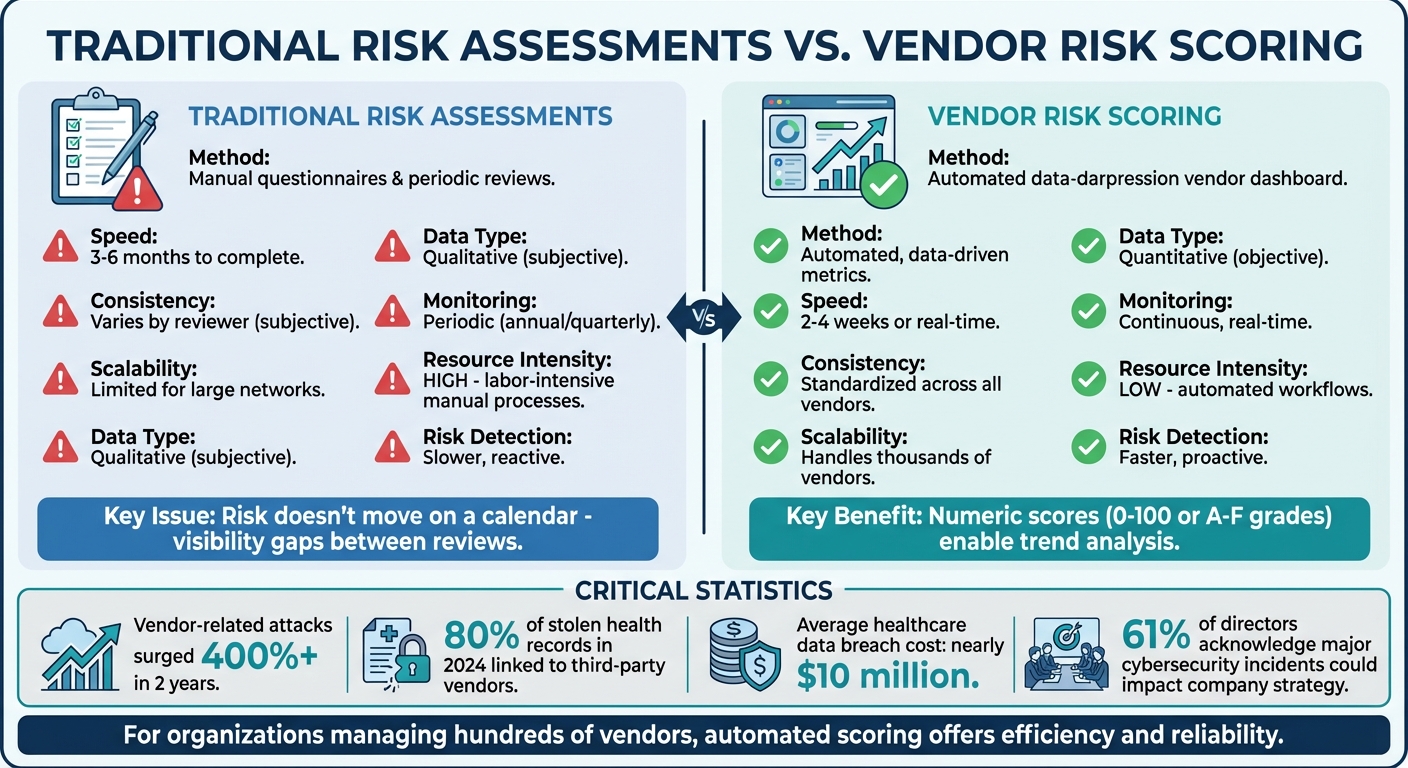
Traditional Risk Assessments vs Vendor Risk Scoring in Healthcare
Managing Third-Party Risk in Large Healthcare Organizations at HIMSS 2022
sbb-itb-535baee
Traditional Risk Assessments in Healthcare
Traditional vendor risk assessments in healthcare often rely on manual processes and subjective scoring. These methods typically involve sending vendors lengthy questionnaires, conducting occasional on-site audits, and reviewing documentation at set intervals. The process is labor-intensive, requiring teams to manually gather and analyze responses while making judgment calls about vendor safety.
Most healthcare organizations conduct these assessments on fixed schedules - often annually or quarterly. This approach treats vendor risk as a periodic task, which is quickly outdated in today’s fast-changing threat environment. Manual tracking tools like spreadsheets often lead to missed deadlines and overlooked tasks, creating compliance documentation riddled with gaps [1]. The urgency of this issue is underscored by the fact that vendor-related attacks surged by over 400% in just two years [2], and in 2024, 80% of stolen health records were linked to third-party vendors [1]. Yet, many organizations still treat vendor due diligence as a one-time onboarding task, failing to maintain the ongoing monitoring needed to address evolving risks [1][2].
These challenges highlight the need to examine the core features and inherent issues with traditional risk assessment methods.
Main Features of Traditional Risk Assessments
Traditional assessments primarily rely on qualitative data collection through vendor questionnaires, security documentation reviews, and periodic audits. Security teams manually evaluate vendor responses, often depending on self-reported data. This process lacks standardization, leading to inconsistent results - different assessors may interpret the same responses in varied ways, resulting in uneven risk ratings across the organization.
Scalability is another major issue. For hospitals managing hundreds of vendors, manually reviewing each one becomes an overwhelming task. This is especially problematic in healthcare, where the sheer number of vendors demands constant oversight. As a result, many organizations focus only on the most visible or recently contracted vendors, leaving others unmonitored for long periods.
Problems with Traditional Methods
While traditional assessments provide a structured framework, they come with significant drawbacks that undermine security efforts.
The subjective nature of these assessments introduces bias into risk management. Without standardized metrics, two reviewers might assign vastly different risk levels to the same vendor, making the approval process inconsistent [2].
The resource-intensive process also places a heavy strain on security teams. Reviewing documents, chasing vendor responses, and maintaining spreadsheets require countless hours. Tech writer Zachary Amos emphasizes the risks of this approach:
Relying on manual practices to manage vendors and mitigate risks is the surest way to fall victim to a security breach. [1]
Considering that the average cost of a healthcare data breach is nearing $10 million [1], these inefficiencies carry severe financial implications.
Perhaps the most critical issue is the visibility gaps created by periodic review cycles. As Nasir R from Atlas Systems explains:
The problem is that risk doesn't move on a calendar. A vendor's security posture can shift in weeks. A data breach can happen overnight. [3]
A vendor’s security posture - whether due to ownership changes or weakened controls - can change abruptly between scheduled reviews. This leaves healthcare organizations vulnerable to threats that emerge and evolve far faster than their review cycles can address.
Vendor Risk Scoring: A Data-Driven Method
Vendor risk scoring moves away from outdated, manual assessments and leans into automated, data-driven analysis. Instead of relying on periodic questionnaires and subjective opinions, this approach uses real-time numeric scores to evaluate risk. This shift allows organizations to transition from reactive compliance checks to ongoing, adaptive monitoring.
By reducing subjectivity, vendor risk scoring makes it possible to monitor a large number of vendors simultaneously. Instead of waiting months for updates, organizations can access current risk ratings that reflect the latest conditions. This is especially critical in industries like healthcare, where weak vendor security can compromise sensitive patient data. The result? A more precise and proactive strategy for managing risks.
What Vendor Risk Scoring Involves
At its core, vendor risk scoring translates risk into clear, measurable metrics. Vendors are assigned scores - often ranging from 0 to 100 or represented by letter grades (A through F) - that make it easy for stakeholders to understand risk levels at a glance. These scores are calculated by combining various data points, such as cybersecurity measures, regulatory compliance, financial health, and operational resilience.
The data behind these scores comes from sources like external security ratings, breach histories, patch management practices, encryption standards, access controls, and compliance certifications (e.g., HITRUST, SOC 2). Unlike traditional self-reported questionnaires, vendor risk scoring relies on independent, continuously updated data, creating a more reliable and objective foundation for evaluation.
Tools like Censinet RiskOps™ integrate these scoring systems into automated workflows, helping healthcare organizations assess critical factors such as patient data protection, PHI security, clinical application integrity, medical device vulnerabilities, and supply chain risks. This is particularly valuable for managing the intricate web of vendor relationships in healthcare.
Advantages of Vendor Risk Scoring
Automated risk scoring eliminates the inefficiencies of manual assessments, offering consistent and scalable insights. With numeric scoring, every vendor is evaluated using the same criteria, ensuring that a score of 75 reflects the same level of risk no matter who assigns it. This standardization makes it easier to compare vendors and prioritize which relationships need immediate attention.
Automation also makes scalability possible. For healthcare organizations juggling hundreds or thousands of vendors, continuous monitoring replaces the outdated practice of reviewing only a subset periodically. The system flags vendors whose scores fall below acceptable levels, enabling security teams to act quickly. What was once an overwhelming task becomes far more manageable.
Another key benefit is the ability to analyze trends and predict potential risks. By tracking score changes over time, organizations can spot vendors whose security is slipping before a breach happens. For instance, if a vendor's score drops from 85 to 70 over a few months, it could signal emerging issues that require closer examination. This forward-looking capability is a game-changer compared to traditional methods that only capture isolated snapshots during scheduled reviews.
Comparing Traditional Risk Assessments and Vendor Risk Scoring
When healthcare organizations assess their vendor relationships, traditional risk assessments often rely on manual methods like questionnaires, document reviews, and subjective evaluations. These processes typically take 3–6 months to complete. In contrast, vendor risk scoring uses automated, data-driven analysis to deliver results within 2–4 weeks. This faster turnaround is particularly valuable for organizations managing a large network of vendors, highlighting a key difference in how each approach impacts efficiency and decision-making.
The contrast becomes even more pronounced when considering the sheer number of vendors that healthcare organizations typically engage with. Traditional methods are difficult to scale, limiting the number of assessments that can be conducted each year. As a result, security teams are often forced to focus only on the most critical vendor relationships. Vendor risk scoring, on the other hand, enables continuous monitoring of thousands of vendors without requiring additional staff, making it a practical solution for large-scale operations.
Standardization and Consistency
A major challenge with traditional assessments is their lack of standardization. Results often vary depending on factors like who conducts the assessment, which questions are prioritized, and how responses are interpreted. For example, two analysts evaluating the same vendor could arrive at different conclusions based on their individual perspectives and experience. Vendor risk scoring eliminates much of this inconsistency by applying uniform criteria and data sources to every evaluation. This ensures that a score of 75 carries the same meaning regardless of which vendor is being assessed.
| Aspect | Traditional Risk Assessments | Vendor Risk Scoring |
|---|---|---|
| Evaluation Consistency | Subject to bias and variation | Standardized across all vendors |
| Evaluation Speed | Slower, manual processes | Faster, automated scoring |
| Scalability | Limited scalability | Highly scalable for large networks |
| Resource Intensity | High resource requirements | Lower resource requirements |
| Data-Driven Insights | Primarily qualitative | Quantitative and actionable |
Standardized scoring also helps eliminate departmental bias. In traditional processes, different teams might apply inconsistent standards when evaluating similar vendors. Tools like Censinet RiskOps™ address this issue by offering consistent frameworks for assessing critical areas such as patient data protection, PHI security, and medical device vulnerabilities across all vendor relationships.
Quantitative vs. Qualitative Analysis
The type of data generated by each method further underscores their differences. Traditional risk assessments primarily produce qualitative findings - narrative descriptions, subjective ratings, and recommendations based on opinion. While this information can be useful, it makes comparing vendors or tracking changes over time challenging. Vendor risk scoring, by contrast, generates numeric values that allow for direct comparisons and mathematical analysis. This makes it easier to pinpoint which vendors pose the greatest risk and monitor how those risks evolve.
| Aspect | Traditional Risk Assessments | Vendor Risk Scoring |
|---|---|---|
| Basis of Evaluation | Qualitative judgment | Quantitative scoring |
| Trend Analysis | Limited capabilities | Enables detailed trend analysis |
| High-Risk Vendor Detection | Slower and less reliable | Faster and more accurate |
Numeric scoring also facilitates trend analysis and early risk detection. For instance, a vendor's score dropping from 85 to 70 indicates a declining security posture that could signal potential issues. Traditional assessments, which are often conducted annually or less frequently, might overlook these gradual declines until a breach occurs. In healthcare, where vendor vulnerabilities can directly affect patient safety and data security, the ability to quickly and accurately identify high-risk vendors is crucial.
Contextual Risk Scoring for Better Decisions
Contextual risk scoring takes numeric evaluations a step further by factoring in your organization's unique circumstances. Two vendors with the same numerical score can pose entirely different levels of risk depending on their roles within a healthcare system. For example, a scheduling vendor with a score of 70 is likely to pose less risk than an EHR vendor with the same score. Adding this contextual layer allows healthcare organizations to assess vendor impact more effectively.
The role a vendor plays significantly influences how its risk is interpreted. Healthcare organizations must evaluate whether a vendor handles protected health information (PHI), integrates with clinical systems, or could disrupt patient care. This understanding helps security teams focus their efforts on areas where a breach would have the greatest consequences.
In addition to role-based assessments, business criticality sharpens the focus on vendors whose failure could directly impact patient safety or care. For instance, an EHR system vendor or a medical imaging provider is far more essential than a marketing analytics firm. Contextual scoring prioritizes risks by assessing how quickly a vendor's failure or data breach could affect clinical operations. This helps organizations decide which vendor relationships need ongoing monitoring and which can be reviewed periodically.
Regulatory requirements also play a key role in shaping risk evaluations. Different vendors face varying compliance standards based on their functions. For example, a vendor managing patient billing data must meet different regulatory obligations than one offering telehealth platforms. Contextual scoring incorporates these factors, flagging vendors that require closer scrutiny under regulations like HIPAA, FDA standards for medical devices, or state privacy laws. This ensures that risk assessments align with legal and compliance expectations.
Platforms like Censinet RiskOps™ make this refined scoring process scalable by automating vendor categorization based on their access to patient data, PHI, clinical systems, and medical devices. This approach minimizes bias from individual judgments and ensures consistent application of risk assessments across all vendor categories. Organizations can also set automated thresholds to flag high-risk vendors for deeper review, streamlining the process [4].
Implementation Considerations for Healthcare Organizations
Healthcare organizations face a complex decision when choosing between traditional and data-driven risk scoring methods. Key factors to consider include the organization's internal capabilities, the complexity of vendor relationships, and HIPAA-compliant vendor risk management. For organizations managing hundreds of vendors, manual assessments can quickly become unmanageable. However, smaller vendor networks might find traditional methods sufficient - at least in the beginning.
Resource Allocation
Data-driven vendor scoring changes the way healthcare organizations allocate their resources. By analyzing vendor risks based on factors like handling of PHI (Protected Health Information), integration with clinical systems, or involvement in patient care, organizations can prioritize their efforts. Vendors with higher risk profiles demand immediate attention, while others can be monitored less frequently. This approach is especially important for security teams that are often stretched thin.
Tools like Censinet RiskOps™ streamline this process by automating workflows and providing dashboards that significantly reduce evaluation time - from weeks to just days. The hours saved can then be reallocated to critical tasks such as fourth-party risk analysis and incident response planning.
Regulatory Compliance
Efficient resource allocation is one piece of the puzzle, but maintaining regulatory compliance is non-negotiable. Healthcare organizations must demonstrate compliance across their entire vendor network, including subcontractors. Modern regulatory frameworks, such as the NIST Cybersecurity Framework, emphasize continuous monitoring of information security risks across all vendor relationships [5].
While traditional qualitative assessments may meet basic legal requirements, they often lack the objective, data-driven insights that regulators and board members now expect [6]. This is particularly important when addressing fourth-party risks - those posed by subcontractors hired by primary vendors. Ensuring these subcontractors meet HIPAA standards and adequately protect patient data is critical [5].
Derek Vadala, Chief Risk Officer at Bitsight Technologies, highlights the importance of this oversight from a board perspective:
The board really wants to understand, 'What should they be worried about? What are you doing about it? How are we doing in that program?' [7]
Vendor risk scoring provides the kind of integrated, enterprise-wide reporting that boards need. By contrast, traditional methods often fail to deliver a clear picture of organizational risk. With 61% of directors acknowledging that a major cybersecurity incident could significantly impact their company's strategy [7], transparent and actionable risk reporting is essential for maintaining board confidence.
To ensure smooth adoption of vendor risk scoring, healthcare organizations should take proactive steps, such as including fourth-party disclosure requirements in all new vendor contracts. These provisions require vendors to notify the organization when subcontractors handling sensitive patient data are added [5]. A phased implementation - starting with mapping the vendor ecosystem and identifying high-impact connections before fully automating processes - can help maintain compliance and mitigate risks during the transition [5] [7].
Conclusion: Selecting the Right Approach
Healthcare organizations face increasing pressure to adopt risk management strategies that deliver on speed, accuracy, and compliance. While traditional risk assessments may feel familiar, they often fall short in addressing the complexity and scale of today’s vendor networks. Manual processes can lead to inconsistencies, drain resources, and fail to provide the real-time insights needed for effective decision-making.
Modern approaches, like vendor risk scoring, offer a solution by automating evaluations and applying standardized risk criteria. This allows healthcare organizations to efficiently assess a larger pool of vendors and prioritize them based on objective factors, such as access to PHI, integration with clinical systems, and connections to fourth-party vendors. By focusing resources on the highest-risk areas, security teams can work more effectively.
The choice between traditional and modern methods depends on factors like the size of the vendor portfolio, available resources, and compliance requirements. As vendor networks expand, manual methods become increasingly impractical. Standardized evaluations, supported by clear policies, defined risk thresholds, and tiered processes, help eliminate bias and improve overall efficiency [4].
For organizations looking to modernize, a phased approach can ease the transition. Start by mapping your vendor ecosystem and identifying high-risk connections. From there, automating workflows becomes more manageable. Tools like Censinet RiskOps™ can simplify this process, helping to significantly cut down assessment timelines and improve outcomes.
FAQs
What data is used to calculate a vendor risk score?
A vendor risk score is determined by evaluating several key factors, including cybersecurity, compliance, operational impact, and vendor criticality. It blends qualitative insights - like expert evaluations and descriptive categories - with quantitative data, such as numerical ratings and statistical analyses. By combining these elements, the score offers a well-rounded view of the risks associated with a vendor.
How do I set risk score thresholds for different vendor types?
To establish risk score thresholds, start by categorizing vendors into tiers like critical, high, medium, or low. These classifications should reflect factors such as their level of access to Protected Health Information (PHI), their potential operational impact, and specific compliance requirements. Assign a threshold score to each tier, which will determine when actions like audits or mitigation measures are necessary.
Make sure these thresholds align with both your organization’s risk tolerance and HIPAA regulations. Regularly review and adjust them to stay ahead of evolving threats and ensure they remain effective over time.
Can vendor risk scoring replace questionnaires and audits?
Automated vendor risk scoring works well alongside traditional methods like questionnaires and audits, but it’s not a complete substitute. While automated scoring is quick and scalable - perfect for initial screenings or ongoing monitoring - it can overlook subtle, complex risks. On the other hand, manual approaches, such as audits and questionnaires, provide a more thorough understanding of a vendor’s practices and compliance. Combining both methods creates a balanced approach: automation for efficiency and manual assessments for addressing vendors that pose higher risks.
