
Cyberattacks in healthcare can disrupt life-saving operations. AI-powered incident response tools now help healthcare organizations resolve breaches in hours, not days, by automating detection, triage, and containment processes. These systems reduce errors, speed up investigations, and ensure compliance with strict regulations like HIPAA.
Key Takeaways:
- Why it matters: Faster response times in healthcare can prevent operational shutdowns, patient data breaches, and even loss of life.
- Challenges: Outdated systems, complex networks, and strict compliance requirements make manual responses ineffective.
- AI solutions: Real-time monitoring, anomaly detection, automated containment, and predictive analytics are transforming incident response.
- Results: Organizations using AI report fewer compliance issues, reduced downtime, and faster breach resolutions.
AI is reshaping cybersecurity in healthcare, offering a faster, smarter way to protect critical systems and patient safety.
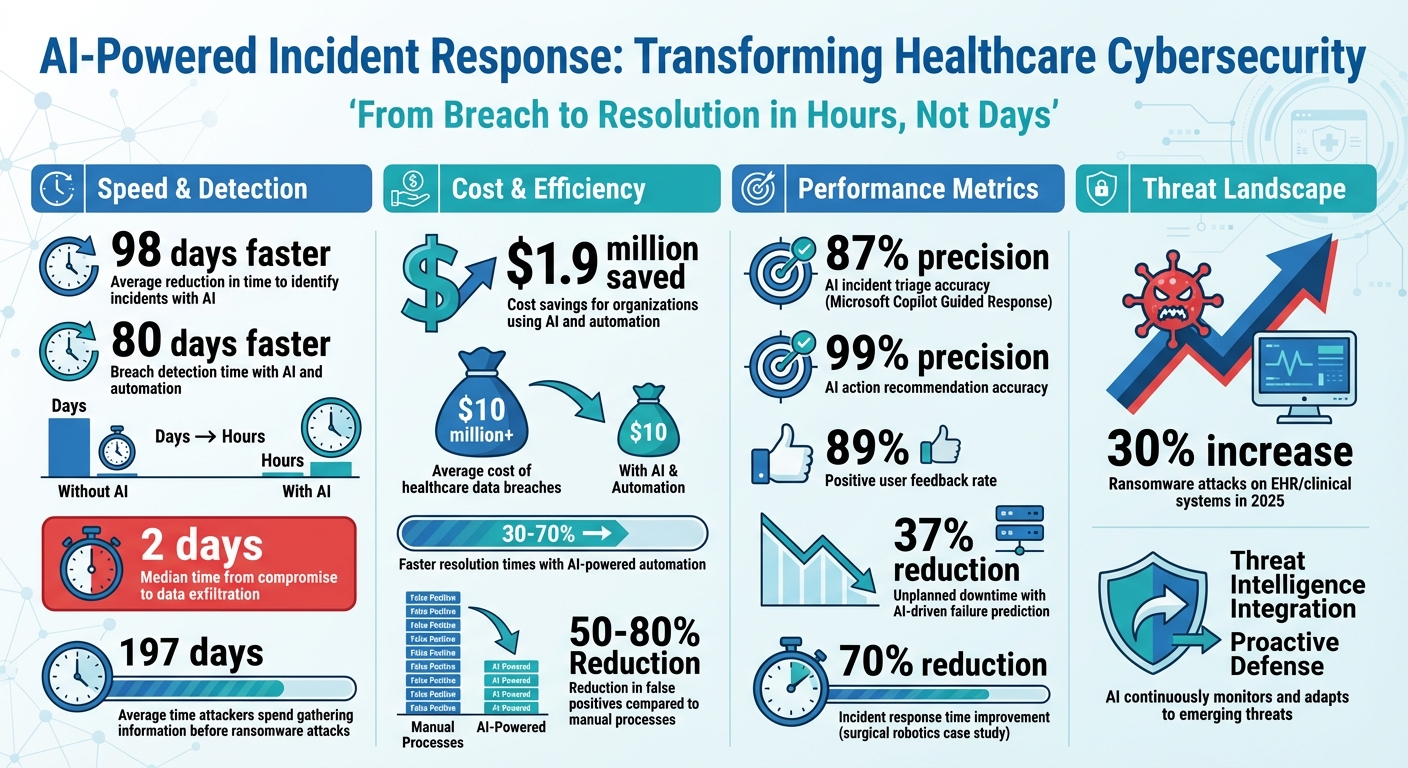
AI-Powered Incident Response Impact: Key Statistics for Healthcare Cybersecurity
AI Capabilities That Speed Up Incident Response
AI-Powered Anomaly and Behavioral Analytics
AI has become a vital tool for healthcare systems, continuously monitoring user, device, and network activity to detect unusual behavior. By using machine learning, it establishes a baseline for normal operations and flags any deviations that might signal a security threat. For instance, AI has been instrumental in uncovering unauthorized access to patient records. In one notable case in 2025, AI identified an employee attempting to access patient data without proper authorization. This triggered an immediate investigation, effectively stopping a potential data breach in its tracks [6][8].
Tapan Mehta, Healthcare and Pharma Life Sciences Executive, Strategy and GTM, highlights the unique advantage of AI in this domain:
"AI is exceptionally capable of scaling solutions to manage billions of IoT devices, which is very hard for a human being to do." [6]
Additionally, AI processes real-time data from sources like threat intelligence feeds, user activity logs, and device telemetry. It then updates its detection models automatically, ensuring that defenses remain sharp and up-to-date.
Automated Detection, Correlation, and Containment
When a threat is detected, AI doesn't just stop at identification - it takes swift action to contain the issue. AI-powered systems have dramatically reduced the time it takes to identify incidents, cutting it down by an average of 98 days [7]. Once an anomaly is confirmed, AI can automatically lock files, restrict access, enforce multi-factor authentication for certain accounts, or isolate compromised systems to stop ransomware from spreading [8].
What sets AI apart is its ability to correlate alerts from multiple sources - network logs, endpoint data, and access records - to prioritize the most critical threats. This approach has proven invaluable in identifying ransomware attacks as they unfold, minimizing both data loss and operational disruptions [5].
Predictive and Real-Time Decision Support
AI doesn’t just react to threats - it anticipates them. By analyzing historical logs, performance data, and telemetry, AI predicts potential issues before they can disrupt operations [9]. For example, a SaaS provider saw a 37% drop in unplanned downtime after implementing AI-driven failure prediction [9]. This kind of foresight is especially critical in healthcare, where even brief downtime can have serious consequences.
During active incidents, AI provides security teams with actionable insights - pinpointing likely root causes, suggesting remediation steps, and forecasting potential impacts. Its real-time anomaly detection capabilities can catch subtle deviations that might go unnoticed by human analysts. AI-powered automation also accelerates resolution times by 30–70% and reduces false positives by 50–80% compared to manual processes [9]. This proactive approach not only prevents escalation but also ensures patient data and care delivery remain secure and uninterrupted. AI seamlessly integrates into incident response workflows, offering healthcare organizations a powerful ally in safeguarding their systems.
AI-Enabled Incident Response Workflow for Healthcare
Monitoring and Detection Across Critical Systems
AI keeps a close watch on essential healthcare components like EHRs, IoMT devices, and cloud-based systems, constantly scanning for potential threats. This continuous monitoring allows the system to quickly identify unusual device activity or unauthorized attempts to access sensitive patient data. When these anomalies are detected, the system initiates a detailed analysis, laying the groundwork for swift incident triage.
Automated Enrichment and Triage
Once a threat is identified, AI steps in to piece together data from network logs, endpoint activity, and access records to assess the full scope of the incident. This automated process prioritizes incidents based on their potential to disrupt patient care or clinical operations. A typical AI-driven incident response setup includes several layers: event ingestion, data processing, AI/ML analysis, orchestration, storage, and an interface layer [10]. By sifting through massive datasets to uncover emerging risks, this approach not only speeds up resolution but also enhances its accuracy [4]. Security teams receive pre-analyzed, categorized, and severity-ranked incidents, cutting down on the manual workload significantly.
Human-in-the-Loop Automation
While AI handles much of the heavy lifting, human intervention remains essential to ensure clinical safety. AI systems deliver real-time insights that empower teams to make quick, well-informed decisions [11][12]. For example, these systems can conduct automated root cause analyses and suggest fixes, offering "complete visibility into how and why every decision is made" [12]. This transparency allows responders to review and approve actions before they are executed. Automated workflows can be customized to strike the right balance between efficiency and the need for critical human oversight.
Use Cases: Reducing Response Time for High-Impact Threats
Building on the earlier discussion of improved detection and automated decision-making, here are some real-world examples of how AI significantly reduces response times in critical scenarios.
Ransomware Attacks on EHR and Clinical Systems
In 2025, ransomware attacks against electronic health records (EHR) and clinical systems spiked by 30%, with attackers spending an average of 197 days gathering information before launching their attacks [7]. AI changes the game by shifting the focus from reacting to threats to predicting them. Using advanced analytics, AI can anticipate attacker behavior before any malicious activity begins [13]. For instance, machine learning models create behavioral profiles for every user, device, and application - including essential clinical systems like X-ray machines. These models can detect early warning signs of threats, such as unusual movements within the network, and quickly map out the Cyber Kill Chain [13].
Endpoint Detection and Response (EDR) systems take it a step further by autonomously isolating compromised devices, implementing Zero Trust micro-segmentation, and activating Security Orchestration, Automation, and Response (SOAR) playbooks for immediate action. These measures drastically cut down downtime and reduce the potential damage [13].
"The seconds saved by automation are the critical difference between a single compromised computer and an entire hospital network going down" [13].
Compromise of IoMT Devices
The Internet of Medical Things (IoMT) introduces specific vulnerabilities that can directly impact patient care. Real-time AI monitoring of these devices can detect irregular behavior - such as an infusion pump sending unexpected communications - and instantly isolate the affected device to maintain safe operations [1][14]. This swift action ensures that patient care remains uninterrupted, highlighting AI's essential role in healthcare cybersecurity.
Additionally, integrating secure-by-design principles into AI-enabled medical devices addresses risks like data poisoning, model manipulation, and exploitation of model drift right from the start [14]. The combination of AI and blockchain technology is also gaining traction, enabling healthcare providers to proactively manage risks and prevent issues before they impact patient safety [1].
PHI Exfiltration and Cloud Data Breaches
With healthcare data breaches costing over $10 million on average, AI-powered predictive analytics have become a must-have for identifying threats before they escalate [13]. AI systems process enormous volumes of data in real time, learning what normal system behavior looks like and flagging anomalies - such as unauthorized access to patient records - before sensitive information can be exfiltrated [8][15]. Organizations leveraging AI and automation in their security operations detect breaches 80 days faster and save $1.9 million compared to those without these tools [16].
AI systems not only detect anomalies but also act immediately by enforcing lockdown measures like multi-factor authentication and restricting file access. They also speed up forensic investigations to minimize downtime and reduce financial losses [8][13][15][16]. Extended Detection and Response (XDR) platforms further enhance security by providing unified visibility across networks, endpoints, identities, and cloud environments. By correlating signals across the entire attack surface, XDR can identify threats that might slip past isolated detection systems [16]. AI also continuously analyzes access patterns, applying behavioral analytics to enforce encryption and secure access controls, ensuring breaches are resolved in hours rather than days while keeping patient data safe [8][15].
sbb-itb-535baee
Building AI-Ready Incident Response Capabilities
Creating effective AI-driven incident response systems goes beyond just implementing detection tools and automated workflows. It requires a strong technical setup and organizational readiness to ensure everything runs smoothly.
Technical and Organizational Prerequisites
To make AI-driven incident response work, you need a system that provides unified visibility across your entire environment. This involves setting up an event-driven infrastructure capable of collecting and analyzing massive data streams from networks, endpoints, cloud platforms, and even medical devices [10]. Without high-quality data pipelines, even the smartest AI algorithms can fall short in identifying threats accurately.
But technology isn't the only piece of the puzzle. Organizational adjustments are just as crucial. You'll need clear governance policies for AI, which define roles, establish decision-making processes, and outline when human oversight is required [2]. Collaboration between technical and clinical teams is also key to ensuring AI systems can correctly identify "normal" operations.
"Post-deployment monitoring of artificial intelligence (AI) systems in health care is essential to ensure their safety, quality, and sustained benefit - and to support governance decisions about which systems to update, modify, or decommission." - Timothy Keyes et al., Authors of "Monitoring Deployed AI Systems in Health Care" [2]
Stanford Health Care provides a great example of this approach. Their monitoring framework is built around three core principles: system integrity (ensuring uptime and detecting errors), performance (maintaining accuracy), and impact (measuring value for clinicians and patients). This framework helps them decide when to update, modify, or retire AI systems based on real-world performance data [2].
Operationalizing AI with Censinet RiskOps™
Once you have the right infrastructure and governance in place, platforms like Censinet RiskOps™ can help streamline AI integration and oversight.
Censinet RiskOps™ acts as a central hub for managing AI in incident response workflows. It combines risk management, threat intelligence, and compliance monitoring into one platform, providing a unified view of risks across third-party vendors, enterprise systems, and AI tools.
With features like Censinet AI™, the platform speeds up risk assessments by allowing vendors to complete security questionnaires in seconds. It automatically summarizes evidence, generates risk reports, and provides actionable insights - all while keeping human oversight in the loop. Risk teams maintain control with customizable rules and review processes, ensuring automation supports decision-making rather than replacing it.
Think of the platform as an "air traffic control" system for AI governance. Key findings and tasks are routed to the right stakeholders, including AI governance committees, for review and approval. Real-time data is displayed on an intuitive dashboard, making it easier for teams to address critical issues efficiently.
For instance, a surgical robotics company reduced its incident response times by 70% by integrating continuous AI monitoring and Infrastructure-as-Code [17].
Maturity Stages for AI-Powered Response
Progressing from basic logging to fully AI-orchestrated responses builds on earlier steps like anomaly detection and automated workflows. While healthcare organizations are still in the early stages of adopting AI for cybersecurity, the path forward is clear. As Tapan Mehta, Healthcare and Pharma Life Sciences Executive, explains:
"When we think about AI in healthcare, I would say it is very much in its early infancy. And to use the baseball analogy, I would say it's like inning one or two of this journey in the healthcare space" [6].
Organizations typically advance through several stages: starting with basic logging and manual analysis, moving to automated threat detection, incorporating AI-assisted response recommendations, and eventually achieving fully AI-orchestrated responses with human oversight. Platforms like Censinet RiskOps™ provide the tools to centralize data, automate processes, and ensure governance at each stage.
Looking ahead, the focus will shift to deeper integration of AI with IoT systems, enabling more scalable and faster threat detection and response [6]. However, challenges remain. Organizations must navigate regulatory requirements like HIPAA and GDPR, ensure data quality, avoid bias, bridge skill gaps, integrate legacy systems, manage costs, and maintain transparency in AI decision-making [6].
"Security needs to be automated and real-time in the era of AI. As we face new challenges and zero-day threats, we need to innovate new solutions at a much faster pace. And that's also where the opportunities will come to improve quality of care and access to care." - Tapan Mehta, Healthcare and Pharma Life Sciences Executive, Strategy and GTM [6]
The ultimate goal is to balance speed and safety - using AI to cut incident response times from days to hours while keeping human oversight intact.
Conclusion
Cyberattacks are happening faster than ever, with the median time from compromise to data exfiltration now just two days [22]. In this high-stakes environment, manual responses simply can't keep up with the speed and sophistication of AI-driven threats [19][21]. The shift from response times measured in days to resolutions achieved in mere hours isn't just about efficiency - it’s about safeguarding patient lives, avoiding operational shutdowns, and staying compliant with strict regulations, where every second matters.
AI-powered incident response is changing the game in threat detection and mitigation. These systems automate investigative workflows, provide precise triage, and offer customized remediation strategies, cutting out the delays caused by manual processes [9][18]. By learning the normal patterns of healthcare operations, AI can differentiate between routine activities and genuine threats, reducing alert fatigue and improving diagnostic accuracy [3]. The result? Faster resolutions, fewer errors, and more reliable outcomes across all incidents.
The effectiveness of this technology has already been demonstrated on a large scale. For example, Microsoft’s AI-powered Copilot Guided Response system, deployed to hundreds of thousands of organizations in 2024, delivered impressive results: 87% precision in triaging incidents and 99% precision in recommending actions [20]. Even more telling, 89% of users gave positive feedback, showing that AI-assisted responses are winning the trust of organizations where it matters most [20].
These proven successes pave the way for even more integrated solutions. Censinet RiskOps™ is a prime example, bringing AI into healthcare by combining risk management, threat intelligence, and compliance into a unified platform - all while ensuring critical human oversight remains in place. With tools like Censinet AI™, which speeds up risk assessments and directs urgent findings to the appropriate teams, healthcare organizations can enjoy the speed and efficiency of automation without losing the human judgment and accountability that patient safety demands.
FAQs
How does AI help healthcare organizations respond faster to cyberattacks?
AI dramatically improves response times to healthcare cyberattacks by automating essential tasks like spotting threats, analyzing data, and taking action to contain issues. These tools can catch and address potential breaches in real time, cutting response times from hours - or even days - down to just minutes.
With AI-powered tools, healthcare organizations can swiftly identify suspicious activity, process enormous amounts of security data, and act immediately to safeguard systems. This approach not only reduces downtime and shields sensitive patient information but also helps maintain compliance with stringent healthcare regulations.
How does AI improve incident response in healthcare?
AI is transforming incident response in healthcare by enabling quicker threat detection, real-time data analysis, and automated responses to cybersecurity risks. These advancements shrink response times from days to just hours, helping healthcare organizations limit disruptions and safeguard sensitive patient data.
With AI, healthcare providers can also achieve greater precision in identifying threats, allowing for a more proactive stance in protecting critical information while adhering to regulatory standards. This not only streamlines operations but also reinforces confidence in the security of patient care systems.
How does AI help healthcare organizations stay compliant with regulations like HIPAA?
AI plays a crucial role in helping healthcare organizations uphold HIPAA compliance by keeping a constant watch on systems for vulnerabilities and any unauthorized access. It identifies unusual patterns, protects data integrity, and alerts teams to potential risks as they happen, significantly lowering the risk of breaches.
By automating compliance checks and catching issues early, AI protects sensitive patient data while ensuring organizations meet strict regulatory requirements. This approach not only reduces the burden of manual monitoring but also strengthens patient trust and reinforces accountability within the organization.
Related Blog Posts
- How Incident Response Automation Improves Healthcare Security
- How Healthcare Organizations Lost Access to Patient Records for 15 Hours - And What Happens Next
- The Self-Healing Network: How AI Automates Cybersecurity Response
- Process Intelligence: Using AI to Optimize Business Operations and Reduce Risk
