
ISO 27001 is transforming cybersecurity in healthcare by providing a structured framework to manage risks, protect patient data, and meet regulatory requirements. With healthcare organizations facing increasing threats - from vulnerable medical devices to third-party breaches - ISO 27001 offers a clear path to strengthen security while ensuring compliance with standards like HIPAA and FDA guidelines. Here’s what you need to know:
ISO 27001 is not just about compliance - it’s about building resilience in healthcare systems to protect lives and data. Keep reading for detailed examples, statistics, and actionable strategies.
ISO/IEC 27001: The path to securing healthcare data
sbb-itb-535baee
Medical Device Security Challenges
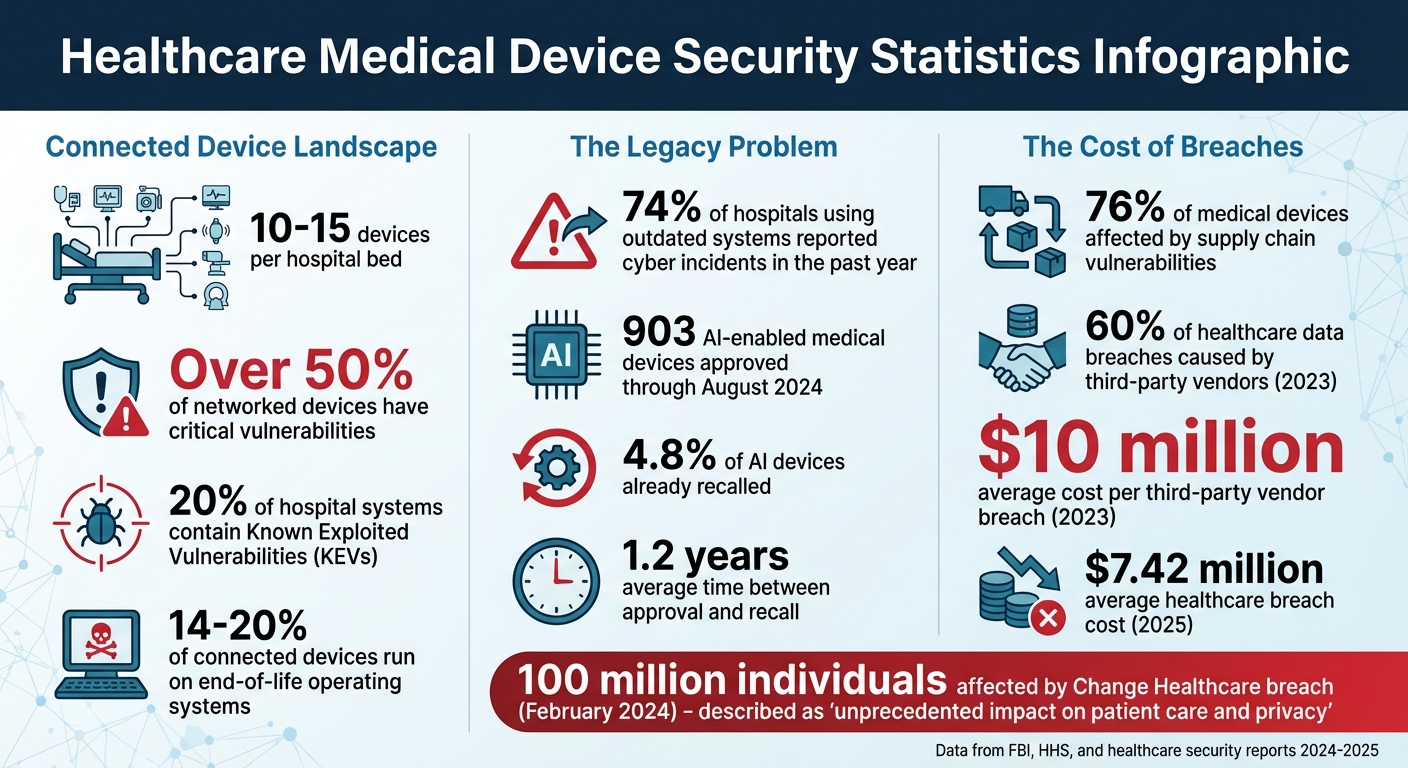
Healthcare Cybersecurity Statistics: Device Vulnerabilities and Breach Costs
Healthcare organizations face unique cybersecurity challenges when it comes to medical devices. While frameworks like ISO 27001 provide a structured approach to managing risks, medical devices introduce distinct threats due to their direct impact on patient care. A security failure in these devices doesn’t just disrupt operations - it can endanger lives. The growing number of connected devices in hospitals only adds to the complexity, creating more potential gateways for attackers.
Device Connectivity and Vulnerabilities
On average, hospitals manage 10–15 connected devices per bed [5], ranging from infusion pumps to patient monitors. This level of connectivity significantly increases the attack surface. Alarmingly, over half of networked devices have critical vulnerabilities, and 20% of hospital systems contain Known Exploited Vulnerabilities (KEVs) linked to ransomware [6].
Legacy systems make the situation worse. 74% of hospitals using outdated systems reported cyber incidents in the past year [6]. Many older devices run on unsupported or end-of-life operating systems, making up 14–20% of connected devices [5][6]. These systems can’t receive essential security updates, leaving them exposed. Even newer devices are not immune - of the 903 AI-enabled medical devices approved through August 2024, 4.8% have already been recalled, with an average time of just 1.2 years between approval and recall [6].
"Cyber actors will likely increase cyber intrusions against health care systems – to include medical devices – due to mandatory transition from paper to electronic health records (EHR), lax cybersecurity standards, and a higher financial payout for medical records in the black market."
– FBI
As vulnerabilities grow, the risks extend beyond the devices themselves, spilling into third-party interactions.
Third-Party and Supply Chain Risks
The medical device supply chain is another weak link. 76% of medical devices are affected by supply chain vulnerabilities [6]. In 2023, 60% of healthcare data breaches were caused by third-party vendors, with healthcare making up 41.2% of all third-party breaches in 2024 [1]. The financial toll is staggering - the average cost of a third-party vendor breach in healthcare reached $10 million per incident in 2023 [1].
Real-world examples highlight these dangers. In February 2024, a cyberattack on Change Healthcare compromised the data of 100 million individuals, disrupting key services like electronic prescribing and claims submissions. The Office of Civil Rights described it as an "unprecedented impact on patient care and privacy" [2]. Just months later, in July 2024, a faulty software update from CrowdStrike caused widespread system outages, delaying medical procedures worldwide [2].
Attackers exploit supply chains through various methods, such as embedding malicious code in software updates, tampering with hardware during manufacturing, targeting cloud service providers, or even altering medical devices during distribution. To counter these risks, organizations are turning to tools like Software Bills of Materials (SBOMs) to track software components, adopting Zero Trust Architecture to verify users and devices continuously, and including "right-to-audit" clauses with encryption mandates in vendor agreements [3].
These vulnerabilities and attacks underscore the importance of meeting strict regulatory demands.
Regulatory Compliance Requirements
Navigating the regulatory landscape has become increasingly challenging for healthcare organizations. The 2025 HIPAA Security Rule now requires Multi-Factor Authentication (MFA) for all access points to electronic Protected Health Information (ePHI) [6]. The HHS Office for Civil Rights has stepped up enforcement, demanding healthcare providers produce full compliance documentation within 10 business days of a request [6].
The FDA has also raised its standards. Manufacturers must now include cybersecurity risk management plans, patching strategies, and update protocols in pre-market submissions like 510(k) clearances [4][6]. This heightened scrutiny has contributed to a 10-year low in FDA approvals for high-risk medical devices as of Q1 2025 [6]. Non-compliance is costly - the average healthcare breach cost hit $7.42 million in 2025 [6].
ISO 27001 offers a framework to manage these overlapping requirements, focusing on the principles of confidentiality, integrity, and availability [4]. When medical devices are networked, breaches can lead to unauthorized data access (compromising confidentiality), altered device settings that result in incorrect clinical decisions (affecting integrity), or denial-of-service attacks that prevent critical alerts (impacting availability). Each of these scenarios has serious regulatory and patient safety consequences.
ISO 27001 Implementation Case Studies
addressing vulnerabilities in medical devices and navigating regulatory demands, these case studies showcase how ISO 27001 can be practically applied. Each example highlights its influence on improving security and compliance, with measurable results.
Case Study 1: SaMD Company Boosts Cyber Resilience
TouchPoints.health, a cloud-based practice management platform in the UK, achieved UKAS-accredited ISO 27001 certification in just six months (October 2025 to March 2026). Led by CEO and Founder Alex Almoudaris, the company transitioned from manual tracking tools like SharePoint and spreadsheets to a structured Information Security Management System (ISMS) platform.
The initiative focused on protecting sensitive patient data while scaling operations. By employing the "Assured Results Method", compliance became an integral part of daily workflows rather than a separate administrative task. This approach resulted in certification with zero non-conformities - a rare feat for first-time implementations.
"We estimate IO has saved us at least 30–40% of the time compared with trying to build and maintain our ISMS manually, particularly when it comes to mapping controls and gathering evidence." – Alex Almoudaris, CEO and Founder, TouchPoints.health
This time efficiency allowed the team to concentrate on product development without compromising security standards. For SaMD companies managing clinical data, this case proves that achieving certification doesn't have to hinder innovation.
The success of this rapid implementation highlights alternative strategies that could be adapted for more complex manufacturing environments.
Case Study 2: Integrating ISO 13485 and ISO 27001 in Manufacturing
Matrix One, a supplier of medical device software, opted for a different approach in June 2024 by integrating ISO 27001 into their existing ISO 13485 Quality Management System. Instead of creating separate frameworks, they enhanced current processes to incorporate information security controls, reducing redundancy and improving efficiency.
Their process included a gap analysis, asset documentation, and revising 70% of process-related risk assessments. This integration doubled the total number of identified risks, linking data security with patient safety [9].
"The biggest change was in the area of risk management. We updated 70% of our existing process related risk assessments and also doubled the total number of identified risks." – Matrix One
Before the final certification audit, Matrix One enlisted an external specialist for a two-day internal audit. This proactive step uncovered minor gaps, which were promptly addressed. The combined surveillance audit for ISO 13485 and certification audit for ISO 27001 concluded with just two minor non-conformities, showcasing the efficiency of this integrated approach [9].
Another example comes from Epiphany Healthcare in Virginia, which provides ECG management software to over 950 hospitals. Their Information Security Manager, Eddie, led a team of eight part-time colleagues through an eight-month implementation, dedicating 60 hours per week to policy development and documentation [7].
"The ISO/IEC 27001 standard has enabled us to develop a framework that focuses on remaining current with security methodologies." – Eddie, Information Security Manager, Epiphany Healthcare
These examples highlight two distinct paths: a rapid implementation for SaMD companies and an integrated approach for manufacturers already certified under ISO 13485. Both strategies demonstrate how organizations can strengthen their security practices and meet regulatory requirements effectively.
ISO 27001 Benefits for Healthcare Organizations
ISO 27001 offers practical solutions to the challenges healthcare organizations face, addressing risks with measurable results.
Patient Safety and Data Protection
When it comes to safeguarding patient data and ensuring uninterrupted care, ISO 27001 makes a real difference. Take, for example, a 200-bed community hospital that faced a ransomware attack at 2:00 AM in 2020. Thanks to ISO controls like A.12.4.1 and A.13.1.3, the hospital detected the attack immediately, isolated its network within 15 minutes, and limited downtime to 12 hours - without paying a ransom. In contrast, a nearby hospital without ISO certification was down for 11 days and ended up paying $450,000 [10].
ISO 27001's 93 controls provide a broader safety net than HIPAA’s 18 standards, tackling modern challenges like AI and IoT vulnerabilities. For instance, role-based access controls (ISO A.9.4.1) have helped reduce privacy violations by 94% in healthcare organizations. With medical records fetching as much as $250 each on the dark web - compared to just $5 for stolen credit cards - this level of security is indispensable [10].
Regulatory Compliance Alignment
ISO 27001 goes beyond HIPAA by filling critical gaps in regulatory compliance. While HIPAA focuses on periodic reviews (typically every three years), ISO 27001 requires annual surveillance audits, ensuring continuous compliance. This proactive approach minimizes audit-related risks and penalties.
The certification also supports global research efforts by aligning with international data protection standards, opening doors to significant grant opportunities. For healthcare organizations, this can mean millions in potential funding. Additionally, ISO 27001 enhances security for medical devices and third-party vendor risk management, strengthening the broader control framework. On a financial note, certification can slash cyber insurance premiums by up to 50%, saving large health systems around $1 million annually and mid-size hospitals approximately $170,000 [10].
Scalable Risk Management Framework
ISO 27001 is more than just a compliance tool - it’s a flexible framework that evolves with organizational needs. For example, NHS Professionals achieved certification in just four months by using a centralized compliance management platform [8]. Organizations leveraging automated ISO 27001 tools report a 30–40% reduction in the time spent maintaining their Information Security Management System. This allows security teams to concentrate on critical risks instead of getting bogged down in administrative work [8].
The framework also boosts efficiency by streamlining software licenses and cutting down preventable system downtime [10].
"ISO 27001 didn't prevent the attack. But it ensured we were prepared, protected, and able to respond effectively. That made all the difference." – Hospital CISO
Given that the average cost of a healthcare data breach is $10.93 million, investing in ISO 27001 certification offers tangible returns through minimized breach risks, lower insurance premiums, and improved operational efficiency [10].
Using Censinet RiskOps™ for ISO 27001 Compliance
Healthcare organizations aiming for ISO 27001 compliance often face significant administrative challenges, from gathering evidence to managing vendor assessments and maintaining ongoing compliance. Censinet RiskOps™ simplifies this process by offering a centralized platform designed specifically for healthcare needs. It addresses the unique complexities of the industry, as discussed earlier, while streamlining risk management tasks.
Automated Third-Party Risk Assessments
Managing third-party vendors is one of the trickiest parts of ISO 27001 compliance, especially for controls like A.15.1.1 (supplier relationships) and A.15.2.1 (monitoring supplier services). Censinet RiskOps™ uses AI to simplify vendor assessments. It processes vendor questionnaires instantly, summarizes critical documentation, and identifies fourth-party risks - key for organizations working with medical device manufacturers or cloud service providers that handle sensitive patient data. These capabilities are crucial for improving oversight and ensuring compliance with ISO standards.
Cybersecurity Benchmarking and Incident Response
For ISO 27001 controls like A.16.1.1 (incident management) and A.12.6.1 (technical vulnerability management), real-time insights into an organization’s security posture are vital. Censinet RiskOps™ provides a centralized hub that consolidates risk data, enabling security teams to measure their performance against industry benchmarks. Automated workflows ensure that critical findings are quickly routed to the right stakeholders, allowing for immediate action. When incidents arise, teams can easily access relevant documentation, security controls, and escalation procedures, ensuring a swift and coordinated response that aligns with ISO 27001 requirements.
AI-Driven Compliance Management
Maintaining ISO 27001 certification involves continuous tasks like evidence collection and policy updates, which can be time-consuming for security teams. Censinet AI™ streamlines these processes with human-guided automation, handling tasks such as evidence validation, policy drafting, and risk mitigation. The platform allows for configurable rules, ensuring human oversight in key decisions. For healthcare organizations juggling multiple frameworks - like ISO 27001, HIPAA, and ISO 13485 - this approach reduces administrative burden while maintaining the rigor needed for annual audits. By integrating these capabilities, the platform not only supports compliance but also strengthens overall cybersecurity readiness, preparing organizations for the ever-changing demands of healthcare security.
Conclusion
Key Lessons from ISO 27001 Implementation
ISO 27001 demonstrates that a structured approach to risk management can do more than ensure compliance - it actively protects patient safety. Research shows that implementing ISO 27001:2022 can cut the risk of data breaches by as much as 70% [11]. A notable example of its importance is the 2021 Pfizer incident, where a former employee allegedly used personal cloud storage to steal over 12,000 confidential files. This case stresses the need for strong Data Loss Prevention measures. Similarly, a separate high-profile breach highlighted the critical role of Identity and Access Management controls [14].
"ISO 27001:2022 compliance cultivates a security-conscious mindset across the organization, mitigating risks associated with sensitive patient data."
The effectiveness of ISO 27001 relies on continuous improvement, not just static policies. Organizations must frequently update risk assessments to counter new threats like ransomware and phishing. Extending security requirements to third-party vendors through binding agreements is equally vital. Beyond technical measures, fostering a company-wide culture of security - where every team member understands their role - remains essential. With over 50% of digital health organizations aiming for ISO 27001 certification by 2025 [13], the standard is becoming a core expectation across the industry.
These insights are helping shape the future of healthcare cybersecurity, preparing organizations to tackle emerging challenges with confidence.
The Future of Healthcare Cybersecurity
The benefits of ISO 27001 are laying the groundwork for the next phase of healthcare cybersecurity, which will adapt to new technologies and regulatory shifts. Key drivers include AI-focused governance frameworks like the EU AI Act and the Cyber Resilience Act, as well as the growing reliance on cloud-based systems for patient records [11][15]. ISO 27001 not only strengthens current defenses but also equips organizations to meet these evolving demands.
Cutting-edge platforms like Censinet RiskOps™ are playing a pivotal role in this evolution. By leveraging AI with human oversight through configurable rules, these tools simplify the management of 93 ISO 27001 controls while integrating frameworks like HIPAA and GDPR. This streamlined approach ensures that healthcare providers can maintain compliance and safeguard patient data, even as cyber threats grow more sophisticated.
FAQs
What are the first steps to implement ISO 27001 for medical device security?
To begin applying ISO 27001 to secure medical devices, start by defining the scope of your Information Security Management System (ISMS). Focus on the key assets - medical devices and any connected systems. Then, perform a risk assessment to pinpoint assets, identify potential threats, and uncover vulnerabilities. Use this analysis to prioritize the necessary controls to address the most pressing risks. Lastly, choose the right controls and work with an independent ISO 27001 auditor to confirm compliance. These steps lay the groundwork for effective security measures.
How does ISO 27001 map to HIPAA and FDA cybersecurity requirements?
ISO 27001 works hand-in-hand with HIPAA and FDA cybersecurity requirements by providing a structured, risk-focused framework for managing information security. It highlights key controls such as risk assessment, access management, encryption, and incident response - all of which align with HIPAA's safeguards for protecting PHI (Protected Health Information).
When it comes to FDA regulations, ISO 27001 supports device-specific security measures, helping healthcare organizations tackle both compliance issues and broader cybersecurity challenges. This approach ultimately strengthens patient safety and safeguards sensitive data.
What ISO 27001 controls best reduce third-party and supply chain risk?
Key ISO 27001 controls for managing third-party and supply chain risks focus on a few critical areas:
A structured risk management process ties it all together, making it easier to identify and address vulnerabilities in your supply chain before they become serious threats.
