
Artificial intelligence is transforming healthcare by improving operations, diagnostics, and patient care. However, this progress comes with serious risks. AI systems handle sensitive data, power medical devices, and make critical decisions, creating vulnerabilities that traditional cybersecurity measures can't fully address. Key risks include data breaches, biased algorithms, and attacks on AI-controlled devices.
To manage these challenges, healthcare organizations must balance AI's benefits with robust risk management strategies. This involves implementing governance frameworks, fostering cross-department collaboration, and using tools like Censinet RiskOps™ to monitor and address vulnerabilities in real time. By pairing AI's capabilities with human oversight, organizations can improve care while minimizing threats.
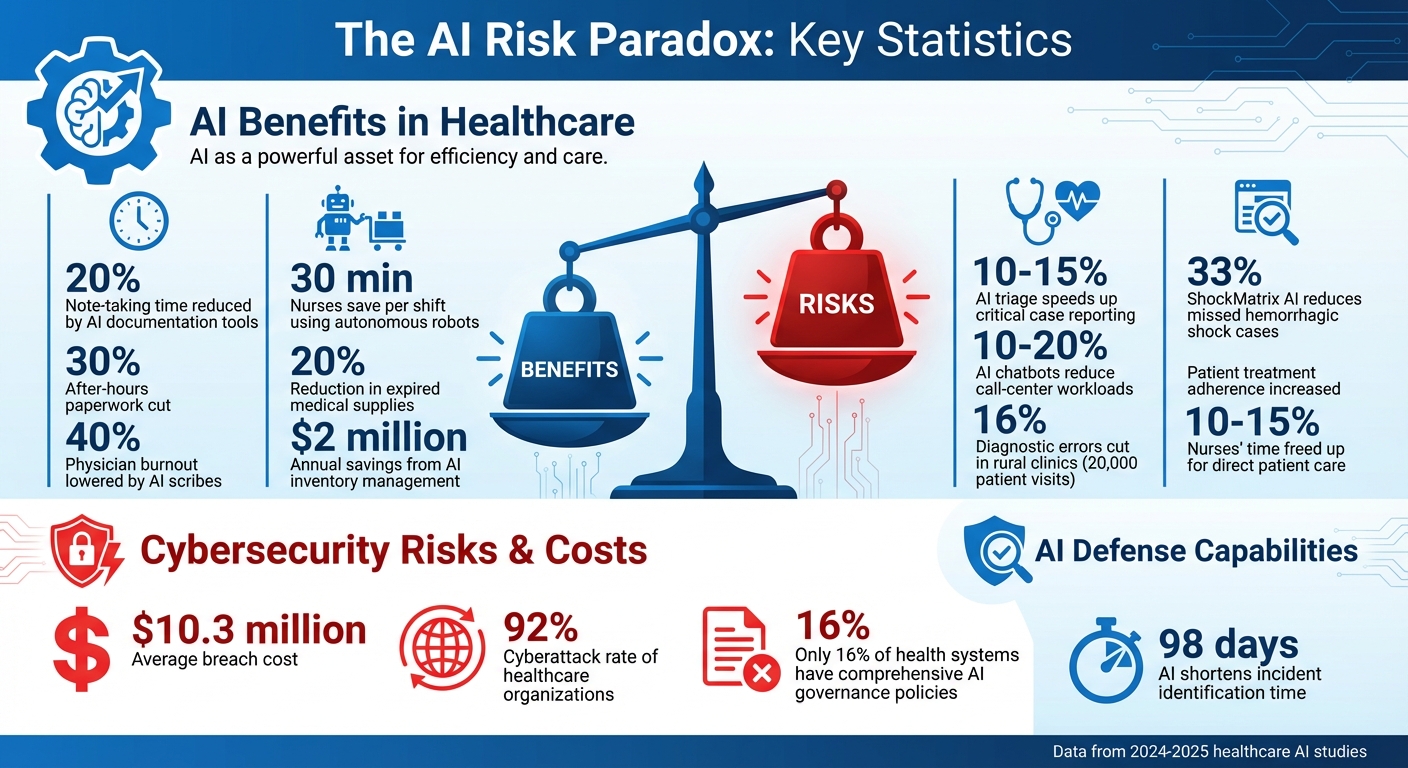
AI in Healthcare: Key Statistics on Benefits, Risks, and Impact
How AI Benefits Healthcare Organizations
Healthcare organizations are turning to AI to improve efficiency, elevate patient care, and bolster cybersecurity. This technology is reshaping the industry by optimizing operations, enhancing treatment quality, and strengthening defenses against cyber threats. Despite challenges, its adoption continues to grow.
Streamlining Operations and Workflows
AI is revolutionizing how healthcare facilities handle daily operations by automating time-consuming administrative and clinical tasks. This shift is especially crucial in tackling clinician burnout. For instance, by October 2025, studies revealed that AI-powered documentation tools reduced note-taking time by about 20%, cut after-hours paperwork by 30%, and lowered physician burnout by 40% for those using AI scribes [5].
Beyond documentation, AI is making significant strides in logistical efficiency. Nurses reported saving an average of 30 minutes per shift by assigning tasks to autonomous mobile robots. Hospitals using AI to manage inventory saw a 20% reduction in expired supplies and nearly eliminated stock shortages, saving around $2 million annually. In radiology, AI triage sped up critical case reporting by 10–15%, while AI chatbots handling routine patient queries reduced call-center workloads by 10–20% [5].
Better Patient Care and Treatment
AI is transforming patient care by enhancing diagnostic precision and improving treatment outcomes. HIMSS highlights this progress:
AI is already improving documentation, accelerating diagnosis and reducing friction in day-to-day workflows
.
By October 2025, the "ShockMatrix" AI system underwent trials in eight French hospitals, analyzing data from 1,292 trauma patients. It predicted hemorrhagic shock risks with accuracy comparable to trauma surgeons, potentially reducing missed cases by up to 33% [5]. In rural clinics, tools like "AI Consult" cut diagnostic errors by 16% across 20,000 patient visits.
AI also plays a key role in managing chronic conditions. It suggests personalized lifestyle adjustments and therapeutic changes, while AI-driven education tools have increased patient adherence to treatment plans by approximately 15%. One U.S. hospital network reported that AI-assisted documentation and virtual check-ins freed up 10–15% of nurses' time, allowing for more direct patient care [5]. These advancements underscore AI's growing influence in healthcare.
Stronger Cybersecurity Defense
AI’s ability to analyze massive amounts of security data swiftly makes it a cornerstone of modern cybersecurity strategies. Healthcare organizations are deploying AI-driven systems to monitor network traffic and security logs, identifying vulnerabilities and potential breaches far faster than human analysts could [6]. The American Hospital Association emphasizes this dual benefit:
We're very optimistic about the potential uses of artificial intelligence (AI) in health care. It can improve care delivery and patient outcomes, relieve administrative burden so clinicians have more time to focus on their patients, and streamline revenue cycle and other back-office operations
.
However, the same technology fueling defense is also being exploited by cybercriminals, creating a technological arms race. To address this, the Health Sector Coordinating Council is preparing 2026 guidelines to help healthcare organizations manage AI-related cybersecurity risks. These efforts aim to leverage AI’s strengths while minimizing vulnerabilities [3].
Major Cybersecurity Risks from AI Systems
AI has undoubtedly revolutionized healthcare operations, offering improved efficiency and precision. However, alongside these advancements come significant security challenges. If not properly managed, these vulnerabilities can undermine the very benefits AI aims to deliver. Below are some of the most pressing risks that healthcare organizations must address to safeguard their systems and data.
Data Privacy Violations and PHI Breaches
AI systems thrive on vast amounts of data, but this reliance brings heightened privacy concerns. Healthcare organizations often handle sensitive patient health information (PHI), and issues can arise when this data is collected without clear consent or used for purposes beyond what patients initially agreed to [7][8]. The situation becomes even riskier when healthcare professionals inadvertently input confidential patient data into AI tools. Once this information enters the system, it may end up in the AI's training data, potentially exposing it to unauthorized access or misuse.
AI Errors and Biased Algorithms
AI systems, while powerful, are not immune to errors. They can produce inaccurate outputs - sometimes referred to as hallucinations - that may lead to incorrect diagnoses or treatment plans [1]. Bias is another critical issue. Algorithms trained on incomplete or skewed datasets can perpetuate disparities in care, while the opaque nature of "black box" models, like deep learning algorithms, complicates accountability. These challenges highlight the need for rigorous oversight and validation of AI systems to minimize risks.
Compromised AI-Controlled Medical Devices
Medical devices powered by AI are not just tools for treatment - they are also potential targets for cyberattacks. Many such devices operate on outdated systems or lack robust security measures, making them vulnerable [9]. Threats like data poisoning, adversarial attacks, or prompt injection can disrupt device functionality, leading to misdiagnoses, faulty treatment recommendations, or even patient harm [10][11]. The consequences of a breached device extend beyond data security; they can directly jeopardize patient safety.
Ransomware and Third-Party Vendor Risks
The interconnected nature of healthcare systems creates a web of vulnerabilities, particularly through third-party vendors and supply chain partners. These external entities often have access to hospital networks, and if their systems are compromised, they can serve as gateways for cybercriminals [9]. When vendors integrate AI tools into these networks, the risks multiply. A single weak link in the supply chain can lead to devastating outcomes, such as encrypted networks, operational disruptions, and costly ransom demands.
Managing AI Risks with Censinet RiskOps™
Healthcare organizations face mounting challenges in managing AI-driven cybersecurity risks. To address these, Censinet RiskOps™ offers a centralized platform tailored for healthcare cybersecurity and risk management. It helps organizations tackle vulnerabilities while keeping critical decisions under the watchful eye of experts. Here's how specific AI risks align with Censinet's targeted solutions.
Matching AI Threats to Censinet Solutions
For data privacy violations and PHI breaches, Censinet RiskOps™ provides comprehensive third-party and risk assessments. These tools enable organizations to evaluate how both vendors and internal systems handle sensitive patient data, ensuring compliance with healthcare regulations like HIPAA.
When it comes to algorithmic errors and biases, the platform supports collaborative reviews. Risk teams can monitor AI-enabled processes, identify areas for improvement, and consolidate insights through centralized dashboards. This setup allows teams to quickly detect and address potential issues.
For vulnerabilities in critical medical devices, Censinet RiskOps™ helps by tracking known device risks and ensuring security assessments are always up to date. Automated workflows streamline the process, adapting as new threats arise to maintain a strong defense.
To combat ransomware and third-party vendor risks, Censinet Connect™ simplifies vendor risk assessments. This feature allows healthcare organizations to evaluate the security practices of their vendors, identifying weak points in their supply chain. Together, these solutions work alongside vigilant human oversight to strengthen overall security.
Using Human Oversight for AI Safety
Censinet’s approach combines automation with expert judgment for a balanced risk management strategy. Censinet AI™ incorporates a human-in-the-loop model, where routine tasks - such as completing security questionnaires, summarizing vendor documents, and drafting risk reports - are automated. Meanwhile, experienced professionals oversee critical decisions to ensure accuracy and accountability.
Risk teams can customize rules and workflows to determine when human review is required, ensuring complex evaluations receive expert attention. Key findings are directed to the appropriate stakeholders, creating a system akin to air traffic control for AI oversight. This ensures accountability while supporting operational efficiency.
sbb-itb-535baee
Building a Balanced AI Risk Management Program
A surprising statistic: only 16% of health systems have comprehensive, systemwide AI governance policies in place. This leaves the majority exposed to risks that AI is designed to mitigate [12]. Below, we’ll explore strategies to establish governance, encourage collaboration, and maintain vigilance to effectively manage these risks.
Setting Up AI Governance Frameworks
Start by defining clear risk tolerance levels and identifying how data systems, staff, and vendors are interconnected. Establish governance committees specifically tasked with overseeing AI, blending technical and clinical expertise. Training is key - ensure all employees understand AI-related risks, regulatory requirements, and best practices for safe use [12][2]. Make ethical, transparent, and accountable AI oversight a core part of your organization’s culture [12].
Cross-Team Collaboration for AI Oversight
Strong governance is only part of the equation; effective collaboration across departments is just as critical. A great example comes from October 2024, when the HSCC Cybersecurity Working Group launched an AI Cybersecurity Task Group with 115 healthcare organizations to tackle AI cybersecurity risks [3]. Healthcare organizations can adopt a similar approach by fostering partnerships between cybersecurity and data science teams, engaging stakeholders across clinical, financial, and operational areas, and defining clear roles throughout the AI lifecycle [3][13]. Tools like Censinet RiskOps™ make this easier by centralizing key assessments and AI-related tasks, ensuring the right teams handle the right issues at the right time.
Ongoing Monitoring and System Updates
AI systems aren’t set-it-and-forget-it solutions - they need constant monitoring to stay secure and effective. Use centralized dashboards for real-time insights into system performance, security, and emerging risks. Automated workflows can handle updates and patches, ensuring assessments are always current. Frameworks like the NIST AI Risk Management Framework (AI RMF) and HSCC guidance provide structured methods for managing AI risks throughout their lifecycle. By staying proactive with AI-driven analytics and consistent monitoring, healthcare organizations can not only strengthen security but also fully realize AI’s potential to transform patient care.
Conclusion
AI stands as both a formidable ally and a potential risk for healthcare organizations. With breach costs now averaging $10.3 million and a staggering 92% cyberattack rate, the stakes have never been higher. Yet, AI also shortens incident identification time by an impressive 98 days, proving its immense potential when properly applied [11]. The key lies in how effectively it is managed.
The future demands a balanced approach, not avoidance. Many healthcare organizations remain vulnerable to AI-related risks, highlighting the urgent need for stronger governance and smarter risk management strategies. The solution isn’t to sideline AI but to pair its analytical capabilities with vigilant human oversight, rigorous monitoring, and collaboration across departments.
Action is needed now. With cyber threats escalating, the time for robust risk management is now [11]. Platforms like Censinet RiskOps™ offer a centralized way to address these challenges - streamlining AI-related findings to the right teams, providing real-time risk visibility, and ensuring human experts retain control over critical decisions.
The healthcare organizations that succeed won’t be those that shy away from AI. Instead, they’ll be the ones that adopt it thoughtfully and strategically. By implementing clear governance structures, encouraging teamwork between clinical and technical teams, and using specialized risk management tools, leaders can turn AI into a game-changing asset. When paired with human expertise and ongoing monitoring, AI has the potential to drive innovation while keeping patient safety and organizational security at the forefront.
FAQs
How can healthcare organizations maximize the benefits of AI while managing its risks?
Healthcare organizations can navigate the benefits of AI while managing risks by adopting a well-thought-out and proactive strategy. A key step is implementing a strong enterprise risk management (ERM) framework that specifically accounts for the unique challenges posed by AI. This framework should emphasize the use of ethical and explainable AI systems, which are essential for building transparency and trust.
To further strengthen this approach, organizations should set clear standards for evaluating vendors, ensure staff receive regular training to stay informed, and adhere to all applicable regulations. It's also important to routinely review and refine risk management protocols, prepare contingency plans for potential issues, and use incident reporting tools to address weaknesses as they arise. With this comprehensive strategy, healthcare providers can leverage AI's potential while keeping risks firmly under control.
What are the biggest cybersecurity risks AI poses to healthcare organizations?
AI has brought remarkable advancements to healthcare, but it also opens the door to serious cybersecurity challenges. One major concern is data breaches, where sensitive patient information could be exposed. Another is algorithm manipulation, where attackers tamper with AI systems to produce incorrect or even harmful results. Similarly, adversarial attacks and data poisoning can disrupt AI models, leading to flawed diagnoses or misguided treatment plans.
Healthcare systems also face risks from connected medical devices that may be vulnerable to hacking, third-party vendor breaches, and outdated legacy systems lacking modern security protocols. On top of this, AI misuse - such as creating deepfakes or exploiting insider threats - further threatens patient safety and the trustworthiness of healthcare organizations. Addressing these risks is essential to ensure AI’s positive impact isn’t overshadowed by its vulnerabilities.
How does Censinet RiskOps™ help healthcare organizations manage AI-related risks?
Censinet RiskOps™ makes handling AI-related risks in healthcare easier by automating risk assessments and spotting vulnerabilities as they happen. Its predictive analytics features bolster cybersecurity, helping organizations tackle threats before they escalate.
By simplifying risk management, Censinet RiskOps™ allows healthcare providers to harness the advantages of AI while reducing its risks, promoting safer and smoother operations.
