
If an AI vendor touches patient data or clinical decisions, I treat that review as a patient-safety check, not just a procurement step. With 71% of U.S. hospitals using predictive AI in EHRs, the main job is simple: ask for proof on training, PHI handling, security, bias checks, updates, and incident response before anything goes live.
Here’s the article in one view:
- I ask how the model was trained and tested
- I confirm whether it accesses, processes, or stores PHI/PII
- I check if customer data is used for training
- I review the security architecture and controls
- I ask who owns the AI system and who can stop it
- I verify performance monitoring, drift checks, and update notices
- I request documentation, explainability, and audit records
- I confirm FDA, HIPAA, ONC, state law, and other rule exposure
- I review incident response, logging, and audit trails
- I map EHR, API, and clinical workflow integrations
The core idea: standard vendor reviews often miss AI-specific risk. A vendor can pass a normal security review and still have gaps in model drift, subgroup performance, logging, prompt attacks, or data use.
Navigating AI Vendor Risks: Essential Considerations for Healthcare Organizations
sbb-itb-535baee
Quick comparison
| Question area | What I want to see | Common warning sign |
|---|---|---|
| Training and validation | Model docs, test results, subgroup metrics, U.S. clinical fit | No clear validation data |
| PHI/PII handling | Data-flow diagram, BAA, retention and deletion terms | Vague answer on where data goes |
| Customer data for training | Written no-training policy without approval | Fuzzy language on fine-tuning |
| Security controls | Encryption, MFA, RBAC, segmentation, test results | Generic claims with no proof |
| Governance and oversight | Named owners, review committee, override path | No one clearly accountable |
| Drift and updates | Monitoring plan, version history, release notices | Silent model changes |
| Transparency and docs | Model summary, change logs, audit records | Marketing material instead of source docs |
| Regulatory status | FDA status, HIPAA terms, law mapping | “FDA registered” used as a substitute for clearance or approval |
| Incident response and logging | AI-specific playbooks, tamper-evident logs, SIEM export | Logs too thin to rebuild an event |
| Integration and workflow fit | Connection maps, access scope, clinical review points | Deep EHR access with weak controls |
If I had to reduce the whole piece to one rule, it would be this: don’t score vendor answers by polish - score them by evidence.
Why Standard Vendor Reviews Miss AI-Specific Risks
Standard third-party reviews usually check encryption, SOC 2, and access controls. That matters. But it doesn’t cover the risks that come with AI.
The problem starts with how AI systems learn, change, and fail.
AI is not deterministic software. The same model can produce different outputs based on its training data, live inputs, and retraining. In some cases, that change can happen without a formal release. So a vendor might pass a standard security checklist and still run a model that slowly loses accuracy after deployment.
Model drift is documented. The Epic Sepsis Model missed roughly two-thirds of sepsis cases in real-world use and produced frequent false alarms compared with initial performance reports.[10]
Training data is another major blind spot. One analysis found that a common U.S. health risk algorithm underestimated risk for Black patients because it used healthcare costs as a proxy for illness severity.[9] Most standard vendor questionnaires don’t ask about dataset composition, demographic representation, or labeling quality. That’s a big omission.
This is why validation, monitoring, and accountability matter so much. A normal vendor review can also miss issues like:
- Prompt injection, where malicious input manipulates the tool
- Undocumented model updates, where a vendor retrains a model without clear notice
- Unclear responsibility, where no one has explicitly agreed on who is accountable when AI output causes harm
Checking those claims takes more than a checkbox review. You need model cards, validation reports, change logs, subcontractor disclosures, and contract language that clearly assigns responsibility for harmful output.
That leads to the first question: how is the model trained and validated?
1. How Is Your AI System Trained and Validated?
Start here. Before you look at anything else, find out where the model came from, what data shaped it, and whether it was tested on data that matches Censinet Connect™ Copilot can help you automatically answer these types of vendor questionnaires. U.S. clinical practice and your patient population.
Ask the vendor for a model documentation package. This should spell out the model architecture and intended clinical use, along with the training and test methods. It should also show the size of the dataset, where the data came from, how it was labeled, and the demographic makeup of the sample. On top of that, you want the clinical validation results: sensitivity, specificity, AUC-ROC, and calibration.
The package should also include subgroup analysis by age, sex, race, and ethnicity. That matters because performance can shift across patient groups, and you want to spot those gaps before rollout. Imaging datasets often skew demographically, and published chest X-ray studies have found accuracy gaps by sex and race.[13] If a vendor can't show how the model performs across different groups, take that as a red flag.
On the data side, ask exactly how PHI and PII were handled during training. Vendors should confirm whether they used HIPAA-compliant de-identification methods - Safe Harbor or Expert Determination - before data entered the training environment. They should also explain whether engineers and data scientists had minimum-necessary access, and how access to raw training data was restricted and logged.[15][17]
Validation by itself doesn't tell the whole story. You also need to know who reviewed the results and who signed off on deployment. A vendor should have a multidisciplinary review board that includes clinicians, data scientists, safety leaders, and compliance leaders.[14][16] Ask for proof, not just a verbal answer. That can include board charters, membership lists, or examples where clinical review changed the model, such as narrowing indications or adjusting thresholds after a safety concern came up.
Then look at the environment used to train and store the model. Ask how the training infrastructure - including any cloud GPU clusters - is hardened, segmented, and monitored.[11][17] Keep the discussion centered on AI-specific controls, not generic compliance badges. The point is simple: you want to know the training environment itself is protected, not just the production system.
2. Does Your AI Solution Access, Process, or Store PHI or PII?
This sounds like a simple yes-or-no check. In practice, it almost never is.
A vendor may say it doesn't store PHI, but its logs still collect patient identifiers. Or a support team may open raw records while fixing an issue. That’s why you need a clear view of every place PHI and PII show up across the full system - not just inside the main model.
Ask for a visual data-flow diagram that shows where PHI/PII enters the system, where it moves, where it sits, and where it gets deleted. That should include EHR integrations, APIs, logging, monitoring, and subcontractors. It also needs to show where data is stored, including cloud regions and any processing that happens outside the U.S.[20][22][23]
This diagram is not just paperwork. It’s the map you use to judge exposure, storage, and breach surface. If PHI appears anywhere in that flow, the BAA and the control scope need to line up with that fact.
Persistence matters a lot here. There’s a big difference between a tool that briefly processes de-identified vitals for real-time risk scoring and a tool that stores labeled encounter transcripts tied to patient IDs in its own cloud setup. The second case creates a much larger breach surface.
And this isn’t a far-off risk. A Censinet-sponsored Ponemon study found that 54% of healthcare vendors have had at least one breach exposing provider PHI, and 41% of those had six or more PHI breaches over a two-year period.[24] In plain terms, repeated PHI breaches should be treated as a baseline vendor risk, not a rare edge case.
Once PHI touches the system, the contract starts doing heavy lifting. Any vendor whose AI solution receives, processes, or stores PHI is generally a HIPAA business associate. That means you need a signed Business Associate Agreement (BAA) before data goes anywhere.[22][21]
That BAA should clearly spell out AI-specific terms, including:
- how data can be used
- how long it can be kept
- what subcontractors must do
- how fast breach notices must be sent
It should also say whether PHI is used only to deliver the service or whether the vendor can also use it for model improvement. If that point is fuzzy, treat it as a gap.[22][20]
You should also ask for proof that PHI is protected inside the AI workflow itself. Request evidence of AES-256 at rest, TLS 1.2+ in transit, least-privilege access, and audit logs. Then check whether SOC 2 Type II, HITRUST, or ISO 27001 reports clearly include the AI components - not just the company at large.[18][19][20][23][26]
3. Do You Use Customer Data for Training or Model Improvement?
This question gets to the heart of the issue: can the vendor actually prevent your data from being used for training or fine-tuning?
Start by asking for a written policy that spells out whether customer data is used for training or model improvement, and the exact conditions that allow it. Then get specific. You need to know which types of data the vendor may route into training or fine-tuning.
That policy should clearly explain whether PHI, PII, clinical notes, logs, or metadata can enter training or fine-tuning workflows. It should also name which subprocessors can access that data. When you review data flows, keep the focus narrow: don't just ask where data moves. Ask whether any of those paths lead to training or fine-tuning.
If PHI goes into training, the risk changes fast. The datasets, model weights, and outputs may all carry HIPAA duties. And if the vendor can't stop that use by contract, security controls by themselves won't cover the gap.
Your contract should say, in plain terms, that the vendor may not train on PHI or identifiable customer data unless you approve it in writing. It should also define de-identification, ban reuse, and require the return or destruction of data and fine-tuning artifacts when the contract ends.[7][27][28][29][31]
You also want proof that these guardrails work in practice. Ask for evidence such as:
- a segregated training environment
- role-based access
- encryption
- logging
- audit results, such as SOC 2 Type II or HITRUST
Those controls should show that the vendor can block unauthorized training use. If the vendor can't provide architectural diagrams, security controls, and audit evidence, treat that as a material risk.[17][25][30]
4. What Security Architecture and Controls Protect the AI System?
Contract language tells you what a vendor promises. Architecture tells you whether they can actually do it.
Once you've covered training and data-use questions, ask for architecture diagrams and written control descriptions for the full AI workflow. That means everything from ingestion and preprocessing to inference, storage, and integrations with EHRs and other clinical systems.
You want a clear map of the data path:
- Where PHI/PII enters
- Where it is stored or cached
- Which components touch or process it
- Which controls protect each boundary
Pay close attention to the boundaries between PHI environments and de-identified or test environments. This is where problems often hide. The vendor should show explicit segmentation and identity controls at every crossing point, not just broad claims that systems are “separated.”
The baseline controls should also be confirmed in writing. At a minimum, look for TLS 1.2 or higher for data in transit, AES-256 for data at rest, centralized key management with rotation policies, and role-based least-privilege access for AI management consoles and segmented data repositories. SSO and MFA should be enforced as well. If the vendor won't confirm these controls in writing, that's a gap.
AI systems also face attack paths that normal app security reviews can miss. The FDA's draft guidance on AI-enabled device software functions points to risks such as data poisoning, model inversion, adversarial examples, and membership inference attacks. These attacks can change outputs, expose training data, or lead to unsafe clinical decisions, and the guidance calls for documented mitigations across the product lifecycle.[33][1][34]
That may sound abstract, but the risk is not far-fetched. Research shows that attackers with access to as few as 100–500 samples have successfully compromised healthcare AI systems.[32] In plain English: a strong perimeter by itself doesn't solve the problem.
For clinical use, security also has to protect the recommendation itself. Ask whether the system checks for implausible output, whether there are thresholds that force human review before a recommendation reaches a clinician, and whether rollback procedures exist for model updates that change clinical recommendations.
Then ask for proof those controls were actually tested. Good examples include penetration tests, vulnerability scans, SOC 2 Type II, and HITRUST results.
5. What AI Governance, Human Oversight, and Accountability Mechanisms Are in Place?
After you review the controls, the next step is simple: who owns them, and who can shut the model down when something goes wrong? Controls on paper don’t mean much if no one clearly runs the AI, checks its output, or steps in when it fails.
Ask vendors for a formal AI governance policy that senior leadership has approved. Also ask for proof that an AI Governance Committee exists, including its charter, membership, and meeting schedule. That group should review deployments, approve updates, and lead incident investigations. Use NIST AI RMF as the benchmark for governance, accountability, and third-party AI risk.[36][4]
Accountability needs to be spelled out, not implied. Ask for a RACI matrix (Responsible, Accountable, Consulted, Informed) for each AI system. It should name the business owner, data owner, security owner, and compliance owner across both vendor and customer roles. Contracts should also assign responsibility for AI-related adverse clinical events. CMS AI guidance is clear on this point: the people and teams using AI still remain responsible for system outputs, even when the tool comes from a third party.[37]
Human oversight is where governance either works or starts to crack. For high-risk uses like diagnostic support or medication recommendations, vendors should show human-in-the-loop workflows that go beyond a box-checking sign-off. Oversight only works when reviewers have enough context and enough authority to override AI decisions in high-stakes cases.[38][35][39]
A few things are worth checking:
- Clinicians should be able to override AI recommendations without friction.
- Flagged cases should move to a multidisciplinary team with clinical, technical, and compliance staff.
- Vendors should provide override rates, error-catch rates, and time-to-intervene.
- Those metrics should feed model-update reviews and drift monitoring.
Finally, look closely at how PHI/PII is handled inside oversight workflows. Reviewers should see only the minimum data needed for the task. The vendor should log every review, override, and escalation. Staff with review duties should be trained on HIPAA, data minimization, and ethical data use. And the vendor should be able to produce audit logs that show those rules are being followed.[40]
6. How Do You Monitor Model Performance, Manage Drift, and Communicate Updates?
Monitoring doesn't stop at go-live. It has to continue after launch, because model drift can chip away at performance as data, clinical practice, patient populations, or workflows change over time.[41][42][45] If no one catches that drift, the result can be missed alerts, delayed care, or recommendations that aren't safe.
Ask vendors for a documented monitoring plan that clearly lays out:
- which metrics they track
- how often they review them
- when retraining or other changes are triggered[49][12][50]
That plan should cover both data drift and concept drift. It should also track performance, bias, and subgroup fairness.[44][52] In plain terms, monitoring shouldn't just sit in a dashboard. It should shape update decisions.
You should also keep a model version registry with training data summaries, validation results, deployment dates, and the periods when each version was in use.[41][51] Each update should be revalidated on an updated test set. Vendors should document how the update changes outputs, thresholds, or workflow behavior, along with any effect on PHI/PII data flows, logging, and integrations. For AI tools that qualify as Software as a Medical Device (SaMD), ask how the change-control process aligns with FDA Predetermined Change Control Plan (PCCP) requirements.[8][43][46]
When a model changes, each group needs a different kind of heads-up. Clinicians, IT, privacy, and security teams all look at updates through a different lens, and they need that information before the change goes live. Ask vendors to share sample release notes and update notices.[45][51] The best release notes explain what changed, include an impact analysis for clinical workflows and alert thresholds, and spell out any steps your team needs to take, such as policy updates or staff retraining.
Last piece: confirm that vendors keep immutable audit logs for model predictions, version changes, and access events, with retention periods that match policy and regulation.[47][48] Those logs should feed into the update record and review package. When it's time to review third-party risk management transparency, these records should be simple to pull and easy to inspect.
7. What Transparency, Explainability, and Documentation Do You Provide?
Once update notices come in, don’t stop there. Ask for the documents behind those notices. Monitoring plans and release notes can help, but they don’t tell you much if the core materials are missing or hard to find.
Ask the vendor for a standard documentation package through automated vendor solutions that includes:
- A model summary that explains the system’s purpose, intended use, limits, and performance across the patient groups that matter
- A plain-language system description that lays out the main inputs, features, and how the system gets to its outputs
- Validation metrics split by age, sex, race/ethnicity, and site of care
- A data flow diagram that shows where PHI/PII enters, where it moves, where it’s stored, and when it’s deleted
- A PHI/PII handling policy, a clinical safety case that spells out failure modes and mitigations, and change logs that track model updates and retraining events
This is the proof you need to check what the vendor says about training, validation, and monitoring. Audit records should make it possible to reconstruct model use, access, and changes.[55] The point is auditability, not re-checking controls that were already covered earlier.
Explainability also has to work in clinical settings. A vendor should spell out how it generates explanations, whether that’s SHAP, feature importance, or another method, and be plain about the limits of those methods. If a tool gives a neat-looking reason for an output, that doesn’t always mean the reason is dependable. That’s where role-based guidance matters.
Clinical staff should get clear instructions on:
- How to read AI outputs
- How to question them
- How to document them
- When to rely on the output and when to override it
You should also require subgroup performance metrics, bias monitoring, and a clear statement of where the model performs poorly. Those findings belong in the main documentation set. They shouldn’t be tucked away in dense appendices where no one will see them.
For certified EHR tools, clinicians must be able to access source attributes and performance data inside the EHR.[54][56] That makes review easier during procurement and during an audit.
Periodic performance reports, updated data flow diagrams, and transparency materials should all be written into the SLA. Then you can use those materials to test the vendor’s answers instead of taking them at face value.
8. What Regulatory Requirements and Approvals Apply to This AI?
Transparency tells you how the system works. Regulatory status tells you which rules apply. Those are not the same thing, and mixing them up is a common slip during vendor reviews. That matters because regulatory status changes how you vet the vendor, how you write the contract, and how you keep an eye on the tool after launch.
Start with the basics. Ask whether the tool is FDA-regulated, and request the intended use statement, device classification, submission pathway, and decision letter. If the tool diagnoses, treats, or steers clinical decisions, it may count as Software as a Medical Device (SaMD) and may need FDA clearance or approval.[2][58][60][61][62] One point trips people up all the time: FDA registered is not the same as FDA cleared or FDA approved.
If the vendor says the tool is exempt as non-device clinical decision support, ask for a written explanation of how it meets the 21st Century Cures Act criteria. In plain English, the vendor should show that the tool only informs clinician decisions and lets the clinician independently review the basis for the recommendation.[58][62] If PHI is also in the mix, privacy duties sit on top of device rules.
If the AI creates, receives, maintains, or transmits PHI, require a BAA that covers all AI features, APIs, logs, and beta functions. A generic BAA that does not line up with the tool's actual data flow is a red flag. Treat AI outputs derived from PHI, including summaries or recommendations, as protected PHI.[3][66]
Then look beyond FDA and HIPAA. Review ONC HTI-1 requirements, state privacy laws such as Washington's My Health My Data Act, CMS-related workflow impacts, and Section 1557 nondiscrimination risk.[59][63][64][65][5] You should also check whether the AI touches billing, quality measures, or reimbursement workflows. Use those rules to test the vendor's written risk controls, not the sales pitch.
A few documents are worth asking for right away:
- The vendor's AI risk register
- Its bias assessment
- Its compliance mapping for the laws and frameworks it says it meets
NIST AI RMF is not mandatory, but it is a useful benchmark.[6]
9. How Do You Support Incident Response, Logging, and Audit Trails?
Once the rules are set, the next step is simple: can the vendor reconstruct, contain, and report an AI incident? In healthcare, breaches happen often, and they cost a lot. More than that, they can affect patient care. So logging and incident response aren't just compliance chores. They're patient-safety work.
Ask for a formal, HIPAA-aware incident response plan that covers AI-specific events, not just standard IT problems. The plan should address cases like:
- unapproved disclosure of PHI to an external LLM
- a compromised API key that exposes model access
- an AI output that pushes a clinician toward an unsafe clinical recommendation
The vendor should also show how they preserve evidence, handle notifications, and keep incident records for the required retention period.[67][70][72][73] Just as important, that plan should line up with the logs needed to investigate patient-facing AI events.
For logging, the standard is higher than it is for ordinary software. You need enough detail to rebuild what happened. That means logs should show who acted, when, from where, which model and version ran, what data was sent, what the model returned, and whether a clinician accepted, modified, or overrode it.[57][68][69][74][75] Access logs by themselves won't let you piece together a clinical event.
This is where weak answers fall apart. A weak answer stays vague. A useful answer gets specific. It names the exact log fields, shows that logs are tamper-evident, and includes AI-focused incident playbooks with steps for clinical reconstruction.
Then check the two controls that make those logs usable in the real world. First, make sure logs are append-only, tamper-evident, and protected by strong access controls.[57][71] Second, make sure the vendor can export audit trails straight into your SIEM or centralized logging platform. That way, your security and clinical teams can connect AI activity with network and care events without scrambling to get data from the vendor after an incident has already started.[75]
10. How Does the AI Solution Integrate With Our Clinical and IT Environment?
Integration is the point where AI risk can turn into PHI risk. Every connection to an EHR, PACS, LIS, or interoperability layer adds another path into your data. And that risk isn't theoretical. A publicly reported breach in early 2025 exposed over 480,000 patient records from a regional health system after attackers compromised an integrated AI and service management vendor.[79] So this isn't just an IT checklist item. It's a security issue.
Start by asking the vendor for an integration package. That should include architecture diagrams for every system connection, the direction of each data flow - read-only, write, or bidirectional - supported standards, network requirements, and environment prerequisites. If the vendor can't hand this over, that's a red flag. From there, map which connections touch PHI.
Why does that matter? Because each connection creates a new identity, a new permission set, and a new data path that can be scoped the wrong way or left active long after it's needed.[76] Ask the vendor:
- Which systems connect
- What each connection can do
- How access is removed when the relationship ends
Data security is only half the picture. Clinical safety matters just as much. Before go-live, define the workflow with the vendor in plain terms: what triggers the AI, what data it needs, what it sends back, and what happens when it gets something wrong.[77] For diagnostic or triage AI, outputs should support clinician review, not silently change orders or documentation. ECRI lists insufficient AI governance and medical error and delay in care resulting from cybersecurity breaches among its top patient safety threats.[53][80]
Once the workflow and safety rules are set, make sure the contract and technical controls back them up. Confirm the BAA clearly covers every PHI-touching integration and data flow.[78] Also require TLS, role-based access, and logging for API calls, data exchanges, and configuration changes.
AI Vendor Security Controls at a Glance
Use the table below to score vendor answers, spot control gaps, and assign follow-up actions. One thing matters more than a polished questionnaire: the quality and independence of the evidence. In other words, maturity ratings should reflect what the vendor can prove, not what the vendor says about itself.
| Control Area | What "Advanced" Looks Like | Common Gap | Residual Risk / Follow-Up |
|---|---|---|---|
| IAM | SSO with SAML/OIDC, least privilege, automated deprovisioning, quarterly access reviews | Contractor accounts not deprovisioned promptly | Require a contractual offboarding timeline; schedule periodic access audits |
| MFA | App-based or FIDO2 MFA enforced for all admin, remote, and API access; failed MFA attempts logged | SMS-based MFA still in use for admin portals | Require stronger MFA before go-live |
| RBAC | Granular roles separating clinical use from model admin; break-glass access logged; roles mapped to your job codes | AI configuration and training functions not segregated from clinical roles | Define and contractually lock role boundaries; review separation of duties |
| Encryption | AES-256 at rest, TLS 1.2 or 1.3 in transit, per-customer key management, encrypted backups and logs | Shared encryption keys across customers; mixed-region storage | Require dedicated key management; confirm U.S.-only PHI data residency and BAA coverage |
| Logging & Audit Trails | Tamper-resistant logs of auth events, admin actions, AI inputs/outputs, and model version per inference; SIEM export supported | Logs not exportable to your SIEM; short retention periods | Confirm log retention meets regulatory and medico-legal needs; require SIEM integration |
| Threat Detection | Continuous monitoring, IDS/IPS, EDR, anomaly detection for prompt abuse and data exfiltration; SOC integration | No alerting on unusual AI query patterns or data export spikes | Require integration with your SOC; define escalation and notification SLAs |
| Independent Assessments | Annual third-party pen tests covering AI APIs, SOC 2 Type II, HITRUST; critical findings remediated within 30 days | Pen tests don't cover AI endpoints; certifications lapsed | Request current reports; add a contractual requirement for annual testing and disclosure |
| AI-Specific Safeguards | Tested guardrails against prompt injection, data poisoning, and unsafe outputs; model version control and rollback; no PHI used in training without consent | No documented adversarial testing; guardrails not configurable by your organization | Require red-team test results; confirm PHI training restrictions in the BAA; test guardrails in staging |
Treat residual risk as a tracked action list with:
- an owner
- a deadline
- a status
That step sounds simple, but it's often where teams lose the thread. A gap without an owner tends to sit there. A gap with a due date and status is much harder to ignore.
Organizations using Censinet RiskOps™ can assign residual risks, track remediation, and close gaps between reviews.
One pattern shows up again and again: the biggest gap is usually AI-specific safeguards, especially adversarial testing and logging of model inputs and outputs. That matters most in clinical AI. If a bad output slips through and no one can trace what happened, the impact can reach patient care fast.
Use these findings to sort strong answers from polished claims that don't have proof behind them.
How to Interpret Vendor Responses
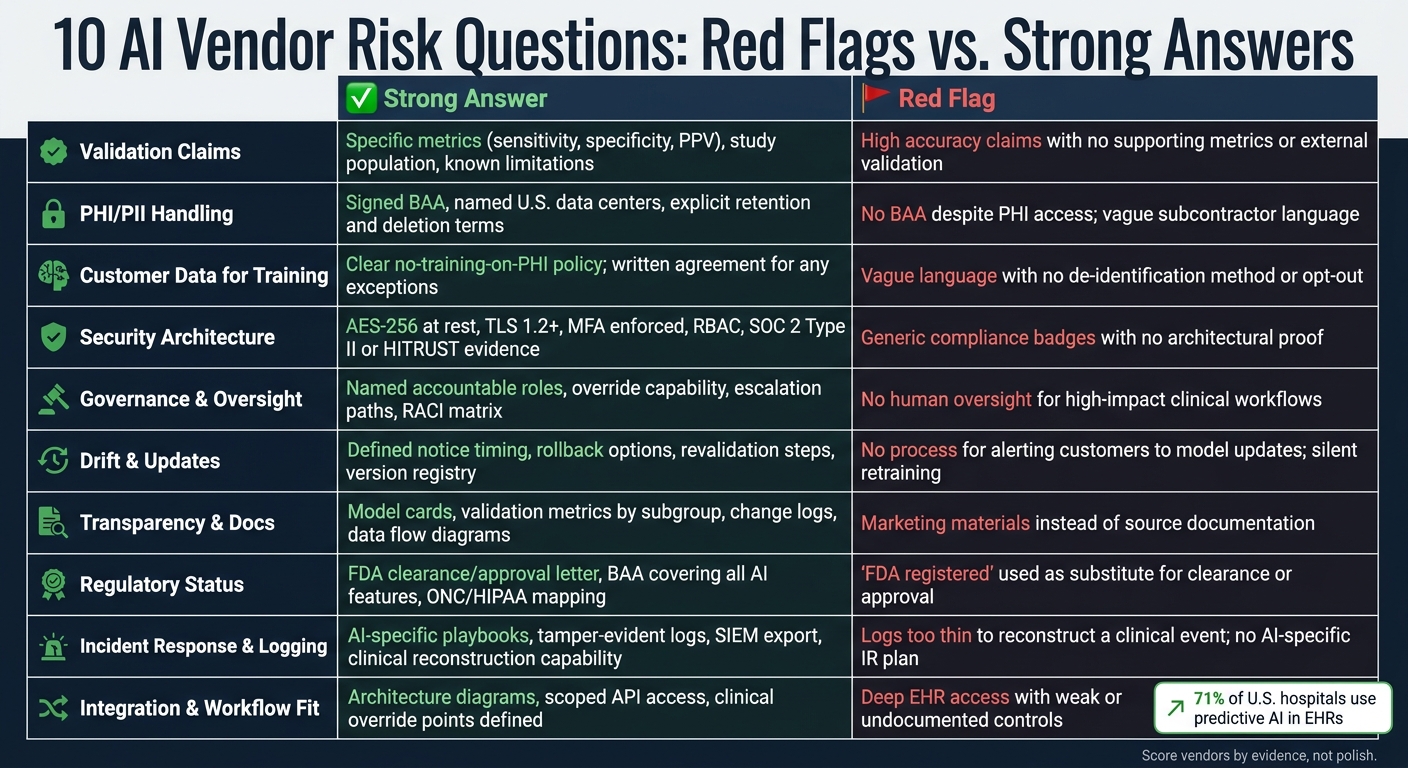
10 AI Vendor Risk Questions: Red Flags vs. Strong Answers
Once you ask the questions, judge the answers by evidence, not tone. A polished reply can sound good and still tell you very little. What matters is specificity and proof.
A strong vendor gives exact version numbers, explains who was included in validation, and points you to source documents, not just polished summaries. If there’s no documentation, the claim is unverified. Then check whether the story stays the same across training, privacy, governance, and change control. If those answers don’t line up, that’s a problem.
Pay close attention to vague language about training use and fuzzy statements about human oversight. Those aren’t small issues. They tie straight to PHI exposure and patient safety. And if a vendor can’t clearly explain notice timing and rollback, their change control process is weak.
Use the summary below to sort answers fast and spot gaps that need follow-up.
| Area | Strong | Red Flag |
|---|---|---|
| Validation claims | Specific metrics (sensitivity, specificity, PPV), study population, known limitations | High accuracy with no supporting metrics or external validation |
| PHI/PII handling | Signed BAA, named U.S. data centers, explicit retention and deletion terms | No BAA despite PHI access; vague subcontractor language |
| Customer data for training | Clear no-training-on-PHI policy; written agreement for any exceptions | Vague language with no de-identification method or opt-out |
| Human oversight | Named accountable roles, override capability, escalation paths | No human oversight for high-impact clinical workflows |
| Change notification | Defined notice timing, rollback options, revalidation steps | No process for alerting customers to model updates |
| Evidence provided | Model cards, third-party pen test results, SOC 2 Type II, incident-response runbooks | Generic marketing materials; refusal to share documentation |
Assign each gap an owner and a due date.
Using Censinet to Scale AI Vendor Risk Assessments
Asking the right questions is only half the job. The other half is handling the answers at scale across AI vendors, multiple clinical teams, and overlapping risk areas. Once gaps are assigned, a shared workflow helps send them to the right owners and turn vendor responses into decisions, ownership, and follow-up.
Censinet RiskOps™ gives healthcare organizations one intake and workflow layer for AI vendor reviews. That means teams can use a single assessment workflow for clinical, imaging, and other AI vendors, with shared questions, scoring, and escalation paths. That kind of consistency matters when security, privacy, clinical, compliance, and procurement teams all need to review the same vendor from different angles.
Its Digital Risk Catalog™ can show whether a vendor already has a verified assessment on file. According to Censinet, the average assessment time dropped from more than 40 days to less than 5 days.[83][81]
The platform is built for the risk areas that matter most in healthcare AI, including:
- PHI and PII handling
- Clinical applications
- Medical devices
- Supply chain dependencies
It also maps fourth-party relationships, including the upstream model, cloud, and API dependencies behind a vendor's AI solution. If several vendors rely on the same underlying infrastructure, that creates concentration risk. And that's the kind of issue you want to spot early, not after something goes wrong.
Evidence review is part of the workflow too. Reviewers can track whether required evidence has been submitted and verified. Censinet AI™ speeds this up by automatically summarizing vendor evidence, mapping upstream model, cloud, and API dependencies, and generating risk summary reports, while keeping human reviewers involved in final decisions.
After the review, findings need to get to the teams responsible for action without delay. The platform routes them to the right stakeholders automatically. PHI handling gaps go to the privacy team, clinical validity concerns go to clinical governance, regulatory questions go to legal and compliance, and contract gaps go to procurement.
That routing creates accountability and a clear audit trail: a documented record of who reviewed what, when decisions were made, and why a vendor was approved or rejected. Findings also feed into a Risk Register, where ownership, remediation timelines, and follow-up are tracked through resolution.[82]
Conclusion
Use these 10 questions as a repeatable part of vendor review, not a one-and-done checklist. They do their best work inside a standing review process. That’s where they become practical, not just procedural.
Taken together, these questions cover privacy, security, compliance, clinical safety, and day-to-day fit. And that matters because AI risk doesn’t sit in one place. It shows up across data handling, model behavior, governance, and system integration.
The next step is simple: turn vendor answers into decisions. Score the gaps, assign owners, and put key requirements into the contract. A vendor risk review only matters if it changes access, contract terms, and go-live decisions.
Third-party vendors are still a major source of breaches, and AI vendors can add more exposure when they touch PHI or clinical workflows. These questions help surface AI risk before it affects care.
For teams that need a repeatable process at scale, Censinet RiskOps™ helps healthcare teams scale recurring AI vendor reviews, track PHI-related controls, and document remediation across the vendor portfolio.
FAQs
What evidence should I ask vendors to provide first?
Start by asking vendors for concrete evidence behind their claims, not just polished summaries. You want paperwork that shows how the algorithm performs in practice, with a close look at safety, reliability, and accuracy. That usually means clinical evidence, validation studies, and any test results that show the tool works as promised.
It also helps to ask for proof that they take data protection and compliance seriously. Look for items like signed BAAs and SOC 2 Type II certification, along with bias audit results, incident response plans, and healthcare case studies or customer references. Those materials can tell you a lot about how the vendor operates when the stakes are high.
When does an AI vendor need a BAA?
An AI vendor needs a Business Associate Agreement (BAA) if it creates, receives, maintains, or transmits PHI. Under HIPAA, that’s mandatory any time PHI is involved.
Here’s the key point: the trigger is the presence of PHI, not the contract type.
That matters because some teams get hung up on labels. Is it a software deal? A consulting deal? A pilot? A data-processing add-on? Under HIPAA, that’s not the main issue. If the vendor touches PHI in any of those ways, a BAA is required.
And there’s not much room to dodge that rule. Sharing PHI with a vendor that has not signed a BAA is a HIPAA violation. For most AI tools that process or analyze data, the conduit exception usually doesn’t apply. In plain English: if the service does more than just pass data from point A to point B, you should assume a BAA is on the table.
How can I spot model drift after go-live?
Use continuous monitoring to track technical and day-to-day performance after go-live. Ask your vendor for real-time dashboards that show the metrics that matter: AUROC, precision, recall, sensitivity, specificity, false positive rates, and alert burden.
That gives you a live view of how the model is doing in practice, not just how it looked during testing. If performance starts to slip, you want to spot it early.
It also helps to use statistical tests to catch data shifts as they happen. On top of that, run quarterly bias audits across demographic groups. And don’t leave these points vague in the contract. Spell out defined performance thresholds, regular reports, and retraining notifications so everyone knows what happens if results change.
