
When healthcare organizations use cloud services, two agreements are critical: Business Associate Agreements (BAAs) and Service Level Agreements (SLAs). These serve different purposes but work together to ensure compliance with HIPAA and reliable cloud performance.
- BAA: A HIPAA-required contract that governs how vendors handle Protected Health Information (PHI). It focuses on data privacy, security measures, breach notifications, and compliance responsibilities. Without a valid BAA, handling PHI in the cloud violates HIPAA.
- SLA: A commercial agreement that sets measurable performance standards like uptime, disaster recovery, and support response times. It ensures operational reliability but does not address HIPAA compliance directly.
Key takeaway: A BAA protects patient data and ensures regulatory compliance, while an SLA ensures the cloud service meets performance expectations. Both are necessary to manage risks like data breaches, service disruptions, and compliance failures.
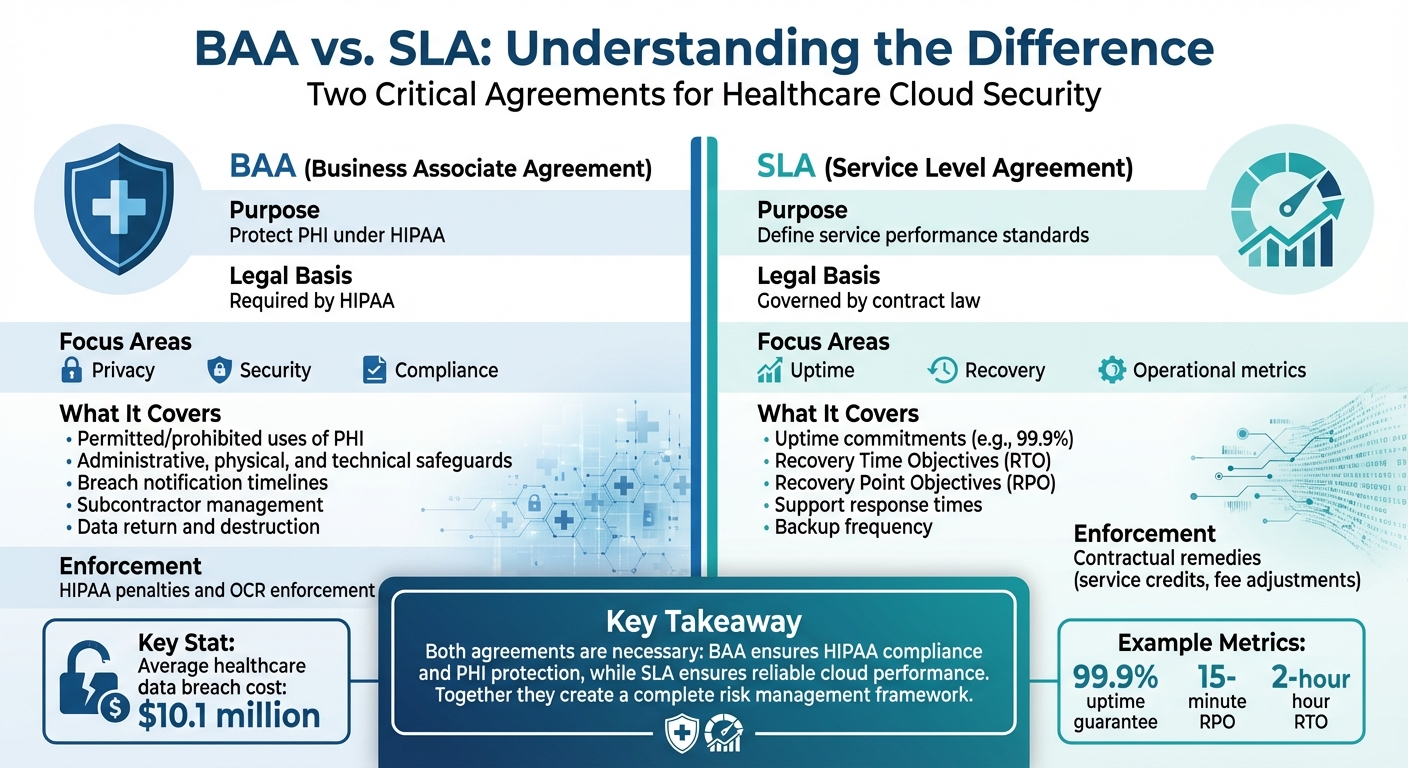
BAA vs SLA in Healthcare Cloud Security: Key Differences
Quick Comparison
| Dimension | BAA | SLA |
|---|---|---|
| Purpose | Protect PHI under HIPAA | Define service performance standards |
| Legal Basis | Required by HIPAA | Governed by contract law |
| Focus | Privacy, security, and compliance | Uptime, recovery, and operational metrics |
| Enforcement | HIPAA penalties for non-compliance | Contractual remedies (e.g., service credits) |
Together, BAAs and SLAs form a framework to safeguard healthcare data and ensure reliable cloud services. Misunderstanding their roles can lead to HIPAA violations, service issues, and costly breaches.
What Are Business Associate Agreements (BAAs)?
BAA Definition and Requirements
A Business Associate Agreement (BAA) is a legally mandated contract under HIPAA that establishes a formal relationship between a covered entity - like a hospital, health plan, or health system - and a business associate that handles protected health information (PHI) or electronic PHI (ePHI) on behalf of the covered entity. In the context of cloud services, this applies to any provider that stores, processes, backs up, or analyzes ePHI.
Before any PHI is handled, a BAA must be in place. Without it, both parties risk penalties from the Office for Civil Rights (OCR). Common scenarios requiring a BAA include hosting electronic health records (EHRs), managing patient portals, offering cloud backup solutions, disaster recovery services, processing analytics on patient data, and using collaboration tools for case discussions.
It’s important to note that both business associates and any subcontractors they work with are held accountable for HIPAA violations. The BAA ensures that vendors adhere to HIPAA’s Privacy and Security Rules, outlining how patient data must be handled, secured, and reported in the event of an incident.
The agreement must clearly define responsibilities and security measures, as detailed in the following sections.
What BAAs Must Include
To comply with HIPAA, a BAA must address several key areas. First, it must specify permitted and prohibited uses and disclosures of PHI. This includes whether the vendor can use the data for purposes like de-identification, aggregation, or service improvements, with strict limitations on any secondary uses.
Next, the BAA must require the vendor to implement robust safeguards. These include administrative, physical, and technical measures such as role-based access controls, multi-factor authentication, encryption, audit logging, network segmentation, vulnerability management, and tested disaster recovery plans.
Another critical element is breach notification and incident response. The agreement should define what constitutes a security incident or breach, set a notification timeline after discovery, and outline the details to be shared - such as the systems affected, types of data involved, scope of the issue, containment steps, and remediation plans.
The BAA must also address subcontractor management. Subcontractors who handle PHI must sign agreements that meet the same stringent standards as the primary BAA. Additionally, the vendor is responsible for maintaining oversight of subcontractors' security practices.
Finally, the agreement must detail data return and secure destruction procedures for when the contract ends. This includes specifying how PHI will be returned, the format for data export, deadlines, and methods for securely erasing PHI from systems, backups, logs, and caches. Common methods in cloud environments include cryptographic erasure (crypto-shredding of keys), secure overwriting, and confirmation that PHI has been removed from replicated systems. Many healthcare organizations also require a certificate of destruction as part of the offboarding process.
What BAAs Don't Cover
While BAAs are essential for meeting HIPAA requirements, they have limitations. They focus solely on PHI protection and regulatory obligations and do not address broader operational or performance aspects. For instance, BAAs don’t typically include guarantees for service uptime, response times for support, recovery time objectives (RTOs), recovery point objectives (RPOs), or financial remedies for downtime. They also don’t specify backup frequency, retention policies, or other service-level details.
Additionally, BAAs may not outline configuration responsibilities in shared-responsibility cloud models or set precise technical standards, such as log retention durations or performance benchmarks. These operational and performance details are generally covered in Service Level Agreements (SLAs) or security addenda, which complement the BAA. While the BAA ensures compliance with HIPAA, SLAs are necessary to address service reliability and operational continuity.
What Are Service Level Agreements (SLAs)?
SLA Definition and Purpose
A Service Level Agreement (SLA) is a formal contract between a cloud service provider and a customer, outlining specific performance standards the provider must meet to ensure reliable operations. While a Business Associate Agreement (BAA) focuses on HIPAA-required privacy and security measures for Protected Health Information (PHI), an SLA addresses measurable service expectations like system uptime, disaster recovery capabilities, and support response times.
Although HIPAA doesn’t require SLAs, they are essential in healthcare cloud arrangements. The U.S. Department of Health and Human Services (HHS) highlights that covered entities and business associates often use SLAs to define operational expectations such as system availability, data backups, and security roles. Without clearly defined SLA terms, organizations risk confusion over responsibilities, potentially leading to service disruptions, compromised patient care, or compliance failures.
These metrics lay the foundation for the operational details discussed below.
What SLAs Must Include
A well-crafted SLA for HIPAA-regulated cloud services should establish clear, measurable metrics that directly support security and operational reliability, complementing the goals set in the BAA. Here are some key components:
- Uptime and Availability Commitments: SLAs typically guarantee uptime levels, such as 99.9% or 99.95% monthly availability for production systems. They should also clarify what constitutes downtime and how planned maintenance is handled.
- Recovery Objectives: These include Recovery Point Objectives (RPO), which define the maximum allowable data loss, and Recovery Time Objectives (RTO), which specify the maximum time to restore services. For instance, an SLA might promise an RPO of 15 minutes and an RTO of 2 hours for critical systems like electronic health records (EHR).
- Support Responsiveness: SLAs should outline response times based on incident severity. For example, a critical (P1) issue might require a 15-minute acknowledgment and resolution within a set timeframe, with 24/7 support availability.
- Security Event Logging and Monitoring: The SLA should specify which systems are logged, how long logs are retained (typically 1–2 years in healthcare), customer access to logs, and support for Security Information and Event Management (SIEM) tools to detect threats to PHI.
- Backup and Redundancy: Clear terms on backup frequency, geographic redundancy, and data handling - such as export or deletion processes at contract termination - are critical.
- Continuity Planning: Provisions for major incidents like cyberattacks or regional outages should include commitments to maintain service continuity.
Many SLAs also include financial penalties or service credits if the provider fails to meet agreed performance targets, ensuring accountability beyond regulatory requirements.
How SLAs Work with HIPAA and BAAs
SLAs must work in harmony with BAAs and HIPAA requirements to create a unified security and compliance framework. They should align with and support the BAA and HIPAA mandates, never contradicting or replacing them. The HHS advises that covered entities carefully review SLAs to ensure they clearly allocate security and privacy responsibilities without conflicting with BAA obligations.
For example, SLA timelines for incident reporting must align with stricter breach notification requirements in the BAA or HIPAA. If the BAA mandates breach notification within 24 hours, the SLA’s response timelines must complement - not delay - this obligation. Similarly, SLA terms around security responsibilities (like managing encryption keys or access controls) must reflect the shared responsibility model outlined in the BAA.
Together, SLAs and BAAs form a robust risk management strategy for cloud services, where SLA performance metrics reinforce the security measures required by law, ensuring a seamless approach to compliance and operational reliability.
sbb-itb-535baee
BAAs vs. SLAs: Side-by-Side Comparison
Main Differences Between BAAs and SLAs
BAAs and SLAs play key roles in healthcare cloud security, but they have distinct purposes. A Business Associate Agreement (BAA) is required under HIPAA and governs how Protected Health Information (PHI) is managed. On the other hand, a Service Level Agreement (SLA) outlines performance expectations for services. Even if PHI is encrypted, cloud providers are still classified as business associates and must sign a BAA.[1]
Violating a BAA can trigger HIPAA enforcement by the Office for Civil Rights (OCR), leading to investigations, corrective action plans, or hefty civil penalties. Business associates, including cloud providers, are directly liable if they fail to implement safeguards or report breaches. SLA breaches, however, are usually handled through contractual remedies like service credits, fee adjustments, or termination rights. Regulators typically step in only if poor service performance results in a broader HIPAA violation.
Here’s a quick comparison of the two:
| Dimension | BAA (Business Associate Agreement) | SLA (Service Level Agreement) |
|---|---|---|
| Legal Basis | Required by HIPAA/HITECH when a vendor handles PHI; enforced by OCR | Governed by general contract law; no direct HIPAA liability |
| Primary Purpose | Protect PHI and define HIPAA responsibilities | Set performance standards, such as uptime and support |
| Security Focus | Centers on HIPAA safeguards and compliance | Focuses on operational performance like availability and recovery |
| Parties Covered | Applies to covered entities, business associates, and subcontractors handling PHI | Limited to the direct customer-provider relationship |
| Enforcement | Non-compliance may result in OCR penalties and corrective actions | Breaches are resolved contractually (e.g., service credits) |
| Typical Contents | Covers PHI use, safeguards, breach notification timelines | Includes uptime targets (e.g., 99.9%), support response times, disaster recovery terms |
Despite their differences, misunderstandings about BAAs and SLAs are common and can lead to compliance risks.
Common Mistakes About BAAs and SLAs
Many organizations mistakenly assume that a high-performing SLA guarantees HIPAA compliance, or that a BAA ensures excellent service quality. The truth? An SLA often lacks the HIPAA-specific safeguards that a BAA addresses, while a BAA focuses solely on PHI protection and regulatory responsibilities - not service performance metrics like uptime or support.
HIPAA compliance issues often arise when BAAs fail to include critical services or SLAs omit clear disaster recovery terms.[4] Another frequent error involves cloud providers using a "no-view" model, where data is encrypted, and the provider lacks the decryption key. Some believe this exempts the provider from signing a BAA. However, the Department of Health and Human Services (HHS) has clarified that such providers are still considered business associates and must sign a BAA.
These misconceptions can lead to serious risks. Relying solely on an SLA for HIPAA compliance may leave PHI vulnerable, potentially triggering OCR enforcement. On the flip side, weak SLA terms around recovery times or backups could disrupt clinical operations during outages, even if PHI remains secure. The HIPAA Journal warns that using cloud services outside the "in-scope" list defined in a BAA violates compliance rules, as PHI must only be processed on HIPAA-compliant services.[2]
Understanding the distinctions between BAAs and SLAs is essential for creating contracts that address both compliance requirements and operational needs effectively.
How to Use BAAs and SLAs Together
Healthcare organizations need to combine Business Associate Agreements (BAAs) and Service Level Agreements (SLAs) to create a strong compliance framework. BAAs outline the privacy and security responsibilities required under HIPAA, such as permitted uses of Protected Health Information (PHI), necessary safeguards, breach reporting, and data handling guidelines. SLAs take these responsibilities a step further by setting measurable performance standards, like uptime percentages, recovery time objectives (RTO), response times, and backup intervals.
This dual-contract approach ensures compliance isn't just theoretical but actively enforced through operational performance. For instance, a BAA might require a cloud vendor to maintain audit controls that satisfy HIPAA Security Rule standards. The corresponding SLA would then specify enforceable commitments, such as retaining logs for one to six years, delivering logs within 15 minutes, providing regular security reports, and setting thresholds for alerts. Without this alignment, legal protections may exist on paper, but operational enforcement could fall short. This alignment also lays the groundwork for precise contract negotiations.
What to Negotiate in Contracts
When working on contracts with cloud vendors, healthcare organizations should focus on integrating BAA requirements with SLA performance metrics seamlessly. Key areas to negotiate include breach notification clauses with clear timelines and detailed incident reporting. Some BAAs mandate customers to enable encryption, audit logging, and restrict usage to covered services, emphasizing the need for SLAs and configurations that align with BAA compliance.
After establishing initial contract terms, it's critical to ensure that logging and monitoring requirements are consistently enforced across both agreements. BAAs typically require audit controls and log retention, while SLAs should specify the monitoring tools, event capture processes, log delivery timelines, and response expectations.
Another important area is disaster recovery and business continuity planning. Contracts should define specific RTO and Recovery Point Objective (RPO) values for essential clinical systems, ensure frequent backups, require geographic redundancy within the U.S., and mandate annual disaster recovery testing, with documented results shared with the healthcare organization.
To strengthen this risk management framework, it's also crucial to address subcontractor compliance. Vendors must be required to extend BAA obligations to any subcontractors with PHI access and maintain SLAs that meet or exceed the healthcare organization's standards for security and performance. This is especially important given the financial stakes - IBM's 2024 Cost of a Data Breach report highlights that the average cost of a healthcare data breach is approximately $10.1 million per incident, the highest across all industries [3].
Using Risk Management Platforms
Managing these complex agreements can be streamlined with centralized risk management platforms. Tools like Censinet RiskOps™ help healthcare organizations standardize and oversee BAAs and SLAs across numerous vendors. These platforms provide a centralized system to inventory vendors and their agreements, conduct risk assessments tailored to HIPAA requirements, and identify gaps where SLAs might not fully support BAA or regulatory needs.
For example, Tower Health's CISO, Terry Grogan, shared that using Censinet RiskOps™ allowed three full-time employees to return to their primary roles, while the organization managed to conduct more risk assessments with just two dedicated staff members. Similarly, James Case, VP & CISO at Baptist Health, noted that Censinet replaced spreadsheets for risk management and enabled collaboration with a broader network of hospitals.
"Censinet RiskOps allowed 3 FTEs to go back to their real jobs! Now we do a lot more risk assessments with only 2 FTEs required."
- Terry Grogan, CISO, Tower Health
These platforms also automate important tasks like contract renewal reminders, disaster recovery test result tracking, incident history documentation, and collaborative remediation efforts with vendors. For cloud vendors managing PHI, Censinet RiskOps™ ensures that contractual obligations align with the actual maturity of their controls across clinical applications, medical devices, supply chains, and other ePHI-related services. This kind of centralized approach tackles real-world challenges - according to a 2023 American Health Information Management Association (AHIMA) survey, 40% of organizations reported delays due to incompatible digital signature tools when managing BAAs and related contracts [3].
Conclusion
Business Associate Agreements (BAAs) and Service Level Agreements (SLAs) serve distinct yet complementary purposes in the realm of healthcare cloud security. While the BAA ensures compliance with HIPAA regulations, the SLA focuses on maintaining the operational performance needed for clinical care. Together, they form a critical foundation for safeguarding both regulatory and service standards.
Relying on just one of these agreements can leave dangerous gaps. A BAA without an SLA might tick the compliance box but leaves you exposed to service disruptions, delayed incident responses, and vague recovery timelines - issues that can directly impact patient care. On the flip side, an SLA without a BAA puts you at risk of non-compliance with HIPAA, which could result in penalties and enforcement actions. With healthcare data breaches averaging a staggering $10.1 million per incident[3], the financial and reputational risks of inadequate contracts are far too great to overlook.
This underscores the importance of an integrated approach. The best strategy is to view BAAs and SLAs as interconnected elements of your cloud security and risk management efforts. A BAA establishes the baseline for HIPAA compliance, while an SLA ensures those requirements align with your organization's tolerance for risks like downtime, data loss, or slow recovery times. Negotiating contracts that address specifics - such as backup frequency, geographic redundancy within the U.S., and penalties for missed performance targets - ensures both compliance and operational resilience.
To simplify this complex process, healthcare organizations can leverage centralized platforms like Censinet RiskOps™. These tools help standardize BAAs and SLAs across vendors, conduct HIPAA-aligned risk assessments, and pinpoint gaps where operational commitments fall short of regulatory standards. By aggregating risk data, automating contract reminders, and monitoring performance, these platforms turn BAAs and SLAs into proactive tools for managing evolving threats and compliance needs. This holistic approach is key to ensuring both regulatory adherence and uninterrupted, high-quality patient care.
FAQs
What’s the difference between a BAA and an SLA in healthcare cloud security?
A Business Associate Agreement (BAA) is a legal document that spells out the responsibilities of vendors when they handle Protected Health Information (PHI). Its primary goal is to ensure compliance with HIPAA regulations while safeguarding patient data and privacy.
In contrast, a Service Level Agreement (SLA) focuses on setting clear expectations for a vendor's performance. This includes details about service reliability, response times, and specific security measures.
When it comes to healthcare cloud security, BAAs tackle the legal and privacy aspects, while SLAs concentrate on operational performance and maintaining security standards. Together, these agreements work to ensure compliance and dependable service.
What roles do BAAs and SLAs play in ensuring HIPAA compliance and reliable cloud operations?
In healthcare, Business Associate Agreements (BAAs) and Service Level Agreements (SLAs) play crucial roles in protecting protected health information (PHI) and ensuring dependable cloud services. BAAs focus on meeting HIPAA standards by outlining how vendors must handle and safeguard PHI, holding them legally accountable. On the other hand, SLAs set clear expectations for performance metrics like uptime, security measures, and response times, ensuring consistent operational reliability.
Together, these agreements form a cohesive framework that helps healthcare organizations minimize risks, adhere to regulations, and uphold strong security and performance standards.
Why is it crucial to negotiate both BAA and SLA terms with cloud vendors?
Negotiating a Business Associate Agreement (BAA) alongside a Service Level Agreement (SLA) is crucial when partnering with cloud vendors, particularly in the healthcare industry. These agreements ensure accountability and establish clear security protocols.
A BAA focuses on HIPAA compliance, mandating that vendors protect Protected Health Information (PHI) and adhere to legal standards for data security. It’s all about safeguarding sensitive patient information and ensuring the vendor meets its obligations.
Meanwhile, an SLA sets expectations for the vendor’s performance, covering areas like security protocols, uptime commitments, and remedies if standards aren’t met. Together, these agreements create a solid framework that minimizes risks, defines responsibilities, and reinforces trust in managing healthcare data.
