
Benefits of Cybersecurity Standards in Supply Chain Frameworks
Post Summary
Cybersecurity standards are essential for protecting medical device supply chains. They address vulnerabilities like outdated software, unsecured components, and third-party risks, which can lead to costly breaches and operational disruptions. For example, healthcare data breaches reached an average cost of $9.8 million in 2024, and incidents involving medical devices surged by 437% in 2023.
Key takeaways:
- Stronger Risk Management: Standards like FDA Section 524B and ISO 13485 ensure manufacturers and suppliers identify and address vulnerabilities early, using tools like SBOMs (Software Bill of Materials) for real-time monitoring.
- Improved Compliance: Aligning with regulations such as the FDA's QMSR (effective February 2026) integrates cybersecurity into quality management, reducing risks of recalls or enforcement actions.
- Enhanced Incident Response: Clear protocols, such as reporting critical vulnerabilities within 24 hours, improve coordination across stakeholders.
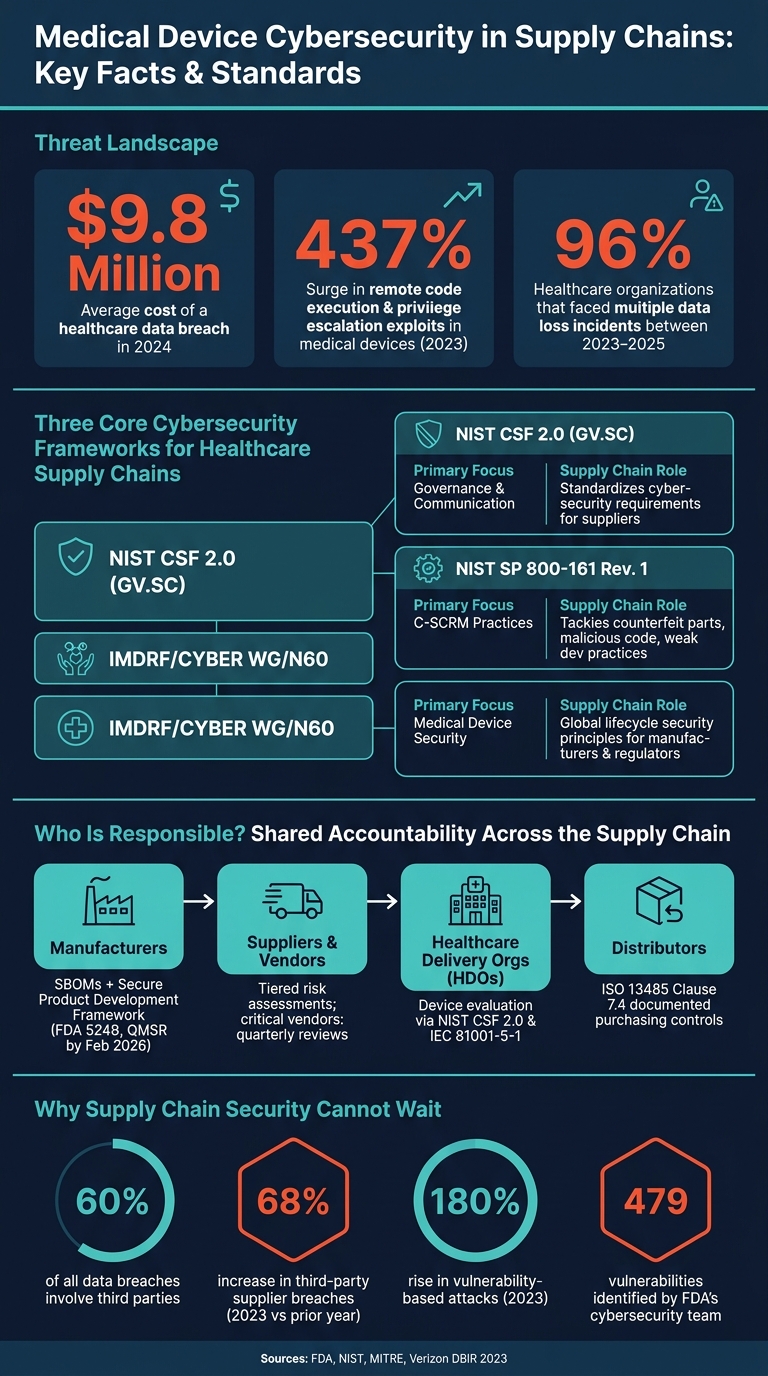
Medical Device Cybersecurity: Key Stats & Standards at a Glance
Supply chain security in the health sector SBOMs and digitally-enabled medical devices: by Nick Baty
sbb-itb-535baee
Overview of Cybersecurity Standards in Supply Chains
This section dives into key frameworks that play a crucial role in securing supply chains, particularly in the healthcare sector. These standards are not just procedural checklists - they provide a structured approach to identifying risks, setting clear requirements, and ensuring accountability across the intricate web of supply chain participants.
Key Standards and Guidelines
When it comes to medical device supply chains, three frameworks stand out for their relevance and application:
NIST SP 800-161 Rev. 1 adopts a layered approach to Cybersecurity Supply Chain Risk Management (C-SCRM). It weaves risk management into strategic planning, policy-making, and product evaluations, emphasizing the need to address threats like counterfeit components, malicious software, and weak development practices.
"Organizations are concerned about the risks associated with products and services that may potentially contain malicious functionality, are counterfeit, or are vulnerable due to poor manufacturing and development practices within the supply chain." - National Institute of Standards and Technology [5]
NIST CSF 2.0 expands on this with the introduction of its GV.SC (Governance – Supply Chain) category. This framework helps organizations formalize their C-SCRM capabilities and standardize cybersecurity expectations for technology providers. As NIST explains:
"The CSF can help an organization become a smart acquirer and supplier of technology products and services." [4]
IMDRF/CYBER WG/N60, created by the International Medical Device Regulators Forum, lays out globally aligned principles for managing the security of medical devices throughout their lifecycle - from initial design to retirement. This framework is particularly valuable for manufacturers navigating multiple regulatory environments, with input from entities like the U.S. FDA and the European Commission [6].
| Standard | Primary Focus | Role in Healthcare Supply Chain |
|---|---|---|
| NIST CSF 2.0 (GV.SC) | Governance and communication | Standardizes cybersecurity requirements for suppliers [4] |
| NIST SP 800-161 Rev. 1 | C-SCRM practices | Tackles risks from counterfeit parts, malicious code, and weak development practices [5] |
| IMDRF/CYBER WG/N60 | Medical device security | Provides global lifecycle security principles for manufacturers and regulators [6] |
These frameworks offer a foundation for securing the supply chain, tailored to the unique needs of different stakeholders.
How Standards Apply Across Supply Chain Stakeholders
Each stakeholder in the medical device supply chain has specific responsibilities to ensure these standards are upheld, creating a system of shared accountability.
Manufacturers play a central role. By February 2026, under FDA Section 524B and the updated QMSR incorporating ISO 13485, manufacturers must adopt a Secure Product Development Framework and produce machine-readable Software Bill of Materials (SBOMs). These SBOMs provide transparency into third-party components embedded in devices, ensuring downstream stakeholders are informed.
Suppliers and vendors are bound by contractual cybersecurity requirements. Risk assessments are tiered based on their access to sensitive data or control over devices. For instance, critical vendors like cloud service providers undergo quarterly reviews, while lower-risk vendors might only face scrutiny during onboarding.
Healthcare Delivery Organizations (HDOs) act as the "acquirers" in this ecosystem. They rely on frameworks like NIST CSF 2.0 and IEC 81001-5-1 to evaluate device security. For older devices no longer supported with patches, HDOs often implement compensating controls such as network segmentation.
"Cybersecurity risk management of medical devices has always been shared between device manufacturers and healthcare delivery organizations." - MITRE [1]
Distributors must comply with ISO 13485 Clause 7.4, which requires documented purchasing controls for entities handling cybersecurity-critical components or services. This ensures that security measures are verified at every stage of the distribution process, rather than assumed.
Tools like Censinet RiskOps™ simplify risk assessments across the entire supply chain, connecting manufacturers, suppliers, HDOs, and distributors under a unified platform.
Research Findings: Risk Reduction Benefits
A staggering 96% of healthcare organizations faced multiple data loss incidents between 2023 and 2025 [1]. This underscores the pressing need for a structured, standards-driven approach to identifying and addressing cybersecurity vulnerabilities. Tackling these risks requires proactive strategies during the development phase of devices.
Earlier Identification of Vulnerabilities
Standards like FDA Section 524B mandate manufacturers to provide machine-readable Software Bill of Materials (SBOMs) in formats such as SPDX or CycloneDX. These SBOMs enable organizations to automatically cross-check every third-party component against vulnerability databases like NVD/CVE in real time. This means newly disclosed threats can be addressed immediately, rather than weeks later. Such real-time monitoring plays a critical role in addressing vulnerabilities early.
The February 2026 QMSR transition strengthens this approach by aligning FDA requirements with ISO 13485. It integrates cybersecurity into design controls under Clause 7.3, ensuring vulnerabilities are identified during development and validation - long before a device reaches a patient. Additionally, contractual clauses requiring vendors to report critical vulnerabilities within 24 hours further enhance this early detection process.
Better Risk Visibility and Control Consistency
Prompt identification of vulnerabilities is only part of the equation. Cybersecurity standards also bring consistency to oversight processes. By classifying vendors into risk categories - Critical, High, Medium, and Low - organizations can align assessment frequencies with actual risk levels. For instance, vendors handling sensitive patient data undergo quarterly reviews, while lower-risk vendors are assessed less frequently. This systematic approach replaces irregular reviews with a reliable, repeatable framework.
In 2023, vulnerabilities became a primary breach vector, with attacks exploiting them rising by 180%. Alarmingly, 15% of these breaches involved third-party suppliers - a 68% increase from the previous year [7]. By linking cybersecurity practices like threat modeling and penetration testing to specific regulatory clauses, standards-based frameworks ensure critical gaps are addressed.
"Typical supply chain risk management techniques, such as questionnaires and ratings, are no longer sufficient." - RSAC Executive Security Action Forum (ESAF) [7]
Lower Exposure to Breaches and Supply Chain Failures
Weak supply chain controls can lead to devastating breaches. The Change Healthcare incident serves as a vivid example of how a single supply chain failure can spiral into catastrophe [1]. In 2023, remote code execution and privilege escalation exploits in medical devices surged by 437% [1], highlighting the speed at which unmanaged vulnerabilities can escalate.
With third parties accounting for nearly 60% of all data breaches [7], strengthening supply chain controls is essential. Documented vendor controls, continuous monitoring, and shared responsibility frameworks significantly reduce these risks. For example, the FDA's cybersecurity team has identified 479 vulnerabilities and issued 17 safety alerts by enforcing standardized security-by-design protocols [3]. Tools like Censinet RiskOps™ help healthcare organizations implement these controls at scale, connecting risk data across vendors, devices, and supply chain partners to minimize exposure to breaches.
Operational and Compliance Benefits
Cybersecurity standards aren’t just about reducing risks - they also bring operational and compliance perks that make supply chain management smoother. By integrating cybersecurity into governance, procurement, audits, and incident response, these standards help organizations stay ahead in regulatory and operational efficiency.
Stronger Governance and Accountability
One major shift driven by cybersecurity standards is the move to treat security as a core part of quality management, not just an IT concern. This change is reinforced by the FDA's Quality Management System Regulation (QMSR), effective February 2, 2026, which embeds cybersecurity into ISO 13485 design and development controls. The FDA emphasizes this integration:
"Cybersecurity is not separate from quality - it is part of it." - U.S. Food and Drug Administration (FDA) [8]
This approach creates standardized documentation, such as SBOMs, supplier risk classifications, and quality agreements, which simplifies regulatory submissions and audit preparations. For example, manufacturers maintaining an Approved Supplier List (ASL) with detailed supplier classifications and quality agreement references are better equipped during FDA inspections.
Quality agreements play a key role in holding suppliers accountable. These agreements typically include change notification timelines (60–90 days) and audit rights, ensuring manufacturers maintain control over outsourced components or processes. As Ran Chen, a Global MedTech Expert, puts it:
"When you outsource a manufacturing step or purchase a component, you do not outsource regulatory responsibility." - Ran Chen, Global MedTech Expert [2]
By embedding these governance measures, organizations naturally strengthen their compliance efforts.
Support for Regulatory Compliance
The QMSR has reshaped how the FDA evaluates supplier oversight. ISO 13485 Clause 7.4 now enforces a risk-based approach to supplier evaluation, replacing the older QSR rule (21 CFR 820.50). Here’s a breakdown of the shifts under QMSR:
| Area | Pre-QMSR (820.50) | Post-QMSR (ISO 13485 via QMSR) | Practical Impact |
|---|---|---|---|
| Supplier Evaluation | Evaluate and select suppliers | Clause 7.4.1: Structured criteria for selection, monitoring, and re-evaluation | Requires documented, risk-based criteria |
| Purchasing Info | Include quality requirements | Clause 7.4.2: Detailed specs, QMS requirements, and change notification | Must align purchasing documents to a 7.4.2 checklist |
| Verification | Establish acceptance activities | Clause 7.4.3: Risk-based verification tied to supplier risk level | Must document risk rationale for verification intensity |
Failing to meet these updated standards can have serious consequences. For instance, if cybersecurity information is missing or inadequate in device labeling, the device could be classified as "misbranded" under section 502(f) of the FD&C Act, potentially leading to recalls or even criminal charges [9]. Adopting frameworks like IEC 81001-5-1 or using Predetermined Change Control Plans (PCCPs) can help organizations streamline post-market security updates, avoiding the need for repeated full regulatory reviews.
Better Incident Response Coordination
A strong compliance framework also improves how organizations handle security incidents. Under QMSR, incident response is aligned with ISO 13485 Subclause 8.5.2, treating cybersecurity issues with the same rigor as physical defects. This ensures vulnerabilities are addressed through formal corrective action processes rather than ad hoc IT fixes.
Machine-readable SBOMs further enhance incident response by enabling manufacturers and healthcare organizations to quickly identify affected devices when a new CVE is disclosed. Vendor contracts with clear incident reporting timelines - such as 24 hours for critical vulnerabilities and 72 hours for high-risk issues - ensure swift coordination across the supply chain. Tools like Censinet RiskOps™ help centralize risk data and automate workflows, making it easier to manage risks across vendors, devices, and partners.
"Those who treat cybersecurity as part of their quality culture and not just their submission strategy will be best positioned to meet regulatory expectations and build long-term trust." - George Strom, Director, Intertek Connected World [8]
Challenges and Implementation Considerations
Healthcare organizations face numerous hurdles when trying to implement cybersecurity standards across their supply chains. These challenges are significant, and understanding them is critical to addressing them effectively. Without tackling these issues head-on, the potential advantages of robust cybersecurity measures remain out of reach.
Common Adoption Barriers
One of the biggest challenges is extended vendor risk. Cybersecurity vulnerabilities often don’t originate from direct vendors alone - they can stem from third-party vendors further down the chain. For example, a cloud provider used by your software supplier could introduce risks that you never directly agreed to manage. This layered complexity makes it tough to maintain thorough oversight.
Adding to the problem are legacy medical devices. Many of these devices remain in use for 10–15 years, even after their original software stops receiving security updates. This leaves unpatched systems vulnerable, creating a growing risk for healthcare organizations.
Another issue is the siloed nature of organizational structures. When cybersecurity efforts are confined to the IT department, they fail to integrate with other critical areas like engineering and quality management. Even well-established frameworks, such as the Secure Product Development Framework (SPDF), lose their effectiveness when isolated.
"A siloed SPDF rarely delivers consistent, comprehensive impact." - Exponent [9]
Uneven vendor maturity is another obstacle. Many suppliers lack basic security certifications, such as ISO 27001 or SOC 2. Without standardized assessments, organizations often have no clear understanding of their weakest links. These barriers highlight the need for a more integrated, collaborative approach to cybersecurity.
What It Takes to Succeed
Overcoming these challenges requires targeted strategies that address specific gaps. The table below outlines common issues and their solutions:
| Gap | Risk | Solution |
|---|---|---|
| Siloed Teams | Cyber risks not managed through QMS | Integrate cybersecurity into QMS risk management and CAPA |
| Incomplete SBOMs | Cannot identify vulnerable components | Require machine-readable SBOMs (SPDX or CycloneDX) from all software vendors |
| Legacy Devices | Unpatched components in clinical use | Implement compensating controls like network segmentation |
| No Contract Clauses | Cannot enforce vendor cooperation | Add specific security and incident response clauses to all agreements |
In addition to these fixes, organizations should classify vendors through third-party vendor risk management - Critical, High, Medium, or Low. This ensures resources are focused where risks are most significant. For instance, critical vendors should undergo quarterly assessments, while lower-tier vendors might only need reviews during onboarding or after specific events [1].
Contracts also play a key role. They should enforce clear cybersecurity requirements, such as mandatory SBOM delivery, vulnerability notifications within 24 hours for critical issues, and audit rights. These measures transform vendor security from informal agreements into enforceable obligations [1].
Finally, continuous monitoring is more effective than annual reviews. Automated tools that scan against CVE databases and threat intelligence feeds allow organizations to identify vulnerabilities as soon as they’re disclosed. This proactive approach ensures that affected devices and components are flagged immediately, rather than weeks later during a scheduled review.
"Cybersecurity must be designed, validated, documented, and sustained through the same disciplined processes that govern every other aspect of medical device compliance." - George Strom, Director, Intertek Connected World [8]
Platforms like Censinet RiskOps™ support this kind of ongoing oversight by centralizing risk data and automating assessments. This enables healthcare organizations to maintain proactive supply chain risk management, reducing exposure to breaches and ensuring compliance with industry standards.
Conclusion
Key Takeaways
Cybersecurity standards are proving to be a game-changer for managing risks in medical device supply chains. By embedding proactive measures like early detection of vulnerabilities and lowering remediation costs, these standards create a more secure foundation. The inclusion of SBOM (Software Bill of Materials) requirements further strengthens the process, offering transparency that allows swift responses to newly disclosed CVEs.
On the compliance front, aligning with regulations like FDA Section 524B and QMSR provides tangible benefits. It minimizes the likelihood of deficiency letters, market entry delays, and enforcement actions. When cybersecurity is woven into ISO 13485 processes - spanning from design inputs to corrective actions - it evolves from being just an IT concern to a core component of quality management.
Final Thoughts on Cybersecurity Standards
These insights underscore the critical importance of robust security practices in medical device supply chains. Integrating cybersecurity into every phase of device development and oversight not only supports compliance but also strengthens operational resilience.
Medical devices represent 5% to 11% of all endpoints in hospital settings [10]. Yet, a single compromised device can lead to widespread clinical disruptions. With the average cost of a breach reaching $9.8 million in 2024 [1], ignoring supply chain security is a risk no organization can afford to take.
Adopting cybersecurity standards ensures that medical devices function as intended, free from unexpected interference. As Phil Englert, Director of Medical Device Security at Health-ISAC, aptly states: "Cybersecurity engineering is about preventing devices from doing tasks you don't want or expect." [10] Tools like Censinet RiskOps™ make this vision actionable by centralizing risk data and facilitating continuous, standards-aligned oversight across vendors and devices.
FAQs
What should we require from vendors beyond an SBOM?
Vendors should go beyond just providing a Software Bill of Materials (SBOM). They need to update SBOMs regularly, report critical vulnerabilities within 24 hours, and ensure compliance with recognized standards like ISO 27001. Additionally, vendors must disclose any vulnerabilities, maintain well-documented incident response plans, and give 12–18 months’ notice before retiring end-of-life components. These steps are in line with FDA guidelines and global frameworks aimed at tackling cybersecurity risks effectively.
How do we manage cybersecurity risk for legacy medical devices that can’t be patched?
Managing cybersecurity risks for legacy medical devices that can't be patched demands a forward-thinking, risk-focused strategy. Start by identifying these devices through constant monitoring and ensure they're documented within a detailed risk management program. Tools like Censinet RiskOps™ can assist healthcare organizations by automating Software Bill of Materials (SBOM) assessments and vendor evaluations. This process provides clear insights into vulnerabilities, allowing teams to prioritize risks effectively and apply compensating controls when direct patching isn't an option.
How can we align FDA 524B and the QMSR deadline without slowing procurement?
To meet the February 2, 2026, QMSR deadline outlined in FDA Section 524B without slowing down procurement processes, it's essential to integrate cybersecurity measures directly into your purchasing controls. Since QMSR is built on ISO 13485:2016, ensuring supplier cybersecurity becomes a key part of maintaining quality standards.
Tools like Censinet RiskOps™ can simplify this process. They help automate risk assessments, manage Software Bill of Materials (SBOMs), and standardize the collection of critical evidence, such as penetration test results and vulnerability scans. By embedding these steps into your purchasing workflow, you can ensure compliance while making quicker, more informed decisions.

