
If I had to cut this down to one point, it’s this: no single framework is enough for healthcare cloud risk review. I’d use HIPAA as the legal floor, then add NIST, ISO, CIS, or FedRAMP based on the type of vendor, the data involved, and how much proof I need.
Here’s the short version:
- HIPAA is required when a cloud vendor handles ePHI and needs a BAA
- NIST CSF helps me organize vendor risk and score maturity
- NIST SP 800-53 gives deep control detail for high-risk systems
- CIS Controls gives me a short list of technical checks
- ISO/IEC 27001 adds third-party certification and ISMS oversight
- ISO/IEC 27017 adds cloud-specific control areas like shared responsibility and tenant isolation
- ISO/IEC 27018 focuses on privacy for public-cloud data processing
- FedRAMP adds federal-level assessment, authorization, and monitoring
In plain terms: HIPAA tells me what must be protected, NIST and CIS help me test security, ISO helps me review governance and audit scope, and FedRAMP fits federal healthcare work. That matters because healthcare data breaches are still costly, and cloud risk often comes down to one simple question: can the vendor prove its controls work for the exact service I use?
Cloud Compliance Explained: SOC 2, HIPAA, PCI-DSS & GDPR Guide
sbb-itb-535baee
Quick Comparison
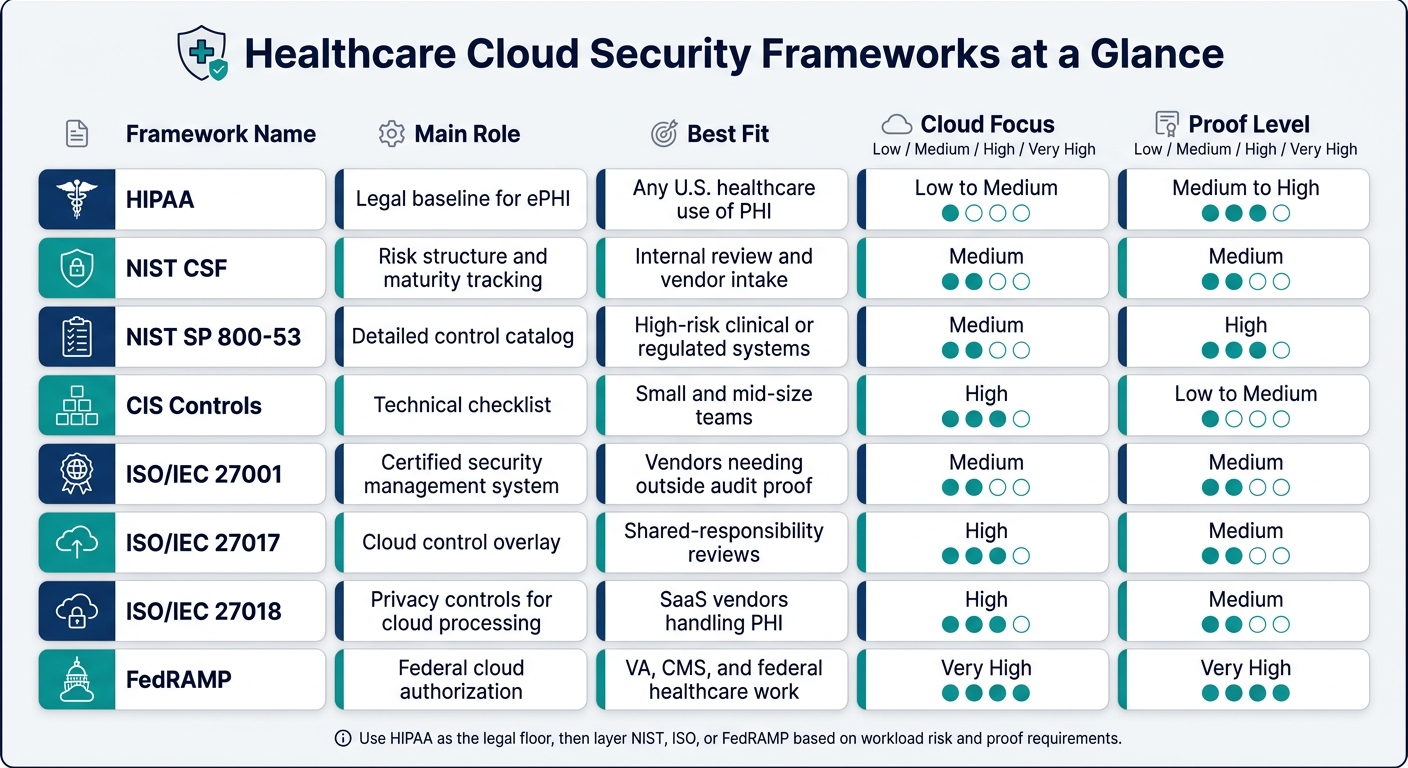
Healthcare Cloud Security Frameworks Compared: HIPAA, NIST, ISO & FedRAMP
| Framework | Main Role | Best Fit | Cloud Focus | Proof Level |
|---|---|---|---|---|
| HIPAA | Legal baseline for ePHI | Any U.S. healthcare use of PHI | Low to medium | Medium to high |
| NIST CSF | Risk structure and maturity tracking | Internal review and vendor intake | Medium | Medium |
| NIST SP 800-53 | Detailed control catalog | High-risk clinical or regulated systems | Medium | High |
| CIS Controls | Technical checklist | Small and mid-size teams | High | Low to medium |
| ISO/IEC 27001 | Certified security management system | Vendors needing outside audit proof | Medium | Medium |
| ISO/IEC 27017 | Cloud control overlay | Shared-responsibility reviews | High | Medium |
| ISO/IEC 27018 | Privacy controls for cloud processing | SaaS vendors handling PHI | High | Medium |
| FedRAMP | Federal cloud authorization | VA, CMS, and federal healthcare work | Very high | Very high |
My takeaway: pick the lightest framework mix that still fits the workload. A scheduling app, claims tool, and cloud clinical platform should not all be reviewed the same way.
Below, I break down where each framework fits, what it does well, and what proof I’d ask a cloud vendor to provide.
1. HIPAA
Healthcare fit
HIPAA is the federal baseline for U.S. covered entities and business associates that handle electronic protected health information (ePHI). If a cloud provider stores or processes ePHI for a customer, that provider is a business associate. That means it must meet the Security Rule and Breach Notification Rule. It also means a signed BAA is required.
For vendor review, the core issue is pretty simple: can the provider show, in writing, that it meets those duties?
Cloud specificity
This is where things get a little messy for healthcare buyers. HIPAA tells you what duties exist, but it doesn't spell them out for a cloud setup. It assigns responsibility by entity type, not by architecture layer.
So the split often looks like this: the provider secures the platform, while the healthcare customer still owns configuration, identity settings, and access controls. If those lines aren't clear, gaps can slip in fast.
HIPAA also uses required and addressable controls. That gives room for different approaches, which can help in practice. But it can also lead to uneven vendor security if you don't pair HIPAA with stricter frameworks like NIST or ISO 27001.
PHI/privacy alignment
HIPAA's Privacy, Security, and Breach Notification Rules set the rules for how PHI can be used, protected, and reported when a cloud vendor is part of the picture.
Evidence burden
HIPAA requires a documented risk analysis for each cloud configuration, plus 6-year log retention. That's a heavy proof burden, especially in cloud setups where settings can change over time.
HIPAA also does not require vendor audit access by default. Because of that, healthcare organizations often add those terms directly into the BAA or SLA.
HIPAA sets the legal floor. The next frameworks add the technical and governance depth needed to review cloud vendors with more consistency.
2. NIST Cybersecurity Framework (CSF)
Healthcare fit
NIST CSF gives healthcare organizations a clear way to set cybersecurity priorities and track risk over time. HIPAA tells you what you’re on the hook for. CSF helps organize how to manage it.
That makes it useful in day-to-day vendor reviews. Teams can use CSF to structure vendor risk assessment questions, score maturity, and compare cloud providers in a more consistent way.
The biggest change in NIST CSF 2.0 is the new Govern function. Govern covers risk strategy, ownership, and policy oversight. For vendor assessments, that matters a lot. It gives healthcare organizations a clearer way to assign accountability, including when third-party cloud vendors handle PHI.
Cloud specificity
NIST CSF is platform-neutral. It works across AWS, Azure, GCP, and hybrid environments. But there’s a catch: it doesn’t tell you which platform controls to use.
So healthcare teams have to translate CSF outcomes into platform-level controls. For example, they might map the Protect function’s data security outcomes (PR.DS) to AWS KMS or Azure Key Vault. Without that extra step, CSF can stay a bit abstract.
PHI/privacy alignment
CSF outcomes line up closely with PHI safeguards such as encryption, access control, and third-party risk management. In practice, teams can use the framework to check whether a vendor handles encryption, access control, logging, and third-party risk in a way that meets healthcare privacy needs.
Evidence burden
NIST CSF comes with a medium evidence burden. Since it is not certifiable, there is no formal certification to ask for.
Instead, request:
- Current Profile
- Target Profile
- Implementation Tier
- Any self-assessments or third-party reviews
That flexibility helps, but it also means the proof can vary a lot from one vendor to another. So it’s smart to be very specific about the evidence you want. If you need control-level detail, the next framework goes a step further. NIST SP 800-53 gets more specific by defining the controls behind these outcomes.
3. NIST SP 800-53
Healthcare fit
SP 800-53 takes CSF-style outcomes and turns them into detailed, auditable controls for healthcare cloud risk. That level of detail matters. It gives teams a place to review actual control families, not just high-level policy language.
It fits best when a system failure could affect patient safety or create legal risk.
Cloud specificity
SP 800-53 is cloud-neutral, so teams need to map it to the controls in their cloud platform. It also serves as the technical backbone for FedRAMP, which tailors these controls for cloud service providers.
If you're reviewing cloud vendors, focus first on vendors mapped to FedRAMP Moderate or FedRAMP High baselines.
PHI/privacy alignment
Revision 5 fully integrated privacy controls into the core control set instead of treating privacy as a separate add-on. [3]
| Control Family | Why It Matters for Healthcare Cloud |
|---|---|
| Access Control (AC) | Helps enforce least-privilege access to PHI in cloud IAM systems |
| Audit and Accountability (AU) | Supports logging and monitoring of cloud activity for HIPAA audit trails |
| Privacy / PII Processing and Transparency | Directly addresses privacy risks tied to patient data |
| Incident Response (IR) | Supports HIPAA Breach Notification Rule readiness |
| Contingency Planning (CP) | Covers cloud-based disaster recovery for patient data |
Evidence burden
SP 800-53 comes with a very high evidence burden, with over 1,000 individual controls in Revision 5. [3] In plain English, this is not a lightweight framework you skim and move on from. Teams usually need an SSP, a POA&M, and assessment evidence to show the controls are in place and working.
A practical shortcut is the official NIST-to-HIPAA crosswalk. It helps you see which SP 800-53 controls line up with specific HIPAA Security Rule requirements, so you don't have to start from the full catalog.
If your team needs a lighter operational checklist, the next framework is CIS Controls.
4. CIS Controls
Healthcare fit
For teams that don't need the extra layer of detail in SP 800-53, CIS gives you a faster place to start. The CIS Controls work well as a practical, prioritized checklist for cloud vendor reviews, especially for small and mid-size healthcare teams that don't have a large compliance group.
In plain English: CIS sits under HIPAA and NIST CSF as the day-to-day action layer. It helps teams turn broad security goals into specific checks they can actually run.
Cloud specificity
Version 8.1 adds direct guidance for hybrid cloud setups.[4] Control 1 calls for an inventory of cloud-based assets, which helps teams keep track of devices and systems that touch PHI.[5]
CIS also goes a step further with CIS Benchmarks. These give technical configuration guidance for platforms like AWS, Azure, and GCP, similar to other healthcare cybersecurity tools, so they are more prescriptive than NIST CSF or HIPAA when it comes to actual cloud setup.[2] That's a big deal during vendor review. Before you get into a deeper privacy review, you can check whether the vendor can lock down the cloud environment in the first place.
PHI/privacy alignment
CIS is about security, not HIPAA Privacy Rule duties. It helps protect the confidentiality, integrity, and availability of PHI, but it doesn't cover patient access rights or "Minimum Necessary" use policies.
For cloud vendor assessments, Control 15 is the main safeguard to focus on. Three controls matter a lot for healthcare cloud work:
| CIS Control | Relevance to Healthcare Cloud |
|---|---|
| Control 3 (Data Protection) | Identifies, classifies, and protects PHI, aligning with PHI handling requirements [5] |
| Control 11 (Data Recovery) | Ensures availability of medical records after an incident [5] |
| Control 15 (Service Provider Management) | Requires processes to evaluate third-party risk for cloud vendors holding sensitive data [5] |
Control 15 gives healthcare teams a clear way to ask cloud vendors the right technical questions before signing a contract.
Evidence burden
The evidence burden is lower here than with SP 800-53. Each CIS "Safeguard" asks for one specific, implementable action instead of a policy document.[4] That makes the framework easier to use when time and staff are tight.
CIS also groups its safeguards into three Implementation Groups (IGs). IG1 covers core cyber hygiene, IG2 fits more mature security teams, and IG3 is aimed at advanced threat environments.[2] For evidence, ask for items that show current security in action, such as:
- CIS Benchmark reports
- MFA logs
- Vulnerability scan results
Those usually tell you more than static PDFs that may already be out of date.
When a healthcare organization needs formal certification, ISO/IEC 27001 is the next step.
5. ISO/IEC 27001
Healthcare fit
CIS gives teams a practical checklist. ISO/IEC 27001 goes a step further by adding a certifiable management system.
That matters in healthcare because it puts an auditable system on top of HIPAA. It also goes past minimum HIPAA requirements to cover enterprise data more broadly, including PHI.
Cloud specificity
When you review a vendor, don’t stop at the fact that they have a certificate. Check whether the certificate scope covers the exact cloud services, regions, and data types you use. This is a critical step in healthcare vendor risk assessment to ensure no hidden gaps exist.
That detail matters more than most teams think. A vendor may be certified, but only for part of its environment. The 2022 revision also added stronger supply-chain controls in Annex A.5.19–A.5.23 [7]. That’s directly tied to cloud vendor review in healthcare, where data often moves across a web of providers, subprocessors, and hosted systems.
PHI/privacy alignment
ISO 27001 is not a privacy law. Still, Annex A.5.34 deals with PII protection.
Even so, that does not replace HIPAA-specific paperwork and response duties. You still need separate coverage for BAAs and HIPAA breach timelines.
Evidence burden
ISO 27001 certification requires an accredited third-party audit, not a self-assessment. So when a cloud vendor gives you an ISO 27001 certificate, an independent body has already checked its ISMS.
The single most important artifact to request is the Statement of Applicability (SoA). This document shows all 93 Annex A controls, which controls the vendor has put in place, and - just as important - which controls were excluded and why [7][9].
If a vendor excluded controls such as data masking (A.8.11) or data leakage prevention (A.8.12), treat that as a coverage gap.
| Key Artifact | What It Tells You |
|---|---|
| Statement of Applicability (SoA) | Which of the 93 controls are in scope and why any are excluded [7][9] |
| Accredited Certificate | Confirms independent third-party verification of the ISMS [8][9] |
| Scope Definition | Verifies coverage includes your specific cloud services, regions, and PHI data types [9] |
For more cloud-specific depth, pair ISO/IEC 27001 with ISO/IEC 27017 and ISO/IEC 27018.
6. ISO/IEC 27017
Healthcare fit
ISO/IEC 27017 builds on ISO 27001 and adds cloud-focused controls that matter in shared-responsibility setups. It’s a cloud-specific companion to ISO/IEC 27001 that spells out security duties for cloud services.
For healthcare vendor reviews, that matters for a simple reason: you need to know who owns which risk. ISO/IEC 27017 helps sort out what the provider must secure and what stays on the customer side, with a close focus on cloud duties for systems that store or process PHI.
Cloud specificity
The seven added controls focus on cloud gaps that show up again and again in vendor reviews.
| Control Area | What It Means for Healthcare |
|---|---|
| Shared responsibility | Defines exactly what your organization vs. the vendor must secure |
| Secure data deletion | Procedures for removing PHI when a contract ends or a service is decommissioned |
| Tenant isolation | Ensures PHI in a multi-tenant cloud is logically isolated from other customers |
| VM configuration hardening | Security configurations for virtual machines processing healthcare data |
| Privileged admin controls | Enhanced monitoring of the vendor's privileged administrators |
| Cloud activity monitoring | Monitoring for suspicious cloud activity |
| Cloud network controls | Ensures virtual network security meets internal healthcare network standards |
In practice, that puts shared-responsibility mapping and cloud audit rights at the center of vendor review. If a provider can’t clearly show where its job ends and yours begins, that’s a red flag.
PHI/privacy alignment
ISO 27017 fits well for healthcare teams that already map HIPAA to ISO 27001/27002 and need cloud-specific controls on top of that base. It gives those teams a more direct way to check cloud safeguards without starting from scratch, often by using automated security questionnaires.
Evidence burden
Treat ISO 27017 as something usually audited alongside ISO 27001, not as a standalone certification. Ask for the Statement of Applicability, then verify that both Annex A controls and the seven cloud-specific controls are in scope.
That’s why ISO 27017 is most useful when it’s paired with ISO 27001, rather than reviewed on its own.
7. ISO/IEC 27018
Healthcare fit
ISO/IEC 27017 deals with cloud operating duties. ISO/IEC 27018 adds privacy controls for PII handled by public-cloud providers acting as processors. In healthcare, it matters when a cloud vendor processes PHI in a public cloud.
PHI/privacy alignment
For healthcare vendor review, focus on three proof points.
- Purpose limitation: Vendors can collect only the data needed for the stated purpose, and they must delete it once that purpose is met.
- Subprocessor disclosure: If your cloud provider uses subcontractors that touch PHI, ISO/IEC 27018 requires disclosure of that chain.
- Access, correction, and deletion workflows: The standard requires technical support for these rights [10].
These controls give healthcare teams a cleaner way to standardize evidence requests during third-party reviews [6].
Cloud specificity
Use the 2025 edition as your review baseline. Older certifications may not reflect current control expectations [11]. Ask vendors to show data portability in exportable, machine-readable formats. That helps confirm the certification is tied to day-to-day controls, not just paperwork [10].
Evidence burden
Use ISO/IEC 27018 to check privacy evidence, not just policy language. It is often put in place as an extension of an ISO/IEC 27001-based ISMS [11][6]. Ask for control mapping, test procedures, audit artifacts, and an inheritance matrix that shows which controls the provider manages and which ones your organization owns [6]. Also verify that the cloud services, regions, and features you use are inside the vendor’s audit boundary [6].
8. FedRAMP
For federal healthcare vendors, FedRAMP adds an authorization layer for third-party risk that HIPAA and ISO certifications don’t provide.
Healthcare fit
FedRAMP is the best match for cloud vendors that serve federal healthcare customers or handle high-sensitivity clinical workloads to protect patient care from cyberattacks.
Cloud specificity
FedRAMP standardizes cloud authorization, assessment, and continuous monitoring through controls based on NIST SP 800-53. Put simply, it turns those controls into a cloud authorization program. That makes it the only framework in this list that brings assessment, authorization, and ongoing monitoring together in one structure.
PHI/privacy alignment
FedRAMP gives you a high-assurance security baseline for PHI, but it doesn’t replace HIPAA. You still need a BAA, and you still have to address HIPAA Privacy Rule and Breach Notification Rule requirements on their own [12][13]. FedRAMP covers the technical baseline; HIPAA still handles the legal and administrative side.
Evidence burden
Ask for:
- the authorization letter
- the SSP
- the latest 3PAO report
- the POA&M [13]
You’ll also want to confirm the authorization level. Use Moderate for lower-risk workloads and High for the most sensitive PHI systems [13].
If a vendor says it is FedRAMP-aligned instead of authorized, ask for a third-party gap analysis or a NIST SP 800-53 assessment report before you move forward [14]. Those documents help you verify whether the vendor is in fact authorized for your cloud workload.
Which Framework Mix Fits Each Healthcare Use Case
The better question isn't which single framework should you use. It's which mix fits the workload without piling on work you don't need.
Think of the frameworks above as building blocks. The right stack depends on the job in front of you and the level of proof you need to show regarding cybersecurity metrics.
| Use Case | Recommended Framework Mix | Best Use | Cloud Depth | Privacy Fit | Proof Burden |
|---|---|---|---|---|---|
| Enterprise Governance | HIPAA + NIST CSF | High (Baseline) | Moderate (Agnostic) | High | Low to Moderate |
| Cloud Vendor Assessments | HIPAA + ISO/IEC 27001 + 27017 | Moderate | High (Cloud-specific) | Moderate | Moderate (Auditable) |
| Privacy-Sensitive SaaS Reviews | HIPAA + ISO/IEC 27018 | Moderate | High (PII in Cloud) | Very High | Moderate |
| Federal Healthcare Procurement | HIPAA + FedRAMP (NIST SP 800-53) | High (Regulatory) | Very High | High | Very High |
This table gives you the default mix. The notes below spell out when each option makes sense. The goal is simple: match the stack to your governance, vendor review, privacy, or procurement risk without adding controls that don't help the workload.
Next, look at the tradeoffs across these frameworks so you can pick the lightest stack that still meets your risk requirements.
Pros and Cons of Each Framework for Healthcare Cloud Vendor Assessment
No single framework covers everything. Each one does a different job, and the tradeoffs matter. The table below compares them side by side by value, limits, and best-fit use case so you can match the level of review to the workload and proof you need.
| Framework | Key Pro | Key Con | Best-Fit Healthcare Scenario |
|---|---|---|---|
| HIPAA | Mandatory baseline for U.S. covered entities and business associates handling ePHI [1] | No formal certification; requires heavy documentation to prove due diligence [1] | All U.S. healthcare entities and business associates handling ePHI |
| NIST CSF | Flexible and technology-agnostic; maps easily to other standards using Implementation Tiers (1–4) [1] | No formal certification; leaves control selection entirely to the organization [1] | Internal security posture baselining and gap analysis before vendor onboarding |
| NIST SP 800-53 | Detailed, auditable control families that map directly to HIPAA Security Rule requirements | Very high evidence burden; over 1,000 controls require an SSP, POA&M, and assessment artifacts | High-sensitivity clinical systems where a control failure could affect patient safety or create legal risk |
| CIS Controls | Action-oriented; prioritized safeguards with direct cloud configuration guidance via CIS Benchmarks [15] | Lacks the governance and ISMS structure needed for enterprise-level compliance [15] | Technical security teams focused on immediate, measurable risk reduction |
| ISO/IEC 27001 | Globally recognized and certifiable; provides an auditable ISMS with independent third-party verification [1] | Broad scope; not healthcare-specific without additional overlays [1] | Global cloud vendors and international healthcare operations |
| ISO/IEC 27017 | Extends ISO/IEC 27001 with cloud-specific controls covering shared responsibility, tenant isolation, and secure data deletion [15] | Requires ISO/IEC 27001 as a prerequisite; narrow focus on cloud-specific risks [15] | Cloud service providers where shared-responsibility boundaries need formal definition |
| ISO/IEC 27018 | Adds enforceable privacy controls for PII in public cloud, including purpose limitation and subprocessor disclosure | Typically implemented as an extension of ISO/IEC 27001; not a standalone privacy compliance mechanism | Privacy-sensitive SaaS reviews where a vendor processes PHI in a public cloud environment |
| FedRAMP | Highly rigorous; built for government-level assurance with continuous monitoring built in [15] | High cost and effort to achieve and maintain [15] | Vendors serving federal healthcare agencies such as the VA or CMS |
Some patterns jump out fast. HIPAA is the floor for U.S. healthcare handling ePHI, but it does not give you a neat certificate to point to, so proof depends on documents and audit trails [1]. NIST CSF works well when you want a plain-language way to size up a vendor using cybersecurity benchmarks before onboarding, but it gives your team a lot of freedom, which can be good or messy depending on how disciplined the review process is [1].
Then there’s NIST SP 800-53, which is a different beast. It gives deep control detail and strong audit support, but the evidence load is heavy. For high-risk clinical systems, that level of rigor may be worth it. For a lower-risk tool, it can feel like using a fire hose to water a houseplant.
CIS Controls helps technical teams move fast. If the goal is to lock down cloud settings, reduce attack paths, and get to measurable fixes, CIS is often a smart pick [15]. But it does not give you the management system structure many large healthcare groups want when they’re checking enterprise compliance.
The ISO/IEC family fits best when the vendor operates across countries or needs third-party certification. ISO/IEC 27001 gives the management system and outside verification [1]. ISO/IEC 27017 goes further into cloud issues like shared responsibility and tenant separation [15]. ISO/IEC 27018 adds privacy rules for PII in public cloud, which matters a lot in SaaS reviews involving PHI.
FedRAMP sits at the far end of rigor. It is expensive and time-heavy, but if a vendor serves agencies like the VA or CMS, that level of assurance may be expected [15].
That leads to one practical rule: choose the lightest mix of frameworks that still fits the risk. A small scheduling app should not need the same proof stack as a cloud-hosted clinical platform tied to patient care.
Conclusion
HIPAA sets the legal baseline. NIST CSF helps teams organize risk. NIST SP 800-53 goes a step further by mapping that risk to specific controls and the proof reviewers often want to see. CIS Controls adds a more hands-on, prioritized layer for technical teams. The right mix comes down to your workload risk, how much of your setup lives in the cloud, and the kind of evidence your reviewers expect.
For cloud vendors, the next step is figuring out how much cloud-focused and privacy-focused proof you need. ISO/IEC 27001 adds governance and certification. ISO/IEC 27017 and 27018 build on that with cloud-focused shared responsibility guidance and privacy controls. Which combination makes sense depends on the sensitivity of the PHI involved, the scope of your cloud footprint, and the proof you need to provide.
In day-to-day work, a layered, risk-based approach tends to make the most sense. Censinet RiskOps™ helps healthcare teams run third-party and enterprise risk assessments and benchmark vendor controls.
FAQs
Which framework should we start with?
For healthcare organizations that are just getting started with cloud security, NIST CSF is often the best place to begin. It gives teams a flexible, risk-based way to think about security through six core functions: Govern, Identify, Protect, Detect, Respond, and Recover.
That matters because healthcare teams often need a framework that fits where they are now, not one that feels too heavy on day one. NIST CSF lines up well with HIPAA and can work for organizations with different sizes and maturity levels.
Once that base is in place, HITRUST CSF can help make compliance work easier to manage and support certification.
When is a BAA required for a cloud vendor?
A Business Associate Agreement (BAA) is required any time a cloud vendor stores or handles electronic protected health information (ePHI).
Under HIPAA, cloud service providers count as business associates even if they can't encrypt or decrypt the data.
How do we verify a vendor’s cloud controls?
Request supporting documentation such as SOC 2 Type II reports, HITRUST certifications, ISO 27001 certificates, and other audit reports to confirm the vendor’s controls line up with industry standards and HIPAA rules.
Then review each document closely. Check the scope, the date, and the source. Make sure it covers the systems that will store, process, or transmit PHI. It’s easy to see a certificate and assume you’re covered, but that can be a trap if the audited systems don’t match the ones your team will use.
A few things to verify:
- The report or certificate is current and issued by a known third party
- The scope includes the vendor services and systems tied to your PHI
- The claims match official registries or issuer records
- A signed BAA is in place where required
Keep records of audit reports, certifications, and signed BAAs so your team can show due diligence and support compliance over time.
