
Healthcare IT systems are unique because vulnerabilities can directly affect patient safety. Threat modeling is a critical process to identify and address these vulnerabilities early, especially in clinical workflows, medical devices, and systems handling Protected Health Information (PHI). Here's a quick summary of the key practices:
- Integrate into Agile Development: Conduct short, focused threat modeling sessions during development to catch risks early.
- Use STRIDE Framework: Identify threats systematically (Spoofing, Tampering, etc.) and prioritize risks to safety and data security.
- Focus on Clinical Goals: Prioritize protecting workflows that impact patient care.
- Leverage Threat Libraries: Use predefined resources like OWASP Top 10 to streamline risk identification.
- Map Data Flows: Visualize PHI movement to highlight vulnerabilities. This is critical as many healthcare vendors have experienced data breaches exposing sensitive patient information.
- Review Regularly: Update models with every new feature or system change.
- Align with Regulations: Ensure compliance with FDA and HIPAA requirements through structured documentation.
- Score Risks: Rank threats based on likelihood and patient safety impact.
- Document Thoroughly: Maintain detailed records for audits and compliance.
- Use Collaborative Tools: Platforms like Censinet RiskOps simplify risk management and third-party vendor risk assessments.
Threat modeling is essential for maintaining security, compliance, and patient safety in healthcare IT. By following these practices, organizations can address risks proactively and effectively.
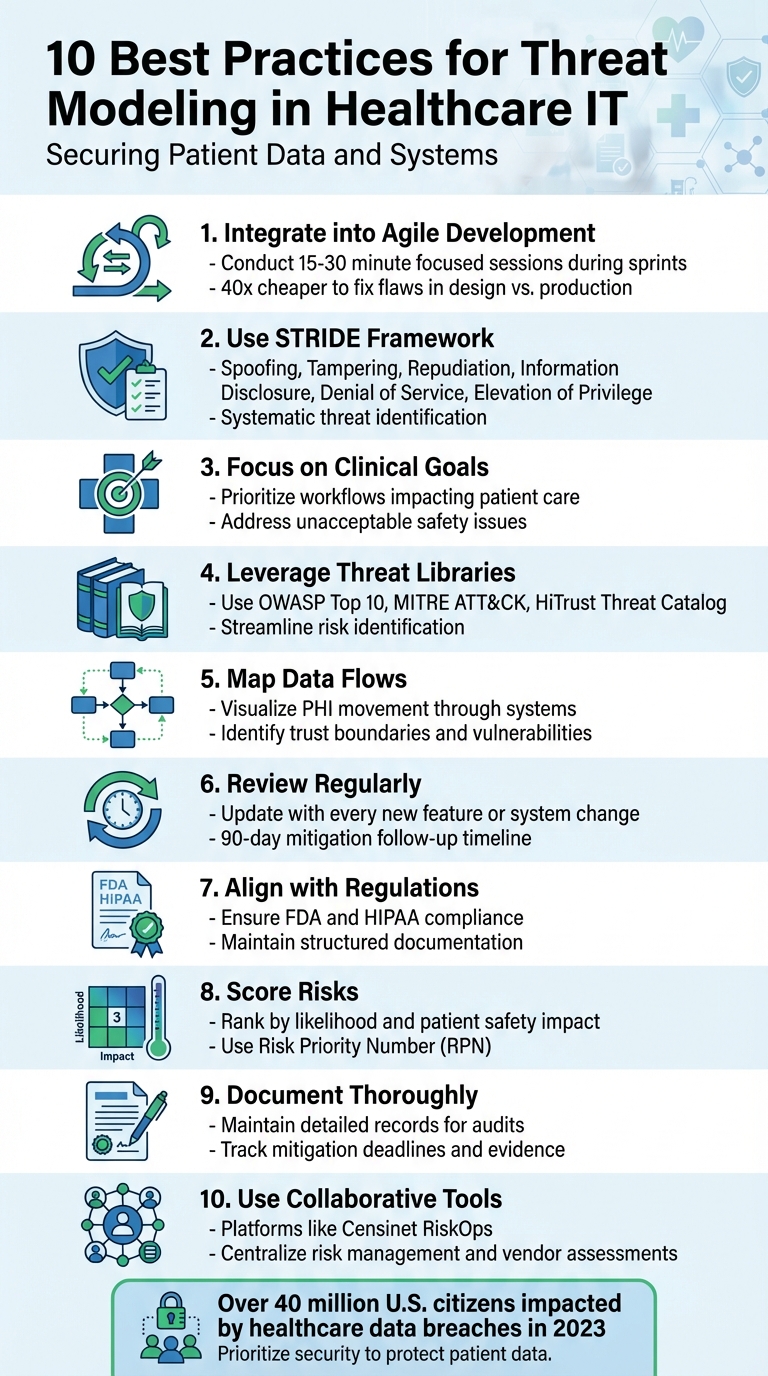
10 Best Practices for Threat Modeling in Healthcare IT
Threat Modeling and Risk Assessment Webinar
sbb-itb-535baee
Benefits of Threat Modeling in Healthcare IT
Threat modeling brings a host of advantages that go beyond the usual security checklists. One major perk? It helps catch vulnerabilities before any code is written, saving organizations from the headache and expense of fixing issues after deployment. As Black Duck emphasizes:
Threat modeling is the most effective way to detect problems early in the software development life cycle (SDLC) - even before coding begins [4].
But it doesn’t stop there. Threat modeling can uncover design flaws that automated tests and code reviews might miss. These flaws, often hidden in the architecture, could expose protected health information (PHI) or disrupt clinical workflows. By tackling vulnerabilities from an attacker’s perspective, healthcare organizations can preemptively implement safeguards like encryption or access controls, reducing the likelihood of a breach.
Another critical benefit? It directly protects patient safety. By identifying enterprise risks that could impact clinical outcomes, threat modeling ensures that cybersecurity measures are tailored to the specific needs of connected medical devices and clinical systems.
From a compliance standpoint, threat modeling also creates crucial documentation for HIPAA and FDA requirements. It generates audit-ready materials like Data Flow Diagrams and prioritized mitigation plans. As the HHS Office for Civil Rights explains:
Conducting a risk analysis is the first step in identifying and implementing safeguards that comply with and carry out the standards and implementation specifications in the Security Rule. Therefore, a risk analysis is foundational [7].
Following up on identified risks is equally important. CMS advises completing threat mitigation steps about 90 days after a threat modeling session to ensure nothing falls through the cracks [1]. This documentation not only helps with compliance but also ensures resources are allocated where they’re needed most.
Threat modeling also helps optimize security investments. By using frameworks like STRIDE - which categorizes threats into Spoofing, Tampering, Repudiation, Information Disclosure, Denial of Service, and Elevation of Privilege - organizations can focus on the highest-risk components and the most likely attackers [1]. This structured approach ensures common attack vectors are addressed while making the best use of limited budgets and resources.
1. Integrate Threat Modeling into Agile Development Processes
Make threat modeling a natural part of agile workflows instead of treating it as a separate, time-consuming task. By adopting a "little and often" mindset, teams can address security concerns without derailing development. Technology experts Gayathri Mohan and Jim Gumbley emphasize this idea:
Spending fifteen minutes examining the security implications of a new feature can yield more practical value than hours analyzing hypothetical scenarios for code that isn't written yet [9].
This method involves short, focused sessions - lasting about 15–30 minutes - during sprint planning, design discussions, or even daily standups. The goal is to assess the security risks of features currently under development. For instance, if your team is working on a new patient portal login, you might identify risks like unauthorized access to protected health information (PHI) or tampering with dosage data. These threats can then be turned into actionable tasks and added directly to the product backlog [9][10].
Addressing design flaws early is not just smart - it’s cost-effective. Fixing a flaw during the design phase is about 40 times cheaper than correcting it in production, saving money and safeguarding patient trust [10].
To make this work, involve a mix of developers, product owners, and security specialists in these quick threat modeling sessions. Assigning a Security Champion from the DevOps team to lead these efforts can minimize reliance on overstretched security experts [10]. Additionally, update your Definition of Done to include reviews of threat models or checks on mitigations [9]. Enhance user stories with a "WITHOUT" clause for clarity, such as: "Access patient records WITHOUT unauthorized disclosure" [10].
This integrated approach not only keeps development efficient but also helps maintain compliance and patient safety. As Microsoft highlights, "Threat modeling is the first activity you can do to secure your solution because it operates on the solution design. This characteristic makes it the most effective security practice you can apply to your SDLC" [10].
2. Use STRIDE Methodology for Systematic Threat Identification
STRIDE offers a clear and organized way to identify potential threats across clinical applications, ensuring no critical vulnerabilities are overlooked. Originally developed by Microsoft in 1999, this framework has stood the test of time as a reliable tool for threat modeling [13][15]. The acronym represents six key security threats: Spoofing, Tampering, Repudiation, Information Disclosure, Denial of Service, and Elevation of Privilege. Each of these targets a fundamental security property, such as authentication, integrity, or confidentiality.
For healthcare applications, STRIDE plays a vital role in supporting patient safety and meeting regulatory requirements. The FDA views threat modeling as a critical method for enhancing the cybersecurity and safety of medical devices [2]. STRIDE aligns with the FDA's 2025 cybersecurity guidance for premarket submissions [12]. Unlike traditional IT systems, healthcare environments place a heightened focus on availability and integrity. This is because failures in these areas - such as a denial of service attack on a patient monitoring system or tampering with medication dosages on an infusion pump - can result in direct harm or life-threatening delays [12][15]. STRIDE helps protect patient safety and secure protected health information (PHI) across clinical workflows.
To apply STRIDE effectively, map threats to specific elements in your Data Flow Diagrams (DFDs). For example:
- External entities: Focus on Spoofing and Repudiation.
- Processes: Evaluate all six STRIDE categories.
- Data stores and flows: Examine risks like Tampering, Information Disclosure, and Denial of Service [12].
This "per element" approach ensures vulnerabilities are identified at critical trust boundaries - those points where clinical data transitions between systems, such as when a thermometer transmits readings via Bluetooth to a mobile app.
One of STRIDE's strengths is its standardized language, which brings together developers, security teams, and clinical stakeholders [1][14]. Maril Vernon, Senior Application Security Architect at CMS, emphasizes this benefit:
The strength of STRIDE is that it provides a simple and easy-to-understand framework that can be used to identify a broad range of threats [14].
You can start small, using whiteboarding sessions with your team, or scale up with automated tools like the Microsoft Threat Modeling Tool, OWASP Threat Dragon, or IriusRisk for larger projects [1][12].
To prioritize identified threats, pair STRIDE with the DREAD scoring model (Damage, Reproducibility, Exploitability, Affected users, Discoverability). This approach helps rank risks based on their clinical impact [13][14]. For example, in medical device risk assessments, probabilities range from "Improbable" (1:100,000 to 1:10,000) to "Frequent" (greater than 1:100), while severity spans from "Negligible" (minor inconvenience) to "Severe" (risk of death or permanent injury) [15]. Together, STRIDE and DREAD allow you to focus on the most critical threats to patient safety and data security. The next step builds on this foundation by aligning threat models with clinical asset priorities.
3. Adopt Goal-Centered Threat Modeling to Prioritize Clinical Assets
Goal-centered threat modeling zeroes in on safeguarding clinical workflows that directly affect patient care - an especially critical focus in healthcare IT. This method begins with understanding the user's objective, charting a path from the clinical goal to its successful completion [1]. Instead of treating every system equally, this approach prioritizes assets based on how security risks might lead to "unacceptable safety issues", which traditional controls often overlook in the intricate healthcare landscape [2].
The FDA has embraced this methodology, collaborating with the Medical Device Innovation Consortium (MDIC), MITRE, and Adam Shostack & Associates to host threat modeling bootcamps in 2020 and 2021 [6]. These efforts highlight the limitations of standard security measures in addressing the diverse ways medical devices are used, their integration into healthcare systems, and the potential patient safety risks they pose [2].
To implement goal-centered threat modeling effectively, start by identifying key stakeholders - such as developers, business owners, and clinicians - and ensure alignment on the clinical goal [1]. Use data flow diagrams tailored for goal-centered modeling to map workflows and visualize how information moves through the system. Pay close attention to trust boundaries, like when a medical device sends data to a remote server [1]. For example, Promenade Software's 2022 analysis of an infusion pump highlighted "Patient Data" and "Device Treatment Parameters" as critical assets. They assessed the impact of compromising treatment parameters as high for both integrity (e.g., incorrect dosage) and availability (e.g., therapy interruption). This led them to prioritize secure boot mechanisms and encrypted communications [17]. Such real-world cases illustrate how the method adapts as organizations evolve.
4. Use Library-Centered Threat Modeling with Predefined Threat Libraries
Predefined threat libraries take the guesswork out of identifying risks by offering a structured way to assess clinical application vulnerabilities. Instead of starting from scratch, these curated resources - like the HiTrust Threat Catalog, OWASP Top 10, and MITRE ATT&CK - provide a ready-made list of known threats, attack methods, and common vulnerabilities that can be directly applied to healthcare systems [1][11]. This approach not only ensures that common risks aren’t overlooked but also speeds up the process of creating actionable threat models [11]. By complementing frameworks like STRIDE, these libraries help cover well-documented attack patterns.
Specialized libraries are particularly useful in healthcare IT, where industry-specific risks often fall outside the scope of generic frameworks. For instance, STRIDE identifies threats such as Information Disclosure, which could compromise Protected Health Information (PHI), and Tampering, which might alter treatment parameters [1]. Similarly, LINDDUN focuses on privacy concerns like Linkability and Identifiability - key issues for maintaining patient anonymity and meeting HIPAA's Privacy Rule requirements [1]. Recognizing the importance of these models, the FDA has endorsed threat modeling as a key strategy for bolstering medical device cybersecurity. The collaborative "Playbook for Threat Modeling Medical Devices", developed with MITRE, MDIC, and other experts, provides a consistent framework for identifying threats in the interconnected landscape of healthcare delivery [2][5].
"The Food and Drug Administration (FDA) has recognized the value of threat modeling as an approach to strengthen the cybersecurity and safety of medical devices." - MITRE [2]
To put this into practice, start with established catalogs like the HiTrust Threat Catalog during brainstorming sessions to ensure you’re addressing healthcare-specific risks comprehensively [11]. Pair these libraries with tools such as IriusRisk or ThreatModeler to automate the identification of threats and suggest countermeasures [1]. Following a threat modeling session, the Centers for Medicare & Medicaid Services (CMS) advises completing mitigation follow-ups within 90 days to ensure all identified risks are properly addressed [1]. Keep your threat models up to date, especially after major changes like new feature releases or shifts in the threat landscape, to maintain ongoing protection for clinical applications [11].
5. Perform Data Flow Diagramming to Map PHI and Clinical Workflows
Data Flow Diagrams (DFDs) are essential for threat modeling in healthcare, providing a clear picture of how Protected Health Information (PHI) moves through your systems. These diagrams track every step of data processing - where it enters, exits, is stored, or transformed. For example, they can illustrate the journey of a patient record from a PACS system to a cloud-based analysis platform [1][18]. A key feature of DFDs is their ability to highlight trust boundaries - points where data shifts security contexts, such as when an application processes user inputs, interacts with a remote service, or accesses a database [1]. This visualization is a critical first step in conducting a HIPAA-compliant risk analysis, as it helps identify where electronic PHI is created, received, stored, or transmitted [7]. By mapping these workflows, organizations can pinpoint vulnerabilities in their clinical processes.
DFDs also uncover healthcare-specific risks that might otherwise remain hidden. For instance, tracing DICOM data flow between hospital networks and external vendors can reveal potential attack points. These could include spoofed hospital IP addresses, intercepted diagnostic images altered during transit, or misconfigured cloud storage that exposes sensitive patient data [18]. The urgency of such precautions is clear - over 40 million U.S. citizens were impacted by healthcare data breaches in 2023 alone [18]. Applying the STRIDE framework to each data flow on your diagram allows you to systematically assess risks like Information Disclosure (privacy breaches) or Tampering with clinical data, ensuring patient information remains secure [1][18].
"A Data Flow Diagram (DFD) is the cornerstone of the threat modeling process, offering a visual representation of how data is processed and flows through a Software Medical Device (SaMD)." - QAIR [18]
To make the most of DFDs, collaboration across teams is crucial. Start by gathering existing architecture and sequence diagrams to ensure accuracy [1]. Use tools like Mural, Lucidchart, or Draw.io to facilitate real-time collaboration among developers, security experts, and business stakeholders [1]. Clearly label data types and their sensitivity (e.g., PHI, PII) at every stage, and document external entities such as hospital staff, third-party systems, or patient portals that interact with sensitive information [1][18]. It's also essential to strike a balance: security measures should never interfere with clinicians' access to critical systems during emergencies [18].
DFDs should be updated regularly to reflect changes in clinical features or system architecture. Document both the diagrams and the accompanying threat analysis as part of your official Risk Management File, which is essential for regulatory audits by bodies like the FDA and EU Medical Device Regulation [18][7]. This iterative process ensures that your threat models evolve alongside the complexity of healthcare environments.
6. Conduct Regular Threat Model Reviews for Evolving Clinical Applications
Keeping clinical applications secure requires ongoing effort, especially as these systems continuously evolve. Every new feature or integration can introduce potential vulnerabilities. The CMS Threat Modeling Handbook emphasizes this point: "Once completed, a threat model can be updated as needed throughout the SDLC and should be revisited with each new feature or release" [1]. This means you need to assess both internal changes, like adding a telehealth module, and external threats, such as emerging attack methods targeting healthcare systems. Regular reviews ensure you're staying ahead of risks in an ever-changing environment.
New system integrations often create security gaps that standard controls might overlook [2]. For instance, connecting a clinical app to a remote process or database introduces new trust boundaries, which can become weak points. Regularly revisiting your threat model allows you to identify and address these vulnerabilities before they escalate into patient safety issues.
Regulatory agencies are clear about the importance of this practice. The FDA highlights threat modeling as a key strategy for improving medical device cybersecurity and safety [2][6]. Under Section 524B of the FD&C Act, which took effect on March 29, 2023, manufacturers of "cyber devices" are required to actively monitor and address postmarket vulnerabilities [19]. Regular threat model reviews provide tangible proof that you're meeting these legal obligations. As the FDA notes, "Cybersecurity risks evolve over time and as a result, the effectiveness of cybersecurity controls may degrade as new risks, threats, and attack methods emerge" [19]. These updates aren’t just a best practice - they’re a necessity.
To stay on track, schedule a mitigation follow-up about 90 days after each threat modeling session [1]. Update your Data Flow Diagrams to reflect any architectural changes, and involve a diverse group of stakeholders - developers, business leaders, security professionals, and regulatory experts - to ensure no risks are overlooked [1]. This team effort ensures your resources focus on high-risk areas, such as critical components of your codebase, rather than spreading too thin across all systems.
The payoff is undeniable: addressing vulnerabilities during the design phase avoids costly fixes later. Just like initial threat modeling, these regular reviews protect patient data while simplifying compliance. Updated threat models serve as crucial documentation for HIPAA audits and FDA submissions, proving your commitment to safeguarding patient information and device safety as your technology evolves.
7. Align Threat Modeling with FDA and HIPAA Regulatory Requirements
To comply with FDA and HIPAA standards, it's crucial to align your threat modeling efforts with their specific requirements. Under Section 524B of the FD&C Act, which became effective on March 29, 2023, manufacturers of cyber devices (devices with software that connect to the internet) are required to submit a plan for monitoring, identifying, and addressing postmarket vulnerabilities [19]. Similarly, HIPAA mandates a robust risk analysis to identify safeguards that protect electronic protected health information (ePHI) [7]. Failing to align your threat modeling with these requirements could lead to compliance issues and jeopardize patient safety.
The FDA advises incorporating threat modeling into a Secure Product Development Framework (SPDF) to manage risks throughout a device's entire lifecycle. Specifically, your threat models should address five key security objectives: authenticity, authorization, availability, confidentiality, and timely secure updates [19]. For HIPAA compliance, the focus should be on safeguarding ePHI against "reasonably anticipated threats" and preventing unauthorized disclosures [20]. As Jeffrey Marron from NIST highlights:
The ePHI that a regulated entity creates, receives, maintains, or transmits must be protected against reasonably anticipated threats, hazards, and impermissible uses and/or disclosures [20].
Your threat modeling should cover the full spectrum of regulatory risks. For FDA compliance, this means prioritizing threats that could directly impact patient safety, such as clinical hazards that delay diagnoses or treatments [19]. The WannaCry ransomware attack serves as a stark reminder of these risks [19]. For HIPAA, the focus should extend to threats like malicious software, unauthorized access, accidental data deletion, and environmental hazards [7]. Ensure your threat models encompass all connections, including hospital networks, cloud systems, and software update servers [19][21].
Documentation is a cornerstone of compliance. For FDA premarket submissions, you'll need to prepare detailed artifacts like data flow diagrams (DFDs) and security architecture views that map out trust boundaries and data paths. Maintaining a software bill of materials (SBOM) is also essential for identifying third-party and open-source components [19][1][2]. Be ready to justify your choice of threat modeling methodology - whether it's STRIDE, attack trees, or AAMI TIR57 - during regulatory reviews [21]. Tailor the scope and depth of your threat modeling to the risk profile of your device; for instance, a safety-critical control loop will require a more rigorous approach than a non-connected device [19].
Regulatory alignment isn't a one-and-done task. HIPAA requires ongoing risk analysis to ensure your security measures keep pace with evolving threats and changes in your operational environment [7]. The FDA echoes this sentiment:
Cybersecurity threats to the healthcare sector have become more frequent and more severe, carrying increased potential for clinical impact [19].
8. Score Risks by Likelihood and Patient Safety Impact
When managing risks in healthcare settings, it's crucial to evaluate threats based on their likelihood and impact on patient safety. This ensures that the most critical vulnerabilities - those that could lead to serious harm - are addressed first. By focusing on threats that could disrupt clinical workflows, this method prioritizes protecting patients above all else.
To assess likelihood, think about how easily a vulnerability could be exploited. Factors like remote exploitability, the need for authentication, and whether the exploit can be automated are key considerations [3]. For instance, a legacy medical device with an unauthenticated remote connection poses a greater risk than one requiring authenticated access within a secure network [1][3]. This scoring process helps bridge the gap between identifying threats and implementing targeted mitigation strategies.
The highest priority should go to risks that could result in "unacceptable safety issues", where security vulnerabilities directly endanger patient health [2]. Consider scenarios like attackers crashing vital systems, gaining administrative control, or accessing Protected Health Information (PHI). For example, a Denial of Service (DoS) attack that disrupts real-time patient monitoring is far more critical than one affecting a non-clinical website [1][3]. As MITRE highlights:
Standard security controls... fail to address the myriad of ways that medical devices are used... and most important, how security risks could result in unacceptable safety issues [2].
To effectively rank these risks, evaluate each vulnerability based on its likelihood and its potential impact on patient safety. Use qualitative categories like High, Medium, or Low for both factors [3]. Many healthcare organizations use a Risk Priority Number (RPN) - calculated by multiplying the likelihood and impact scores - to identify which risks demand immediate action [16]. Collaborating with security officers and clinical teams is essential to pinpoint key threats and set deadlines (often within 90 days) for mitigation efforts [1]. This systematic approach not only safeguards patient safety but also helps maintain compliance with regulatory standards [2][8].
9. Document Threats and Mitigations for Compliance Audits
Thorough documentation of threats and their mitigations isn't just a box to check - it's a key requirement for regulatory compliance and can heavily influence the outcome of audits. This documentation acts as proof that you've conducted the risk analysis mandated by HIPAA and are actively addressing security risks that could jeopardize patient safety. As the HHS Office for Civil Rights explains:
Conducting a risk analysis is the first step in identifying and implementing safeguards that comply with and carry out the standards and implementation specifications in the Security Rule. Therefore, a risk analysis is foundational [7].
Expanding on earlier strategies, detailed documentation not only ensures compliance but also reinforces patient safety. It should include everything auditors need: system context (such as system name, version, and data sensitivity), data flow diagrams (DFDs) showing the movement of protected health information (PHI), and a full list of threats categorized using frameworks like STRIDE. For each threat, provide a risk score, the specific security controls in place, and the person responsible for mitigation, along with clear deadlines. In federal healthcare environments like CMS, additional documents such as a Security Assessment Plan (SAP), Security Assessment Report (SAR), and a Plan of Action and Milestones (POA&M) are also required [1][22]. This level of documentation not only supports compliance audits but also strengthens your overall approach to threat modeling.
Timelines for addressing risks are non-negotiable. For instance, CMS mandates that critical risks be resolved within 15 days, high risks within 30 days, moderate risks within 90 days, and low risks within 365 days [22]. Your documentation should track these deadlines and include evidence of completed actions, such as configuration logs or screenshots. Additionally, security and privacy controls must undergo reassessment every 365 days, with results submitted to the Business Owner within 30 days of completing the review [22].
Keeping your documentation up to date is essential. It should evolve alongside your system, incorporating changes from new features or releases to reflect your current security measures. This ongoing effort not only demonstrates your commitment to compliance but can also justify additional funding for security initiatives [1]. To streamline this process, use standardized templates across departments and store all documentation in centralized tracking systems. This creates a clear, verifiable audit trail that highlights your continuous compliance efforts [1][22].
10. Use Collaborative Tools like Censinet RiskOps for Risk Management
Managing threat models in healthcare can quickly spiral into chaos when relying on spreadsheets and email chains. Collaborative platforms tailored for healthcare simplify this process by centralizing risk data, automating assessments, and offering real-time visibility across all vendors. This streamlined approach ensures continuous oversight and directly supports secure software development for clinical applications.
Censinet RiskOps is one such platform, functioning as a collaborative risk exchange where healthcare delivery organizations (HDOs) and vendors share cybersecurity data through a "complete once, share many" model. Instead of vendors repeatedly filling out security questionnaires for each customer, the platform’s Digital Risk Catalog hosts over 50,000 pre-assessed vendors and products, complete with risk scores [23]. For example, when onboarding a new clinical software vendor, you can skip the back-and-forth and immediately verify their risk posture. As Matt Christensen, Sr. Director of GRC at Intermountain Health, puts it:
Healthcare is the most complex industry... You can't just take a tool and apply it to healthcare if it wasn't built specifically for healthcare [25].
Censinet RiskOps is designed to address healthcare-specific challenges. It allows you to tier third parties based on their clinical impact and exposure to PHI (Protected Health Information). Vendors tied to critical areas like EHR systems, IoMT devices, or oncology equipment can be prioritized for more frequent reviews, such as annual reassessments for those flagged as "Critical" or "High" risk [23]. Automated Corrective Action Plans (CAPs) identify vulnerabilities from assessments, suggest remediation steps, and track progress directly within the platform. Additionally, portfolio-wide alerts for breaches or ransomware events eliminate the need to monitor multiple news sources manually. Terry Grogan, CISO at Tower Health, highlighted the platform’s efficiency:
Censinet RiskOps reduced required FTEs, enhancing efficiency in risk assessments [25].
Beyond risk assessments, the platform also simplifies compliance workflows. Its Cybersecurity Data Room securely stores evidence and remediation activities for HIPAA audits, flags missing Business Associate Agreements (BAAs), and tracks mitigation deadlines. Delta-based reassessments, which focus only on updated responses, cut completion times to under one day [23]. This makes it feasible to maintain up-to-date threat models, even as clinical applications evolve.
Experts from MITRE and FDA guidance emphasize that collaborative platforms like Censinet RiskOps enhance systematic threat modeling. By integrating safety risk management, enabling continuous reassessment, and fostering cross-department collaboration among IT, clinical, and security teams, these tools help balance patient safety, compliance, and operational needs in healthcare’s complex ecosystems [26][27]. In environments where threat modeling spans multiple departments and numerous vendors, a centralized platform ensures everyone works from the same data.
Conclusion
In healthcare IT, threat modeling plays a critical role in safeguarding patient safety and protecting sensitive data. By identifying vulnerabilities early in the development process, healthcare organizations can address design flaws that might otherwise go unnoticed during traditional testing. As highlighted in the CMS Threat Modeling Handbook, "Threat Modeling is a proactive, holistic approach of analyzing potential threats and risks in a system or application to identify and address them proactively" [1].
A structured approach to threat modeling not only strengthens compliance efforts but also enhances patient safety. The outlined ten best practices provide a clear framework for integrating security into clinical software. These strategies help organizations make the most of limited testing resources by prioritizing high-risk areas [3][4]. Recognizing its importance, the FDA has emphasized threat modeling as a key component in improving medical device cybersecurity, solidifying its role in regulatory compliance and building institutional trust [2].
Healthcare settings face unique challenges that standard security measures often fail to address. As MITRE explains, "Standard security controls can ensure some baseline security capabilities, but they fail to address the myriad of ways that medical devices are used, interface with the healthcare ecosystem, and most important, how security risks could result in unacceptable safety issues" [2]. To navigate this complexity, organizations need systematic frameworks, continuous updates, and collaborative tools to manage the intersection of clinical workflows, connected devices, and sensitive patient data.
Centralized platforms like Censinet RiskOps simplify these efforts by consolidating threat modeling activities. These tools enable healthcare organizations to centralize risk data, automate third-party risk assessments, and maintain continuous visibility across enterprise and third-party risks [24]. Treating threat models as dynamic, ever-evolving documents - updated with each feature release and supported by interdisciplinary teams - helps organizations stay ahead of emerging threats. This approach also aligns with the recommended 90-day mitigation follow-up timeline for addressing identified risks [1].
Healthcare cybersecurity requires more than generic solutions. By adopting these best practices, organizations can ensure stronger security measures and better patient safety, allowing them to deploy clinical applications with greater confidence.
FAQs
What’s the easiest way to start threat modeling in an agile healthcare team?
Start by weaving small, consistent threat modeling tasks into your agile workflow. Begin with building an asset inventory, mapping out data flows, spotting potential threats, and ranking mitigations based on priority. Frameworks like STRIDE can help you tackle risks like spoofing or tampering in a structured way. By integrating these steps into your sprints, you can steadily enhance security without overwhelming your team.
How do I prioritize threats based on patient safety vs. PHI exposure?
When assessing threats, it's essential to prioritize based on their potential impact. Those that directly jeopardize patient safety - like altering clinical data or causing system outages - should be addressed first since they can immediately affect care delivery. While PHI exposure (e.g., data breaches) is also a major concern, it may rank slightly lower unless the associated regulatory or reputational risks are particularly severe. The key is to concentrate on the threats most likely to harm patients while ensuring compliance with PHI protection standards.
What evidence should we keep to satisfy HIPAA and FDA audits?
To comply with HIPAA and FDA audit requirements, it’s essential to keep thorough documentation. This includes risk assessments, audit reports, and proof of implemented security controls. Examples of critical compliance records are §170.315(d)(3) audit reports, risk analysis documentation, and guidance from trusted standards like NIST. These materials not only showcase compliance with regulations but also play a key role in maintaining the security of clinical software.
