
Medical device security risks require more than just technical severity assessment. The Common Vulnerability Scoring System (CVSS) helps identify and prioritize these risks, but its traditional framework often overlooks patient safety. CVSS 4.0 introduces a Safety metric to address physical harm risks, making it more relevant for healthcare.
Key takeaways:
- Base Metrics: Focus on technical severity but may miss clinical impact.
- Threat Metrics: Assess real-time exploitation risks using tools like CISA's KEV catalog.
- Environmental Metrics: Adjust scores based on healthcare settings (e.g., hospital vs. home use).
For example, a hospital may downgrade a vulnerability's priority due to controlled conditions, while home care settings might increase it due to higher risks. Tools like Censinet RiskOps™ automate this process, combining CVSS data with threat intelligence and clinical context.
This approach ensures vulnerabilities are addressed based on their true impact on patient safety and healthcare operations.
Scoring Security Vulnerabilities in Medical Devices: Rubric for CVSS
sbb-itb-535baee
CVSS Metric Groups for Medical Devices
When applying CVSS (Common Vulnerability Scoring System) to medical device security, it's essential to understand its three core metric groups: Base, Temporal, and Environmental. Each group serves a specific purpose: Base Metrics assess the inherent severity of a vulnerability, Temporal Metrics (renamed "Threat" in CVSS 4.0) evaluate real-time exploitation risks, and Environmental Metrics adjust the score based on the device's deployment context. Together, these metrics provide a comprehensive understanding of vulnerabilities. Focusing solely on Base scores can overwhelm clinical teams with hypothetical threats, a phenomenon often referred to as "vulnerability fatigue."
Base Metrics: Core Vulnerability Characteristics
Base Metrics focus on the technical details of a vulnerability, such as Attack Vector, Attack Complexity, and required privileges. They also measure the potential impact on Confidentiality, Integrity, and Availability. CVSS 4.0 introduced a new factor, the Attack Requirements (AT) metric, which considers conditions like partial authentication or specific configurations. This addition has resulted in an average increase of 0.77 points in Base Scores compared to CVSS 3.1[1]. This adjustment better reflects the interconnected nature of medical systems, where a single device vulnerability can ripple through clinical networks, potentially affecting patient outcomes.
For medical devices, Integrity (VI/SI) and Availability (VA/SA) metrics are especially critical. These metrics highlight vulnerabilities that could disrupt therapy or allow unauthorized control of devices. For example, the Philips Patient Information Center iX vulnerability (CVE-2020-16222) initially had a severity score of 8.8 under CVSS 3.1. However, with CVSS 4.0, the inclusion of the Attack Requirements metric revealed that exploitation required highly specific conditions, reducing the score to 2.3 - a significant 6.5-point decrease[1].
Temporal Metrics: Real-Time Threat Factors
Temporal Metrics evaluate the current risk of exploitation based on real-world activity. The key factor here is Exploit Maturity, which classifies vulnerabilities as Unreported (U), Proof-of-Concept (P), or Attacked (A). Without these metrics, CVSS assumes the worst-case scenario - active exploitation - which can lead to over-prioritizing certain vulnerabilities. For medical devices, most vulnerabilities are categorized as "Unreported", meaning no exploit code or real-world attacks have been documented. However, vulnerabilities with an "Attacked" status demand immediate attention and remediation.
Healthcare organizations increasingly rely on automated threat intelligence feeds to keep these metrics up to date. By integrating tools with sources like CISA's Known Exploited Vulnerabilities (KEV) catalog, Google Project Zero, or the Zero Day Initiative, teams can ensure that Exploit Maturity reflects the latest trends. This layered approach helps healthcare teams prioritize vulnerabilities effectively within their unique contexts.
Environmental Metrics: Healthcare Setting Adjustments
Environmental Metrics adapt scores based on the specific setting where a medical device is used. CVSS 4.0 introduced a Safety metric to account for potential physical harm to patients - a critical addition for evaluating medical device vulnerabilities. This update addresses earlier shortcomings; for instance, under older CVSS versions, an insulin pump vulnerability (CVE-2019-10964) received a lower severity rating than a printer flaw.
Healthcare organizations can further refine assessments by creating "deployment profiles" tailored to different environments like hospitals, outpatient clinics, or home care. A study analyzing 470 medical device vulnerabilities found that environmental scoring downgraded 36.8% of vulnerabilities from "Critical/High" to "Medium/Low" when using a "Hospital" profile. In contrast, a "Home" profile resulted in only a 20% downgrade, reflecting the higher risks associated with devices outside professional supervision and secure networks[3].
Additionally, Security Requirements metrics - Confidentiality (CR), Integrity (IR), and Availability (AR) - allow teams to adjust scores based on a device's clinical role. For example, ensuring high Availability is critical for life-support equipment like ventilators, as any disruption could pose an immediate threat to patients. In controlled hospital environments, factors like trained staff, emergency protocols, and secured networks often reduce environmental scores compared to less regulated settings.
This structured approach ensures CVSS scores are tailored to the unique challenges and risks of medical device vulnerabilities, providing actionable insights for healthcare organizations.
How to Apply CVSS to Medical Device Vulnerabilities
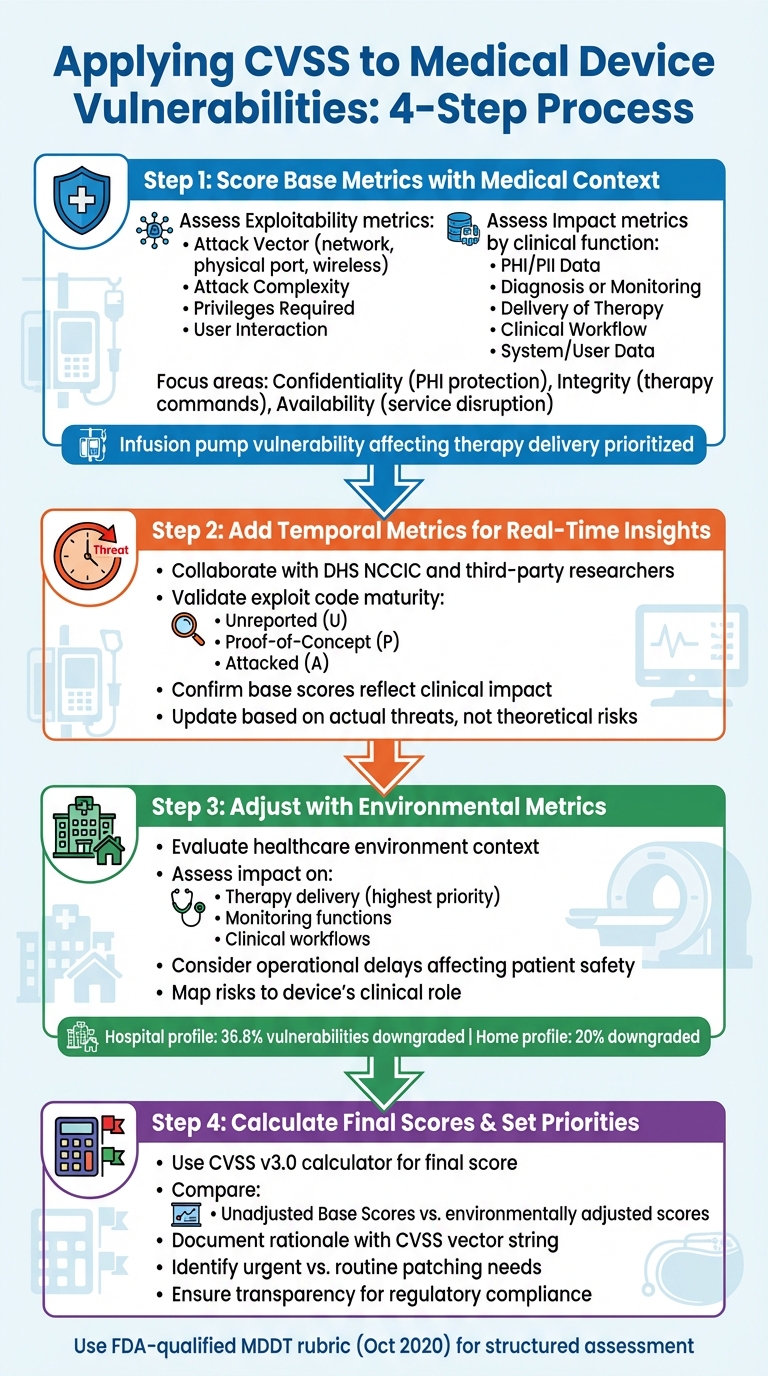
4-Step CVSS Assessment Process for Medical Device Vulnerabilities
Assessing vulnerabilities in medical devices using CVSS requires a methodical approach that considers clinical implications. To streamline this process, healthcare professionals can use the FDA-qualified Medical Device Development Tool (MDDT) rubric, introduced on October 20, 2020. This tool is tailored for CVSS v3.0 and provides structured questions to help accurately determine vulnerability severity while factoring in clinical impacts. It organizes the evaluation into two main groups: the Exploitability Metric Group (covering Attack Vector, Attack Complexity, Privileges Required, and User Interaction) and the Impact Metric Group (addressing Confidentiality, Integrity, and Availability). For example, questions like "Does the vulnerability affect therapy delivery?" guide teams in assigning precise metrics.
"The United States Food and Drug Administration (FDA)... qualified a cybersecurity MDDT that includes a series of structured questions to be used along with the Common Vulnerability Scoring System (CVSS) v3.0 to reliably calculate the severity of security vulnerabilities in medical devices." - Deep Armor
Incorporating Temporal Metrics for Threat Monitoring
Temporal metrics are added by collaborating with the Department of Homeland Security (DHS) National Cybersecurity and Communications Integration Center (NCCIC) and third-party researchers during vulnerability disclosure. This ensures the accuracy of report confidence and validates the existence of exploit code. Post-market surveillance further refines these metrics by monitoring real-world threat changes, ensuring adjustments reflect actual risks rather than hypothetical scenarios.
Aligning Environmental Metrics with Clinical Priorities
Environmental metrics shift the focus from general IT impacts to specific clinical concerns. Vulnerabilities are categorized based on their effect on "Delivery of Therapy" (top priority), "Diagnosis or Monitoring", or "Clinical Workflow." The rubric extends standard CVSS vectors with elements like XCT (Impact to Therapy Delivery) and XCP (Impact to PHI), ensuring assessments align with healthcare-specific needs. This framework facilitates clear communication among manufacturers, hospitals, clinicians, and regulators.
Step 1: Scoring Base Metrics with Medical Context
To begin, assess Exploitability metrics using the MDDT rubric. For example, when evaluating Attack Vector, determine if the device is accessible through the hospital network, a physical port, or wireless connections. Unlike typical IT systems, medical devices may operate on isolated networks or require close physical access.
Impact metrics should be categorized by the device's clinical function, such as PHI/PII Data, Diagnosis or Monitoring, Delivery of Therapy, Clinical Workflow, and System/User Data. Confidentiality metrics focus on protecting sensitive health information, while Integrity examines whether vulnerabilities could alter therapy commands or corrupt monitoring data. Availability metrics assess risks like denial of service that could disrupt therapy or workflows. For instance, a vulnerability in an infusion pump might compromise therapy delivery (Integrity) or halt medication delivery (Availability).
The Scope metric evaluates whether exploiting a supporting component, like a web interface, could impact the device’s core clinical functions.
Step 2: Adding Temporal Metrics for Real-Time Insights
Once base metrics are established, temporal data is incorporated to reflect the current threat landscape. Collaboration with DHS NCCIC and external researchers ensures that exploit code maturity and report confidence are grounded in actual threats rather than theoretical risks.
Before applying temporal adjustments, confirm that base scores accurately represent the device's clinical impact, particularly on therapy delivery and workflow. This step prevents overestimating vulnerabilities with high theoretical scores but low practical exploitability. The CVSS vector string provides a consistent framework for communicating vulnerability priorities to healthcare providers.
"Medical device manufacturers need to assess the severity of vulnerabilities as part of their risk assessment process, both during product development and as part of post-market surveillance after the product has been cleared or approved." - MITRE Corp
Step 3: Adjusting Scores with Environmental Metrics
Environmental adjustments focus on the healthcare environment where the device is used. The rubric evaluates how vulnerabilities affect therapy delivery, monitoring, or clinical workflows. For example, a vulnerability in an infusion pump’s dosage settings would take precedence over one affecting the device’s user interface. Operational delays caused by vulnerabilities should also be considered, as they may indirectly impact patient safety.
By mapping medical risks to CVSS v3.0 metrics, the rubric ensures that Confidentiality, Integrity, and Availability scores reflect the device’s clinical role. For instance, a vulnerability affecting a ventilator’s availability would receive maximum priority due to the immediate risk posed to patients.
Step 4: Calculating Final Scores and Setting Priorities
After scoring all metric groups, use the CVSS v3.0 calculator to determine the final score. Compare the unadjusted Base Scores with the environmentally adjusted scores to identify vulnerabilities requiring urgent attention versus those suitable for routine patching. The CVSS vector string documents the rationale behind each score, offering transparency for regulatory compliance and aiding clinical staff in understanding remediation priorities, even if they lack cybersecurity expertise.
Adding CVSS to Medical Device Risk Management Workflows
Incorporating CVSS into medical device risk management workflows goes beyond simply identifying vulnerabilities - it’s about making those scores actionable. To do this effectively, you need to leverage the full BTE framework (Base, Threat, Environmental) rather than relying solely on static Base scores. This approach transforms CVSS from a set of numbers into a functional tool for prioritizing risks.
The BTE framework integrates multiple data sources to create a well-rounded risk profile. It pulls Base metrics from the National Vulnerability Database (NVD), incorporates Threat metrics from feeds like the Exploit Prediction Scoring System (EPSS) and Known Exploited Vulnerabilities (KEV) Catalog, and uses Environmental factors from internal asset management systems [1]. When applied in healthcare, this method reveals how vulnerabilities can differ in priority depending on the setting. For example, hospitals often downgrade vulnerabilities from "critical/high" to "medium/low" priority due to controlled environments, while home care settings may elevate risks because of unsupervised use and less secure networks [1].
The introduction of CVSS 4.0 adds a Safety metric, addressing the critical issue of physical harm to patients. This is particularly important for medical devices, where vulnerabilities could disrupt therapy or patient monitoring, leading to far more severe consequences than typical IT system breaches.
Automating these assessments can further simplify the process and enhance efficiency.
Automating CVSS Assessments with Censinet RiskOps™
Censinet RiskOps™ streamlines CVSS-based assessments for medical devices by leveraging MDS2 forms from 2013 and 2019. Its AI-powered scoring system evaluates factors like network exposure, software maintenance status, and adherence to industry standards.
The platform consolidates all vulnerability data into a single dashboard, allowing healthcare organizations to monitor Base, Threat, and Environmental scores across their device inventory. By integrating automated threat intelligence feeds, Censinet RiskOps™ ensures that Threat metrics stay up-to-date as new exploit codes emerge or vulnerabilities are reassessed. These updates reflect real-time conditions and adapt to standardized deployment profiles, whether for hospital or home care settings. This automation not only saves time but also enhances accuracy, supporting both patient safety and operational efficiency.
Coordinating Across IT, Clinical, and Compliance Teams
Implementing CVSS effectively requires collaboration across IT, clinical, and compliance teams. Each group plays a vital role:
- IT teams assess technical severity and incorporate threat intelligence data.
- Clinical teams provide environmental context, distinguishing between controlled hospital environments and unsupervised home care.
- Compliance teams ensure that CVSS-based assessments align with regulatory standards like ISO 14971 and FDA cybersecurity requirements [4].
This teamwork helps resolve the inherent tension between security and safety in medical devices. As IEC TR 60601-4-5 highlights:
"A benefit-risk analysis (between safety and security) should be conducted to determine which functionality can be sacrificed, and which cannot" [2].
For instance, adding password protection to a defibrillator might improve security but could delay critical treatment during an emergency. By clearly defining roles and responsibilities, healthcare organizations can make informed decisions that balance cybersecurity needs with patient safety priorities [4].
Conclusion
CVSS provides a standardized way to assess vulnerabilities in medical devices, but its true potential lies in going beyond Base scores to include the full BTE (Base, Threat, Environmental) framework. This broader approach turns CVSS into more than just a severity measurement - it becomes a practical tool to safeguard patient safety. As FIRST aptly states, "The Base Score measures severity, not risk" [1]. By adding threat intelligence and environmental context, organizations can focus on vulnerabilities that pose the greatest real-world risk rather than just technical severity.
Real-world studies back up this approach, showing that a full BTE analysis can significantly shift how vulnerabilities are prioritized, whether in hospitals or home care environments [1].
CVSS 4.0 introduces a Safety metric that directly addresses the potential for physical harm caused by medical device vulnerabilities. When combined with automated threat intelligence and deployment profiles, CVSS transforms into a key part of a broader risk management strategy.
Automation tools like Censinet RiskOps™ further simplify the process. By automating CVSS assessments across an entire device inventory, these platforms consolidate vulnerability data into a single, easy-to-use dashboard. Real-time intelligence keeps threat metrics up-to-date, enabling IT, clinical, and compliance teams to work together seamlessly. This collaboration is critical for balancing security needs with patient care priorities.
FAQs
When should we override a CVSS Base score for patient safety?
In healthcare, some vulnerabilities carry risks that go beyond what a standard CVSS (Common Vulnerability Scoring System) Base score might indicate. When a vulnerability could directly impact clinical outcomes, patient well-being, or critical workflows, it's essential to reassess its severity.
For example, issues that might lead to incorrect medication dosages, device malfunctions, or even physical harm demand heightened attention. These risks often outweigh the generalized scoring system, making it necessary to override the standard score to reflect the true potential impact within a healthcare setting. This ensures vulnerabilities are prioritized appropriately to protect patient safety.
How do we set Threat metrics using KEV and EPSS data?
Threat metrics are determined by examining Known Exploited Vulnerabilities (KEV) to pinpoint issues currently being exploited and leveraging EPSS to estimate the chances of future exploitation. This approach, rooted in data analysis, streamlines risk management by concentrating on vulnerabilities with the highest likelihood of exploitation, ultimately boosting the effectiveness of security measures for medical devices.
What’s the best way to build hospital vs. home CVSS environmental profiles?
Creating CVSS environmental profiles for hospitals and homes requires understanding the distinct risks of each setting. In hospitals, the focus is on patient safety, clinical workflows, and the critical role of medical devices. This often means assigning higher importance to confidentiality, integrity, and availability, as disruptions can directly affect patient care.
For home environments, the emphasis shifts to personal data protection and device functionality. Factors like network exposure and user interaction play a bigger role here, given the less controlled and more varied nature of home networks.
By leveraging CVSS environmental metrics, you can adapt risk assessments to these specific contexts, ensuring that risk prioritization aligns closely with the actual threats faced in each environment.
