
If I had to sum it up in one line: administrative AI usually pays back first, clinical and pathway AI can save more over time, and governance tools help stop big losses.
Here’s the short version:
- Administrative and revenue cycle AI is often the fastest to show results because savings are easy to track through denials, prior auth, eligibility, and staff time.
- Treatment optimization and care pathway AI can cut length of stay, readmissions, and care variation, but the return often takes longer to show.
- Clinical decision support and diagnostic AI can lower error and delay, yet the business case depends on use, validation, and fit inside care workflows.
- AI governance and cyber risk tools do not usually add revenue directly. Their value shows up in lower breach risk, less audit work, and faster vendor review.
A few numbers make the point fast:
- AI at scale could cut U.S. healthcare spending by 5% to 10%, or about $200 billion to $360 billion per year
- Hospital savings alone may reach $60 billion to $120 billion per year
- But only 15% of organizations using revenue cycle AI say they see positive ROI
- The average healthcare data breach cost reached $6.64 million in 2026
So when I look at AI for cost management, I’d judge it on four things:
- How fast it pays back
- How easy it is to measure
- What it costs to buy, connect, train, and monitor
- What risk it adds or helps avoid
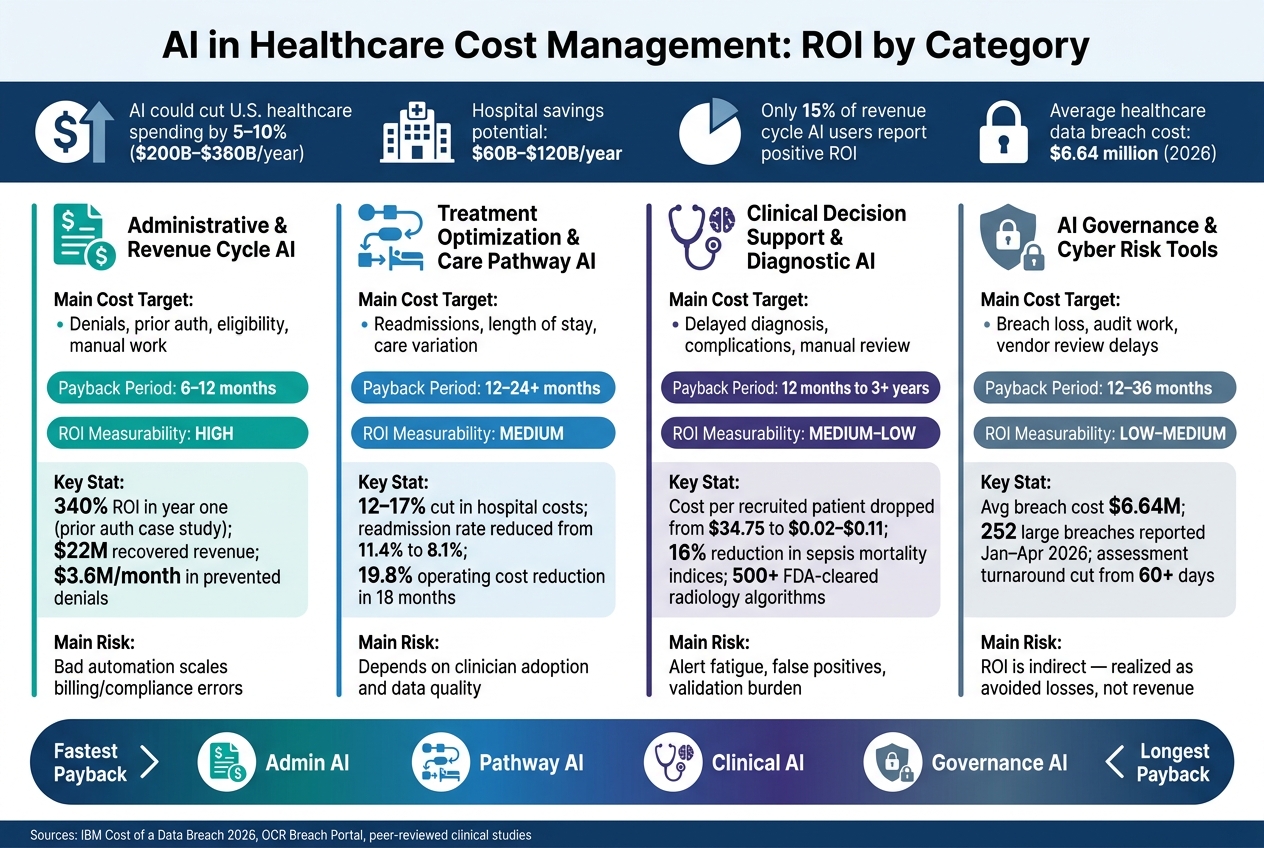
AI in Healthcare: ROI by Category - Payback, Savings & Risk
The AI Transformation of Health Plans: Call Centers, Prior Auth, and ROI That Actually Makes Sense
sbb-itb-535baee
Quick Comparison
| AI Category | Main Cost Target | Typical Payback | Easiest ROI Proof | Main Catch |
|---|---|---|---|---|
| Administrative & Revenue Cycle AI | Denials, prior auth, eligibility, manual work | 6 to 12 months | High | Bad automation can scale billing and compliance mistakes |
| Treatment Optimization & Care Pathway AI | Readmissions, length of stay, care variation | 12 to 24+ months | Medium | Results depend on clinician use and data quality |
| Clinical Decision Support & Diagnostic AI | Delayed diagnosis, complications, manual review | 12 months to 3+ years | Medium to low | Validation, workflow fit, and false positives can cut returns |
| AI Governance & Cyber Risk Tools | Breach loss, audit work, vendor review delays | 12 to 36 months | Low to medium | Value is often tied to avoided loss, not direct savings |
My takeaway: if you want the clearest near-term financial case, start with admin AI. If you want longer-run cost cuts in care delivery, pathway and clinical tools may be worth it. And if you want to protect those gains, governance has to be part of the plan.
That’s the lens I’d use for the rest of this analysis.
1. Administrative and Revenue Cycle AI
Administrative and revenue cycle AI goes after some of the clearest sources of wasted money in healthcare: denied claims, slow authorizations, eligibility mistakes, and the manual rework that eats up staff time. These are high-volume, repetitive tasks, so even modest gains can add up fast across thousands of transactions each month. In many cases, this area delivers the fastest payback because the savings show up in throughput, fewer denials, and recovered revenue.
Total cost of ownership
In revenue cycle AI, the hidden costs usually come from workflow redesign, exception handling, audit support, and human review. A solid TCO model separates startup costs from steady-state operating costs. It also needs to account for risk controls tied to PHI and billing data.
Savings and payback period
Administrative AI tends to pay back fastest when it focuses on prior authorization, denials, and eligibility. That’s where labor savings and revenue recovery are easiest to track.
A mid-sized health system with 200+ beds and 50+ clinics automated 85% of prior authorization workflows with an AI-driven prior authorization system. Turnaround time fell from 14 days to under 3 hours, and manual review dropped from 80% to 15%. Annual PA team costs fell from $2.4 million to $960,000. The system also recovered $800,000 in previously lost revenue and saved $320,000 in appeal costs. The result was 340% ROI in year one, with payback in under 4 months.[3]
Denial management shows a similar pattern. A medical center using an AI-assisted denial management model cut denial rates from 18% to 7%, improved clean claim rates from 75% to 92%, and recovered $22 million in lost revenue in year one. It also reduced accounts receivable days by 15 days.[4] A Midwest outpatient health system using AI-assisted eligibility verification reduced eligibility denials by 26%, cut labor hours by 39%, and saved more than $3.6 million a month in preventable denials.[5]
Risk and governance impact
Administrative AI can create compliance problems when coding suggestions, denials, or eligibility decisions are wrong - or when staff trust the system too much. Compliance mistakes, false denials, and weak vendor oversight cut into savings and can wipe them out.
A few controls aren’t optional here:
- Human review for high-stakes decisions
- Clear audit trails
- Regular model performance checks
- A full cybersecurity and third-party risk review during procurement
Vendor risk matters just as much as model accuracy. Censinet RiskOps™ supports third-party vendor risk management for AI vendors handling PHI and billing data.
Equity and long-term affordability
Automation only lowers costs if patients can actually use it. If people with limited English proficiency or low digital literacy struggle with the tools, the work doesn’t disappear - it shifts back to staff. That drives up call volume, manual fallback, and patient friction, which eats into savings.
There’s another issue: vendor lock-in. Long-term affordability depends in part on avoiding systems that are hard to replace or too costly to expand. The strongest deployments use automation to shift staff into higher-value work instead of cutting capacity.[2]
From here, the ROI test shifts from workflow leakage to care variation and utilization.
2. Treatment Optimization and Care Pathway AI
While administrative AI trims process waste, treatment optimization AI tackles avoidable clinical variation. That includes unnecessary tests, duplicate services, avoidable readmissions, hospital stays that drag on longer than needed, and departures from evidence-based care pathways. It can also help get patients to the right level of care sooner.
The upside can be big. But it usually takes more time to show than revenue cycle AI. The ROI is there, but proving it takes longer because results depend on adoption, data quality, and whether clinicians act on the recommendations.
Total cost of ownership
Upfront costs usually fall between $500,000 and $1.5 million. That covers software, integration, data engineering, validation, training, and change management.
It makes sense to model TCO over 5–10 years. Why? Because the value curve here tends to build slowly rather than hit all at once.
Savings and payback period
The payback period is often 24–42 months, though the longer-term returns can be large. Care pathways have been linked to 12–17% cuts in hospital costs, driven mostly by shorter length of stay and fewer complications.[6][9] One analysis estimated savings of $21,666.67 per hospital per day in year one, climbing to $289,634.83 by year ten as pathways mature.[8]
One of the clearest ROI drivers is readmission reduction. In a 6-month pilot, clinical decision support lowered 30-day readmission rates from 11.4% to 8.1% (p<0.001).[7][12] A discharge prediction tool cut hospital LOS by more than 12 hours on medicine and telemetry units.[11][13] Case management programs have also produced average cost cuts of 19.8% in operating costs within the first 18 months in organizations serving more than 50,000 patients.[10]
Risk and governance impact
Model drift can chip away at ROI and add liability risk. As patient populations or care patterns change, model performance can slip. That’s why pre-deployment validation, ongoing monitoring, and human oversight matter so much.
These controls do more than reduce risk. They also help protect savings by limiting uneven performance across patient groups.
Equity and long-term affordability
If the training data underrepresents certain groups, pathway recommendations may work better for some patients than others. That can create care gaps and weaken financial results over time.
A few checks help reduce that risk:
- Subgroup-level evaluation
- Fairness audits
- External validation
- Post-deployment monitoring across race, ethnicity, language, insurance status, and geography
The next test is diagnostic AI, where the business case depends less on workflow efficiency and more on reducing errors.
3. Clinical Decision Support and Diagnostic AI
Clinical decision support and diagnostic AI shape both patient outcomes and cost. These tools sit right inside the clinical workflow. They can flag sepsis early, triage stroke patients, detect lung nodules, and screen people for clinical trials. That’s where the business case comes from: fewer complications, shorter hospital stays, and less clinician time spent on work that doesn’t need to be manual. If pathway AI cuts variation, diagnostic AI cuts delay and error at the point of care.
Total cost of ownership
Clinical AI usually costs $160,000 to $530,000 per use case, with the main drivers being EHR integration, regulatory clearance, and workflow redesign [14]. Radiology is the most mature area, with more than 500 FDA-cleared algorithms for stroke triage, fracture detection, and lung nodule identification [14]. Stroke triage AI has also won reimbursement approval, which is rare and changes the math for emergency departments in a very direct way [14].
Savings and payback period
The payback period for clinical AI is usually 12 to 24 months [14]. Some use cases are especially striking.
In the COPILOT-HF heart failure trial, a retrieval-augmented generation (RAG) system screened 1,894 patients for clinical trial recruitment with 97.9% accuracy, versus 91.7% for human reviewers [14]. The cost per recruited patient fell from $34.75 to as little as $0.02–$0.11 [14].
Sepsis detection is another strong example. Updated models have been linked to better antibiotic turnaround times and a 16% reduction in sepsis mortality indices [14]. Of course, those gains don’t happen on autopilot. Reimbursement, validation, and clinician adoption still decide whether the upside shows up in practice [14].
Risk and governance impact
FDA 510(k) clearance adds both time and cost before any ROI shows up [14]. There’s also the human review issue. In some settings, clinicians still need to verify outputs, and that verification work can eat into the time savings the tool was supposed to create [14].
That’s why measurement can’t stop at dollars. Teams should track diagnostic accuracy rates, triage time reduction, order-to-antibiotic turnaround times, and mortality indices alongside financial results [14]. Without those clinical markers, it’s easy to think a tool is paying off when it isn’t doing much at the bedside.
Equity and long-term affordability
When model performance slips for underrepresented groups, savings get uneven and the ROI story starts to crack [14]. Clinical AI models used outside the populations they were trained on can see performance drop by 20% to 40% [14]. That can lead to unreliable outcomes, a weaker business case, and plain old regulatory and reputational risk.
New standards are pushing developers to audit training data for demographic representation [14]. So when a health system reviews a clinical AI tool, it should look closely at how the model was tested across race, ethnicity, language, and insurance status, and how post-deployment monitoring is handled [14].
The next ROI test is simple: can governance protect these clinical gains from model drift, compliance failures, and cyber risk.
4. AI Governance and Cyber Risk Management Platforms
AI governance and cyber risk management platforms help healthcare groups deal with the extra oversight that comes with AI, more vendors, and a growing stack of AI tools. They cut down manual risk work and lower the odds of costly breaches, audit misses, and vendor slowdowns. In plain English: governance sits in the ROI stack as a protective layer, not a direct source of revenue.
Total cost of ownership
TCO includes licensing, implementation, integration with security and procurement systems, customization, training, legal and security review, ongoing administration, and advisory support.
Savings and payback period
The clearest savings usually come from three areas: staff time, vendor assessment time, and audit prep.
Emory Healthcare is a good example. It had third-party risk assessment completion times that stretched past 60 days. After it adopted Censinet RiskOps™, the health system cut assessment turnaround in a major way and completed more assessments and reassessments without adding resources [15].
The cost-avoidance side matters just as much, if not more. IBM's 2026 reporting put the average healthcare data breach cost at $6.64 million, the highest across all industries and the top sector for the 13th consecutive year [16][17]. One serious incident can wipe out years of platform spend. And the pressure is not hypothetical: from January 1 to April 30, 2026, 252 large healthcare data breaches were reported to OCR [18]. That number shows the economic impact of third-party risk in healthcare.
As clinical and administrative AI spread, governance becomes the control layer that helps protect the returns from those systems.
Risk and governance impact
Censinet RiskOps™ brings third-party and enterprise risk workflows into one place. It also supports cybersecurity benchmarking, policy and control mapping, audit-ready reporting, and collaboration across IT, compliance, security, procurement, and clinical teams.
Censinet also says its Digital Risk Catalog includes 34,000+ vendors and products [1]. That can speed up due diligence when a healthcare group is reviewing new AI tools or other vendors. On top of that, Censinet AI speeds assessments by drafting questionnaires, summarizing evidence, and generating risk reports, while human reviewers make the final calls.
That tradeoff is the key point here: lower direct savings, but much stronger loss prevention.
Pros and Cons of Each AI Category
No single AI category wins across every measure. Each comes with its own cost structure, risk level, and best-fit setting. Some tools save money fast. Others take longer to show results because their value depends more on trust, use, and risk reduction.
Here’s the side-by-side view:
| AI Category | Main Upside | Main Downside | Ideal Use Case | Likely ROI Timeline |
|---|---|---|---|---|
| Administrative & Revenue Cycle AI | Reduces denial rates, cuts manual processing time, improves net collection rate | Integration complexity with legacy EHR/billing systems; automating flawed workflows can amplify errors | High-volume, rules-based tasks: claims scrubbing, prior auth, scheduling, coding | 6–12 months |
| Treatment Optimization & Care Pathway AI | Reduces length of stay, lowers readmissions, cuts unnecessary procedures | Requires high-quality longitudinal data; clinician override risk if models lack trust | Episodic or chronic care with high practice variation: orthopedics bundles, heart failure, ICU management | 12–24 months |
| Clinical Decision Support & Diagnostic AI | Earlier detection of sepsis, cancer, adverse drug events; reduces malpractice exposure | Alert fatigue, false positives, bias in training data; fee-for-service models may not reward savings | Complex diagnostic domains with large data inputs: radiology triage, sepsis detection, medication safety | 12 months to 3+ years |
| AI Governance & Cyber Risk Management | Cuts assessment cycle time, reduces breach risk, supports compliance workflows | ROI is indirect - realized as avoided losses, not new revenue; requires cross-functional adoption | Organizations with vendor ecosystems, connected medical devices, high PHI exposure | 12–36 months |
The biggest difference isn’t just how much each category can save. It’s how easy that value is to measure in plain financial terms.
A clear pattern shows up here: the faster the payback, the more direct the savings. When ROI takes longer, value tends to depend more on staff use, workflow change, and risk control.
Administrative AI usually pays back first because the math is simple. If a health system cuts denials, speeds up claims work, or improves collections, finance teams can see the impact without much debate.
Clinical AI is different. It may create larger gains over time, but proving those gains can take longer. A tool that helps detect sepsis earlier or flags a drug risk may matter a lot, but tying that result to a clean dollar figure isn’t always easy.
Treatment optimization sits in the middle. It often takes more time to pay back, yet it can grow nicely as patient volume increases. If a system lowers length of stay or reduces readmissions across many cases, the returns can add up.
Governance AI plays a different game altogether. It doesn’t generate new revenue. Its value comes mostly from avoided loss, like fewer breaches, fewer compliance issues, or less vendor risk. That makes adoption the make-or-break factor. If security, compliance, procurement, and clinical teams don’t use the platform, the risk data just sits there, and unused data doesn’t produce ROI.
So each category wins on a different financial yardstick. One is built for direct cost savings. Another is built for care gains that take time to prove. Another helps reduce downside risk before it turns into a costly problem.
Conclusion
ROI changes by use case. Revenue cycle tools tend to pay back the fastest, clinical tools usually need more time, and governance helps keep those gains in place. The same pattern shows up in payback timing.
Measurement matters even more when the savings aren't direct. Credible ROI means tracking both direct savings and avoided losses. Savings on their own miss the cost of breaches, compliance failures, and patient-safety events that never happen because the right controls were in place. Platforms like Censinet RiskOps™ fit into that bigger picture by helping healthcare organizations manage cybersecurity and risk alongside AI-enabled operations.
In practice, the best results come from a disciplined rollout, not a broad launch all at once. Start with high-visibility, high-volume use cases. Track the right metrics. Then build toward a framework that accounts for both direct savings and avoided losses as workflows and data shift. Ultimately, AI ROI comes down to where it's used, how it's measured, and how well it's governed.
FAQs
How should we calculate AI ROI in healthcare?
Calculate AI ROI with a business case tied to measurable business value, not just hours saved.
That means looking at returns from both cost reduction and capacity gains. In practice, that can include lower contractor spend, better documentation, stronger revenue cycle metrics, higher throughput, less leakage, better utilization, and lower turnover risk tied to burnout.
At the same time, include the full cost picture upfront. AI projects often carry expenses that don’t show up in the first demo. Factor in:
- Model operations
- Security review
- Workflow engineering
- Data quality work
- Integration work
- Vendor oversight
- Legal or compliance review
You’ll also want to account for ongoing costs, not just launch costs. That’s where teams often get caught flat-footed.
To measure impact clearly, track operational, clinical, and net revenue KPIs. Use a baseline before rollout, then compare results across cohorts so you can see what changed, where it changed, and whether AI is driving the outcome.
Which AI use cases usually pay back first?
The fastest payback usually comes from AI that takes over high-volume, repetitive admin or risk-workflow tasks.
That often includes:
- claims triage
- coding acceleration
- prior authorization document processing
- customer service support
- supply chain exception handling
In healthcare security and risk programs, AI-driven vendor assessments and risk scoring can also pay back early. Why? They cut manual work and can help stop breaches before they happen. In many cases, that return shows up within months to about 12–18 months.
What hidden costs reduce AI savings?
Hidden costs often show up after the pilot stage.
That’s where teams run into issues like run-rate estimates that were too low, spend that wasn’t tuned well, duplicate tools across departments, and messy decision chains that slow everything down.
There’s also the steady work tied to governance and security, and that can chip away at savings fast. That work can include:
- model operations
- security reviews
- prompt and workflow engineering
- data quality work
- integration refactoring
- vendor oversight
- legal or compliance review
Another risk is “Silent corruption” errors. Those can lead to remediation work, liability, penalties, and lost revenue. In some cases, the damage is big enough to wipe out ROI.
