
Medical devices like MRI machines and infusion pumps store sensitive patient data. When these devices are retired, sold, or transferred, that data must be securely erased to prevent breaches. This process, known as data sanitization, ensures patient information becomes unrecoverable while allowing the device to be reused or resold.
Key points:
- Medical devices often use proprietary systems and embedded storage, making data sanitization more complex than standard IT equipment.
- Failing to sanitize data properly can lead to breaches, with healthcare breaches costing an average of $10.93 million in 2023.
- Regulations like HIPAA require organizations to securely erase electronic protected health information (ePHI) and document the process.
- The NIST 800-88 framework outlines three sanitization levels: Clear (basic), Purge (advanced), and Destroy (physical destruction).
Choosing the right method depends on the device type and data sensitivity. For example:
- HDDs: Overwriting or degaussing.
- SSDs: Cryptographic erasure or physical destruction.
- Encrypted devices: Destroying encryption keys.
Organizations should maintain a detailed inventory, follow strict sanitization policies, and train staff to handle devices securely. Tools like Censinet RiskOps™ can simplify risk management and compliance tracking, ensuring thorough sanitization and reducing breach risks.
Implementing and Managing Electronic Data Disposal and Destruction
sbb-itb-535baee
Data Sanitization Standards and Methods
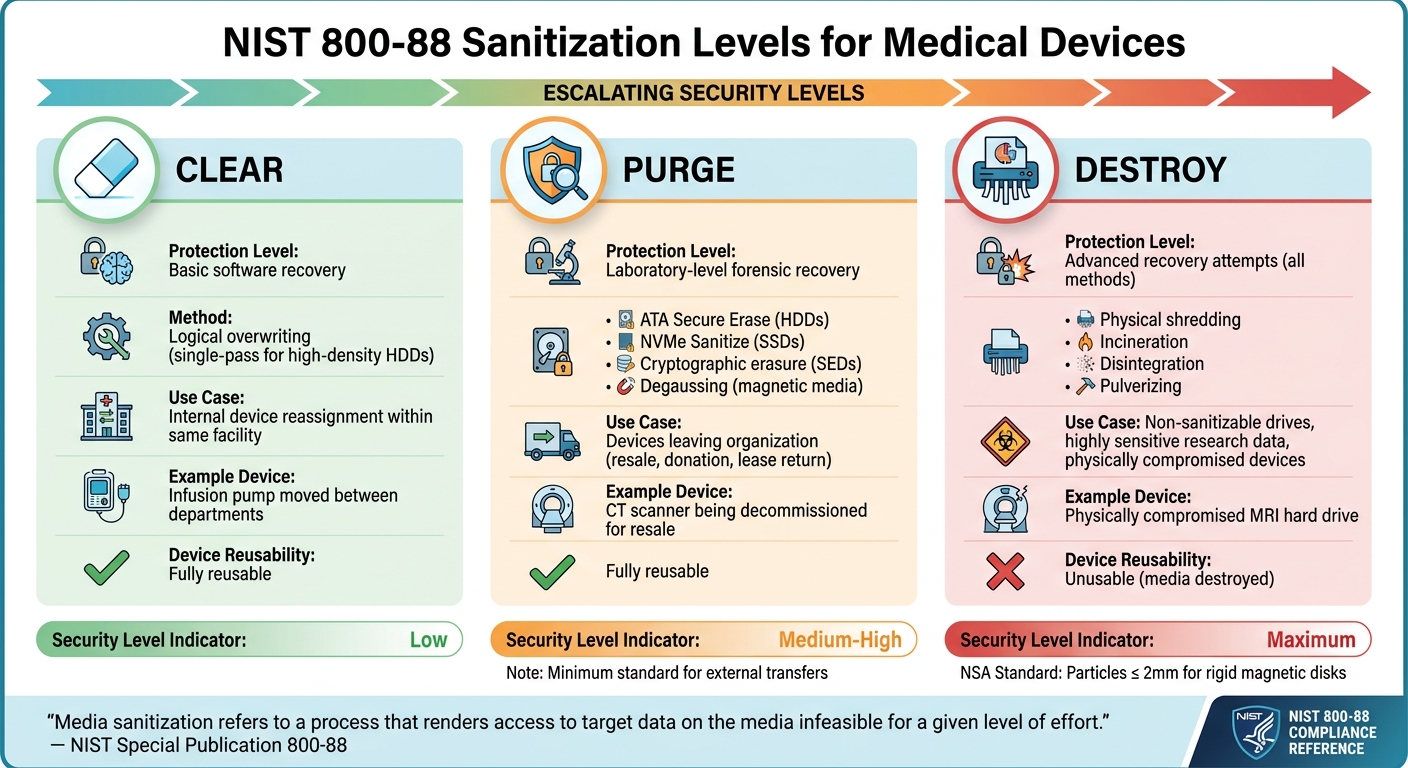
NIST 800-88 Medical Device Data Sanitization Methods Comparison
Healthcare organizations must follow a reliable framework to securely remove protected health information (PHI) from devices. NIST Special Publication 800-88 offers a structured approach to ensure PHI becomes completely unrecoverable. The latest update, Revision 2 (released in September 2025)[2], addresses modern storage technologies like NVMe drives, flash storage, and self-encrypting drives (SEDs), which are increasingly common in medical devices. This framework forms the basis for the technical standards outlined below.
NIST 800-88: Clear, Purge, and Destroy Methods
NIST 800-88 outlines three levels of sanitization, each designed to counter specific data recovery threats. These levels escalate in intensity to match the level of risk.
- Clear: This involves logical methods such as overwriting data to block basic, software-based recovery tools. It’s ideal for internal device reassignments, like moving a patient monitor to a different department within the same facility.
- Purge: More rigorous methods are used here to prevent recovery through advanced forensic techniques. Examples include ATA Secure Erase for hard drives, NVMe Sanitize for SSDs, and cryptographic erasure for self-encrypting drives. Purge is the minimum standard for devices leaving an organization’s control, whether through resale, donation, or lease return.
- Destroy: This involves physically destroying the media to make it completely unusable. Methods include shredding, incineration, or disintegration. This level is necessary for drives that can’t be sanitized through software or for devices holding highly sensitive research data.
Revision 2 has clarified that a single-pass overwrite is sufficient for high-density hard drives.
"Media sanitization refers to a process that renders access to target data on the media infeasible for a given level of effort." - NIST Special Publication 800-88
Selecting the Right Sanitization Method
The choice of sanitization method depends on several factors: the sensitivity of the data, the type of storage media, and the intended disposition of the device. Using the correct method not only protects PHI but also ensures compliance with HIPAA and helps in taking the risk out of healthcare operations. For devices leaving a facility, Purge or Destroy methods are recommended.
Each type of media requires specific handling. For example, SSDs need firmware-based commands like NVMe Sanitize or ATA Secure Erase due to their wear leveling and over-provisioning mechanisms.
Verification is critical. Always document the sanitization process by generating a certificate that includes the device serial number, the method used, and the results of the verification. Utilizing a platform for healthcare risk operations can help teams respond faster to these security requirements. As one expert put it:
"If you cannot verify it, it did not happen for audit purposes." - Excess IT Hardware
For devices with self-encrypting drives, cryptographic erasure provides an efficient Purge-level solution - provided encryption was enabled from the outset using NIST-approved algorithms like AES-256.
| Sanitization Level | Protection Against | Medical Device Example | Device Reusability |
|---|---|---|---|
| Clear | Basic software recovery | Reassigning an infusion pump within a facility | Fully reusable |
| Purge | Laboratory-level forensic recovery | Decommissioning a CT scanner for resale | Fully reusable |
| Destroy | Advanced recovery attempts | Physically compromised MRI hard drive | Unusable |
This structured framework ensures healthcare organizations can securely manage data sanitization while meeting industry standards and protecting sensitive information.
Medical Device Media Sanitization Techniques
Sanitizing storage media in medical devices requires tailored approaches based on the type of media. Methods like those outlined in the NIST 800-88 framework address the unique needs of hard disk drives (HDDs), solid-state drives (SSDs), and other storage types. Using the wrong technique can leave sensitive health information vulnerable.
Overwriting Data on HDDs
Overwriting replaces data on an HDD with non-sensitive values through standard read/write commands. For "Clear" sanitization, a single-pass overwrite is usually enough for modern, high-density drives, making it suitable for internal reuse. However, when devices are leaving your organization, medical device cyber risk management protocols suggest ATA Secure Erase is the preferred option for "Purge" sanitization. This command, managed by the drive’s firmware, ensures all sectors - including those reallocated due to errors - are wiped clean.
A study by Blancco Technology Group in 2019 revealed that 42% of used drives sold on eBay still contained residual data, including personal information [3]. This underscores the importance of verifying that data has been completely removed. Another method for magnetic media is degaussing.
Degaussing Magnetic Media
Degaussing neutralizes data on magnetic media by exposing it to a strong magnetic field, typically 5,000 Oersteds (Oe) or higher. This "Purge"-level method is effective for HDDs and tape drives but permanently disables the media by destroying servo tracks and firmware.
For high-coercivity media like LTO backup tapes - often used for storing medical imaging - degaussers rated at 7,000 Oe or higher may be required [3]. Before degaussing, ensure any metal components that could block magnetic exposure are removed. The process takes only seconds.
It’s important to note that degaussing does not work on SSDs or other flash-based storage. These devices store data using electrical charges, so magnetic fields have no effect. For encrypted devices, cryptographic erasure offers another option.
Cryptographic Erasure for Encrypted Devices
Cryptographic erasure involves destroying the media encryption key (MEK) on a self-encrypting drive (SED), making all encrypted data permanently unreadable. This is one of the fastest "Purge" methods available.
However, this method is only effective if encryption was enabled from the start using NIST-approved algorithms like AES-256. Additionally, the drive must comply with TCG OPAL 2.0 standards to support commands such as Sanitize or Crypto Erase. The strength of the original encryption setup is critical, so it’s essential to confirm that SEDs were configured properly before relying on this technique. When software-based methods fall short, physical destruction becomes the final option. This is especially critical when managing third-party risk management for devices handled by external vendors.
Physical Destruction for SSDs and Flash Media
Physical destruction ensures complete data removal for SSDs and flash-based media. Techniques like shredding, pulverizing, disintegration, or incineration make the media entirely unusable.
SSDs pose unique challenges because individual NAND flash memory chips can survive simple shredding. To meet NSA standards, rigid magnetic disk platters must be reduced to particles no larger than 2mm [3]. Similar requirements apply to flash media, with pulverizing or disintegration ensuring that every memory chip is destroyed beyond recovery.
Physical destruction is also necessary for non-functional drives that cannot be sanitized through software. For example, a damaged hard drive from a CT scanner that won’t power on can only be securely disposed of through physical destruction, guaranteeing that no data can be recovered.
Creating a Medical Device Sanitization Policy
A well-defined sanitization policy ensures that patient data remains secure throughout the entire lifecycle of medical devices. Without clear guidelines, processes like equipment transfers, repairs, or disposals could inadvertently expose sensitive information. A solid policy should outline who is responsible, what actions need to be taken, and how they’re executed - from the initial tracking of devices to verifying their proper destruction. Here’s a breakdown of the essential elements your policy should address.
Core Components of a Sanitization Policy
Start by maintaining a detailed inventory in your CMMS or database. Each device entry should include key details such as the serial number, manufacturer, model, and storage specifications, as outlined in the Manufacturer Disclosure Statement for Medical Device Security (MDS2) [5].
The policy must enforce validated sanitization methods that align with NIST 800-88 standards, such as overwriting, degaussing, or physical destruction [4][5]. It’s also critical to remove IT configurations before decommissioning devices. Chad Waters, Senior Cybersecurity Engineer at ECRI, highlights the risks of overlooking this step:
"If the device isn't disassociated from the cloud service, the device could potentially rejoin the cloud management system if it's reactivated later, providing an unaffiliated user with access to data from the original facility" [5].
To ensure compliance with HIPAA, the policy should require third-party data wiping services and a signed Business Associate Agreement (BAA) [5]. Additionally, all sanitization actions must be thoroughly documented, including details like device serial numbers, sanitization methods used, and decommissioning dates [5]. A proactive measure to consider: encrypt devices by default. This step provides an extra layer of protection if the chain of custody is ever compromised during decommissioning [5].
Once a robust policy is established, the next step is ensuring that staff understand and effectively implement it.
Staff Training and Awareness Programs
A policy is only as effective as the people carrying it out. Training programs are essential to bridge the gap between policy and practice. The Center for Professional Innovation and Education (CfPIE) has trained over 40,000 individuals and issued more than 1,000 certifications in life-science compliance since 2001, illustrating the scale of training needed in healthcare [7]. Successful programs often include interactive modules that use real-world scenarios to teach staff how to validate and sanitize devices [7].
Employees must grasp that data integrity - ensuring the accuracy and reliability of data throughout its lifecycle - depends on proper sanitization at a device’s end-of-life [7]. Training should also address cybersecurity concepts like threat modeling, vulnerability management, and the importance of maintaining clear audit trails for compliance purposes [6][7]. Non-compliance can result in severe consequences, including FDA or EMA-imposed shutdowns [7].
To stay ahead, align training with global standards such as ISO/IEC 27001 for information security and ISO 13485 for quality management [6]. Training should also prepare teams to manage new technologies and transitions, where the risk of data loss is often highest [7].
Policy Review and Updates
Regular reviews ensure that sanitization practices keep pace with evolving regulations and threats. Medical device security has shifted from being a technical concern to becoming a key aspect of patient safety, making policy updates indispensable [8]. For instance, the FDA’s Section 524B now requires organizations to implement formal postmarket vulnerability management plans, emphasizing lifecycle-based security over reactive fixes [8][9].
Schedule quarterly reviews to address new threats and regulatory changes. Studies reveal that 53% to 60% of connected medical devices have critical medical device security risks, and approximately 73% of networked IV infusion pumps contain at least one security flaw [9]. To mitigate these risks, update your policy to include a Software Bill of Materials (SBOM) for all devices. This allows you to pinpoint and sanitize specific components with vulnerabilities [8][9].
Stay aligned with standards like ISO 14971 for risk management, IEC 81001-5-1 for health software lifecycle, and the EU AI Act for AI-enabled devices [9]. Leverage threat intelligence from organizations like the Health Information Sharing and Analysis Center (Health-ISAC) to translate technical vulnerabilities into actionable clinical safeguards [8]. As Phil Englert, Director of Medical Device Security at Health-ISAC, advises:
"The key to solving the legacy problem is understanding where the risks reside and incorporating cybersecurity into replacement planning" [8].
Using Censinet RiskOps™ for Medical Device Data Sanitization
Managing data sanitization across hundreds or even thousands of medical devices is no small feat. It takes more than just a well-crafted policy - it requires a platform tailored to the task. That’s where Censinet RiskOps™ comes in, offering a centralized system specifically designed for healthcare. By combining risk assessments, compliance tracking, and cybersecurity workflows into one platform, it supports over 250 healthcare organizations and 2,500 vendors. This creates a collaborative network that simplifies managing risks and staying ahead of threats. With defined sanitization policies as a foundation, Censinet RiskOps™ makes execution and oversight far more manageable.
Simplifying Risk Assessments with Censinet RiskOps™
One standout feature of Censinet RiskOps™ is its ability to process MDS2 forms (both 2013 and 2019 versions) automatically. These forms, which detail medical device security specifications, are parsed by the platform to extract critical information about data handling and security capabilities [10]. This automation doesn’t just save time - it ensures thorough sanitization verification, cutting risk assessment time by an impressive 85%.
Take Tower Health, for example. Under the leadership of CISO Terry Grogan, the organization leveraged Censinet RiskOps™ to optimize its team’s efficiency. Three employees were freed up to focus on their primary roles, while the remaining two were able to complete more risk assessments than the original five-person team could handle [11]. As Grogan put it:
"Censinet RiskOps allowed 3 FTEs to go back to their real jobs! Now we do a lot more risk assessments with only 2 FTEs required" [11].
The platform’s Digital Risk Catalog™ is another game-changer, offering pre-assessed information on over 50,000 vendors and products. This allows teams to build on existing risk profiles rather than starting from scratch [10][11]. Combined with curated medical device questionnaires, organizations can quickly pinpoint risks - like devices with unencrypted storage or unclear decommissioning protocols - and prioritize them using automated risk scoring dashboards.
Managing Compliance and Documentation
Clear documentation is not just good practice - it’s a requirement for HIPAA compliance. Censinet RiskOps™ simplifies this process with built-in evidence capture and a centralized digital inventory that tracks devices from procurement to disposal [10]. Audit-ready reports and secure logs are generated automatically, saving time and reducing errors.
One example comes from a mid-sized healthcare organization that used the platform to decommission 200 end-of-life infusion pumps. Censinet RiskOps™ assigned tasks for cryptographic erasure verification, auto-generated HIPAA-compliant forms, and stored digital signatures. What once took weeks now took days, all while eliminating potential breach risks. Organizations using these features reported a 92% improvement in audit readiness for managing medical device data.
The platform also offers Automated Corrective Action Plans (CAPs) to address gaps like missing sanitization certificates or incomplete chain-of-custody records. Baptist Health, led by VP and CISO James Case, replaced manual spreadsheet tracking with the platform’s shared risk data capabilities, improving collaboration across its hospital network [11].
Improving Cybersecurity and Data Management
Censinet RiskOps™ also strengthens cybersecurity by integrating real-time risk scoring and threat intelligence feeds. These tools highlight high-risk devices that need immediate attention, such as MRI machines with magnetic media requiring degaussing or infusion pumps with unpatched firmware vulnerabilities. The platform’s dashboard visualizations make it easier to prioritize sanitization efforts, improving data management efficiency by 50% through collaborative task assignments across IT, Risk, Cybersecurity, and BioMed teams [10].
Given the 300% rise in medical device cyber incidents from 2020 to 2023, these tools are more critical than ever. Organizations using Censinet RiskOps™ reported 40% fewer high-risk findings in device assessments compared to industry averages. Benchmarking sanitization processes against peer organizations also helps identify areas for improvement. As Brian Sterud, CIO at Faith Regional Health, explained:
"Benchmarking against industry standards helps us advocate for the right resources and ensures we are leading where it matters" [11].
Conclusion: Medical Device Data Sanitization Best Practices
Key Takeaways for Healthcare Organizations
Protecting patient data through effective sanitization is non-negotiable. In 2023, healthcare organizations faced an average data breach cost of $10.93 million - almost three times higher than other industries - and 88% of these organizations reported experiencing breaches. On average, it took 277 days to detect these incidents[1].
To minimize risks, follow guidelines like NIST 800-88 to select the right sanitization methods. Start with a thorough asset inventory, paying close attention to identifying all internal drives and flash memory components to ensure nothing is overlooked.
Keep detailed, audit-ready documentation and maintain verified chain-of-custody records. If working with third-party IT asset disposition vendors, ensure they sign Business Associate Agreements to meet HIPAA compliance standards.
Using risk management tools like Censinet RiskOps™ can simplify compliance efforts and streamline documentation processes.
Next Steps for Secure Data Disposal
To put these practices into action, consider these steps for secure data disposal:
- Partner with certified vendors: Choose vendors with NAID AAA and R2v3 certifications. For added security, use on-site destruction services, such as mobile shredding, to witness the process firsthand and reduce risks associated with transportation.
- Update policies for IoT devices: Regularly revise sanitization policies to address the growing use of IoT devices like wearables and connected diagnostic tools. For imaging equipment, ensure protocols include complete disassembly to handle all embedded data-bearing components.
- Provide targeted training: Train staff on device-specific sanitization procedures, documentation requirements, and handling protocols. Regularly review and update these policies to keep pace with evolving technologies and regulatory changes.
FAQs
How do I decide between Clear, Purge, and Destroy for a device?
When it comes to managing sensitive data, the right approach depends on your security needs and compliance requirements. Here's a quick breakdown to help you decide:
- Clear: This involves logical methods, such as overwriting data, to make it inaccessible. It's a good choice if the device will be reused internally and the data isn't highly sensitive.
- Purge: For more sensitive information, advanced techniques like degaussing are used. This method minimizes the risk of recovery, making it suitable for data that requires a higher level of security.
- Destroy: When maximum security is essential, physical destruction is the way to go. This is often necessary for devices that have failed or when handling Protected Health Information (PHI) to meet strict compliance standards.
Your decision should factor in how the device will be reused, the sensitivity of the data, and any regulatory mandates you must follow.
What’s the safest way to sanitize SSDs and NVMe drives in medical devices?
The most reliable way to securely sanitize SSDs and NVMe drives in medical devices is through firmware-level commands such as ATA Secure Erase or NVMe Sanitize, as outlined in NIST SP 800-88. These methods work at the hardware level to ensure all data is thoroughly removed. If a drive is non-functional or these methods fail, physical destruction remains the only surefire way to safeguard sensitive information.
What documentation do I need to prove HIPAA-compliant sanitization?
To demonstrate compliance with HIPAA sanitization requirements, you need proper documentation that verifies secure handling and disposal of sensitive data. Essential records include:
- Audit reports detailing the data wiping methods used.
- Certificates of destruction for any disposed hardware.
- Chain-of-custody documentation to track the secure transfer and handling of materials.
These records ensure that your processes align with HIPAA and NIST 800-88 standards for securely disposing of protected health information (PHI), whether it's in paper or electronic form.
