
One hidden failure can disrupt care across many systems at once. My main takeaway is simple: healthcare outages often spread through shared vendors, cloud regions, telecom links, and old interfaces that many teams do not fully map.
Here’s the short version:
- 63% of healthcare leaders do not monitor their healthcare supply chain security or track the data security policies of key services.
- A single upstream issue can hit EHR access, telehealth, portals, devices, claims, and identity systems at the same time.
- Mass General Brigham showed how this works in practice when a vendor outage tied to a hyperscaler region disrupted a deadline-day benefits system in October 2024.
- The Change Healthcare outage in February 2024 showed the same pattern at a national level by blocking claims and prescription workflows.
- Many risk programs still plan for one system failing alone, even though outages often involve network, cloud, authentication, and integrations all failing together.
- Old systems, flat networks, and single-path HL7/FHIR links can let a small issue spread fast.
- The fix starts with one inventory, dependency mapping, risk-based vendor review, and segmentation to limit spread.
If I had to sum up the article in one line: healthcare IT is less stable than it looks because too many teams trust links they cannot fully see.
| Risk area | What goes wrong | What teams should do |
|---|---|---|
| Shared vendors and cloud services | One upstream outage hits many apps | Map vendors, fourth parties, cloud regions, and failover paths |
| EHR and integration dependencies | Downtime spreads into care workflows | Rank systems by recovery order and test multi-system outages |
| Legacy systems and flat networks | Failures move across the environment | Segment networks and limit trust between systems |
| Manual risk processes | Teams miss new tools and connections | Keep one current inventory for assets, integrations, and owners |
That’s the core point of the piece: you can’t control every outage, but you can cut the blast radius when you know what depends on what.

Healthcare IT Fragility: Key Stats & Risk Areas at a Glance
Where the Fragility Usually Hides
EHR Downtime, Cloud Services, and Telecom as Shared Failure Points
EHR access sits near the top of the clinical stack. If it goes down, care teams feel it right away.
The problem is that the systems behind the EHR often share the same hidden plumbing. A cloud region may be sold as separate, but it can still depend on the same control plane. That means one issue upstream can hit more than one service at the same time.
A January 2026 Verizon software fault showed how exposed that setup can be. One transit provider issue knocked portals, telehealth gateways, and clinician apps offline for hours [2].
Legacy Systems and Fragile Interfaces
This same pattern shows up inside the hospital, too. Old infrastructure and flat networks can turn a small local issue into a much larger outage.
Unpatched servers, outdated operating systems, and flat networks mean that a single compromised endpoint can move laterally across an environment with little resistance [2]. And the trouble doesn't stop there. Legacy HL7 links and FHIR APIs often rely on single pathways, so even a short connectivity loss can interrupt data exchange [2].
In plain terms, one weak spot can trigger a chain reaction.
Third-Party and Fourth-Party Dependencies That Are Easy to Overlook
The hardest risks to map usually sit outside your org chart. That's where things get messy. If a fourth-party hyperscaler has a regional failure, the health system still takes the hit, even when that failure sits several layers below direct view.
Many SaaS vendors don't disclose which hyperscaler or cloud region they use, which means the health system cannot see where the dependency actually lives - and that opacity widens the blast radius [1]. Cloud migration also reduced visibility into resiliency details [1].
The farther a dependency gets from your control, the less you can see. And when you can't see it, failures can spread fast.
These hidden dependencies are exactly what standard third-party risk management programs fail to map.
sbb-itb-535baee
Healthcare Cyber Resilience: What Keeps the Doors Open?
Why Standard Risk Programs Miss These Weak Links
Those weak links stay hidden because many healthcare risk programs still judge systems in silos.
Incomplete Inventories and Fragmented Third-Party Risk Processes
Healthcare's ecosystem is fragile because risk teams often can't see every asset, integration, and vendor in one place. Shadow SaaS puts tools outside the formal inventory. Medical devices may live in a separate inventory from software assets. And the integration points - the APIs and data feeds tying systems together - often aren't documented at all.
When vendor tracking is manual, it's easy to miss new integrations and infrastructure changes between review cycles. Fourth-party dependencies make the problem worse: a health system may appear to use separate vendors, while those vendors all rely on the same upstream claims clearinghouse, identity provider, or cloud layer. If that upstream service fails, several systems can go offline at the same time [3].
When inventories miss dependencies, downtime plans are built on the wrong failure model.
Downtime Plans Built for Isolated Failures, Not Cascading Events
Most downtime procedures assume a single system fails at a single time. The EHR goes down, so teams switch to paper. A scheduling platform fails, so staff call the vendor.
That's not how many outages play out.
When a cloud region fails or telecom connectivity drops, the EHR, identity provider, and connected devices can all disappear at once. Paper-only procedures don't account for clinicians who can't log in, devices that can't pull patient data, or labs that can't receive orders.
The February 2024 Change Healthcare breach showed this on a national scale: because Change Healthcare sat in the critical path between providers and payers, its outage prevented prescriptions from being filled and claims from being submitted across the country [5].
Tabletop exercises often deepen the same blind spot. They tend to simulate one application failing in isolation, not the combined loss of network connectivity, cloud services, and authentication [1][2]. If the scenario doesn't look like the outage teams will face, the plan can fall apart fast.
Even when teams know the assets, poor network design can still make the blast radius much bigger.
How Flat Networks and Implicit Trust Widen the Blast Radius
Flat networks - where endpoints, servers, medical devices, and clinical applications share the same trust zone - give failures room to spread [2]. Each implicit trust relationship extends the blast radius of whatever goes wrong first [2].
One survey found that 60% of healthcare IT leaders say that 26%–50% of their infrastructure is insufficiently monitored. The same survey found that 40% of organizations use seven or more monitoring and asset management tools, while only 29% say those tools are fully integrated [4]. More tools without integration don't improve visibility. They just add noise.
"Visibility does not scale linearly with tool count. Rather, it declines when integration and data cohesion lag behind complexity." - Jeff Collins, CEO, WanAware [4]
Standard programs often separate vendor risk, network security, and continuity planning. Real outages don't respect those lines. They cut across all three at once, which is why teams need inventories, assessments, and controls that help them spot and contain failures before they spread.
How Healthcare Leaders Can Reduce Ecosystem Fragility
The fix starts with visibility, then moves to risk control, and then containment.
Build and Maintain Inventories of Assets, Integrations, and Key Dependencies
Healthcare teams need one central inventory for every system that touches ePHI. That inventory should list the vendor, version, owner, and integration links for each system. For major SaaS partners, it should also spell out which cloud hyperscaler and region they use, plus failover sequences and trigger points. The best time to ask for infrastructure and resiliency details is during procurement, when vendors are most likely to share them.
Mass General Brigham uses a six-layer application classification model that helps make this practical. In that model, Tier 0 covers core infrastructure like WAN, wireless, and DNS, while Tier 1 includes clinically necessary systems such as the EHR and blood bank [1]. If things go down, Tier 0 comes back first. Clinical apps depend on it.
That same inventory should guide both vendor review and recovery order. If you don't know what connects to what, recovery turns into guesswork.
Use Risk-Based Assessments and Continuity Planning for Vendors and Internal Systems
Not every vendor carries the same level of risk, so scoring by criticality matters. One three-tier governance model groups systems into the EHR core, the integration layer - engines like Mirth Connect or Rhapsody - and noncore applications such as lab systems, pharmacy software, and medical device middleware [5].
That structure should shape patching expectations too:
- High-severity vulnerabilities in the integration layer should be remediated within 30 days
- Noncore applications will often have a 90-day window [5]
If a dependency can't be patched, the compensating control needs to be documented in the risk registry and reviewed on a set schedule [5]. No hand-waving. No "we'll get to it later."
Continuity plans also need to map cascading failures across clearinghouses, SaaS APIs, identity, and network services [5]. That's where many organizations get caught off guard. A single outage rarely stays neatly contained.
In December 2024, the HHS Office for Civil Rights proposed HIPAA Security Rule updates that reinforce the need for a written technology asset inventory and documented dependency risk analysis [5]. That lines up with what strong operators already know: effective third-party risk assessments should feed continuity planning, not sit in a separate folder no one uses.
Apply Segmentation and Zero Trust Controls to Contain Failures
Once recovery priorities are clear, segmentation helps stop failures from spreading. For unpatchable legacy systems, internal firewalls can limit communication to only the systems that must connect [5]. That's a simple idea, but it matters a lot when one weak point can knock over half the stack.
Integration engines like Mirth Connect should be treated as high-priority isolation targets, especially because of authentication bypass risks such as CVE-2023-43208 in NextGen Mirth Connect deployments [5].
Zero Trust pushes the same idea further. It cuts down implicit trust relationships so a failure or compromise in one area doesn't automatically move across the rest of the environment. In plain English: one bad break shouldn't become everyone's problem.
Inventories, risk tiers, continuity plans, and segmentation work best as a connected system. Together, they cut exposure and help teams recover faster.
Operationalizing Resilience with Censinet RiskOps
Centralize Visibility Across Technology, Vendor, and Integration Risk
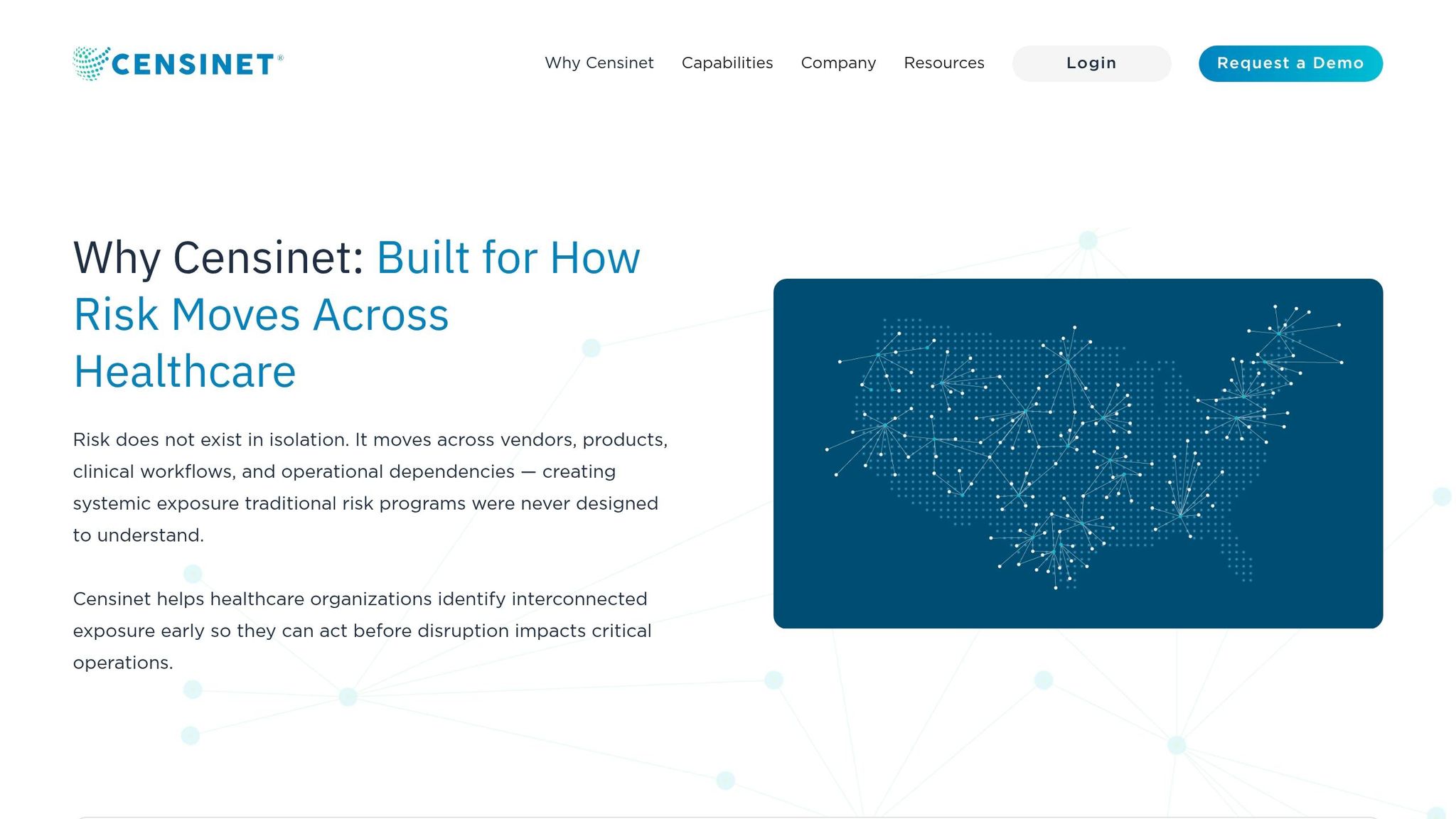
Turning visibility into action takes one shared way of working. Censinet RiskOps™ brings vendors, technologies, data flows, and integrations into one view. That matters because most teams aren't dealing with one clean system. They're juggling spreadsheets, separate reviews, and disconnected notes.
With everything in one place, teams can spot which vendors, integrations, and dependencies touch ePHI and where risk is piling up. Instead of piecing the story together by hand, they can see the pressure points faster.
Speed Assessments with Censinet AI While Keeping Human Oversight
That same shared view can also cut down the time it takes to review vendors and fourth parties. Censinet AI™ helps vendors complete security questionnaires faster, summarizes vendor evidence, pulls out key integration details and fourth-party risk exposures, and generates risk reports.
The main point: speed doesn't mean giving up control. Human review stays part of the process through configurable review rules and escalation paths. In other words, automation helps the review move faster; it doesn't take the reviewer's place.
Conclusion: Fragility Is Manageable When Dependencies Are Visible and Controlled
Healthcare risk is systemic because many dependencies are shared. Hidden dependencies, whether that's a SaaS vendor running on a shared cloud control plane or a fourth-party clearinghouse, can create exposure that standard risk programs often miss [1].
Mass General Brigham's CTO Nallan (Sri) Sriraman captured the shift bluntly:
"We have forgotten to ask the questions." [1]
When teams can see and govern dependencies in one place, resilience stops being just an idea. Fragility becomes manageable when dependencies stay visible, assessed, and controlled.
FAQs
What are fourth-party risks in healthcare IT?
In healthcare IT, fourth-party risk is the security and operational risk that comes from the subcontractors, vendors, and digital services your third-party vendors depend on.
Here’s the problem: many vendors lean on external APIs, plugins, and open-source libraries. Those behind-the-scenes dependencies often aren't easy to see, and you usually don't have direct oversight of them.
That lack of visibility can open the door to cyberattacks through entry points no one is watching. It can also set off chain-reaction failures that put patient data and clinical continuity at risk.
How can one outage disrupt multiple healthcare systems?
Healthcare systems are tightly connected, so one outage at a vendor, cloud provider, or shared infrastructure point can ripple across the whole ecosystem.
That’s the core problem: dependencies are often concentrated in a few places. A single cloud region can go down. A sole-source supplier can fail. And when that happens, the fallout doesn’t stay contained.
Centralized management platforms add another layer of risk. They can turn into single points of failure, where one compromised credential or one bad update hits many endpoints and networks at once.
What should a healthcare organization map first?
First, build a centralized inventory of all external dependencies. That includes vendors, cloud applications, medical devices, and network infrastructure.
Then map how those assets support clinical and business workflows, like surgery scheduling or EHR access. This helps you spot single points of failure and rank them based on their effect on patient safety and continuity of care.
Related Blog Posts
- The AWS Outage Exposed Cloud Vulnerabilities - What It Means for Healthcare Business Continuity
- The AWS Outage and Joint Commission: How Business Continuity Standards Just Got Harder
- Geographic Concentration Risk: What Healthcare Learned When 70% of Internet Traffic Failed in One Region
- How Supply Chains Trigger Risk Cascades in Healthcare
