
Managing third-party risks in healthcare is no longer optional - it's a necessity. With sensitive patient data like PHI at stake and vendor networks expanding, organizations must evaluate their risk management strategies. Here's the key takeaway: manual processes like spreadsheets and emails often fall short, while platform-based solutions offer centralized data, automation, and real-time monitoring to address modern challenges effectively.
Key Insights:
- Manual TPRM: Reactive, fragmented, and resource-heavy. Vulnerable to errors and delays, especially with growing vendor lists.
- Automated Solutions: Centralized platforms like Censinet RiskOps™ simplify risk management, reduce errors, and ensure compliance through continuous monitoring and automation.
The Bottom Line: If your healthcare organization still relies on manual processes, it's time to consider transitioning to automated tools to better safeguard patient data and meet regulatory demands.
1. Censinet RiskOps™
Maturity Model Alignment
Censinet RiskOps™ takes healthcare cybersecurity to the next level by centralizing data to establish a clear and measurable risk baseline. By using this centralized hub, healthcare organizations can set benchmarks and track their progress over time. This makes it easier for leadership to monitor improvements and pinpoint areas that may need extra attention or resources.
On top of this solid foundation, automation plays a key role in simplifying and accelerating risk assessments.
Automation and Scalability
The platform replaces time-consuming manual processes with automation to deliver real-time insights into vendor security. Instead of relying on outdated, calendar-based assessments, Censinet RiskOps™ uses continuous monitoring to detect security changes as they happen. This proactive approach not only saves time but also conserves resources compared to traditional manual methods.
With features like Censinet AITM™, the platform speeds up assessments by allowing vendors to respond quickly, automatically summarizing evidence, and generating clear, actionable risk reports. A human-in-the-loop framework ensures that while automation handles repetitive tasks, experts still oversee critical decisions through configurable rules and review procedures. This balance of automation and human oversight ensures that risk teams remain in control.
These tools are specifically designed to address the unique challenges faced by healthcare organizations.
Healthcare-Specific Features
Censinet RiskOps™ is built with healthcare’s unique needs in mind, focusing on protecting patient data and ensuring safety. The platform supports risk management across clinical applications, medical devices, supply chains, and other healthcare-specific systems. Its advanced routing and orchestration tools ensure that critical findings and tasks are sent directly to the right stakeholders for review and approval. Meanwhile, an intuitive risk dashboard brings all the key data - policies, risks, and tasks - into a single, real-time view, making it easier to manage and act on.
Impact on Risk Reduction
By automating continuous monitoring, the platform helps minimize human error. It automatically verifies essential vendor security measures, such as ensuring regular patching, conducting malware scans, and maintaining up-to-date SSL certifications, flagging any issues that require attention [1]. This process not only helps healthcare organizations reduce risk but also ensures they maintain the oversight needed to protect sensitive patient data and deliver high-quality care.
2. Manual TPRM Processes
Maturity Model Alignment
Manual third-party risk management (TPRM) processes often operate at the most basic maturity levels, leaving organizations vulnerable to various risks. These processes are typically categorized as "Naive" or "Novice", where risk management is reactive and lacks a structured framework. In such setups, organizations depend heavily on a few key individuals who may have limited experience, resulting in inconsistent and fragmented risk management practices across the board [2].
This issue becomes even more critical in healthcare, where managing hundreds - or even thousands - of vendors is a necessity. Add to that the need to comply with strict regulations like HIPAA, and the limitations of manual TPRM become glaringly obvious. Without a structured, proactive approach, organizations struggle to progress to higher maturity levels. This stands in stark contrast to platform-based solutions, which enable continuous and real-time risk monitoring [2].
Automation and Scalability
Manual TPRM processes create significant bottlenecks, particularly when scaling to manage large vendor portfolios. The reliance on lengthy questionnaires makes the process time-consuming and labor-intensive. Additionally, without automation, organizations lack real-time insights into vendor security postures. Instead, manual methods rely on periodic, point-in-time assessments that fail to account for ongoing changes in risk [1].
Impact on Risk Reduction
Low-maturity manual processes introduce serious vulnerabilities, particularly when it comes to safeguarding patient data. Communication often relies on spreadsheets and emails, which fragment workflows and delay essential actions like vendor offboarding. This delay increases the risk of unauthorized access to sensitive patient information [4][3]. Furthermore, the disjointed nature of these processes leads to what security teams refer to as "assessment fatigue", where the sheer volume of work results in inconsistent evaluations and risk mitigation efforts [5].
sbb-itb-535baee
Advantages and Disadvantages
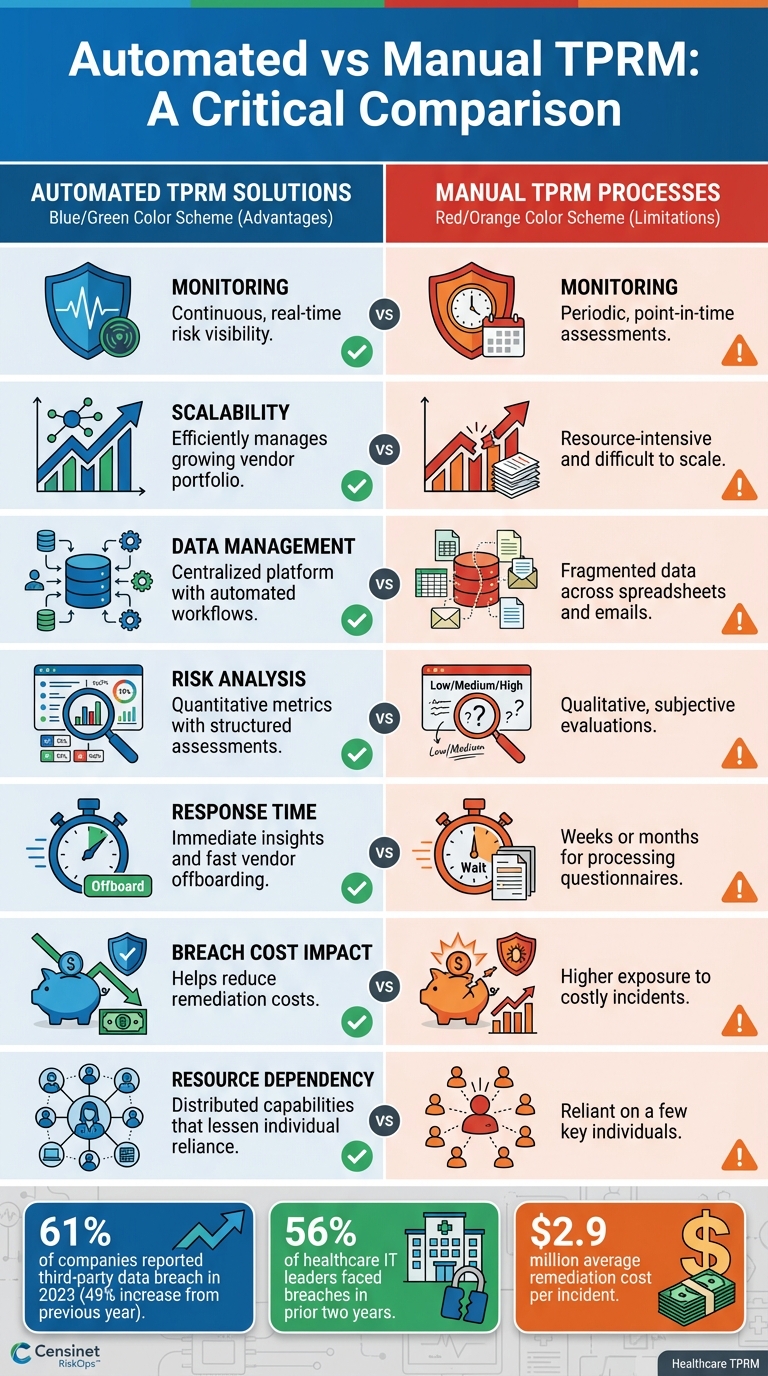
Automated vs Manual TPRM: Key Differences in Healthcare Risk Management
This section expands on the maturity model discussion, weighing the pros and cons of Third-Party Risk Management (TPRM) approaches. By understanding these, healthcare organizations can make better choices for managing their risks effectively.
As highlighted earlier, automated platforms provide continuous, real-time monitoring, ensuring they keep up with ever-changing threats. They consolidate vendor data into a single system and enable quantitative risk analysis, offering clear metrics to support decision-making. Plus, these platforms can scale effortlessly to accommodate growing vendor lists without overburdening resources. Together, these features create a more streamlined and proactive strategy, combining the efficiency of automation with the ability to address vulnerabilities typically found in manual processes.
On the other hand, manual TPRM methods come with significant drawbacks. They often depend on a small number of key staff members, making processes vulnerable if those individuals are unavailable. As discussed earlier, relying on spreadsheets and email can slow processes, creating bottlenecks that delay critical responses. Additionally, manual assessments are usually conducted at specific points in time, which means they can quickly become outdated. This leaves organizations exposed to new risks. For instance, in 2023, 61% of companies reported experiencing a third-party data breach or cybersecurity incident - a 49% increase from the previous year. Similarly, a 2019 survey found that 56% of healthcare IT leaders had faced breaches in the prior two years, with average remediation costs hitting $2.9 million per incident [6].
Automated solutions address these challenges by reducing the likelihood of costly breaches and freeing up staff to focus on broader, strategic risk decisions instead of getting bogged down by administrative tasks. This comparison underscores the importance of adopting modern, automated TPRM platforms, as discussed earlier, to overcome the limitations inherent in manual methods.
The table below highlights the differences between automated platforms like Censinet RiskOps™ and traditional manual TPRM processes:
| Aspect | Censinet RiskOps™ | Manual TPRM Processes |
|---|---|---|
| Monitoring | Continuous, real-time risk visibility | Periodic, point-in-time assessments |
| Scalability | Efficiently manages a growing vendor portfolio | Resource-intensive and difficult to scale |
| Data Management | Centralized platform with automated workflows | Fragmented data across spreadsheets and emails |
| Risk Analysis | Quantitative metrics with structured assessments | Qualitative, subjective evaluations |
| Response Time | Immediate insights and fast vendor offboarding | Weeks or months for processing questionnaires |
| Breach Cost Impact | Helps reduce remediation costs | Higher exposure to costly incidents |
| Resource Dependency | Distributed capabilities that lessen individual reliance | Reliant on a few key individuals |
This comparison makes it clear: automated platforms not only improve efficiency but also help organizations stay ahead of emerging risks while reducing costs associated with breaches.
Conclusion
Understanding where your organization stands on the TPRM maturity spectrum is key to making smarter, more informed decisions about managing risk. This insight lays the groundwork for adopting efficient, automated solutions tailored to your needs.
For smaller organizations, starting with manual processes may work in the short term. But as vendor lists grow or regulations tighten, relying on manual methods becomes impractical. Larger organizations, on the other hand, benefit from automated tools like Censinet RiskOps™, which offer continuous monitoring, centralized data management, and faster risk response - making manual processes a thing of the past.
The real question is whether your current TPRM approach can keep up with the pace of evolving risks. If your team is bogged down by spreadsheets and disjointed workflows, it might be time to assess whether your risk management strategy aligns with the actual threats your organization faces. Automated solutions can help safeguard patient data, ensure compliance, and reduce the financial fallout from security breaches.
Healthcare providers that align their TPRM maturity with their operational demands not only manage risk more effectively but also free up resources to focus on strategic goals. The challenge isn’t deciding if you should advance your TPRM capabilities - it’s determining when and how to make the shift in a way that supports your organization’s unique needs and long-term stability.
FAQs
What are the main advantages of using automated TPRM solutions in healthcare?
Automated Third-Party Risk Management (TPRM) solutions provide clearer insights into potential risks, allowing organizations to pinpoint and address vulnerabilities with greater efficiency. By automating risk assessments and monitoring, these tools help lower the chances of incidents, such as data breaches, ensuring smoother operations.
These systems also make it easier to stay compliant with key healthcare regulations like HIPAA and HITRUST. This not only helps organizations meet required standards but also saves valuable time and resources in the process.
How does Censinet RiskOps™ streamline risk management compared to manual methods?
Censinet RiskOps™ streamlines risk management by automating essential tasks such as data collection and real-time monitoring. This automation not only cuts down on manual labor but also boosts accuracy and speeds up decision-making with better insights.
By enabling proactive risk assessments and providing continuous updates, the platform helps organizations pinpoint and resolve potential problems more efficiently. This leads to a more robust and dependable strategy for managing third-party risks.
Why is continuous monitoring essential for managing third-party risks in healthcare?
Continuous monitoring plays a key role in managing third-party risks in healthcare. It enables organizations to promptly detect and respond to potential threats, security gaps, or compliance issues as they emerge. This proactive strategy reduces the chances of data breaches, service disruptions, and expensive regulatory fines.
By keeping a close eye on third-party activities in real time, healthcare organizations can protect sensitive patient data, ensure smooth operations, and maintain trust with patients and stakeholders. In today’s complex environment, this approach is essential for safeguarding both information and reputation.
Related Blog Posts
- Common Healthcare Third-Party Risk Assessment Questions
- Healthcare Third-Party Risk Management Maturity Model: Where Does Your Organization Stand?
- The Business Case for Healthcare TPRM: Cost Savings and Risk Reduction Statistics
- The Business Case for Healthcare TPRM: Cost Savings and Risk Reduction Statistics
