
If you can’t score HIPAA risk in a consistent way, you can’t rank what to fix first. And that can get expensive: OCR actions have tied weak risk analysis to penalties that can reach millions of dollars, while one source in the article says incomplete risk analysis appears in more than 73% of HIPAA enforcement investigations.
If I had to boil this down, I’d say HIPAA risk scoring manages enterprise risk through 4 jobs:
- Sets scope so no ePHI system, device, workflow, or vendor is left out
- Rates risk by combining likelihood and impact with a fixed scale
- Ranks findings by what risk is left after controls are reviewed
- Turns scores into action with owners, due dates, review cycles, and trigger-based reassessments
Here’s the article in plain English:
- I start with an inventory of all places ePHI is created, received, stored, or sent
- I tie each item to HIPAA’s administrative, physical, and technical safeguards
- I score threats using a simple High / Medium / Low model
- I compare risk before controls and after controls
- I sort by the risk that remains, then assign one owner and one deadline
- I review top risks on a set schedule, and I rescore when things change, like a new vendor, EHR upgrade, cloud move, or security incident
One point stands out: the score itself is not the goal. The goal is a clear record that shows what you reviewed, how you rated it, what controls you checked, and what you did next.
So if you want this process to work, focus on clear scope, one scoring model, residual-risk ranking, and regular reviews. That’s the shortest path from a HIPAA rule on paper to work your team can track and defend.
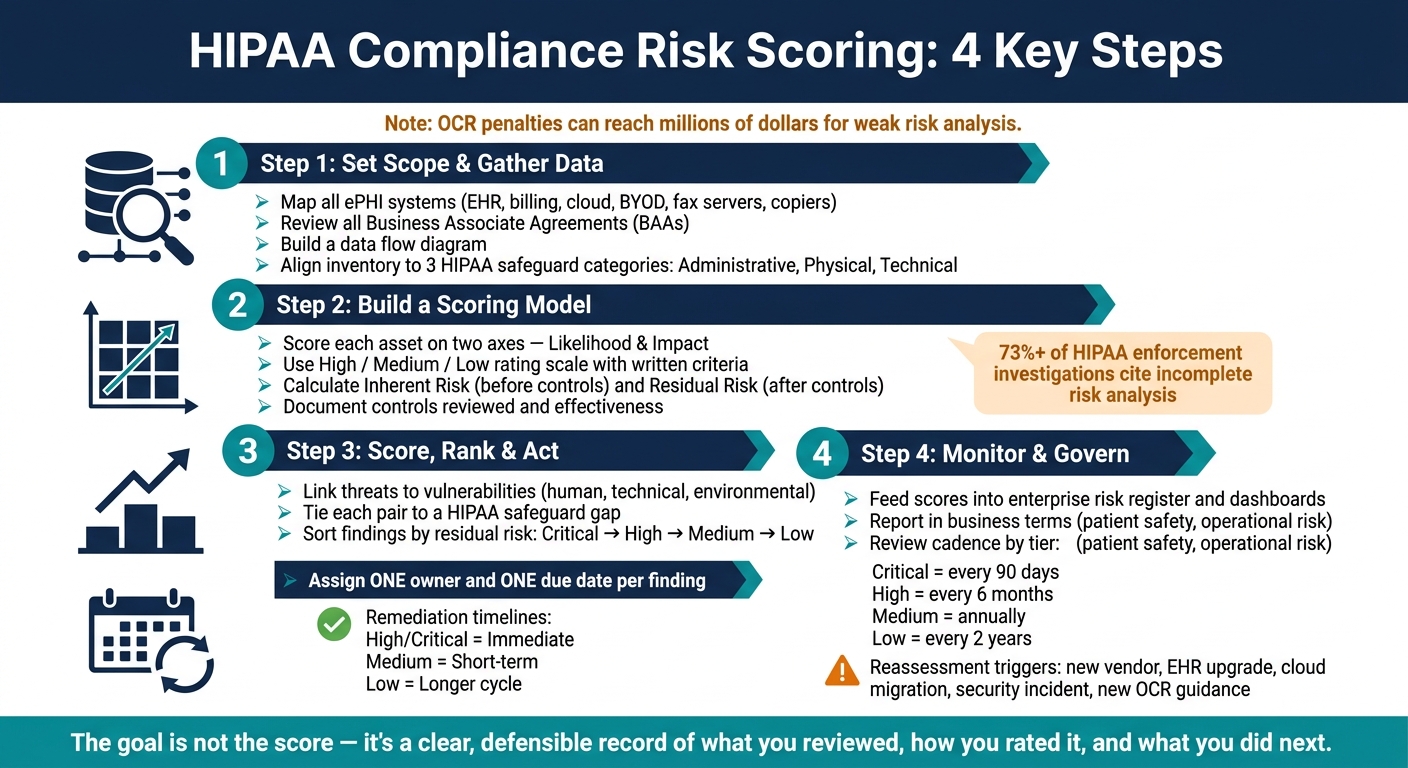
HIPAA Compliance Risk Scoring: 4-Step Process
OCR Webinar: The HIPAA Security Rule Risk Analysis Requirement
sbb-itb-535baee
Step 1: Set Scope and Gather the Right Data
A risk score is only as strong as the inventory behind it. If systems, devices, or vendors are missing, you end up with blind spots.
Map ePHI Systems, Workflows, and Business Associates
Start by listing every asset that creates, receives, maintains, or transmits ePHI. That includes EHR, billing systems, cloud storage, backup environments, remote access, fax servers, copiers, and BYOD devices.
Then review each Business Associate Agreement (BAA). The goal is simple: confirm what PHI each vendor actually touches, not just what the contract says they may touch. IT managed service providers, billing clearinghouses, cloud service providers, and shredding companies all count. Your vendor inventory shapes which BAAs, access paths, and leftover risks go into the score.
A data flow diagram can make this much easier. Follow ePHI from the moment it enters your environment, note where it sits, track how it moves between systems, and mark where it leaves. This often brings shadow IT into view, which a basic asset list can miss.
Scope every system, device, and location that creates, receives, maintains, or transmits ePHI. OCR actions have penalized organizations that failed to include all ePHI systems in risk analysis [1].
Align the Inventory to HIPAA Safeguards and Internal Controls
Once you have the full inventory, group it under the three HIPAA safeguard pillars: administrative, physical, and technical. This makes gaps easier to spot and links your ePHI systems back to the Security Rule's requirements.
| Safeguard Category | Key Focus Areas | Example Controls |
|---|---|---|
| Administrative | Workforce, vendors, policies | BAAs, security training, sanction policies |
| Physical | Facilities, workstations, media | Badge access, privacy screens, media shredding |
| Technical | Data at rest/transit, access | MFA, AES-256 encryption, audit logs |
After that, use the inventory to score likelihood, impact, and control strength. The ONC/OCR Security Risk Assessment (SRA) Tool, available free from HHS, fits small to mid-sized practices well. For larger healthcare delivery organizations, Censinet RiskOps™ can pull these inventories and PHI-related workflows into one place, helping keep scope current as vendors and systems change.
Treat the inventory as a living document. Update it when vendors, systems, or workflows change. Regular updates keep risk scores accurate between assessment cycles and support reassessment triggers. Use this inventory as the input for your scoring model.
Step 2: Build a Scoring Model for HIPAA Risks
Use the ePHI inventory from Step 1 to score each system, workflow, and business associate the same way.
Choose Scoring Factors and Rating Scales
Every HIPAA risk score begins with two core axes: likelihood and impact. Likelihood is the chance that a threat will be exploited. Impact is the damage to ePHI confidentiality, integrity, availability, and patient care. In healthcare, impact should also account for breach notification duties and exposure to regulatory enforcement [1].
Rate each factor as High, Medium, or Low using clear, written criteria [1]:
| Rating | Likelihood Criteria | Impact Criteria (Healthcare-Specific) |
|---|---|---|
| High | Threat source is motivated and capable; controls are inadequate to prevent exploitation. | Large-scale breach, loss of availability affecting patient care, or likely OCR review. These risks to patient care often stem from disruptions to clinical applications. |
| Medium | Threat source is motivated and capable; controls are only partially effective. | Limited breach, temporary system unavailability, or likely regulatory reporting. |
| Low | Threat source lacks motivation or capability, or controls substantially reduce likelihood of exploitation. | Minor ePHI exposure, no major effect on patient care, or unlikely regulatory reporting. |
The key is consistency. If one team calls a short EHR outage “High” and another calls the same event “Medium,” your scores stop being useful. Apply the same scale across all assets so results stay comparable, often through real-time portfolio risk management. Then use a 3×3 matrix to turn likelihood and impact into an overall High, Medium, or Low rating [1].
Calculate Inherent and Residual Risk Ratings
Inherent risk is the starting point before controls. Residual risk is what’s left after you review those controls. If the controls work well, residual risk should drop. If they’re weak or spotty, it may stay close to the inherent rating.
For example, ransomware tied to unpatched workstations can rate High at the inherent level [1]. That’s a plain sign that the threat is serious before you even look at what’s in place to stop it.
Document three things for every rating:
- The controls reviewed
- How well those controls work
- Why the final rating was assigned
That paper trail matters. Incomplete risk analysis shows up in more than 73% of HIPAA enforcement investigations [1]. Put these ratings next to your remediation plan so you can rank work and assign owners without guesswork.
Step 3: Score, Rank, and Act on HIPAA Compliance Risks
Once your scoring model is set, the next move is simple: apply it the same way across everything in scope. That includes every asset, workflow, and vendor. Use the residual-risk score from Step 2 to rank each finding so you can see what needs attention first.
Assess Threats, Vulnerabilities, and Control Strength
Start by linking each threat to the vulnerability it could use. In most cases, threats fall into three groups: human (phishing, malicious insiders, unintentional errors), technical (software vulnerabilities, configuration errors, patch management gaps), and natural/environmental (floods, fires, power failures, equipment malfunctions).
From there, tie each threat-vulnerability pair to a HIPAA safeguard gap. This is where the picture gets clearer. A phishing threat, for example, might connect to weak access controls or missing multi-factor authentication. A lost device might point to unencrypted portable media. Other common gaps include incomplete audit logging and weak workforce training.
Then look at the controls already in place. How much do they reduce the risk? Record the effect of each control on the score. That rating shows whether residual risk drops from the inherent level or stays close to where it started.
Prioritize Remediation by Residual Risk and Ownership
After scoring, sort findings by residual risk level. High and Critical risks should go first. Medium risks come next. Low risks can stay on a longer monitoring cycle.
Set timelines that match the level of risk:
- High/Critical: immediate deadlines
- Medium: short-term deadlines
- Low: longer review cycles
If a risk can't be remediated, document leadership-approved risk acceptance. Also, give each finding one owner and one due date. That keeps accountability clear and cuts down on the usual "someone else is handling it" problem.
Use Healthcare-Specific Automation to Scale the Process
This is where automation starts to pull its weight. When you're dealing with dozens of business associates, clinical applications, and medical devices, manual tracking gets messy fast.
Automation helps you:
- standardize scoring
- centralize evidence
- track remediation across the risk register
For healthcare teams, Censinet RiskOps™ supports standardized assessments, automated scoring, and risk tracking. Those ranked findings then feed directly into the review cadence in Step 4.
Step 4: Turn Risk Scores into Monitoring and Governance
Risk scoring isn't a one-and-done task. After you rank residual risk in Step 3, those scores should move straight into day-to-day governance.
The HIPAA Security Rule calls for ongoing risk management, and OCR guidance says risk analysis should be reviewed and updated on a regular basis - at least once a year, and any time major changes happen.
Once findings are ranked and remediation is in motion, feed those scores into your enterprise risk register, departmental dashboards, and corrective action plans. Every high or critical risk should have a documented status and a next review date.
It also helps to report scores in plain business terms. Think:
- patient safety
- care delivery
- operational risk
A short top-risks view, quarterly trend changes, and vendor risk summaries give executives and the Board what they need to make decisions with their eyes open. That's how scoring becomes an active monitoring program instead of a static spreadsheet.
Set Review Cadence and Reassessment Triggers
Use the same cadence for internal systems and third parties. Tie review frequency directly to the residual risk tier so your team spends more time where the stakes are highest.
| Risk Tier | Review Frequency |
|---|---|
| Critical | Every 90 days, plus after any trigger event |
| High | Every 6 months |
| Medium | Annually |
| Low | Every 2 years |
Scheduled reviews are only part of the picture. Some events should trigger an immediate unscheduled reassessment, including a security incident or near-miss involving ePHI, onboarding a new vendor or business associate, an EHR upgrade or cloud migration, a merger or acquisition, or new HHS or OCR guidance that changes acceptable safeguards.
A simple way to make this stick is to connect those triggers to change management. If a major system update happens, a score review should happen too. That keeps the program current instead of leaving it to chance.
Use the same reassessment rules for business associates. Scores should carry across the full vendor lifecycle. High-risk vendors should face stronger contract terms and more frequent reassessments, and critical and high-risk vendors should be reviewed at least annually. Censinet RiskOps™ supports ongoing third-party vendor risk management in healthcare by automating reassessments and generating updated scores as new information surfaces.
Conclusion: Key Steps to Make HIPAA Risk Scoring Work
Effective HIPAA risk scoring comes down to three things: a documented methodology, steady use of residual risk to set priorities, and a review cadence that keeps scores current.
Just as important, maybe more so, is the documentation behind it. OCR investigations look closely at whether an organization had a reasonable, systematic process in place - not only whether an incident happened. Consistent methodology, version-controlled records, and clear proof of follow-through are what make a risk scoring program a real compliance asset.
FAQs
What counts as ePHI in a risk assessment?
ePHI includes all electronic protected health information that a healthcare organization creates, receives, maintains, or transmits.
That applies no matter where the data lives, how it's stored, or which system handles it.
How do I decide whether to accept or remediate a risk?
Start by rating the risk as high, medium, or low. Then look at how it could affect the confidentiality, integrity, and availability of PHI or ePHI.
Address higher-priority risks first and assign clear timelines for mitigation. If remediation isn't feasible because of budget or operational limits, formally document risk acceptance and get leadership approval to show the decision was deliberate and compliant.
Who should own HIPAA risk scoring internally?
HIPAA risk scoring should sit with designated compliance roles, most often the privacy officer and security officer. That setup helps make sure policies and procedures line up with HIPAA requirements.
In larger organizations, these are often two separate roles. In smaller ones, one person may wear both hats. It also helps to assign ownership to roles instead of specific people. If staff members leave or change jobs, accountability stays in place and the work doesn’t fall through the cracks.
