
The healthcare industry is under attack, and AI is making it worse. Cybercriminals are now using AI to launch faster, more precise, and harder-to-detect attacks on hospitals, patient data, and medical devices. In 2025, the average cost of a healthcare breach hit $10.3 million, with 33 million Americans affected. Why? Personal health information (PHI) is highly valuable on the dark web, fetching up to 50x more than credit card data.
AI-powered threats include phishing scams, ransomware, and even attacks on AI-driven clinical systems. Hospitals, already stretched thin with limited cybersecurity staff, are struggling to keep up. Attackers exploit vulnerabilities in connected medical devices, third-party vendors, and outdated security systems, putting patient safety and care at risk.
Key points to know:
To combat this, healthcare providers must adopt AI-specific cybersecurity frameworks, establish strict AI governance, and use advanced detection tools that can identify and respond to threats in real-time. Platforms like Censinet RiskOps™ help streamline risk management, improve collaboration with vendors, and centralize oversight.
The bottom line: As AI reshapes cyber threats, healthcare leaders must prioritize robust security measures to protect patients and systems.
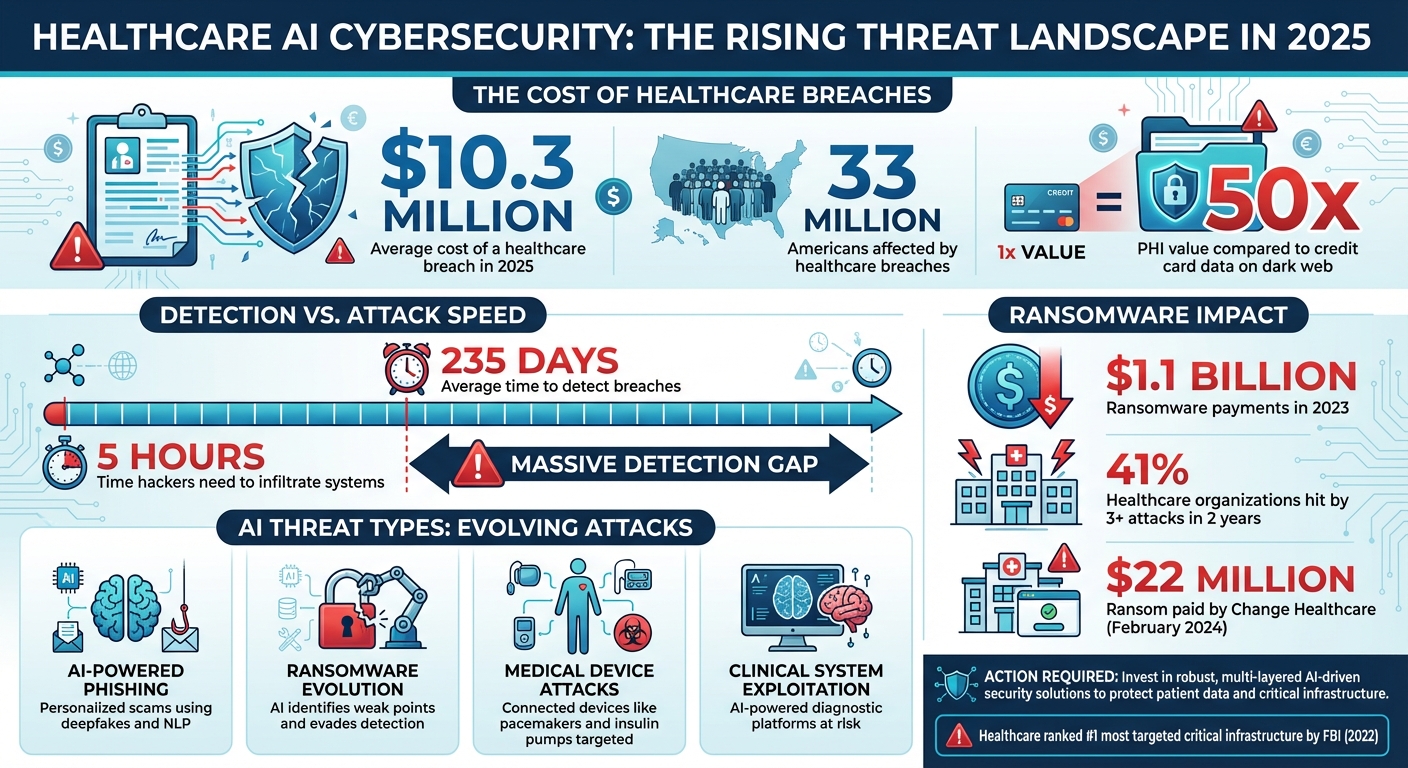
AI-Driven Healthcare Cyber Threats: Key Statistics and Impact 2025
How Cybercriminals Use AI to Attack Healthcare Organizations
AI-Powered Phishing and Social Engineering
Cybercriminals are leveraging generative AI tools to craft phishing emails and deepfakes that are alarmingly convincing. Unlike older phishing attempts that were often riddled with typos or generic content, these AI-driven attacks use natural language processing to create highly personalized messages. By analyzing employee communications and social media activity, attackers can tailor their approaches to specific individuals at scale [2].
Deepfakes take this a step further, generating realistic audio, video, and images to impersonate trusted figures. When these elements - voice, video, and text - are combined, they can even bypass biometric security systems [2][3]. This use of AI has added a new layer of sophistication to cyber threats, making it harder for healthcare organizations to defend against these attacks.
AI-Optimized Ransomware Attacks
Ransomware has become more precise and destructive thanks to AI. Attackers now use AI to identify the most valuable targets, strategically time their attacks for maximum disruption, and adapt malware to evade detection [5]. The healthcare sector, ranked by the FBI as the most targeted critical infrastructure for ransomware in 2022, has been hit particularly hard [6]. In 2023 alone, ransomware payments reached $1.1 billion, with 41% of healthcare organizations reporting three or more attacks in just two years [6][7].
The consequences of these attacks can be devastating. In September 2020, Düsseldorf University Hospital in Germany experienced a ransomware attack that crippled its IT systems. A critically ill patient, unable to receive immediate care, had to be transferred to another hospital and tragically passed away during the delay. German authorities even investigated the incident as manslaughter, directly linking the cyberattack to the patient's death [4].
More recently, in February 2024, the BlackCat (ALPHV) gang targeted Change Healthcare, a major U.S. health-tech company. Using stolen credentials, they accessed a Citrix portal that lacked multi-factor authentication and deployed ransomware written in Rust - a programming language known for its resistance to detection and analysis [7]. The company paid a $22 million ransom in Bitcoin, but the attackers never returned the stolen data [7]. These examples highlight the real-world dangers of AI-enhanced ransomware, threatening both patient safety and the stability of healthcare organizations.
Attacks on AI-Powered Clinical Systems
AI isn’t just being used to exploit external vulnerabilities - it’s also being turned against internal clinical systems. AI-powered tools, such as clinical decision support systems and diagnostic platforms, are increasingly targeted due to their unique weaknesses. Many of these systems were built with a focus on accuracy and efficiency, often overlooking security considerations. As they become more integrated into healthcare workflows, they’ve outpaced the development of regulatory safeguards [1].
One major challenge lies in the complexity of "black box" AI models. These systems are notoriously difficult to interpret, making it unclear how they process data or arrive at decisions. This lack of transparency complicates patient understanding and informed consent, leaving room for attackers to exploit these gaps [4]. The rapid adoption of AI in healthcare has expanded the attack surface, exposing critical systems to new and evolving threats.
High-Risk Areas for AI-Driven Cyber Attacks in Healthcare
As AI-powered attacks exploit vulnerabilities, healthcare systems face growing risks across several critical areas of operation.
Clinical and Operational Systems
Electronic health records (EHRs) and clinical support platforms are at the heart of patient care, storing vast amounts of sensitive data. Unfortunately, many of these systems were designed with a focus on functionality rather than security. Their deep integration into healthcare workflows has made them attractive targets for cyberattacks [1]. AI-driven techniques can pinpoint and exploit these weaknesses, threatening the very systems healthcare providers rely on to deliver care.
Third-Party Vendors and Supply Chains
Healthcare organizations often depend on third-party vendors, from EHR providers to telehealth services. While these partnerships are essential, they also create multiple vulnerabilities [1]. A significant number of breaches originate from compromised third-party connections, opening doors for attackers. This dependency further broadens the attack surface, a problem that extends to connected medical devices.
AI-Enabled Medical Devices and IoT Systems
Devices like pacemakers, insulin pumps, and imaging equipment are increasingly connected, but their design often prioritizes usability and cost over security [4][8]. This makes them highly susceptible to AI-driven threats such as ransomware or denial-of-service attacks [4][8]. Worse, unauthorized access to these devices could pose immediate risks to patient safety. These vulnerabilities underline the urgent need for comprehensive AI risk management strategies, which will be explored further in the next section.
Strategies to Defend Against AI-Driven Cyber Threats
Healthcare organizations face mounting challenges as AI-powered cyber threats become more sophisticated. To combat these risks effectively, they need to go beyond traditional cybersecurity measures and adopt strategies that integrate proven frameworks with specialized protections tailored to AI-specific vulnerabilities.
Cybersecurity Frameworks for AI Threats
Healthcare providers can strengthen their defenses by enhancing established frameworks like NIST with AI-focused threat modeling. These additions address the unique vulnerabilities of machine learning systems. A standout approach is the MITRE ATT&CK® framework, which outlines tactics, techniques, and procedures (TTPs) to mitigate AI-driven attacks [9]. Additionally, Enterprise Risk Management principles can help ensure the secure integration of AI technologies [4].
In November 2025, HIMSS introduced a whitepaper titled "Operationalizing AI: A Strategic Framework for Safe Deployment in Healthcare." This resource provides hospitals with structured guidance for managing AI integration through deliberate oversight [11]. By combining these enhanced frameworks with robust governance practices, healthcare organizations can better prepare for the evolving threat landscape.
Establishing AI Governance and Oversight
Effective governance is critical for managing AI risks across healthcare operations. The Health Sector Coordinating Council (HSCC) has taken a leadership role in this area, with its AI Cybersecurity Task Group - comprising 115 healthcare organizations - developing guidance for managing AI-related cybersecurity risks [12]. In November 2025, the HSCC previewed an AI Governance Maturity Model, designed to help organizations assess their capabilities and prioritize improvements [12].
Healthcare providers should maintain a thorough inventory of AI systems, detailing their functions, data dependencies, and associated security risks. Classifying AI tools based on their level of autonomy helps align oversight efforts with risk levels. Additionally, organizations should implement data provenance controls, such as cryptographic verification of training data and audit trails to track modifications [1][12]. Cross-functional collaboration among teams - including engineering, cybersecurity, regulatory affairs, quality assurance, and clinical staff - is essential for effective governance [12].
While governance sets the foundation, proactive threat detection is equally important for staying ahead of AI-driven attacks.
Improving Detection and Response to AI Threats
AI-powered detection tools can transform healthcare cybersecurity from reactive to proactive. For example, advanced pattern recognition can identify anomalies like unauthorized access to clinical data, unusual device communication, or suspicious login attempts across hospital networks. Predictive analytics can even forecast potential breaches before they disrupt patient care [10][13].
Automating real-time responses is another key strategy. AI can be configured to isolate threats, patch vulnerabilities, and deploy countermeasures automatically [10][13]. Continuous scanning ensures that emerging vulnerabilities are quickly identified, allowing healthcare organizations to prioritize high-risk systems for immediate action [10]. As Health Catalyst aptly noted:
AI is not a silver bullet, but it is a powerful partner in defending healthcare organizations from an evolving threat landscape
.
Finally, training cybersecurity teams to leverage AI insights ensures that human expertise complements automated defenses, creating a comprehensive and adaptive security approach [10].
sbb-itb-535baee
Managing AI Risk at Scale With Censinet
Healthcare organizations are grappling with an ever-expanding landscape of cyber threats - ranging from internal system vulnerabilities to risks tied to third-party vendors and AI-powered medical devices. To tackle these challenges, they need a comprehensive risk management solution like Censinet RiskOps™. This platform offers a unified approach that simplifies assessments, encourages collaboration, and ensures thorough oversight.
Streamlined AI Risk Assessments
Censinet RiskOps simplifies the process of evaluating risks. By maintaining an up-to-date inventory of critical assets, the platform ensures healthcare organizations can monitor risks effectively - whether they arise internally or through vendor partnerships.
Collaborative Risk Management for AI
After streamlining assessments, collaboration takes risk management to the next level. With Censinet Connect™, healthcare providers and their vendors can share findings from risk assessments. This reduces redundant efforts and strengthens the overall approach to addressing vulnerabilities across the healthcare network.
Centralized Oversight With Censinet AI

To round out its capabilities, Censinet AI provides a centralized dashboard that consolidates risk data. This user-friendly interface enables continuous monitoring and governance, ensuring stakeholders stay informed and equipped to handle risks proactively.
Conclusion: Protecting Healthcare From AI-Driven Cyber Threats
Key Takeaways for Healthcare Leaders
The rise of AI has brought both opportunities and challenges to healthcare cybersecurity. On one hand, it has amplified the scale and sophistication of cyber threats. On the other, the rapid evolution of AI poses challenges for regulation and oversight, leaving healthcare organizations at greater risk [14]. To navigate this shifting landscape, healthcare leaders must adopt comprehensive strategies that prioritize security across their operations.
For Chief Information Security Officers (CISOs) in healthcare, the focus needs to move from merely reacting to threats to actively preventing them. Cybersecurity should be viewed not just as a defensive measure but as a strategic advantage [10]. Incorporating AI-specific risk management into current governance and cybersecurity frameworks is no longer optional - it’s essential. Enterprise Risk Management frameworks, particularly those addressing clinical risks, provide a robust starting point for tackling these emerging challenges. With AI integration comes new risks, such as data breaches, opaque algorithms, and vulnerabilities in AI-powered medical devices. Acknowledging these risks is the first step toward crafting effective solutions.
How Censinet Supports AI Risk Management
Censinet RiskOps offers a tailored solution for managing the complex risks that arise from AI-driven cyber threats in healthcare. This platform integrates streamlined risk assessments, vendor management through Censinet Connect, and centralized oversight powered by Censinet AI - all within a single system.
Censinet AI simplifies risk assessments by automating processes, consolidating essential data into a user-friendly dashboard, and enabling targeted oversight through customizable rules. Risk teams maintain control by configuring these rules and reviewing processes, ensuring automation enhances oversight rather than replacing it. The platform’s intuitive AI risk dashboard acts as a central hub for managing policies, risks, and tasks related to AI. Findings are routed to the appropriate stakeholders, such as members of the AI governance committee, for review and approval. This cohesive approach highlights the strategic shift required for modern healthcare cybersecurity, making it more efficient and effective in addressing AI-driven challenges.
FAQs
How is AI being used to make cyber attacks on healthcare systems more effective?
AI is reshaping the way cyberattacks occur in healthcare, making them more sophisticated and harder to defend against. By automating tasks like scanning for system vulnerabilities or crafting highly convincing phishing emails, attackers can exploit weaknesses with greater efficiency. One alarming development is the use of deepfakes - realistic but entirely fabricated audio or video content. These can be used to trick employees or manipulate patients, creating new avenues for deception.
What makes AI-driven threats even more concerning is its ability to learn and adapt. This capability allows it to bypass traditional security measures, evolving to stay one step ahead of detection systems. The result? Faster, more precise attacks that can target sensitive medical data and even jeopardize patient safety.
To counter these risks, healthcare organizations need to prioritize strong cybersecurity strategies. Staying ahead of these evolving threats requires constant vigilance and the implementation of advanced security measures.
What parts of the healthcare system are most at risk from AI-driven cyber attacks?
Healthcare systems face a growing risk from data breaches, AI algorithm tampering, and deepfake technology. These threats don’t just jeopardize sensitive patient information - they can disrupt essential medical services and undermine trust in healthcare institutions.
Imagine attackers using AI to sidestep security protocols, altering diagnostic tools to produce false results, or crafting realistic deepfake messages to mislead both staff and patients. The consequences could be devastating. To tackle these challenges, healthcare providers need to implement cutting-edge cybersecurity solutions, maintain strict oversight of AI systems, and adhere to rigorous data protection laws. Without these measures, the risks could spiral out of control.
How can healthcare organizations protect themselves from AI-driven cyber attacks?
Healthcare organizations can strengthen their security measures by leveraging AI-driven threat detection tools. These tools can spot unusual activity and respond to potential breaches in real-time, helping to minimize the damage caused by cyberattacks. Combining this with advanced analytics and automated incident response ensures faster and more effective handling of threats. Regular vulnerability assessments and continuous monitoring are also key strategies for staying one step ahead of emerging risks.
To build a more secure environment, it's essential to establish strong AI governance policies, provide staff with training on cybersecurity best practices, and adhere to healthcare data protection standards like HIPAA. These proactive steps play a crucial role in reducing vulnerabilities and protecting sensitive patient data.
Related Blog Posts
- The AI Cyber Risk Time Bomb: Why Your Security Team Isn't Ready
- AI Cyber Risk: When Your Smart Defense Becomes the Attack Vector
- Protecting Digital Health: Cybersecurity Strategies for Medical AI Platforms
- The Healthcare Cybersecurity Gap: Medical AI's Vulnerability Problem
{"@context":"https://schema.org","@type":"FAQPage","mainEntity":[{"@type":"Question","name":"How is AI being used to make cyber attacks on healthcare systems more effective?","acceptedAnswer":{"@type":"Answer","text":"<p>AI is reshaping the way cyberattacks occur in healthcare, making them more sophisticated and harder to defend against. By automating tasks like scanning for system vulnerabilities or crafting highly convincing phishing emails, attackers can exploit weaknesses with greater efficiency. One alarming development is the use of <strong>deepfakes</strong> - realistic but entirely fabricated audio or video content. These can be used to trick employees or manipulate patients, creating new avenues for deception.</p> <p>What makes AI-driven threats even more concerning is its ability to learn and adapt. This capability allows it to bypass traditional security measures, evolving to stay one step ahead of detection systems. The result? Faster, more precise attacks that can target sensitive medical data and even jeopardize patient safety.</p> <p>To counter these risks, healthcare organizations need to prioritize strong cybersecurity strategies. Staying ahead of these evolving threats requires constant vigilance and the implementation of advanced security measures.</p>"}},{"@type":"Question","name":"What parts of the healthcare system are most at risk from AI-driven cyber attacks?","acceptedAnswer":{"@type":"Answer","text":"<p>Healthcare systems face a growing risk from <strong>data breaches</strong>, <strong>AI algorithm tampering</strong>, and <strong>deepfake technology</strong>. These threats don’t just jeopardize sensitive patient information - they can disrupt essential medical services and undermine trust in healthcare institutions.</p> <p>Imagine attackers using AI to sidestep security protocols, altering diagnostic tools to produce false results, or crafting realistic deepfake messages to mislead both staff and patients. The consequences could be devastating. To tackle these challenges, healthcare providers need to implement cutting-edge cybersecurity solutions, maintain strict oversight of AI systems, and adhere to rigorous data protection laws. Without these measures, the risks could spiral out of control.</p>"}},{"@type":"Question","name":"How can healthcare organizations protect themselves from AI-driven cyber attacks?","acceptedAnswer":{"@type":"Answer","text":"<p>Healthcare organizations can strengthen their security measures by leveraging <strong>AI-driven threat detection tools</strong>. These tools can spot unusual activity and respond to potential breaches in real-time, helping to minimize the damage caused by cyberattacks. Combining this with <strong>advanced analytics</strong> and automated incident response ensures faster and more effective handling of threats. Regular vulnerability assessments and continuous monitoring are also key strategies for staying one step ahead of emerging risks.</p> <p>To build a more secure environment, it's essential to establish strong <strong>AI governance policies</strong>, provide staff with training on <a href=\"https://www.censinet.com/resource/best-practices-enterprise-risk\">cybersecurity best practices</a>, and adhere to <a href=\"https://censinet.com/perspectives/8-best-practices-for-patient-data-protection\">healthcare data protection standards</a> like <a href=\"https://en.wikipedia.org/wiki/Health_Insurance_Portability_and_Accountability_Act\" target=\"_blank\" rel=\"nofollow noopener noreferrer\">HIPAA</a>. These proactive steps play a crucial role in reducing vulnerabilities and protecting sensitive patient data.</p>"}}]}
