
AI is reshaping how healthcare organizations tackle cybersecurity and operational challenges. With ransomware attacks up 40% earlier this year and the average data breach costing $4.24 million, healthcare systems face growing risks. AI-driven process intelligence offers a solution by improving threat detection, automating compliance, and reducing response times.
Key Insights:
- Cybersecurity Challenges: 93% of healthcare networks are vulnerable; breaches cost $10.93M on average.
- AI Benefits: Faster threat detection, real-time monitoring, and reduced compliance costs by 30%.
- Successful Example: A surgical robotics company cut incident response times by 70% using AI.
AI tools analyze patterns, predict risks, and secure systems, helping healthcare organizations protect sensitive data while staying compliant with regulations like HIPAA. With threats evolving, AI ensures faster responses and reduced financial impacts.
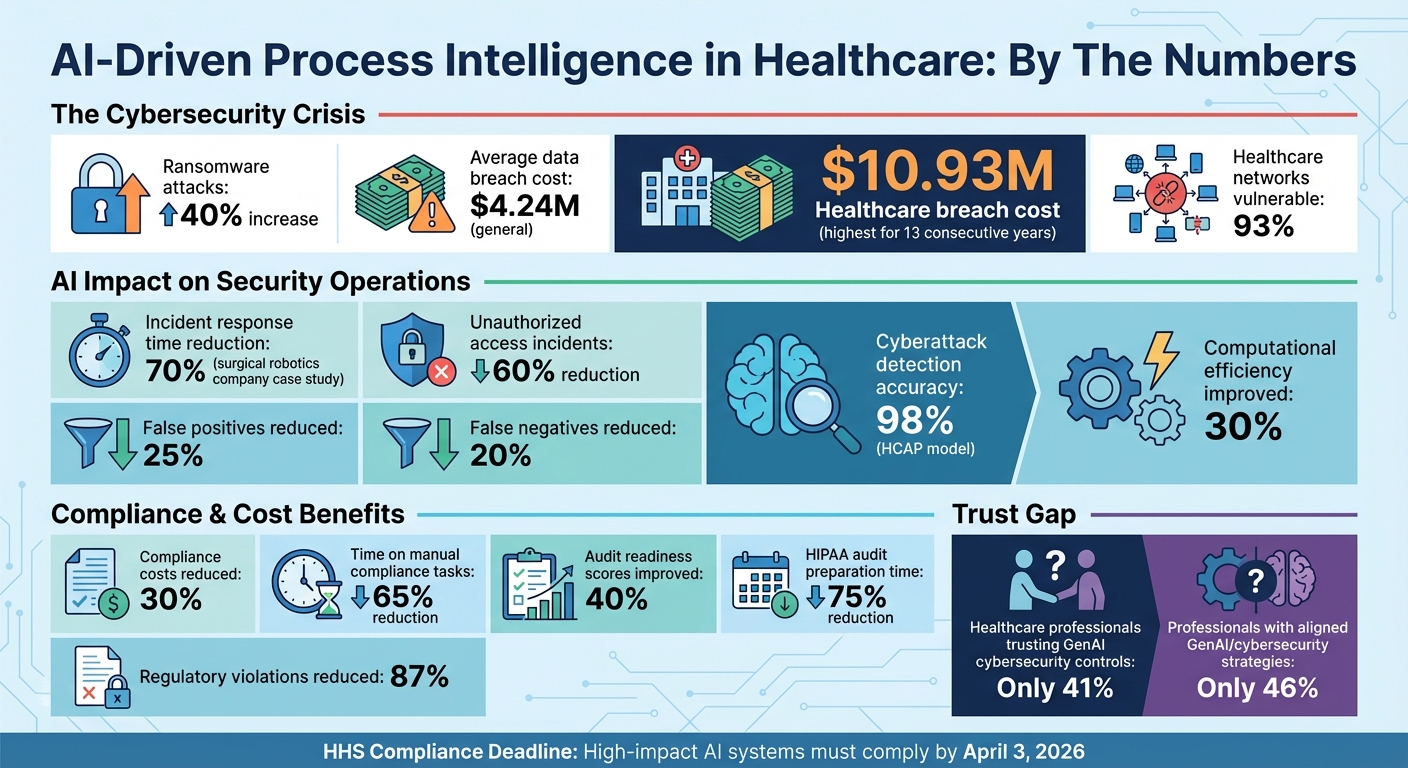
AI-Driven Process Intelligence Impact on Healthcare Cybersecurity: Key Statistics and Benefits
Core Components of AI-Driven Process Intelligence
These essential elements outline how AI powers process intelligence in healthcare cybersecurity, enabling organizations to stay ahead of risks.
AI-driven process intelligence in healthcare cybersecurity relies on several critical building blocks. Modern AI solutions use machine learning to analyze patterns, spot anomalies, and respond to threats in real time[2]. Predictive analytics plays a key role by using historical and operational data to anticipate risks, creating a well-rounded view of cybersecurity challenges. These components form the backbone of the key ideas discussed below.
Key Concepts in AI-Driven Process Intelligence
Machine learning models are central to these AI solutions, continuously improving as they process more data. In healthcare, this capability supports better clinical decision-making, improves diagnostic accuracy, and ensures ongoing system evaluation[1]. Additionally, AI delivers risk assessments tailored to the specific needs and vulnerabilities of an organization's infrastructure[4]. This adaptability allows AI systems to keep up with changing threats and refine risk management strategies effectively.
Data Sources for Process Intelligence in Healthcare
A strong AI-driven process intelligence system relies on high-quality data. Key sources include electronic health record (EHR) logs, which track access patterns and user actions, and Security Information and Event Management (SIEM) systems, which compile alerts from across the network. Other valuable inputs include detailed inventories of devices, applications, and systems, as well as assessments of third-party vendors' security postures. By integrating these varied data streams, predictive analytics creates a dynamic system capable of responding to emerging threats.
Regulatory Context and Compliance Requirements
Healthcare organizations must operate within strict regulatory boundaries when implementing AI-driven process intelligence. For example, HIPAA mandates continuous monitoring, swift incident responses, and strong data protection measures for systems managing patient information[2][6]. The NIST Cybersecurity Framework provides additional guidance on identifying, protecting against, detecting, responding to, and recovering from cyber threats[3]. Furthermore, recent guidelines from the U.S. Department of Health and Human Services (HHS) detail specific requirements for using AI in healthcare environments. AI tools can streamline compliance by automating monitoring processes, reducing administrative burdens, and ensuring regulatory adherence. However, organizations must also address challenges like algorithmic bias, data privacy concerns, and regulatory uncertainties to avoid introducing new vulnerabilities.
Improving Healthcare Cybersecurity Workflows with AI
Artificial intelligence (AI) is reshaping how healthcare organizations approach cybersecurity. By automating repetitive tasks, anticipating potential threats, and ensuring continuous compliance, AI helps tackle the increasingly complex healthcare IT landscape while easing the workload on security teams. Here's a closer look at how AI enhances these critical areas.
Improving Core Security Processes
AI is revolutionizing core security workflows, which traditionally required significant time and resources. Take vulnerability management, for example - AI-powered tools continuously scan networks, identify potential weaknesses, prioritize patches based on risk, and flag exploitable gaps proactively instead of reactively [2][5].
In the realm of identity and access management, AI enforces the principle of "minimum necessary access." It automatically adjusts user permissions based on roles, documents any changes, and detects unusual access patterns that could signal compromised credentials [12]. These advancements have a tangible impact: organizations using AI for identity governance report 60% fewer unauthorized access incidents [12].
Using Predictive Analytics for Risk Assessment
Predictive analytics takes cybersecurity to the next level by forecasting where risks are most likely to arise. By analyzing historical breach data, current system configurations, and emerging threat intelligence, AI models can pinpoint vulnerabilities with remarkable precision. For instance, a Hybridized Cyber Attack Prediction (HCAP) model tested in Internet of Medical Things (IoMT) environments achieved 98% accuracy in detecting cyberattacks, while reducing false positives by 25% and false negatives by 20%. It also improved computational efficiency by 30% compared to older systems [9].
AI excels at monitoring IoMT devices, identifying anomalies that traditional security measures often overlook [2][5]. These systems generate dynamic risk scores that update in real time, helping organizations prioritize mitigation efforts based on factors like potential patient harm, compliance risks, and financial impact [8]. Additionally, Long Short-Term Memory (LSTM) neural networks analyze data streams from connected medical devices, detecting subtle abnormal patterns over time - critical for uncovering sophisticated attacks that evade signature-based detection [9].
Automating Governance and Compliance Monitoring
AI doesn’t just predict and prevent threats - it also simplifies governance and compliance, which are essential for healthcare cybersecurity. AI-powered tools streamline compliance with regulations like HIPAA across complex IT environments. These systems automatically gather logs, align security controls with regulatory requirements, and produce audit-ready documentation without manual effort [2].
Organizations leveraging AI-driven compliance solutions report a 65% reduction in time spent on manual compliance tasks [12]. AI identifies control gaps in real time, spotting unusual activity before it leads to violations. For example, if configurations deviate from approved security policies - such as encryption protocols or multi-factor authentication settings - AI can automatically correct the issue or roll back changes [10].
AI also keeps compliance officers informed of regulatory updates, suggesting adjustments to internal policies as needed [11]. This proactive approach delivers measurable benefits: healthcare organizations have seen compliance management costs drop by 30%, audit readiness scores improve by 40%, and preparation time for HIPAA audits decrease by 75% [12]. Perhaps most strikingly, AI-driven compliance systems have reduced regulatory violations by 87%, significantly lowering financial risks and protecting reputations [11].
With healthcare data breaches costing an average of $10.93 million per incident in 2023 - the highest across all industries for 13 years running [12] - the case for AI in healthcare cybersecurity has never been stronger. By automating complex processes and providing real-time insights, AI helps organizations safeguard sensitive data while reducing costs and enhancing operational efficiency.
Reducing Cyber Risk Through AI-Driven Process Intelligence
Improving Threat Detection and Response
AI is transforming how healthcare organizations detect and respond to cyber threats by identifying unusual patterns in network behavior. By using machine learning, these systems establish what "normal" looks like across medical devices and user activities, flagging anything out of the ordinary that could indicate a potential attack [13]. This is particularly crucial when dealing with advanced threats like AI-generated phishing emails, which are becoming harder to distinguish from legitimate ones [13].
Human analysts might take hours - or even days - to investigate suspicious activity. In contrast, AI can perform an initial threat assessment in seconds or minutes [13]. Organizations that adopt AI-powered security tools report faster response times and improved threat mitigation.
AI-driven Security Information and Event Management (SIEM) systems take this a step further by automating responses. They can instantly quarantine compromised systems, halt the spread of ransomware, and disable suspicious accounts [2][4]. These systems are programmed to learn the typical communication patterns within healthcare networks, flagging any deviations that require further investigation [13]. This advanced detection capability is vital for addressing vulnerabilities unique to AI systems in the healthcare sector.
Securing AI Systems in Healthcare
While faster threat detection is a game-changer, securing the AI systems themselves is equally important. Alarmingly, only 41% of healthcare professionals trust the current GenAI cybersecurity controls, and just 46% feel that their GenAI and cybersecurity strategies are properly aligned [7]. This misalignment leaves sensitive patient data and other private information at risk as AI adoption grows [7].
To address this, healthcare organizations need to adopt privacy-by-design principles, ensuring robust safeguards are in place to protect patient information from unauthorized access or misuse [13]. The U.S. Department of Health and Human Services (HHS) has set a deadline of April 3, 2026, for implementing minimum risk management practices for high-impact AI systems. These practices include measures like bias mitigation, ongoing outcome monitoring, security protocols, and human oversight. AI tools that fail to meet these standards must be discontinued or phased out until they comply [6].
Measuring Risk Reduction and Performance Improvements
Securing AI tools is just one piece of the puzzle - measuring their impact is equally important. Metrics like Mean Time to Detect (MTTD) and Mean Time to Respond (MTTR) are critical for gauging how quickly threats are identified and neutralized. In December 2025, the HHS released an AI strategy that outlines how divisions should integrate AI initiatives into their annual performance plans. Key performance indicators (KPIs) include the number of processes improved through AI, cost or time savings, staff training percentages, and health outcomes enhanced by AI projects [6].
"Key performance indicators might include, for instance, how many processes have been improved by AI, cost or time savings achieved, percentage of staff trained in AI or improvements in health outcomes attributable to AI projects."
- Holland & Knight Healthcare Blog [6]
Strong governance is a must. High-level AI Governance Boards should be established to regularly review these metrics, identifying both successes and areas that need improvement [6]. AI models also need continuous training and validation to stay ahead of evolving attack patterns while reducing false positives - overly aggressive filters could inadvertently delay critical communications [13][14]. Additionally, benchmarking vendor security policies against industry standards with AI tools can enhance compliance and improve third-party risk management [14].
To build trust and ensure transparency, HHS has committed to annually publishing an updated inventory of AI use cases, along with evaluations and risk assessments of major AI systems [6]. This approach not only demonstrates accountability but also helps healthcare organizations stay aligned with best practices in AI-driven cybersecurity.
sbb-itb-535baee
Implementing AI-Driven Process Intelligence in Healthcare Organizations
Assessing Maturity and Building a Roadmap
Before diving into AI implementation, it’s crucial to evaluate where your organization currently stands. A maturity assessment can help identify gaps and priorities by examining governance, data infrastructure, workforce readiness, and compliance. The U.S. Department of Health and Human Services (HHS) AI strategy provides a helpful framework built around five key pillars: governance, infrastructure, workforce development, research, and care modernization [6]. This strategy not only enhances security but also improves efficiency across healthcare systems.
To adapt this framework, consider establishing an AI Governance Board that includes representatives from IT, clinical operations, compliance, and risk management. Workforce development is equally important - continuous, targeted AI training ensures your team is equipped to handle new challenges. Regular monitoring and auditing processes should also be put in place to keep AI systems effective as threats evolve and regulations shift. Once a roadmap is in place, the focus naturally shifts to data quality and integration.
Data and Integration Requirements
The success of AI depends heavily on the quality of the data it uses. Prioritize ensuring that your data is complete, accurate, and standardized. Issues like inconsistencies, errors, or missing values can undermine model performance, leading to false positives or overlooked risks. Your technical infrastructure must also be up to the task, offering sufficient processing power (such as GPUs), scalable cloud or on-premises solutions, and ample storage to support both current and future needs.
A multi-cloud approach - leveraging platforms like AWS, Azure, or Google Cloud - can help meet AI requirements. Additionally, integrating AI with existing IT systems such as EHRs, lab systems, imaging archives, and SIEM platforms is essential. Using established interoperability standards can streamline this process. Consolidating data into centralized data lakes or warehouses gives AI models a more comprehensive view of operations and potential risks [15]. With your data infrastructure in place, the next step is choosing the right AI tools.
Selecting and Using AI Tools
Selecting AI tools that address your organization’s specific challenges is key. Look for platforms that excel in areas like threat detection, breach containment, predictive analytics, and automated compliance monitoring [4]. The goal is to move from reactive problem-solving to proactive risk management.
Take Censinet RiskOps™ as an example. This AI-driven platform simplifies cybersecurity operations by automating tasks like third-party risk assessments, evidence collection, and reporting. It even captures fourth-party risks and routes findings to the appropriate stakeholders. By centralizing governance and automating workflows, the platform ensures that the right teams address issues promptly, maintaining continuous oversight while safeguarding patient safety. This type of solution not only shortens assessment timelines but also strengthens proactive risk management, aligning perfectly with the broader goal of improving healthcare operations and cybersecurity.
Conclusion
AI-driven process intelligence is transforming both cybersecurity and operational efficiency. By identifying risks early, it shifts organizations from a reactive approach to a proactive stance, reducing vulnerabilities, speeding up threat responses, and ensuring better protection for patient data and healthcare delivery systems [1].
In healthcare, AI-powered diagnostic tools and predictive algorithms are reshaping how care is delivered. These technologies improve diagnostic accuracy through advanced data analysis, simplify treatment planning, and optimize resource use across healthcare networks [16]. The result? Tangible gains in productivity, enhanced care quality, and cost savings - all while upholding stringent patient safety standards. This efficiency is becoming increasingly critical as cyber threats grow more sophisticated.
The rise in complex cyber threats has made AI-driven security solutions a necessity for healthcare operations. Real-time threat detection offered by AI surpasses traditional methods [13]. For organizations managing sensitive patient data, interconnected medical devices, and third-party partnerships, these tools provide a level of protection that is not just strategic but essential. They ensure that healthcare systems remain resilient and capable of handling the challenges of modern operations.
FAQs
How does AI-powered process intelligence help detect cyber threats in healthcare?
AI-driven process intelligence is transforming how healthcare organizations detect and respond to cyber threats. By analyzing massive amounts of data in real time, these systems can spot unusual behaviors - like unauthorized access or malware activity - almost instantly. This rapid detection means potential risks can be flagged and addressed in minutes, rather than days.
With tools that use predictive analytics and automated monitoring, vulnerabilities are assessed continuously, giving healthcare providers a stronger line of defense. Beyond improving cybersecurity, these advancements also help ensure compliance with regulations and safeguard sensitive patient information.
What types of data are essential for using AI in healthcare cybersecurity?
AI in healthcare cybersecurity relies on several key data sources, such as electronic health records (EHRs), network traffic logs, user activity data, medical imaging, genetic information, and device telemetry. Each of these plays a critical role in helping AI spot irregularities, flag unauthorized access, and pinpoint potential vulnerabilities in real time.
By diving into these datasets, AI can offer actionable insights to bolster cybersecurity, minimize risks, and reinforce the protection of healthcare IT systems.
How does AI help healthcare organizations stay compliant with regulations?
AI plays a crucial role in helping healthcare organizations meet regulatory requirements by taking over intricate tasks like risk assessments and incident reporting. It strengthens data security, safeguards privacy, and offers real-time insights while ensuring compliance with standards like HIPAA.
By using AI tools, healthcare providers can pinpoint potential vulnerabilities, simplify governance processes, and manage compliance more effectively. This reduces the reliance on manual work and lowers the chances of errors.
