
The COVID-19 pandemic exposed major flaws in medical device supply chains, from component shortages to export bans. AI agents are now transforming supply chain management to prevent future disruptions. Here's how:
- Pandemic Impact: Global supply chains collapsed under the strain of demand for ventilators, masks, and respirators. Lack of visibility into suppliers and over-reliance on single sources worsened the crisis.
- AI's Role: AI agents monitor supply chains in real-time, predict disruptions, and suggest alternatives. They also enhance cybersecurity for AI-enabled medical devices, reducing risks tied to legacy systems and third-party vulnerabilities.
- Tools in Action: Platforms like Censinet RiskOps™ automate risk mapping, track regulatory changes, and analyze supplier performance. This shifts healthcare from reactive problem-solving to proactive risk management.
- Key Benefits: AI reduces supply chain delays, improves forecasting accuracy, and strengthens compliance with federal standards, ensuring devices remain available and secure.
AI-powered solutions are helping healthcare organizations move beyond past challenges, creating supply chains that are smarter, faster, and more resilient.
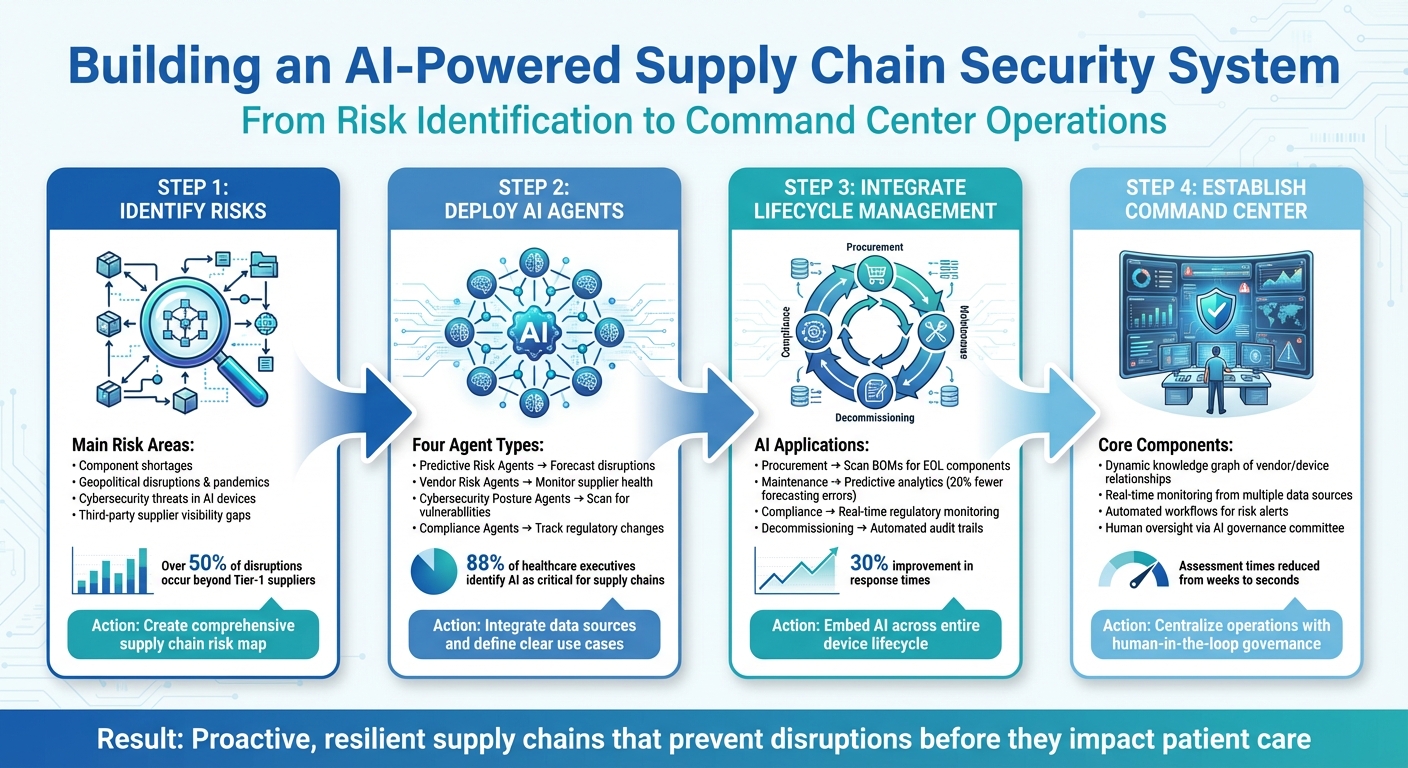
4-Step Framework for Implementing AI-Powered Supply Chain Risk Management in Healthcare
Identifying Risks in Medical Device Supply Chains
Let’s dive into the specific vulnerabilities that challenge medical device supply chains, building on earlier insights.
Main Risk Areas in Medical Device Supply Chains
Medical device supply chains face several pressing risks. Component shortages, caused by manufacturing issues or market pressures, can jeopardize the availability of life-saving equipment [1][4]. On top of that, geopolitical events, pandemics, and natural disasters can disrupt access to essential materials [3][4]. Another growing concern is cybersecurity threats, especially in AI-enabled devices, which can compromise both patient data and device functionality.
A major contributor to these risks is the lack of visibility into third-party suppliers. Over half of supply chain disruptions stem from issues beyond Tier-1 suppliers [3]. Without a clear understanding of deeper supplier relationships, healthcare organizations may miss warning signs of potential failures. This highlights the need for constant monitoring and better management of complex supplier networks.
Building a Supply Chain Risk Map
To tackle these challenges, creating a supply chain risk map is essential. This process involves documenting every critical device, vendor, and AI component within the network. Supply Chain Intelligence (SCI) offers a structured way to gather, analyze, and use information from all stages of the supply chain [4]. It’s more than just maintaining a list of vendors - it’s about gaining a full understanding of the ecosystem that supports each medical device.
A robust risk map should include:
- Multi-tier dependencies and the origins of components.
- Single points of failure, such as reliance on specific suppliers.
- End-of-life components and regulatory changes that could impact operations.
AI-powered platforms can simplify this process by automating data collection, pulling information from suppliers, logistics providers, and regulatory databases [4]. With such a detailed map, organizations can better analyze risks and make informed decisions.
Using Censinet RiskOps™ for Centralized Risk Mapping
Censinet RiskOps™ offers a centralized solution for managing supply chain risks. By aggregating data from supplier databases, logistics systems, and regulatory feeds, it provides healthcare organizations with an easy-to-navigate dashboard.
The platform’s predictive analytics can identify potential disruptions and demand shifts before they escalate. Automated tools flag issues like end-of-life components, regulatory updates, and supplier delays, eliminating the need for manual audits. By consolidating risk data in one place, Censinet RiskOps™ helps healthcare providers stay ahead of potential crises and ensures smoother supply chain management.
Deploying AI Agents for Supply Chain Security
With 88% of healthcare executives identifying AI as a critical tool for their supply chains in the next three years [5], effectively deploying these technologies requires careful planning and execution. The shift from reactive monitoring to proactive, AI-driven security highlights the need for precision in implementation. Let’s break down the types of AI agents and how they can be applied.
Types of AI Agents and Their Applications
AI agents bring a variety of specialized capabilities to supply chain management:
- Predictive risk agents: These tools analyze historical disruption patterns and supplier performance data to anticipate potential supply chain issues. For example, they can alert healthcare organizations to an impending component shortage before it disrupts device availability.
- Vendor risk agents: These agents continuously monitor third-party suppliers, assessing factors like financial health, cybersecurity incidents, and regulatory compliance across multiple tiers of the supply network.
- Cybersecurity posture agents: Focused on AI-enabled medical devices, these agents scan for vulnerabilities by monitoring network traffic and detecting potential breaches.
- Compliance agents: These tools automatically track regulatory changes, flag devices with outdated or end-of-life components, and ensure documentation aligns with FDA and other regulatory requirements.
How to Implement AI Agents in Healthcare Organizations
To make the most of these AI agents, healthcare organizations need a strategic approach:
- Integrate diverse and reliable data sources: AI systems thrive on data. Start by connecting ERP systems, legacy platforms, IoT sensors, and external feeds into a unified data foundation. This allows the AI to process vast amounts of information, spot trends, and make predictions based on new data [6].
- Define clear use cases: Focus on objectives like reducing assessment times, improving supplier visibility, and preventing device shortages. Clear goals ensure that AI implementation addresses the organization’s most pressing challenges.
- Establish data governance frameworks: Security, privacy, bias awareness, and ongoing monitoring should all be part of the governance strategy. Configuring AI agents with escalation parameters ensures that alerts are prioritized correctly - distinguishing between those requiring immediate human action and those suitable for automation. During the pandemic, 74% of companies faced critical parts shortages, with 70% taking over three months to recover [7]. Properly configured AI systems can help avoid such delays by enabling quicker detection and response.
Censinet AI™ and Censinet AITM in Action
Censinet AI™ and Censinet AITM streamline risk assessments, cutting the time needed to complete vendor questionnaires from weeks to seconds. These platforms automatically summarize vendor evidence, highlight key integration details, and assess fourth-party risk exposures.
The human-in-the-loop approach ensures that while automation handles repetitive tasks, critical decisions remain under human oversight. Configurable rules and review processes allow risk teams to scale their operations without losing control. Key findings and tasks are routed to appropriate stakeholders, such as AI governance committees, ensuring that decisions are reviewed and approved with care. This balance of automation and human input helps organizations efficiently manage cyber risks while maintaining robust oversight.
Integrating AI into Third-Party and Lifecycle Risk Management
Keeping supply chains secure requires constant vigilance over vendor relationships and the lifecycle of devices. AI is revolutionizing this process, turning manual methods into real-time, adaptive systems capable of addressing new threats and evolving regulations.
AI-Driven Third-Party Risk Management
AI-powered platforms, like Supply Chain Intelligence (SCI) systems, collect and analyze data from suppliers, logistics networks, and regulatory sources to provide a holistic view of the supply chain[4]. These platforms create dynamic maps that connect companies, suppliers, materials, products, locations, and associated risks[3]. For example, if a supplier experiences a cybersecurity event, AI tools can immediately update vendor risk scores and send out alerts based on the severity of the situation.
This process often combines large language models (LLMs) for organizing unstructured vendor data with autonomous AI agents for ongoing monitoring and response[3]. Together, they streamline the identification of compliance gaps and prioritize areas needing attention. Tools like Censinet RiskOps™ consolidate risk data in a central hub, allowing teams to address vendor issues promptly. This setup acts like an "air traffic control" system, ensuring the right teams handle risks efficiently while maintaining human oversight. Importantly, this approach to third-party risk management also integrates smoothly into device lifecycle management.
Using AI in Device Lifecycle Processes
AI plays a critical role throughout the medical device lifecycle, from procurement to decommissioning. During onboarding, AI scans bills of materials (BOMs) to flag components nearing end-of-life (EOL) and identify supplier dependencies. During the maintenance phase, predictive analytics help forecast when devices will need updates or replacements, cutting forecasting errors by up to 20% and improving response times by as much as 30%[8].
When integrated with Product Lifecycle Management (PLM) platforms, AI provides early insights into BOM health, enabling organizations to design systems that are resilient to supply chain disruptions rather than merely reacting to failures[4]. AI agents also monitor regulatory databases in real-time, alerting teams to any compliance changes. At the end-of-life stage, AI ensures decommissioning follows proper protocols and creates detailed audit trails to meet regulatory demands. These lifecycle insights are key to building strong, AI-supported compliance strategies.
Meeting AI and Supply Chain Compliance Requirements
Healthcare organizations adopting AI-driven tools must adhere to strict federal and international cybersecurity standards for medical product manufacturing and supply chain management[9]. Key frameworks include NIST Federal Information Product Standards (FIPS), the NIST SP-800 series, CISA guidelines, ISA-95/IEC-62264 for enterprise architecture, and ISA-99/IEC-62443 for industrial control systems[9].
AI agents simplify these complex regulations, translating them into actionable steps while continuously monitoring compliance and highlighting any gaps. The move toward secure-by-design principles means AI systems must integrate security measures at every stage of the supply chain. For instance, AI agents can verify that suppliers have implemented proper cybersecurity protocols and ensure that all documentation is up-to-date with regulatory standards. Tools like Censinet AI™ speed up this process by summarizing vendor evidence, identifying risks from fourth-party vendors, and generating detailed risk reports. This reduces assessment times from weeks to mere seconds without compromising the thoroughness required for compliance.
sbb-itb-535baee
Creating an AI-Powered Risk Management Command Center
Once AI agents are deployed, the next step is to centralize your operations. Imagine a command center where everything - vendor monitoring, device lifecycles, and compliance alerts - comes together. This hub pulls data from a variety of sources, like supplier networks, IoT sensors, news feeds, shipping manifests, and regulatory databases. The result? A single, unified view that transforms scattered alerts into coordinated actions. Instead of reacting to crises, you’re addressing vulnerabilities before they spiral out of control. This setup seamlessly complements earlier efforts in risk identification and AI deployment, creating a stronger, more secure supply chain framework.
Setting Up an AI-Driven Risk Command Center
Start by organizing vendor and device data into a dynamic knowledge graph. This tool maps out relationships - between suppliers, materials, products, locations, and risks - in real time. To make this work, pull in data from sources like trade databases, customs records, SEC filings, and procurement documents. Then, use generative AI and large language models to identify patterns and insights.
Once your command center is up and running, it can direct AI-generated insights to the right people through automated workflows. For instance, if a monitoring agent detects a cybersecurity issue at a key supplier, the system can immediately update vendor risk scores and notify teams in procurement, IT security, and clinical engineering. Integrated response playbooks guide these teams on next steps, such as activating backup suppliers, isolating affected devices, or escalating the issue to leadership.
Advanced track-and-trace systems add another layer of visibility, providing real-time updates on supply and demand. When paired with blockchain technology, these systems create permanent transaction records, which improve transparency and reduce risks like trade credit contagion. On top of that, digital workflows connect every stage of the product lifecycle, enabling remote management and breaking down silos between departments [1][2][9].
Maintaining Human Oversight and Governance
Even the most advanced AI systems need human oversight to ensure they remain safe and accountable. That’s why it’s important to have people review AI outputs and guide strategic decisions [3].
Setting up an AI governance committee is a key step in this process. This cross-functional team - made up of representatives from clinical operations, IT security, compliance, procurement, and legal - ensures that AI-driven decisions align with federal standards like NIST Federal Information Product Standards and CISA guidelines, as well as regulations such as HIPAA. Routine audits also confirm that AI systems stay within ethical and regulatory boundaries, following frameworks like IEC 62443 [9].
"Securing medical product manufacturing cannot be done by individuals or single companies. It requires coordinated efforts from all involved parties across public and private sectors."
In June 2025, the FDA shared insights from a demonstration manufacturing line that integrated advanced software for execution, operations, and lifecycle management. The findings highlighted a common issue: many Commercial Off-the-Shelf (COTS) products don’t meet security requirements out of the box and often need reconfiguration. This underscores the importance of building security measures into systems from the beginning, rather than adding them later [9].
Effective change management plays a big role here, too. Regular security training and the prompt removal of temporary privileged accounts are essential. Additionally, close collaboration between AI teams and medical staff ensures that new technology integrates smoothly with clinical workflows [9][10].
Measuring AI-Driven Solution Performance
To evaluate the success of your AI-powered command center, focus on the right metrics. Start by measuring how many disruptions you’ve avoided. For example, if AI agents flag a supplier issue weeks in advance, calculate the cost savings from avoiding emergency procurement or delays in patient care.
Another key metric is how quickly your organization mitigates risks. AI and machine learning have been shown to improve reaction times to supply chain disruptions by 20–30% [8]. Track the time it takes to resolve alerts to highlight these operational gains.
Vendor risk scores also provide valuable insights. Monitor how many vendors move from high-risk to lower-risk categories after implementing AI-driven actions. Estimate the financial impact by calculating the potential costs of breaches that were avoided. Other improvements, like a 10–20% reduction in demand forecasting errors and more reliable delivery schedules, further demonstrate the advantages of an AI-powered approach [8]. Tools like Censinet AI™ can also significantly speed up vendor assessments, allowing you to conduct more reviews each year without adding to your team - broadening your risk coverage without increasing costs.
Conclusion: The Future of Healthcare Supply Chain Security
The pandemic exposed critical weaknesses in healthcare supply chains, pushing the industry to move from reactive crisis management to a more forward-thinking, risk-prevention approach powered by AI. These technologies now provide a clearer picture of supply chain health by pulling together data from multiple sources [4]. This progress paves the way for advanced tools that can help organizations act before issues arise.
AI-driven predictive analytics play a key role by identifying potential disruptions and changes in demand before they can affect patient care. Real-time monitoring systems notify stakeholders about risks like outdated components, regulatory updates, or supplier delays as they happen [4]. This proactive approach shifts the focus from merely responding to crises to preventing them, fundamentally changing how healthcare organizations safeguard their operations and care for patients.
Platforms like Censinet RiskOps™ showcase how centralized risk management can streamline processes. With tools like Censinet AI™, organizations can automate risk identification, conduct vendor assessments, and perform in-depth reviews - without needing to grow their teams.
In short, creating a resilient supply chain calls for embracing digital tools, fostering transparency, and encouraging collaboration across departments. By investing in AI-powered solutions, healthcare organizations position themselves to tackle future challenges effectively. The goal isn’t just quicker reactions - it’s staying one step ahead of potential risks to ensure uninterrupted patient care.
FAQs
How do AI agents enhance visibility in healthcare supply chains for medical devices?
AI agents boost supply chain transparency in the medical device industry by pulling together real-time data from various sources. This gives healthcare organizations the ability to closely track inventory levels, assess supplier performance, and spot potential disruptions before they become major problems. By leveraging predictive analytics, these systems can flag risks early, helping to avoid delays and maintain a reliable flow of essential medical devices.
On top of that, AI agents send instant alerts about vulnerabilities like supplier setbacks or compliance issues. This allows healthcare providers to address risks proactively, make smarter decisions, and ensure patient care continues smoothly - even when unexpected obstacles arise.
What risks can AI agents address in healthcare supply chains for medical devices?
AI agents are transforming how risks in medical device supply chains are managed. These systems excel at identifying and addressing challenges like component shortages, product recalls, and supply chain delays by offering real-time insights and predictive analytics. They also tackle vulnerabilities in areas such as end-of-life (EOL) components, third-party software, and manufacturing infrastructure, helping to minimize risks related to cyberattacks and compliance issues.
By analyzing disruptions stemming from geopolitical events, natural factors, or regulatory shifts, AI agents play a pivotal role in maintaining supply chain stability. Their ability to anticipate and respond to potential issues ensures healthcare organizations can deliver uninterrupted patient care and keep critical medical devices functioning reliably.
How can healthcare organizations use AI agents to improve supply chain security?
Healthcare organizations can strengthen their supply chain security by using AI agents to anticipate demand, track inventory in real time, and streamline procurement. These tools are capable of spotting potential issues, like supplier disruptions or shortages, before they escalate into larger problems.
For a smooth rollout, it's important for organizations to work closely with supply chain partners, set up reliable and secure data-sharing systems, and train staff on how to effectively use AI tools. Taking these steps helps healthcare providers build a more resilient supply chain and ensures they can continue delivering uninterrupted patient care.
