
In October 2025, a 15-hour AWS outage caused by a failed DynamoDB update and DNS errors revealed a deeper problem: the loss of skilled engineers. Between 2022 and 2025, Amazon faced layoffs and high attrition rates, leaving critical gaps in expertise. The outage cost $75 million per hour and delayed issue identification by 75 minutes.
Healthcare is facing a similar workforce crisis with over 500,000 unfilled U.S. cybersecurity roles. Critical gaps in talent, especially in roles like cloud security and incident response, increase risks to patient safety and data protection. Challenges like budget cuts, high stress, and limited training mirror the issues AWS faced, creating vulnerabilities in an already strained system.
Key points:
- AWS's talent loss led to costly delays and system failures.
- Healthcare cybersecurity faces a 700,000-role gap in the U.S., with breach costs averaging $9.77 million per incident.
- Retention issues, understaffing, and outdated policies are worsening the problem.
- Solutions include prioritizing key roles, internal training, mentorship, flexible work policies, and automation to ease workloads.
Both industries show how talent mismanagement can have far-reaching consequences. Healthcare must act now to avoid similar large-scale failures.
What Happened at AWS: How Talent Loss Created System Failures
Why AWS Lost Critical Talent
While no direct link between workforce changes and the outage was documented, the incident exposed weaknesses in AWS's system design. It revealed how complex architectures and reliance on single-region setups can delay the identification and resolution of issues [2]. This serves as a clear reminder of the importance of creating resilient cloud architectures. These design flaws not only prolonged downtime but also heightened overall operational risks, as explored further below.
The Real Cost of Talent Gaps
The outage caused widespread disruption to operations and service delivery across the globe [2]. It highlighted how a single failure at a major cloud provider can instantly impact countless organizations dependent on its infrastructure [2]. This incident brought to light a critical truth: in an interconnected world, risks can quickly escalate. Tackling technical weaknesses head-on is key to preventing localized problems from spiraling into larger crises.
Healthcare Faces the Same Workforce Crisis
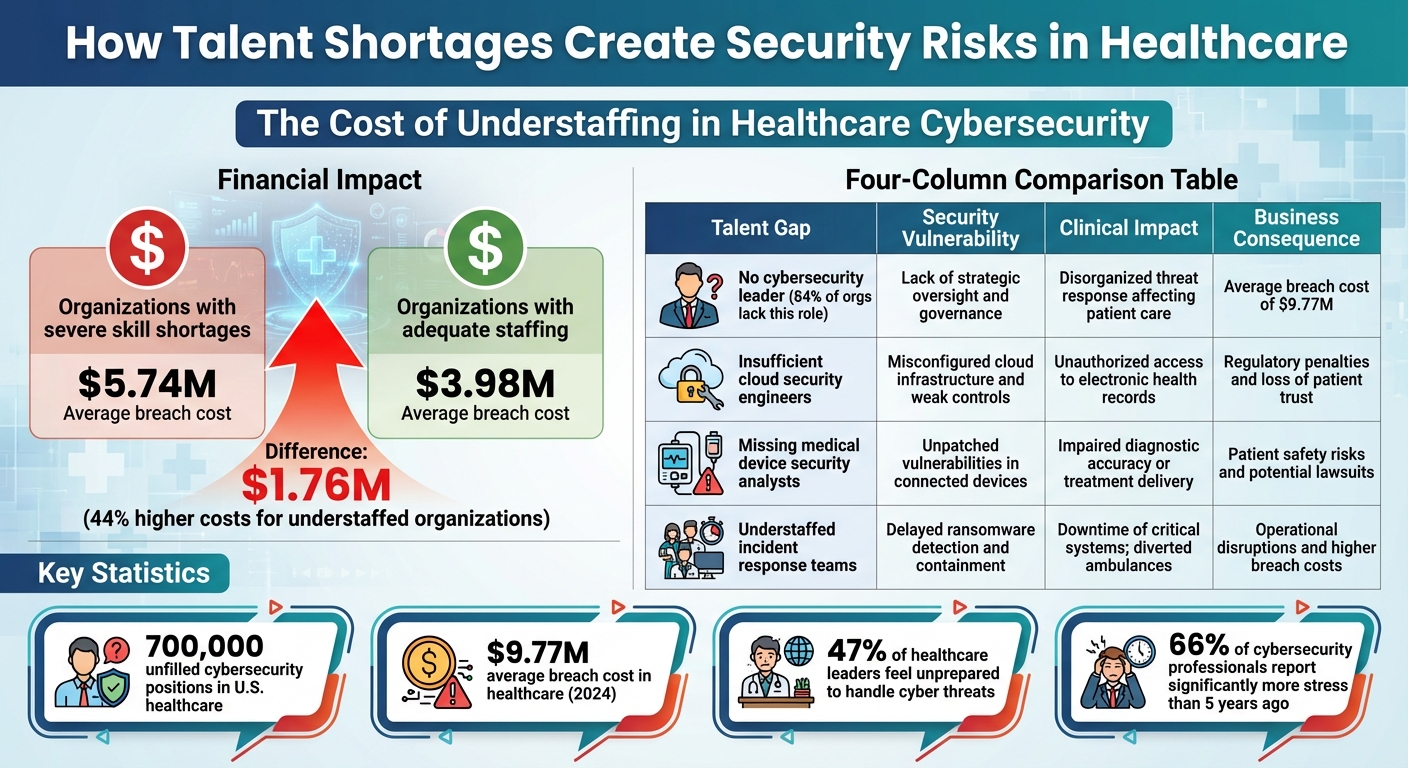
Healthcare Cybersecurity Talent Crisis: Impact of Staffing Gaps on Security Outcomes
The U.S. healthcare system is grappling with a cybersecurity talent shortage that mirrors challenges faced by industries like AWS. Nationwide, there’s a gap of approximately 700,000 unfilled cybersecurity positions. Globally, the demand for cybersecurity professionals requires an 87% increase to close this shortfall [3]. This stark reality highlights the pressing cybersecurity challenges specific to healthcare.
Healthcare organizations in the U.S. face the steepest costs from data breaches, averaging $9.77 million per incident in 2024 [4]. For the pharmaceutical sector, that figure rises to $10.9 million - nearly double what financial services experience [7]. A sobering example is the 2024 Change Healthcare breach, which affected over 192 million individuals, showcasing the severe consequences of insufficient cybersecurity expertise [4].
Adding to the complexity, financial constraints are tightening the noose. In 2024, 37% of healthcare organizations reported budget cuts in cybersecurity, 25% faced layoffs, and 38% implemented hiring freezes [4]. On top of that, nearly half (48%) of companies take over six months to fill a single cybersecurity position [3]. These delays leave critical roles vacant at a time when cyber threats are becoming more sophisticated and frequent.
Critical Roles Healthcare Can't Fill
Healthcare is struggling to fill essential cybersecurity positions, which are crucial for both patient safety and data protection. Alarmingly, 84% of healthcare organizations do not have a dedicated cybersecurity leader, and as of 2018, only 11% had plans to create such a role [8]. This leadership void trickles down, leaving other key positions unfilled. Healthcare organizations face challenges hiring for roles like:
- Cybersecurity leaders
- Cloud security engineers with HIPAA expertise
- Medical device security analysts
- Incident response specialists
Even entry-level positions aren’t immune - 31% of security teams lack junior professionals [4].
Retention issues make matters worse. Sixty-six percent of cybersecurity professionals say their jobs are significantly more stressful than they were five years ago [4]. Nearly half of cybersecurity leaders are expected to leave their roles by 2025 due to work-related stress [4]. Lower salaries and fewer career growth opportunities compared to tech companies exacerbate the problem. Compounding the issue, the stakes in healthcare are uniquely high - security failures can directly endanger patients. When experienced professionals leave, they take with them years of institutional knowledge, which can be difficult and time-consuming to replace.
How Talent Shortages Create Security Risks
The financial impact of understaffing is stark. Organizations with severe skill shortages face average breach costs of $5.74 million, compared to $3.98 million for better-staffed teams - a difference of $1.76 million [4]. These gaps expose healthcare systems to serious vulnerabilities. For example:
- Patch management falls behind because there aren’t enough skilled professionals to test and apply updates across numerous medical devices and systems.
- Incident response suffers, delaying the identification, containment, and resolution of cyber threats.
The consequences can be devastating. In September 2020, a ransomware attack at Düsseldorf University Hospital in Germany led to an ambulance being diverted, tragically contributing to a patient’s death [7]. This incident underscores how cybersecurity failures can directly harm patients. Nearly half (47%) of healthcare leaders admit they feel unprepared to handle cyber threats [7]. Without skilled personnel, organizations struggle to monitor networks, secure medical devices, assess vendor risks, and combat sophisticated ransomware-as-a-service (RaaS) attacks [6]. For instance, when the Everest ransomware group attacked a UAE-based healthcare provider, around 4GB of confidential employee data was compromised [1]. These incidents highlight the urgent need to address staffing shortages before they jeopardize patient care.
| Talent Gap | Security Vulnerability | Clinical Impact | Business Consequence |
|---|---|---|---|
| No cybersecurity leader | Lack of strategic oversight and governance | Disorganized threat response affecting patient care | Average breach cost of $9.77 million [4] |
| Insufficient cloud security engineers | Misconfigured cloud infrastructure and weak controls | Unauthorized access to electronic health records | Regulatory penalties and loss of patient trust |
| Missing medical device security analysts | Unpatched vulnerabilities in connected devices | Impaired diagnostic accuracy or treatment delivery | Patient safety risks and potential lawsuits |
| Understaffed incident response teams | Delayed ransomware detection and containment | Downtime of critical systems; diverted ambulances | Operational disruptions and higher breach costs |
Why Healthcare Struggles to Keep Cybersecurity Talent
Healthcare organizations face an uphill battle in attracting and retaining cybersecurity professionals. The challenges stem from fragmented governance, chronic underfunding, and outdated hiring practices.
Take rural hospitals, for example. Operating on razor-thin margins, these facilities often push cybersecurity to the back burner. Mike Hamilton, Field CISO at Lumifi Cyber, explains:
"Rural hospitals operate on such thin margins that cybersecurity controls are often the last thing they're thinking about. When you're worried about keeping the doors open, investing in security infrastructure becomes a secondary concern. The margins also make it tough for these providers to find and keep cybersecurity talent." [9]
With limited budgets, offering competitive salaries becomes nearly impossible, driving talent toward higher-paying industries. On top of this, unrealistic entry-level job requirements and lackluster training programs further stifle the talent pipeline. Only 32% of organizations provide solid IT security training, and 27% treat it as a mere formality rather than embedding it into their culture [10][11]. This is a missed opportunity, especially since 93% of employees report they’d stay longer at a company that invests in their career development [10].
Adding to the problem, many boards fail to grasp the real impact of cyber breaches, which weakens overall security strategies. Lee Kim, Senior Principal of Cybersecurity and Privacy at HIMSS, puts it bluntly:
"You can't go after talent that is the cheapest. Unfortunately, your cybersecurity program may fail without that buy-in … because then they just realize that they are a number and they're just simply doing the job, as opposed to having a career within your organization." [12]
This fragmented governance reduces cybersecurity to a technical afterthought, rather than treating it as a strategic priority. These systemic issues mirror mistakes made by major organizations like AWS.
Healthcare Is Repeating AWS's Mistakes
Healthcare organizations now find themselves making the same cost-cutting and policy missteps that once disrupted AWS. Just as AWS faced a talent exodus due to rigid policies, healthcare is losing critical cybersecurity staff for similar reasons.
Aggressive budget cuts and outdated workplace policies - like inflexible on-site requirements - alienate top talent. These conditions create single points of failure, leaving organizations vulnerable when key personnel leave. The loss of experienced staff drains institutional knowledge, making it harder to adapt to evolving cyber threats. Alarmingly, 66.5% of healthcare cybersecurity professionals identify retention as a major issue [12]. When organizations rely too heavily on a few individuals, their departure can severely weaken security operations, compliance efforts, and overall threat response.
The Consequences: Compliance Failures and Patient Risk
The ripple effects of these talent shortages go beyond operational inefficiencies - they jeopardize both regulatory compliance and patient safety.
Without enough skilled personnel, healthcare organizations struggle to meet critical regulations like HIPAA and HITECH, exposing themselves to fines and reputational damage. Core compliance tasks, such as monitoring access to patient records, conducting risk assessments, and maintaining audit trails, become harder to manage [14]. A weakened security posture also increases the likelihood of costly breaches. In 2023, the average cost of a ransomware attack in healthcare reached nearly $10 million [5].
Even more concerning, these gaps in cybersecurity can endanger lives. When teams lack the capacity to patch vulnerabilities, monitor networks, or respond swiftly to incidents, attackers have more opportunities to disrupt systems that are essential for patient care.
The World Economic Forum highlights the urgency of this issue, noting that two-thirds of organizations face heightened risks due to a shortage of cybersecurity skills. Yet, only 15% expect a meaningful increase in available talent by 2026 [13]. For healthcare, this growing gap between security needs and available expertise poses an ever-increasing threat to patient safety and regulatory compliance.
sbb-itb-535baee
How to Fix the Talent Problem and Strengthen Cybersecurity
Healthcare organizations can't afford to repeat the mistakes that led to AWS's talent crisis. The silver lining? There are proven ways to reverse talent loss and build strong cybersecurity teams - even with tight budgets and a competitive hiring landscape. Just as AWS faced challenges when key staff left, healthcare organizations face even greater risks when critical expertise is lost.
Identify and Staff Critical Cybersecurity Roles
Focus your hiring efforts on roles that address your biggest risks. With 74% of healthcare IT professionals citing hiring qualified cybersecurity staff as a major challenge, organizations must avoid scattershot hiring approaches [17]. Instead, prioritize positions that protect patient safety and ensure compliance - like those specializing in medical device security, patient data privacy, and secure cloud environments [15].
The stakes are high. In the first half of 2025 alone, U.S. health systems reported 307 breaches, closing in on 2024's record of 385 [16]. With threat actors remaining undetected for an average of 194 days, healthcare organizations need skilled professionals who can identify and mitigate threats quickly [18].
When external talent is scarce, look inward. For example, Frank Sinatra, CISO at University Hospital in New Jersey, transitioned a programmer into a managerial cybersecurity role. That individual excelled, automating alert processes and improving threat detection [16]. Similarly, Tower Health trained IT support and engineering staff with CISSP certification and outside coaching to fill critical roles [16].
"We can teach those skills."
- Tracey Touma, Senior Cybersecurity Business Liaison, Cleveland Clinic [17]
Touma stresses the importance of hiring candidates who are passionate about protecting patients, even if they lack direct experience. Look for traits like curiosity, a growth mindset, and a patient-focused approach - qualities that often outweigh immediate technical expertise [16][17].
After filling these critical roles, the next challenge is retaining institutional knowledge.
Protect Institutional Knowledge
Losing experienced staff means losing invaluable system and process expertise - leaving your organization vulnerable. High turnover is already a problem in healthcare, so it’s essential to have systems in place to capture and transfer knowledge before it walks out the door [19][21].
Mentorship programs can bridge the gap. Pair senior staff with junior team members to work through real-world scenarios. A 2024 ISC2 study highlights mentorship as a key factor in retaining cybersecurity talent [21]. These relationships not only help new hires grow but also ensure that institutional knowledge is passed down [20].
Encourage cross-department collaboration. Involve security teams in broader business discussions, such as product development and strategic planning. This helps them understand the organization’s operations and ensures security is part of the decision-making process [19][20].
Peer networks and clear succession plans also play a role. When employees see opportunities for growth and feel supported by their colleagues, they’re more likely to stay - and so is their expertise [20][21].
Update Work Policies to Keep Talent
Outdated workplace policies are driving cybersecurity professionals to seek opportunities elsewhere. With nearly 457,000 unfilled cybersecurity jobs in the U.S., talented workers have choices - and they’re prioritizing organizations that offer flexibility and work-life balance [21].
Here’s what professionals want:
- Remote work options and flexible hours, especially for on-call roles.
- Additional time off after major incidents.
- Mental health resources, such as Employee Assistance Programs, stress management workshops, and access to therapists.
The numbers are telling: 25% of CISOs and IT security decision-makers are considering leaving their roles due to overwhelming stress, while 27% of cybersecurity professionals report declining mental health. Half are even turning to medication to manage work pressures [21].
Expand your teams to avoid burnout. Rotating on-call schedules can prevent the “always-on” mentality that drives people out of the field.
Competitive pay is non-negotiable. Healthcare salaries often lag behind the tech sector, making it tough to attract top talent [16][17]. MultiCare Health addressed this by using a "try before you buy" model, hiring temporary staff through agencies to evaluate candidates before offering full-time roles. This approach reduces hiring risks while giving candidates a chance to prove themselves [16].
Clear career paths are equally important. Whether employees aim to specialize technically or move into management, transparent promotion criteria and advancement opportunities can keep them engaged. Plus, investing in training pays off - organizations that prioritize employee development reduce phishing-related breach costs by an average of $250,000 [18].
While flexible policies help retain talent, automation can ease the workload on understaffed teams.
Use Automation to Support Understaffed Teams
Manual tasks slow down threat response, putting patient safety at risk. Automation isn’t about replacing people - it’s about enabling them to focus on complex challenges that require human expertise.
Censinet RiskOps™ offers a solution. This platform automates third-party and enterprise risk assessments, saving countless hours of manual work. With Censinet AI™, vendors complete security questionnaires in seconds, documentation is automatically summarized, and risk reports are generated instantly.
Here’s how it compares:
| Manual Process | Automated with Censinet RiskOps™ |
|---|---|
| Days or weeks to complete security questionnaires | Seconds with Censinet AI™ |
| Hours reviewing vendor documentation | Automated summaries and validations |
| Hours writing risk reports per vendor | AI-generated reports based on all data |
| Tracking assessments via spreadsheets | Centralized, real-time risk dashboard |
| Manually routing findings | Automated orchestration to key stakeholders |
Automation keeps human oversight intact. Configurable rules ensure that key findings are routed to the right teams, such as an AI governance committee. This allows your team to scale operations efficiently without compromising accuracy or safety.
With automation handling repetitive tasks, analysts can focus on high-priority decisions, reducing risks faster and more effectively.
Track Talent Metrics in Governance
Staffing shortages directly impact cybersecurity risks - and breach costs. Organizations with severe staffing gaps report breach costs that are 26% higher than those with adequate staffing [21]. Boards need to understand the connection between workforce stability and security outcomes.
Incorporate workforce metrics into governance reports. Track key indicators like vacancy rates for critical roles, training coverage, employee engagement, and time-to-fill for open positions. These aren’t just HR concerns - they’re essential cybersecurity metrics.
Set staffing thresholds tied to your organization’s risk tolerance. If vacancy rates exceed acceptable levels, take immediate action. Make talent retention a regular agenda item in board meetings, alongside breach statistics and compliance updates. With an average breach costing $3.86 million, the link between staffing and security is clear [21].
Use governance to drive accountability. Proposed updates to the HIPAA Security Rule from March 2023 emphasize continuous monitoring and annual cybersecurity risk analyses - tasks that demand skilled, dedicated staff [18]. By tying workforce metrics to regulatory requirements and patient safety, you build a strong case for competitive salaries, flexible policies, and ongoing training.
As healthcare organizations plan to increase IT and digital workforce investments by over 30% in the next three years [15], linking staffing metrics to security outcomes ensures your organization stays ahead of the curve. Don’t let talent shortages turn into preventable breaches.
Conclusion
The talent shortage at AWS serves as a stark warning for healthcare: staffing gaps can jeopardize patient safety. With nearly 4.8 million unfilled cybersecurity positions globally and about 500,000 of those in the U.S. alone [1][19], healthcare organizations are under immense pressure. These workforce challenges don't just strain operations - they create direct risks to patient care.
This crisis also exposes a deeper issue: inadequate cybersecurity staffing increases both financial and operational vulnerabilities. The cost of cybersecurity breaches continues to rise, with stolen health records fetching far more than credit card data on the black market [22]. The financial impact is staggering - each healthcare breach costs an average of $408 per stolen record [22]. For organizations already stretched thin, these shortages lead to devastating financial losses and damage their reputations.
But it’s not just about filling positions - it’s about expertise. Over half of cybersecurity leaders (52%) cite the lack of specialized knowledge as their biggest challenge [1]. Healthcare systems need professionals skilled in securing medical devices, protecting patient data, and managing the risks tied to telehealth and connected devices. When these roles remain vacant, compliance lapses and security vulnerabilities become inevitable.
To safeguard patient safety, healthcare organizations must take a proactive approach to talent management. Data shows that companies with severe staffing shortages face breach costs 26% higher than those with adequate teams [21]. By focusing on strategic hiring, retaining institutional knowledge, offering competitive benefits, adopting automation, and monitoring workforce metrics, healthcare leaders can address these challenges head-on. Experts stress that a significant expansion of the talent pool is essential to protect critical infrastructure [1]. The time to act is now - your patients, your budget, and the future of your organization depend on it.
FAQs
What caused the talent exodus that contributed to AWS's challenges?
The talent drain at AWS stemmed from a mix of issues. Short-term hiring strategies fell short of addressing long-term workforce demands, while the pandemic-driven surge in cloud services created unprecedented pressure. Adding to the challenge, the Great Resignation amplified workforce instability, and the rapid expansion of cloud adoption outpaced the supply of skilled professionals. On top of that, limited efforts in training and upskilling left significant gaps in expertise.
These hurdles underscore the need for forward-thinking workforce planning. Industries like healthcare face similar struggles, where talent shortages can threaten vital IT systems and cybersecurity measures.
What steps can healthcare organizations take to solve their cybersecurity staffing challenges?
Healthcare organizations can address cybersecurity staffing hurdles by focusing on training and certification programs for their existing employees. This approach not only sharpens team skills but also shows employees that their growth matters, which can improve retention.
Another effective strategy is to team up with educational institutions. By creating apprenticeship programs or offering internships, organizations can nurture a steady flow of skilled professionals. Partnering with local schools and universities can attract new talent while helping meet future workforce demands.
For more immediate solutions, healthcare providers might turn to managed service providers or specialized cybersecurity firms. These external experts can step in to handle critical security needs, ensuring systems stay protected while internal teams continue to build their expertise.
What risks does understaffing pose to healthcare cybersecurity?
Understaffing in healthcare cybersecurity creates a perfect storm for cyber threats like data breaches and ransomware attacks. With too few skilled professionals on hand, organizations may struggle to detect and respond to incidents quickly, leaving sensitive patient information exposed.
This shortage also complicates efforts to meet regulatory requirements, disrupts routine operations, and can jeopardize both patient safety and the organization's reputation. To tackle these issues, healthcare providers must prioritize building a strong cybersecurity workforce and investing in the right talent to stay ahead of ever-changing threats.
Related Blog Posts
- 7 Hours Down, Millions Affected: Inside the AWS Outage That Broke Healthcare's Digital Backbone
- The AWS Outage Exposed Cloud Vulnerabilities - What It Means for Healthcare Business Continuity
- The Talent Crisis Nobody's Talking About: Why Healthcare Can't Hire Enough Compliance Experts
- The 30-40% Problem: Why Healthcare's Over-Reliance on US-EAST-1 Is a Patient Safety Risk
