
If a healthcare API handles ePHI, I’d treat TLS 1.2+ in transit, TLS 1.3 by default, AES-256 at rest, and tight key management as the baseline. That’s the short answer.
The reason is simple: healthcare breaches are expensive and slow to spot. These incidents often escalate into significant enterprise risks affecting clinical and financial operations. IBM reported an average breach cost of $9.77 million in 2024, with 213 days to identify a breach. For APIs, weak encryption can expose patient records, session tokens, lab data, and orders.
Here’s what I’d want any reader to know right away:
- Use HTTPS with TLS 1.2 or higher for all healthcare API traffic
- Prefer TLS 1.3 and turn off SSL, TLS 1.0, and TLS 1.1
- Use AEAD cipher suites like AES-GCM or ChaCha20-Poly1305
- Use mTLS for system-to-system PHI flows like EHR, HIE, lab, and payer links
- Encrypt stored PHI with AES-256, especially in databases, backups, and object storage
- Keep keys in KMS or HSM, not in code or config files
- Use OAuth 2.0/OIDC with TLS, because transport encryption alone does not fix access control
- Test and monitor TLS settings, certificates, and key use on a set schedule
- Document decisions for HIPAA, since encryption is addressable but still expected in practice for PHI APIs
A quick way to think about it: TLS protects the connection. AES protects stored data. mTLS checks both sides. KMS protects the keys. OAuth controls who gets access.
For teams working with FHIR, REST APIs, cloud apps, and third-party vendors, that mix gives a clear baseline for security and HIPAA-focused review without overcomplicating the setup.
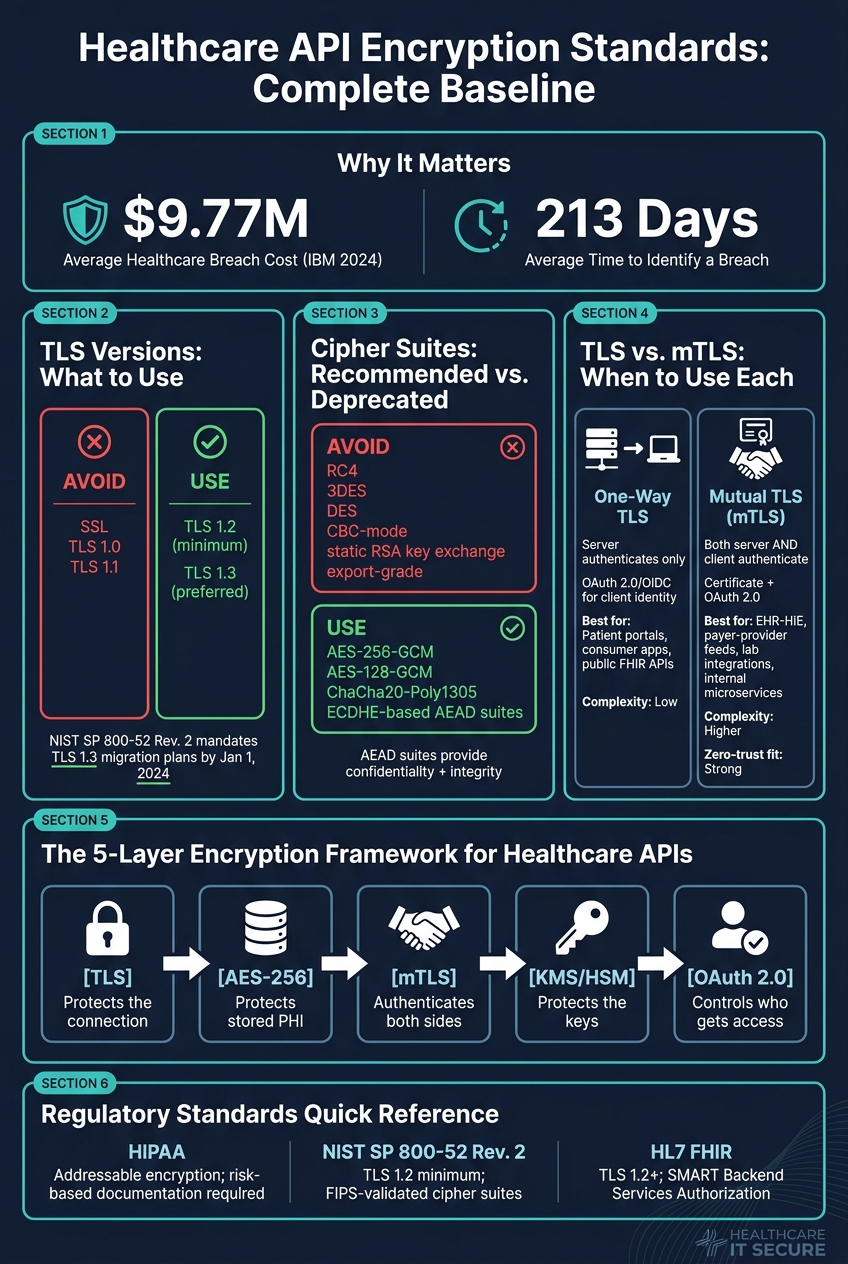
Healthcare API Encryption Standards: TLS, AES, mTLS & Key Management at a Glance
Regulatory and Standards Baseline for Healthcare APIs
HIPAA Requirements for Encryption in Transit and at Rest
Once you get past the basics of transport and storage security, the main issue is simple: what's required, and what's just advised?
HIPAA's Security Rule treats encryption as an addressable implementation specification, not an automatic requirement.[8][11] In plain English, that means an organization has to document a risk-based decision: use encryption, or put an equivalent safeguard in place and explain why. For APIs that carry PHI, the practical expectation is still clear: use HTTPS/TLS for data moving across networks. The same idea applies beyond the live API call itself. Replicas, exports, backups, logs, and downstream systems need the same level of care.[4][7]
Premera's 2019 settlement is a sharp reminder of what weak controls and weak risk analysis can cost.[16]
NIST, ONC, and HL7 FHIR Guidance for API Security

HIPAA sets the legal frame, but day-to-day API encryption is shaped by three main sources: NIST SP 800-52 Rev. 2, ONC interoperability rules, and HL7 FHIR security guidance.
NIST SP 800-52 Rev. 2 sets TLS 1.2 with FIPS-validated cipher suites as the floor and requires TLS 1.3 support and migration plans by Jan. 1, 2024.[13][2][15] It also bans SSL 2.0, SSL 3.0, and TLS 1.0. For external-facing systems, servers must negotiate TLS 1.2 and should prefer TLS 1.3.[2][15] Even outside the federal space, many healthcare teams treat this as the clearest technical baseline for API gateway setup.
At the API layer, FHIR guidance turns that baseline into direct transport and access rules. HL7 FHIR security guidance requires TLS 1.2 or higher for production data exchanges and advises OAuth 2.0 access management through the SMART Backend Services Authorization Profile for system-to-system flows.[5][6] Bulk exports need the same controls from end to end: the original request, status polling, and file retrieval should all use the same transport and authorization model.[5][6] Mutual TLS is optional in that guidance, but for high-volume or high-sensitivity integrations, it's a strong step to take.[6]
| Standard | Hard Requirement | Flexible / Recommended |
|---|---|---|
| HIPAA Security Rule | Risk analysis; addressable encryption controls documented | Choice of encryption method if an equivalent safeguard is justified |
| NIST SP 800-52 Rev. 2 | TLS 1.2 support; FIPS-validated cipher suites; TLS 1.3 support and migration plans by Jan. 1, 2024 | TLS 1.3 negotiation preference for citizen- and business-facing servers |
| HL7 FHIR Bulk Data | TLS 1.2+ for all exchanges; SMART Backend Services authorization | Mutual TLS (optional but recommended for high-risk flows) |
| ONC / SMART on FHIR | HTTPS transport per IETF BCP 195; OAuth 2.0 for app access | SMART App Launch and SMART Backend Services profiles as specified in the implementation guide |
TLS by itself doesn't solve the whole problem. HL7 FHIR implementation guides for domain-specific use cases, including the National Directory of Healthcare Providers (NDH) and the Medicolegal Death Investigation (MDI) guide, explicitly say that all data exchanges must use HTTPS/TLS 1.2+ and should support OAuth 2.0 and SMART on FHIR.[3][14] That's the part teams sometimes miss. Transport security and authorization design go together. If a team stops at TLS, it can still end up with broken access control and exposed data.[17][18]
That baseline leads straight into the TLS versions, cipher suites, and certificate practices used in production.
sbb-itb-535baee
Core Encryption Standards for API Data in Transit
TLS Versions, Cipher Suites, and Certificate Practices
Start with the transport baseline, then lock in the exact settings. Set TLS 1.2 as the minimum and use TLS 1.3 by default. Disable TLS 1.0 and TLS 1.1 across the board. If an older system still depends on them, treat that as a fix-it item, not a standing carveout. [2][19]
For cipher suites, stick with AEAD options like AES-GCM and ChaCha20-Poly1305. They handle confidentiality and integrity together and avoid the weak spots tied to CBC mode. Turn off RC4, 3DES, DES, export-grade algorithms, and any suite that uses static RSA key exchange. Static RSA does not provide forward secrecy, which means older traffic could be exposed if the private key is ever compromised. For TLS 1.2 and 1.3, use ECDHE-based AEAD cipher suites only. [19][25][26]
Certificate policy finishes the job at the transport layer. Use CA-issued X.509 v3 certificates, verify the SAN and full chain, check revocation through OCSP or CRL, and automate 90-day renewal. Avoid self-signed certificates in production, and never reuse shared private keys across systems. [28][29][20][19]
| Category | Deprecated / Avoid | Recommended |
|---|---|---|
| TLS Versions | TLS 1.0, TLS 1.1, SSL | TLS 1.2 (minimum), TLS 1.3 (preferred) |
| Cipher Suites | RC4, 3DES, DES, CBC-mode, export-grade, static RSA key exchange | TLS_AES_256_GCM_SHA384, TLS_AES_128_GCM_SHA256, TLS_CHACHA20_POLY1305_SHA256, TLS_ECDHE_ECDSA_WITH_AES_256_GCM_SHA384, TLS_ECDHE_ECDSA_WITH_AES_128_GCM_SHA256, TLS_ECDHE_RSA_WITH_AES_256_GCM_SHA384, TLS_ECDHE_RSA_WITH_AES_128_GCM_SHA256 |
| Certificate Practices | Self-signed certs in production, shared private keys, no revocation checks, manual renewal | Trusted CA-issued X.509 v3, SAN verification, OCSP/CRL revocation, automated 90-day renewal, HSM or cloud KMS for key storage |
When to Use Mutual TLS for Healthcare Integrations
Standard TLS proves the server's identity to the client. Mutual TLS (mTLS) adds the other half: the client presents a certificate too, so both sides prove who they are before any data is exchanged. For system-to-system PHI traffic, that extra proof matters. [30]
One-way TLS is a good fit for patient portals, consumer mobile apps, and public FHIR endpoints, where client certificate management would be a headache. In those cases, OAuth 2.0 and OpenID Connect handle identity at the app layer. But for automated, high-volume, or high-sensitivity connections, mTLS should be the rule. That includes EHR-to-HIE connections, payer-provider feeds, lab and radiology integrations, and internal microservices in a zero-trust setup. [1][30]
There’s also a practical payoff. When OAuth 2.0 tokens are bound to client certificates under the IETF OAuth 2.0 mTLS standards, a stolen token alone won’t help an attacker. Without the matching certificate, it’s useless. [1][30]
| One-Way TLS | Mutual TLS (mTLS) | |
|---|---|---|
| Who authenticates | Server only | Server and client |
| Client identity | Handled by OAuth 2.0 / OpenID Connect | Certificate + OAuth 2.0 / OpenID Connect |
| Operational complexity | Low | Higher - requires client cert issuance, lifecycle management, revocation |
| Common healthcare use cases | Patient portals, consumer FHIR apps, public APIs | EHR–HIE, payer–provider feeds, lab/radiology integrations, internal microservices |
| Zero-trust fit | Partial | Strong - mutual authentication at transport layer |
A practical policy for many healthcare delivery organizations is simple: require mTLS with certificates issued from the organization's healthcare PKI for all inter-data-center PHI-bearing traffic and all EHR-to-HIE connections. For public-facing apps that can't reasonably manage client certificates, allow one-way TLS plus OAuth 2.0.
Recommended Algorithms and Key Lengths for Transport Encryption
For symmetric encryption, AES-128-GCM and AES-256-GCM cover most PHI-bearing API traffic. AES-128-GCM gives a strong security-to-performance balance. AES-256-GCM fits teams with a more conservative risk posture or contract-driven requirements. Turn on ChaCha20-Poly1305 for systems without hardware AES acceleration, such as some mobile clients and edge devices. This is particularly critical for medical device cyber risk management where hardware constraints are common. [21][25]
For key exchange, use ECDHE as the standard. It provides forward secrecy, so a compromised long-term key does not expose past sessions. Disable TLS_RSA_* and all non-ephemeral DH cipher suites. [19][20][25]
For certificates and signatures, RSA 2048-bit is the accepted minimum. That said, ECDSA P-256 and P-384 deliver the same level of protection with shorter key sizes and better performance. [22][23]
If your environment requires FIPS controls, use FIPS 140-2 or FIPS 140-3 validated cryptographic modules, and document the validated TLS termination points and library components in use. Then verify your endpoints and crypto libraries against the NIST Cryptographic Module Validation Program (CMVP) list. [24][26][27]
Transport encryption is only the first layer; stored PHI and keys need separate controls.
Protecting API Payloads, Stored PHI, and Encryption Keys
AES-256, Field-Level Encryption, and Storage Protection for PHI
TLS protects PHI while it moves across the network. But once that PHI lands in a database, queue, object store, or backup, you need encryption at rest too.
AES-256-GCM is a common option for relational databases, NoSQL stores, object storage, and backups because it protects confidentiality and also verifies that the data hasn't been altered. For full-disk use cases, AES-XTS with pre-boot authentication fits lost media and stolen device scenarios. [36] That said, TDE helps with lost media. It does not protect against compromised credentials or a compromised application. [34]
That’s where application-layer encryption comes in.
Encrypt the most sensitive fields before they’re written to storage, so the database holds ciphertext only. Keep decryption keys in a separate key management system instead of hard-coding them in source code or config files. [10][34] It’s smart to reserve field-level encryption for the highest-sensitivity fields, not every field in the system, because it can make searching, filtering, and indexing much harder.
A common pattern here is envelope encryption. Each dataset, table, or tenant gets its own DEK, and that DEK is then wrapped with a KEK stored in a KMS or HSM. This setup makes rotation far less painful because you can re-wrap the DEK instead of re-encrypting all the underlying data. [12][36] HHS breach guidance also notes that PHI may qualify for breach notification safe harbor when it is encrypted according to NIST standards and the decryption keys are stored separately and protected. [9]
None of this helps much if key access is loose. Encryption works only when key access and key use are tightly controlled.
Transport-Only Encryption vs. Payload-Level Encryption
When a PHI-bearing API call moves directly between two trusted systems and the data is not persisted outside controlled storage, properly configured TLS is enough. The connection is protected, and both endpoints are inside the trust boundary.
Payload encryption matters when the message passes through intermediaries like analytics platforms, integration brokers, vendor integrations, or event buses. TLS protects each hop. JSON Web Encryption (JWE) protects the message content across those hops, which means a system that should not see PHI still can't read it, even if it terminates the TLS session. [10][12]
| Transport-Only (TLS) | Transport + Payload-Level (TLS + JWE) | |
|---|---|---|
| What it protects | Data in motion between endpoints | Data in motion and at each intermediary |
| Trust boundary coverage | Single hop | Across multiple hops and services |
| Security value | Strong for direct, trusted connections | Stronger when intermediaries exist |
| Interoperability | High - universally supported | Lower - requires compatible libraries and shared key agreements |
| Implementation effort | Low | Higher - application-layer encryption/decryption and key distribution |
| Performance impact | Minimal | Added CPU overhead; larger message sizes |
| Best for | Direct trusted integrations | FHIR bundles in queues, vendor integrations, analytics pipelines, and event buses |
This is not an everywhere-all-at-once control. Payload encryption is best used in specific cases: when intermediaries must not see plaintext PHI, when messages sit in queues or event streams and may be replayed, or when data crosses organizational boundaries. [10][12]
Key Management, Rotation, and Audit Controls
Key management is what keeps encryption from turning into a checkbox exercise. If keys are hard-coded or stored next to the data, the whole setup starts to fall apart.
Use a dedicated KMS or HSM for centralized key management. Apply strict role-based access and separation of duties so key use, key administration, and plaintext data access stay separate. Automate certificate and key renewal because manual renewal is where gaps tend to show up, especially in APIs and service-to-service traffic. Define cryptoperiods for each key type so it’s clear how long a key stays active, when it moves to suspended or retired status, and when it should be destroyed. NIST SP 800-57 calls out the need to track key states and document these lifecycle decisions. [33]
You also need logs that show what happened and when. Record key usage, administrative access to the KMS, certificate issuance and renewal events, and any key rotation or re-wrap operations. Those logs support PHI protection, internal security reviews, third-party vendor risk assessments, and incident response. [33] NIST SP 800-66 Rev. 2 ties these controls to HIPAA technical safeguards and encryption governance. [31][32][35]
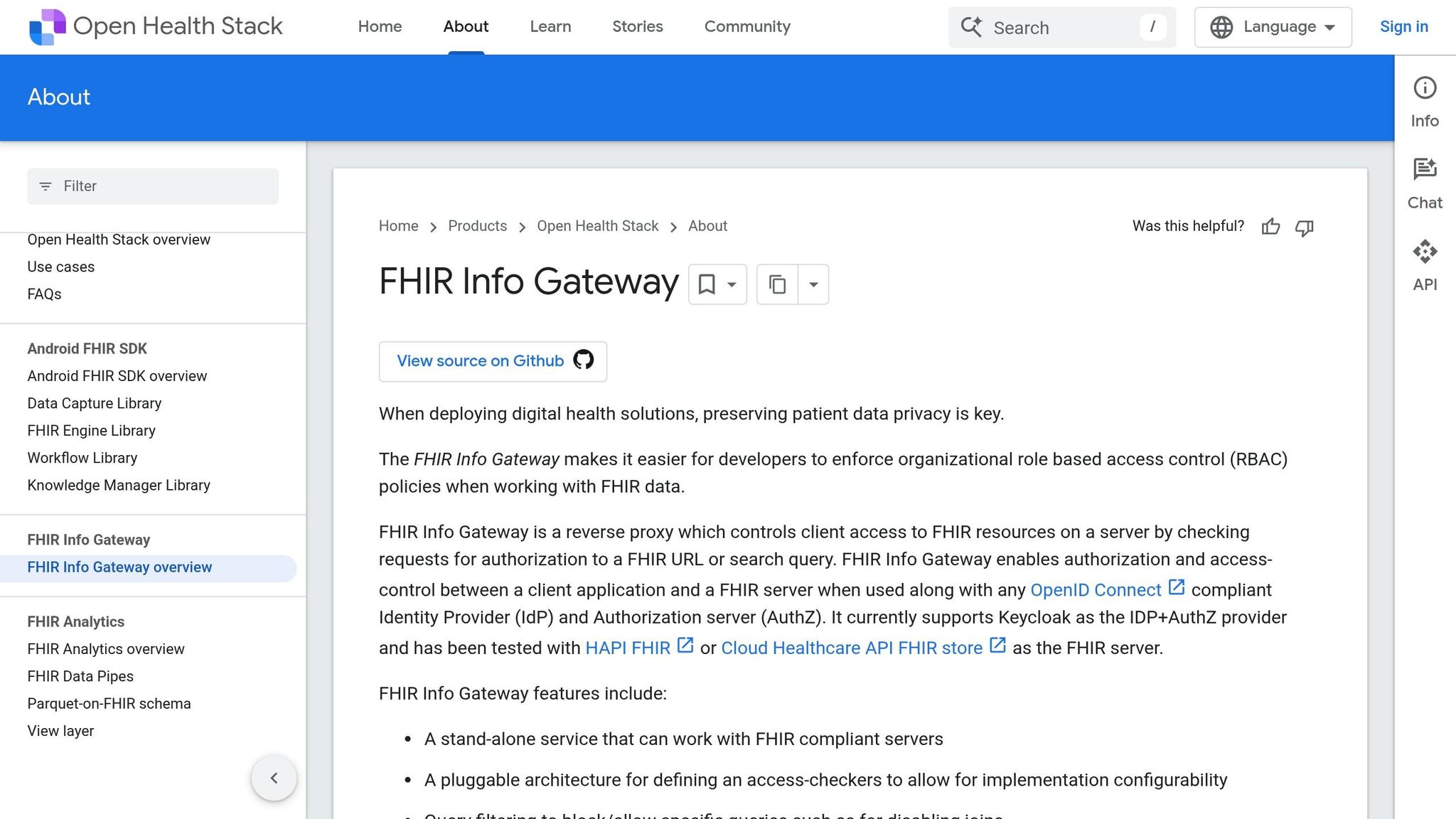
Solve the access-control problems with FHIR Information Gateway
Implementation, Validation, and Risk Governance
Once the standard is set, the next job is making sure it’s enforced and checked across APIs, services, and vendors.
Architecture Patterns for Secure FHIR and REST APIs
Use encryption at every layer, not just at the edge. Start by terminating inbound traffic at an API gateway that enforces TLS 1.2 or higher, checks certificates, and blocks weak protocols. Then encrypt service-to-service traffic again with mTLS or service-mesh policies, so internal calls get the same level of protection as external ones.
For FHIR and REST APIs, transport encryption alone isn’t enough. It needs to work alongside a secure authorization layer. Use OAuth 2.0/OIDC for access control and SMART on FHIR for EHR integrations. For browser and mobile apps, use Authorization Code + PKCE. For backend calls, use client_credentials with mTLS or private_key_jwt. Split internal services into separate zones - public APIs, clinical systems, and analytics - and apply least-privilege access at every hop. For third-party integrations, set clear trust boundaries and enforce them.
How to Test and Monitor API Encryption Posture
Once controls are in place, you need to verify them. That means scanning endpoints, reviewing configurations, and testing again after every major change.
Use automated TLS scanning tools on a recurring schedule to grade endpoints, detect deprecated protocol versions, flag weak cipher suites, and surface certificate issues. [37][41][42] Pair that with configuration reviews against your defined baseline for API gateways and service meshes, plus targeted penetration testing focused on transport security. If there’s a major change - like a cloud migration, a new vendor integration, or an infrastructure update - retest and document the results.
For monitoring, pay attention to metadata, not payloads. Log TLS handshake failures, certificate errors, authentication outcomes, policy-denial events, and request timestamps. Keep PHI out of logs entirely. Send this telemetry to a SIEM, create alerts for TLS downgrade attempts and expiring certificates, and retain logs for at least six years to meet HIPAA documentation rules. [38][39][40] Keep scan results, remediation records, and retest evidence ready for audits.
Using Censinet RiskOps™ to Strengthen Encryption Governance
Vendor encryption controls should line up with internal controls. Censinet RiskOps™ supports third-party risk assessments, evidence collection, benchmarking, and remediation workflows. Encryption controls like TLS configuration, key management practices, and certificate hygiene can be reviewed as part of a broader cyber risk assessment, with findings tracked and fixed across both internal and vendor environments. The result is audit-ready evidence that encryption governance is being maintained.
FAQs
Is TLS 1.2 still enough for healthcare APIs?
Yes. TLS 1.2 is still acceptable for healthcare APIs if it uses strong, modern cipher suites and older protocols like SSL, TLS 1.0, and TLS 1.1 are turned off.
That said, TLS 1.3 is the better choice for new APIs. It uses a simpler handshake, gives you tighter security, and can cut latency. For HIPAA compliance, lean toward TLS 1.3 when you can, and keep TLS 1.2 fallback limited to strong configurations.
When should we require mTLS instead of standard TLS?
Require mTLS instead of standard TLS when you need to verify both sides of the connection, not just the server.
In healthcare, that matters most for system-to-system exchanges such as partner and payer integrations, high-volume PHI workflows, medical device APIs, and other high-risk integrations where token binding helps cut replay risk.
Do we need payload encryption if TLS is already enabled?
Yes. TLS 1.2 or 1.3 is needed to protect PHI while it moves between systems. But TLS only secures the connection itself.
Payload encryption adds a second layer. Once the data reaches the server, TLS is no longer protecting it. That means encrypted payloads can help keep sensitive information unreadable if a system is compromised or accessed by unauthorized parties.
