
10 Questions for AI Ethics Committees in Healthcare
Post Summary
AI in healthcare is advancing quickly, but without proper oversight, patient safety and accountability are at risk. Ethics committees are critical for ensuring AI tools are safe, fair, and effective. Here are 10 key questions every healthcare organization should address to govern AI responsibly:
- What problem does the AI solve? Ensure the tool addresses a specific clinical or operational need, with clear metrics to track outcomes.
- Is the model clinically validated? Verify its performance in real-world clinical settings, not just in controlled environments.
- Could the system produce biased results? Test for disparities across different patient groups and set thresholds for acceptable performance.
- What disclosures are required? Patients and staff must be informed about the AI's role, limitations, and risks.
- How is patient data protected? Map data usage, ensure compliance with privacy laws, and audit vendor security measures.
- Who can override the AI? Clearly define when and how clinicians can override AI recommendations to maintain human accountability.
- Who is responsible for oversight? Assign clear roles for monitoring, compliance, and incident response.
- How does AI change workflows? Assess potential disruptions and risks, such as automation bias or alert fatigue.
- How is performance tracked? Monitor for issues like model drift and recalibrate as needed to maintain accuracy.
- Is there regular oversight? Ensure cross-functional reviews by ethics, legal, clinical, and IT teams to address risks and maintain safety.
These questions form the foundation of ethical AI governance, ensuring tools are safe, unbiased, and transparent throughout their lifecycle.
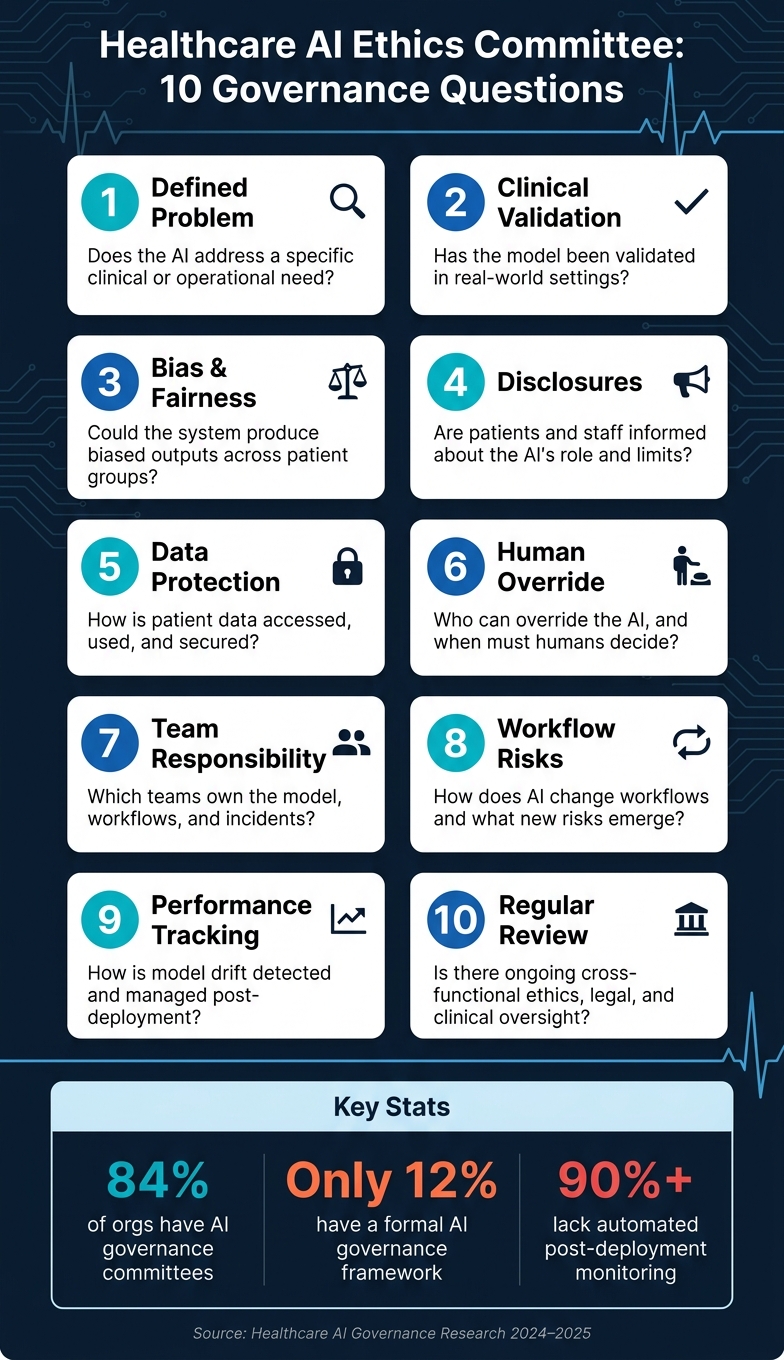
Healthcare AI Ethics Committee: 10 Governance Questions at a Glance
Foundations of Healthcare AI Ethics
sbb-itb-535baee
1. Is This AI System Solving a Clearly Defined Clinical or Operational Problem?
Before an ethics committee gives the green light to any AI tool, it has to tackle a fundamental question: What specific problem is this system designed to solve? Too often, healthcare organizations jump on the AI bandwagon, drawn in by flashy vendor pitches or the allure of cutting-edge technology, without identifying a clear gap that needs addressing.
Having a well-defined problem statement does more than just establish clinical relevance. It sets the stage for measurable outcomes and creates a baseline for assessing whether the tool actually delivers on its promises once deployed.
It’s also critical to understand the difference between process metrics and clinical outcomes. Process metrics might tell you how frequently an AI alert is triggered or how much staff engage with the tool. Clinical outcomes, however, go a step further - they reveal whether the tool’s flagged patients actually develop the predicted condition. Ethics committees should demand both types of metrics but place greater emphasis on those tied directly to patient outcomes.
"Surveyors also distinguish between tracking process metrics, such as how often an alert fires, and tracking clinical outcomes, such as whether patients flagged by the tool are actually developing the predicted condition." – Mosaic Life Tech [1]
Regulators are increasingly focused on these distinctions. On September 17, 2025, The Joint Commission and the Coalition for Health AI (CHAI) issued the Responsible Use of AI in Healthcare (RUAIH) guidance, which emphasizes the importance of quality monitoring and patient safety in AI governance [1]. Accreditation bodies now expect local validation - proof that the AI performs effectively in the specific environment where it’s being used, rather than relying solely on vendor-provided data. For example, an AI tool that excels in a large urban hospital might not yield the same results in a smaller, rural facility.
Once these metrics are clearly defined, the next step is ensuring the AI tool aligns perfectly with the identified problem. Committees need to verify that the issue is genuine, the solution fits the need, and the success metrics are in place - all before the tool is implemented.
2. Has the Model Been Clinically Validated for Its Intended Use Case?
After identifying a clear problem, the next step is ensuring the AI tool has been proven effective - not just in controlled lab settings but in real-world clinical environments. Clinical validation isn’t just a formality; it’s the cornerstone of deploying AI safely.
To truly understand how a model performs in practice, it’s important to look beyond theoretical benchmarks. One common mistake is assuming that strong benchmark scores automatically mean the model will perform well in clinical scenarios. For example, research on the PrinciplismQA benchmark revealed that real-world clinical practice often involves balancing multiple ethical principles at once, a complexity that current reasoning models struggle to handle [3]. High scores on knowledge-based tests don’t necessarily translate to sound clinical decision-making.
External validation plays a key role in confirming that a model operates ethically and effectively across diverse clinical settings. Real-world validation data provides a more comprehensive picture. Take the Sepsis ImmunoScore as an example: this was the first AI sepsis diagnostic authorized by the FDA through the de novo pathway in April 2024. Its prospective study included 3,457 patient encounters across five U.S. institutions. In an external validation cohort of 698 patients, the model achieved an AUROC of 0.81, with in-hospital mortality rates ranging from 0.0% in low-risk groups to 18.2% in very-high-risk groups [5]. Testing the model at institutions separate from where it was developed helps distinguish a reliable tool from one that’s overly tailored to its original environment.
Ethics committees must also consider the gap between validation results and how clinicians actually use the tool. Even with 99% adherence to guidelines, harmful recommendations occurred in 7.8% of cases, emphasizing the need for ongoing validation after deployment. This isn’t just a one-time process - it’s an ethical responsibility to ensure continued safety [6].
As one developer from Texas Medical Center put it:
"The greatest developments that we can work on are the ones where we can encapsulate our expertise and push them out to areas where that expertise doesn't exist." [4]
The key takeaway? Insist on external validation data. Make sure the model has been tested on patient populations that reflect the demographics of your facility. A tool validated only in academic centers might not perform well in community or rural healthcare settings.
3. Could the System Produce Biased Outputs Across Different Patient Groups?
Even with clinical validation, AI models in healthcare can still fall short when it comes to certain patient groups. Bias in these systems can show up as consistent differences in accuracy across racial, age, or gender groups, which can lead to disparities in care. Real-world examples highlight the serious consequences of such biases.
Take pulse oximeters, for instance. These devices, often validated on lighter-skinned populations, have been shown to overestimate oxygen saturation levels for Black and Hispanic patients. In 2024, the FDA advisory panels confirmed this issue, citing studies from the New England Journal of Medicine. This bias led to delayed COVID-19 treatments for many of the affected patients [7].
By early 2025, the FDA had authorized over 1,000 AI-enabled medical devices. Yet, only 13% of these devices included demographic subgroup analyses in their regulatory submissions [7]. This means that most tools reached patients without clear evidence that they performed equally well across different groups.
"The vast majority of AI-enabled medical devices on the market today reached patients without systematic evidence that they work equitably across racial, ethnic, age, sex, and socioeconomic groups." - Ran Chen, Global MedTech Expert [7]
To address these issues, ethics committees should require accuracy disaggregation - a process that tests model performance across various demographics, such as race, gender, and age. The choice of fairness metric should align with the specific application:
| Fairness Metric | Best Use Case |
|---|---|
| Equalized Odds | Diagnostic AI (e.g., pathology detection) |
| Equal Opportunity | Screening tools (e.g., cancer screening) |
| Calibration | Risk scoring and clinical decision support |
| Demographic Parity | Triage or resource allocation |
These metrics help illustrate how small biases can ripple through clinical decisions, potentially affecting outcomes.
Bias can also stem from the training data itself. A 2019 study published in Science revealed that a widely used commercial care management algorithm relied on healthcare costs as a proxy for patient health needs. Because systemic barriers historically led to lower healthcare costs for Black patients, the algorithm required them to be much sicker than White patients before flagging them for the same level of care [7][8].
To mitigate such risks, committees should establish risk-based disparity thresholds to identify when performance differences make a system unsafe [7].
4. What Disclosures Are Required to Keep Patients and Staff Informed?
Spotting bias is just the beginning - keeping patients and staff informed is the other half of the equation. Clear disclosures play a key role in safeguarding patient safety and ensuring accountability in AI use. However, many healthcare organizations still lack clear standards for this.
Here’s what the numbers tell us: 63% of patients want to know when AI is involved in their care, yet only 33% trust healthcare systems to use AI responsibly. On top of that, AI-related malpractice claims rose by 14% between 2022 and 2024 [12]. These figures underline why disclosure isn’t just ethical - it’s also a legal necessity.
For patients, disclosures should cover several points: the AI’s role, how it works alongside clinicians, data protection measures, any extra costs, and how it compares to standard care. This is especially critical when managing medical device cyber risk that could impact clinical outcomes. The American Medical Association emphasizes this need:
"Disclosure should include the diagnosis (when known); the nature and purpose of recommended interventions; the burdens, risks, and expected benefits of all options, including forgoing treatment." - American Medical Association (AMA) [11]
Patients aren’t the only ones who need clarity. Clinicians and support staff also require clear operational guidelines. They need to understand what the AI does, its limitations, and when it’s appropriate to override its recommendations. As the Joint Commission points out, "governance creates accountability which will help to drive the safe use of AI tools" [9]. When frontline staff know their responsibilities, safer practices naturally follow.
Regulations are also stepping in to enforce transparency. For instance, the Texas Responsible AI Governance Act (TRAIGA), which takes effect on January 1, 2026, mandates clear AI disclosures from healthcare providers. Non-compliance could result in penalties ranging from $10,000 to $200,000 per violation [10]. Ethics committees should treat these legal requirements as a baseline, incorporating disclosures into consent forms or intake processes. Using clear, non-technical language ensures patients can fully understand the information provided.
5. What Data Does the System Use, and How Is It Protected?
Once transparency is established, the next critical question is: What patient data does the AI access, and how is it safeguarded? This isn't just a technical detail - it's a core responsibility of governance.
Start by mapping out the data lifecycle. For instance, a clinical documentation tool might only need access to encounter transcripts, while a sepsis prediction model could require a broader range of data, like vitals, lab results, medications, and the full admission history. Committees should scrutinize any data collection that exceeds the actual needs of the use case. For example, a scheduling chatbot should only access appointment availability and basic demographics - it has no reason to interact with clinical notes or imaging records. This kind of mapping provides the foundation for implementing strong technical protections.
The risks are enormous. According to IBM's Cost of a Data Breach report, healthcare data breaches in the U.S. cost an average of $10.93 million per incident - the highest across all industries for 13 years running. Many breaches are tied to third-party vendors or business associates, which is why any AI vendor handling protected health information (PHI) must sign a Business Associate Agreement (BAA) and pass a third-party risk assessment before deployment.
From a technical standpoint, ensure that PHI is encrypted during transmission (TLS 1.2 or higher) and while stored (AES-256). Implement role-based access controls with multi-factor authentication, and keep detailed audit logs to track system activity.
Beyond these technical measures, privacy risks tied to data reuse also need attention. AI models can sometimes "memorize" training data, which can lead to vulnerabilities like membership inference or data extraction attacks. To mitigate these risks, organizations should prioritize vendor assessments and explore privacy-preserving approaches such as federated learning or differential privacy.
If the system uses patient data for training or improving the model, it's essential to secure explicit HIPAA-compliant permissions and patient consent. Internal policies must also align with these practices. Tools like Censinet RiskOps™ can streamline the process of evaluating third-party AI vendors. By systematically verifying security controls, healthcare organizations can integrate privacy and security checks into their ethics governance processes, moving beyond vague vendor promises to enforce measurable standards.
6. Who Can Override the AI, and Which Decisions Must Stay With Humans?
After establishing rigorous validation and bias checks, the next critical step is determining who holds the power to override AI decisions. When AI offers a recommendation, the final decision must always rest with a human clinician - both legally and ethically.
"Physicians retain ultimate responsibility for patient care decisions and cannot delegate medical judgment to AI." - Akin Gump Strauss Hauer & Feld LLP [13]
This principle is backed by law. Under the 21st Century Cures Act, clinical decision support tools are exempt from FDA regulation only if they assist clinicians rather than replace their judgment. Human clinicians must independently evaluate and approve all AI-generated recommendations. If an AI system bypasses this independent review, it is classified as Software as a Medical Device (SaMD) and requires FDA clearance.
Ethics committees play a vital role in defining boundaries for AI use. They must identify which high-stakes decisions - like final diagnoses or surgical planning - can only be made by humans. They also need to assign override authority to specific roles, such as attending physicians, charge nurses, or department leads. Monitoring the frequency of overrides is equally important. A high rate of rejected AI recommendations could indicate issues like alert fatigue, poor model performance, or a disconnect with clinical needs, all of which require immediate attention. These protocols naturally necessitate detailed documentation of decision-making processes.
Clinicians are expected to record their reasoning when overriding AI recommendations in the electronic health record. This ensures transparency and provides a clear audit trail.
"Documentation of AI tool use and physician reasoning in overriding recommendations will be important in defending malpractice claims." - Akin Gump Strauss Hauer & Feld LLP [13]
One area of concern involves generative AI and patient-facing tools, such as triage chatbots or symptom checkers. Currently, no federal regulations exist for these technologies. This leaves the responsibility of defining override protocols to individual organizations, with ethics committees taking the lead in establishing these internal standards.
7. Which Teams Are Responsible for the Model, Workflows, and Incident Response?
Who is accountable for this AI system? Without clearly defined ownership, issues can slip through the cracks - and in healthcare, that can directly impact patient safety. Establishing clear accountability lays the groundwork for assigning specific responsibilities.
There are four key roles that should share ownership:
- Technical AI Lead or CMIO: Oversees algorithm performance and ensures it meets clinical standards.
- Compliance and Privacy Manager: Aligns the system with regulatory frameworks like FDA, ONC, and HIPAA.
- Clinical AI Specialist: Monitors real-world performance, including accuracy and potential model drift after deployment.
- AI Ethics Officer: Conducts audits for bias and assesses equity impacts.
Interestingly, many healthcare AI governance committees are missing critical expertise. Around 75% lack ethics or bioethics professionals, and 55% don’t include Technical AI Leads or CMIOs [14].
Before launching, it’s essential to test how the AI integrates with existing EHR and care coordination systems. But integration isn’t the only concern - having a plan for managing unexpected issues is just as important.
Here’s where the challenge gets bigger: over 90% of organizations don’t have automated AI monitoring in place. To address this gap, ethics committees must require detailed, actionable playbooks for handling AI incidents. These playbooks should cover problems like hallucinations or data poisoning. And with laws like California AB 316 (effective 2026) holding organizations fully liable for AI decisions, having a solid incident response plan isn’t optional - it’s mandatory [14].
This approach - spanning defined roles, integration testing, and incident management - ensures ethical oversight remains a priority throughout the AI lifecycle.
"The most clinically accurate AI model in the world will fail if it disrupts clinical workflow instead of enhancing it." - Selah Digital Team [15]
"A committee that meets monthly but produces no documentation is not compliant governance - it is theater." - Integral Healthcare Solutions [14]
8. How Does the AI Change Existing Clinical Workflows, and What New Risks Could It Introduce?
Even the best-designed AI systems can disrupt clinical workflows if they aren't integrated thoughtfully. Ethics committees must evaluate more than just technical performance - they also need to consider how these tools might interfere with established processes. For instance, automation bias can significantly affect clinical decision-making.
One major concern is automation bias, sometimes called the "lazy genius" effect [18]. When AI outputs appear polished and authoritative, clinicians may trust its recommendations without question - even when they're wrong. This overreliance can lead staff to stop verifying decisions actively. A real-world case highlights this danger: At St. Rose Dominican Hospital in Henderson, Nevada, nurse Adam Hart faced an AI-generated sepsis alert recommending IV fluids for an elderly patient. Recognizing the patient had a dialysis catheter, Hart knew the protocol could harm the patient by overwhelming their kidneys and lungs. Despite pressure to follow the AI's guidance, he insisted on waiting, and a physician later prescribed dopamine instead, preventing a potentially severe complication [17].
AI also struggles with bedside subtleties - those small but critical signs that experienced clinicians pick up, like changes in skin tone, movement, or patient reactions. As Ziad Obermeyer, Associate Professor at UC Berkeley, puts it:
"The models will never have access to all of the data that the provider has." [17]
Another enterprise risk and operational challenge is alert fatigue. In some intensive care units, nurses report that nearly half of the alerts they receive are false positives, which can distract them from focusing on truly high-risk patients [17].
AI tools for documentation bring their own risks. For example, AI scribes can misinterpret information, introduce errors, or create biased clinical notes. This raises medicolegal concerns for physicians who must sign off on these records. Beyond clinical errors, hospitals must also account for third-party risk when integrating external AI vendors into their infrastructure. A study analyzing 46 medicolegal cases found that 87% of AI-related inquiries involved family medicine specialists. Many of these cases were tied to administrative and documentation tools, leaving doctors worried about becoming scapegoats for mistakes they neither caused nor easily detected [16].
To mitigate these risks, it’s essential to involve nurses and frontline staff when choosing AI tools. Nigam Shah, Chief Data Scientist at Stanford Health Care, emphasizes this point:
"Ask nurses first, doctors second, and if the doctor and nurse disagree, believe the nurse, because they know what's really happening." [17]
Ethics committees must carefully evaluate these potential disruptions and risks to ensure patient care remains the top priority.
9. How Will Performance Be Tracked After Deployment, and How Will Model Drift Be Managed?
Deployment is just the beginning of a long-term commitment to governance. As Dr. Casmir Otubo aptly states:
"Deployment is not the end of the governance story. In a functioning system, it is closer to the beginning." [19]
AI systems don’t typically fail in obvious ways - they degrade gradually. For example, a simple change in system-wide documentation caused a model's AUROC to drop by 0.29. Similarly, a 2024 study examining four mortality prediction models showed that performance decline after deployment is inevitable and cannot be predicted through pre-deployment testing [19][20]. This highlights the importance of continuous performance tracking.
To address this, ethics committees should implement a robust monitoring framework that evaluates four key areas:
- Input data shifts: Identifying changes in the data fed into the model.
- Output accuracy: Ensuring the predictions remain reliable over time.
- Subgroup performance: Monitoring accuracy across different patient groups to maintain fairness.
- Calibration: Verifying that probability estimates (e.g., a "70% risk") align with actual outcomes. Calibration drift can be especially tricky - models might still rank patients effectively but produce misleading probability estimates [19].
Another critical but often overlooked tool is structured clinician feedback. If healthcare professionals, such as radiologists or nurses, frequently override AI recommendations, it could signal deeper issues with the model. Formal systems should be in place to capture and analyze these patterns.
"A cardiologist will notice if a stent is failing. It is much less clear that a radiologist will notice, over time, that an AI tool is gradually becoming less reliable." - Dr. Casmir Otubo [19]
Organizations should also define recalibration triggers before deployment. These triggers would automatically initiate a review, adjustment, or even suspension of the model when performance thresholds are exceeded. Assigning a specific individual to oversee recalibration ensures accountability and aligns with the ethical responsibility to treat AI systems as critical clinical infrastructure - on par with lab tests or imaging tools [19].
10. Does the AI Governance Process Include Regular Review by Ethics, Legal, Compliance, IT, and Clinical Leaders?
AI governance isn't something you can set and forget - it's an ongoing responsibility. As Mosaic Life Tech puts it:
"Governance is ongoing, not a one-time deployment decision." - Mosaic Life Tech [1]
While 84% of healthcare organizations have AI governance committees, only 12% have adopted a formal framework like the NIST AI Risk Management Framework. Even more concerning, ethics or bioethics professionals are missing from 75% of these committees [14]. These numbers highlight the pressing need for a well-rounded, cross-functional oversight approach.
Many organizations are addressing this by forming specialized subcommittees focused on areas like Ethics and Legal, Quantitative Assessment, Implementation and Monitoring, and Operations. In this structure, clinical leaders assess how AI performs with local patient populations, IT teams monitor for model drift and data security risks, legal and compliance teams ensure adherence to regulations, and executive sponsors oversee board-level accountability [21].
Duke Health offers a great example. Since establishing its AI governance committee in 2021 based on a People-Process-Technology framework, the organization reviewed 52 clinical models by early 2026. They used a lifecycle map with clear regulatory checkpoints to guide their reviews [21][22]. This demonstrates how event-driven governance can be successfully implemented.
Instead of sticking to rigid quarterly schedules, reviews should respond to specific triggers - like performance declines, changes in datasets, incident reports, or updates to clinical workflows [1][22]. Experts suggest allocating 10–15% of an AI project's total budget to ongoing governance efforts [21].
Tools like Censinet RiskOps™ make continuous, cross-functional oversight possible. Acting as a central hub, the platform collects real-time data and routes AI risk findings to the appropriate teams - ethics, compliance, IT - ensuring timely action and coordination across the organization.
To keep the process dynamic, rotating committee membership helps avoid control centralization and brings in fresh expertise. This kind of consistent, multidisciplinary oversight is essential for maintaining ethical standards in healthcare AI throughout its entire lifecycle.
Comparison Table
Building on the critical questions outlined above, the tables below summarize the essential governance components and decision states for healthcare AI ethics committees. Each question targets a specific ethical issue, linking it to the responsible team and the required documentation to ensure resolution.
| Question | Committee Concern | Team Responsible | Required Evidence |
|---|---|---|---|
| 1. Defined Problem | Operational Alignment | CMIO / Clinical Lead | Clinical workflow analysis; formal inventory & authorization records |
| 2. Clinical Validation | Safety & Efficacy | Clinical AI Specialist | Local validation reports; FDA 510(k) summary |
| 3. Biased Outputs | Equity & Fairness | AI Ethics Officer / Data Science | Bias & disparate impact assessments; demographic audits |
| 4. Disclosures | Transparency | Compliance / Legal | ONC HTI-1 source attribute logs; patient consent forms; staff training records |
| 5. Data Protection | Privacy & Security | Privacy Manager / IT | SBOM; updated vendor BAAs; HIPAA risk assessment |
| 6. Human Override | Accountability | Clinical Lead / Legal | Human-in-the-loop protocols; clinical override logs |
| 7. Team Responsibility | Governance Structure | AI Governance Committee | Governance charter; meeting minutes; approval records |
| 8. Workflow Risks | Patient Safety | Clinical AI Specialist | Incident response playbooks; workflow impact analysis |
| 9. Model Drift | Performance Monitoring | Technical AI Lead / IT | Post-market monitoring logs; PCCP (if applicable) |
| 10. Regular Review | Institutional Accountability | Legal / Compliance / Board | Audit trails; annual risk management review; board reports |
An important statistic to note: 59% of healthcare organizations deploy AI without a documented committee approval gateway [14]. This highlights the critical role of evidence in proper governance. The "Required Evidence" column is not just a procedural formality - it’s what separates governance that withstands scrutiny from what Integral Healthcare Solutions aptly describes as:
"A committee that meets monthly but produces no documentation is not compliant governance - it is theater." - Integral Healthcare Solutions [14]
After mapping questions to their respective teams and evidence, the next step is to translate committee assessments into actionable deployment decisions. The table below outlines clear decision states to guide this process.
| Decision State | Criteria | Action |
|---|---|---|
| Acceptable | All FAVES criteria met (Fairness, Accuracy, Validity, Equity, Safety, Security); local validation complete; documentation filed. | Deploy with scheduled monitoring. |
| Needs Revision | Minor gaps in documentation or bias assessment; performance within acceptable limits; missing key roles (e.g., no Ethics Officer). | Conditional approval; address gaps within 30–90 days. |
| Do Not Deploy | No local validation; significant safety risk; no disclosure mechanism; AI acts autonomously in high-stakes care without override protocols. | Reject or suspend until major remediation is verified. |
Interestingly, the "Needs Revision" state is often underutilized. Many committees lean toward a simple approve/reject framework, which can either push flawed tools into use too quickly or unnecessarily delay promising ones. By offering conditional approval with a 30–90 day remediation period, organizations can address shortcomings in a controlled manner. This approach balances the urgency of deployment with the need for patient safety, ensuring accountability and smooth oversight throughout the AI lifecycle.
Conclusion
An ethics committee that only gathers to approve or reject deployment requests is far from sufficient. The 10 questions outlined in this article reveal a larger reality: governance in healthcare AI is an ongoing responsibility, not a one-time task. Issues like clinical value, bias prevention, privacy, managing third-party AI risk, human oversight, and post-deployment monitoring require continuous attention and action.
Currently, only 12% of healthcare organizations have implemented a formal AI governance framework, and over 90% lack automated systems for post-deployment monitoring - a glaring gap that demands immediate attention [14]. As Teresa and Jim Younkin from Mosaic Life Tech warn:
"If the tool's performance degrades and no one is watching, no one will catch it." [1]
This underscores the need for stronger governance practices that go beyond ethical discussions. As Rajesh Divakaran explains in AI in Clinical Medicine:
"Governance failures in healthcare AI arise less from ethical or regulatory gaps than from weak institutional translation into effective risk management and oversight practices." [2]
This means integrating AI oversight into existing clinical and patient safety frameworks, empowering ethics committees with real authority, and ensuring that critical concerns are escalated to the highest levels of decision-making. Tools like Censinet RiskOps™ (https://censinet.com) can help embed governance into daily clinical and safety operations, making oversight a fundamental part of the system.
These 10 questions are just the starting point. The real challenge lies in maintaining ongoing evaluation, audits, and an unwavering commitment to patient safety.
FAQs
What evidence should we require before deploying a healthcare AI tool?
Before rolling out a healthcare AI tool, it's critical to demand solid evidence to back its reliability and effectiveness. This includes model validation studies, peer-reviewed outcomes, and external validation conducted across multiple sites. Additionally, thorough documentation of the tool's limitations and potential failure modes is essential.
Performance data should also be scrutinized across different demographic subgroups to ensure the tool works equitably for everyone. On top of that, there must be ongoing monitoring and validation to uphold safety, accuracy, and fairness over time. These steps are non-negotiable for responsible deployment.
How can we detect and set limits for AI bias across patient groups?
To address AI bias effectively, it's crucial to conduct regular demographic bias analyses. This involves evaluating performance metrics such as sensitivity and specificity across different subgroups. By doing so, you can identify any disparities in how the AI performs for various populations.
Setting clear thresholds for acceptable differences is another key step. These thresholds act as benchmarks to determine when the performance gap between subgroups becomes problematic.
In addition, continuous monitoring plays a vital role. Automated alerts can flag disparities in real time, allowing for quick action to address potential inequities. This approach helps maintain fairness and ensures that outcomes remain consistent across diverse patient groups.
What should trigger an AI model pause or recalibration after go-live?
When an AI model is deployed in healthcare, it’s crucial to keep a close eye on its performance. If continuous monitoring reveals issues like performance degradation, model drift, or bias, it may be necessary to pause or recalibrate the model.
Key triggers for such actions include:
- Breaching acceptable performance thresholds
- Receiving alerts from real-time dashboards
- Discovering issues during bias audits
These steps are part of a broader effort to ensure the AI operates ethically and effectively, aligning with governance and oversight practices in the healthcare field.

