
Why Data Validation Matters in Supply Chain Recovery
Post Summary
When healthcare supply chains face disruptions, the ability to recover quickly depends on accurate and reliable data. Data validation ensures that information is correct, complete, and safe to use, reducing risks like stock shortages, compliance issues, and patient safety concerns. Without validation, errors can delay recovery, increase costs, and create operational bottlenecks.
Key takeaways:
- Data validation vs. restoration: Restoration brings back data; validation ensures it's accurate and usable.
- Impact on recovery: Validated data improves recovery speed and decision-making, while poor data quality leads to delays and risks.
- Compliance risks: Unvalidated data can result in regulatory penalties and legal complications.
- Best practices: Combine automated tools with manual checks, reconcile data across systems, and maintain a clean data baseline.
Organizations that prioritize data validation recover faster, reduce manual errors, and maintain compliance, ensuring better outcomes for both operations and patient care.
How Data Validation Supports Supply Chain Resilience
Data Validation in Healthcare Supply Chains: Key Stats & Impact
Clean, consistent, and verified data is the foundation for effective recovery in supply chain operations. It’s not just about seeing the problem - it’s about acting on it. Validated data enables supply chain teams to move beyond simple visibility, turning insights into decisive actions. This process is strengthened by validated third-party risk controls that ensure vendor reliability during recovery. This ability to act quickly and accurately often determines whether an organization recovers in weeks or struggles for months [3].
"Data-driven decision-making is the backbone of innovation in healthcare supply chains, enhancing efficiency and patient outcomes." - Dina Al Nuaimi, Researcher, Hamdan Bin Mohammed Smart University [4]
How Data Quality Affects Recovery Metrics
In supply chain recovery, two metrics stand out: Time-to-Recover (TTR) and Time-to-Survive (TTS). TTR measures how quickly operations return to full capacity, while TTS gauges how long existing inventory can last before running out. Both metrics rely entirely on the accuracy of the data used to calculate them [3].
A Deloitte 2025 Medtech Executive Survey highlights the difference data quality makes:
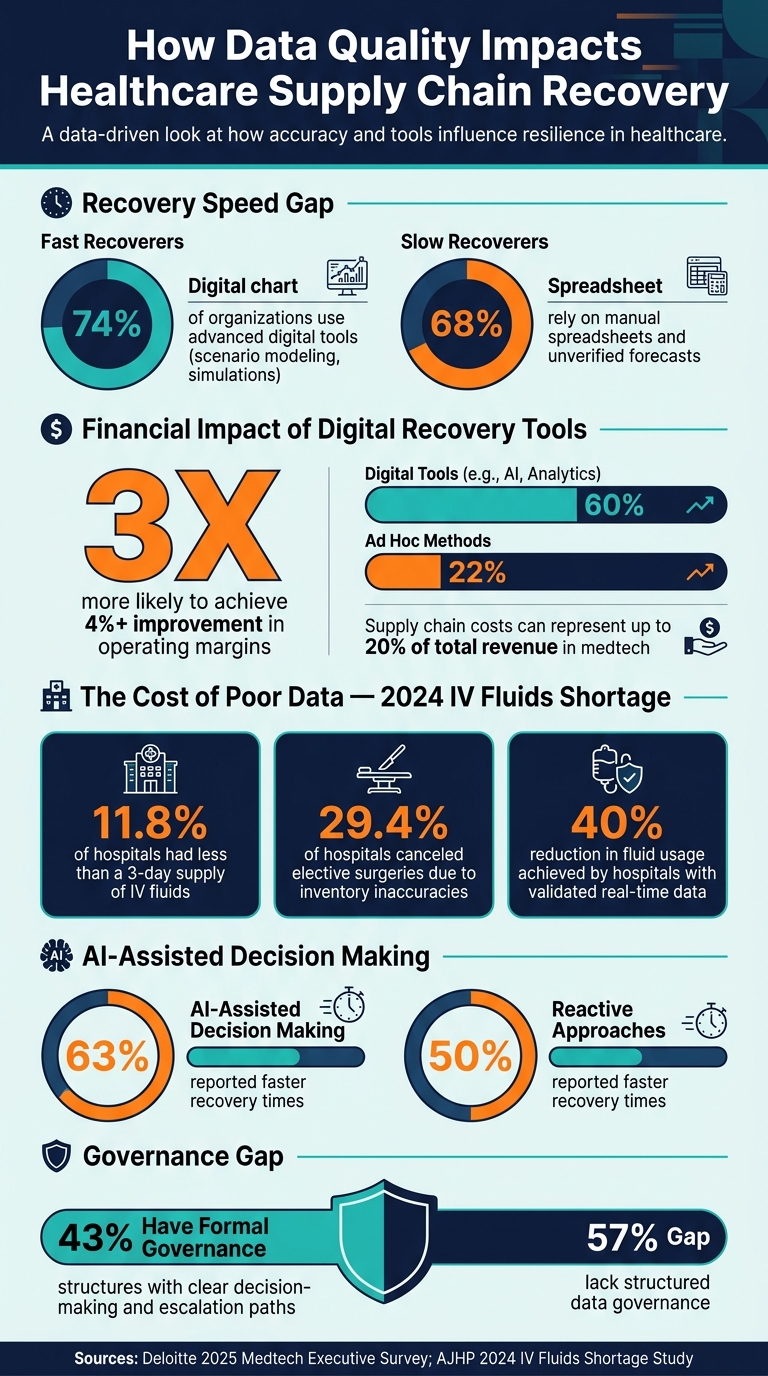
- 74% of fast-recovery organizations use advanced digital tools like scenario modeling and simulations.
- 68% of slow-recovery organizations, on the other hand, still depend on manual spreadsheets and unverified forecasts [3].
The financial impact of this disparity is hard to ignore. Supply chain costs in the medtech sector can account for up to 20% of total revenue. Organizations leveraging digital recovery tools are about three times more likely to achieve at least a 4% improvement in operating margins compared to those relying on ad hoc recovery methods (60% vs. 22%) [3].
These numbers make it clear: poor data quality can be a costly mistake, especially during a crisis.
What Poor Data Quality Looks Like in Practice
The consequences of poor data quality become painfully obvious in moments of disruption. Take the 2024 IV fluids shortage as an example. Hospitals with access to real-time, validated inventory data were able to implement conservation protocols that reduced fluid usage by 40%, effectively avoiding complete stockouts [6]. Meanwhile, the broader picture was far more concerning:
- 11.8% of hospitals were operating with less than a three-day supply of IV fluids.
- 29.4% of hospitals had to cancel elective surgeries due to inventory inaccuracies and shortages [6].
The stakes couldn’t be higher. As Peter Smith, Vice President for Global Supply Chain at Terumo Blood and Cell Technologies, explains:
"AI's value is noise cancellation. You've got all these thousands of transactions going on in the world, but which are the critical few that my team needs to act on today? That's what makes AI interesting for supply chain." [3]
Without validated data, errors in inventory and forecasting can have life-altering consequences, especially in healthcare. These examples underscore why data validation is not just a technical requirement but a critical element in building resilient supply chains.
sbb-itb-535baee
Risks of Skipping Data Validation in Healthcare Supply Chains
Data validation plays a crucial role in ensuring smooth operations, compliance, and effective recovery in healthcare supply chains. Ignoring this process can lead to serious consequences, especially during disruptions. Here’s a closer look at the risks of bypassing data validation in this context.
Inventory Inaccuracies and Stockouts
Relying on inaccurate inventory data can lead to poor decision-making and supply shortages. For example, Estimated Release Dates (ERDs) - the shipment timelines provided by manufacturers - are critical for procurement planning and ensuring a steady supply for patients. However, these dates are often unreliable. A 2025 study revealed that 48.7% of drug shortage trajectories involved at least two ERD updates before shipments finally arrived [7]. Worse, later updates were just as unreliable as earlier ones. This lack of dependable data forces hospitals to make decisions based on flawed information, resulting in unnecessary spending and, more critically, risks to patient care [7].
Compliance and Legal Risks from Unvalidated Data
Errors in unvalidated data don’t just disrupt operations - they can also lead to legal and regulatory complications. Take Item Master records as an example. These records form the backbone of procurement, billing, and clinical supply decisions. A single incorrect data point can cascade through systems, leading to invoicing errors, supply chain disruptions, and even breaking the Unique Device Identifier (UDI) traceability chain mandated by federal regulations.
The FDA’s Quality Management System Regulation (QMSR), aligned with ISO 13485 starting February 2, 2026, requires robust supplier monitoring and validated purchasing controls. Failing to meet these standards can result in FDA 483 observations and Warning Letters [8]. Similarly, under the HIPAA Security Rule, any failure that hinders access to critical supplies could lead to penalties under the Risk Management standard (§164.308(a)(6)(ii)(B)) [9]. Effective third-party risk management is essential to mitigate these vulnerabilities.
| Regulatory Framework | Key Requirement | Risk of Non-Compliance |
|---|---|---|
| FDA QMSR (ISO 13485) | Risk-based supplier monitoring and purchasing controls | FDA 483 observations, Warning Letters [8] |
| HIPAA Security Rule | Availability of systems supporting patient safety | Settlements and penalties [9] |
| UDI System | Lot-level traceability from source to patient | Failed recalls, legal liability [8] |
In addition to these regulatory risks, unvalidated data often forces organizations to rely on inefficient, manual processes.
Slower Recovery and Reliance on Manual Workarounds
When validated data isn’t available, manual processes become the fallback option. These are not only slow but also prone to errors and can place a heavy burden on staff. During the 2024 IV fluids shortage, for instance, 58.8% of hospitals implemented manual oral hydration protocols, while 81.3% switched IV medications to oral alternatives to conserve supplies [6]. Such workarounds increase the likelihood of mistakes and slow down recovery efforts, especially when clinicians are forced to use unfamiliar products [7].
Luis Hakim, Principal at Deloitte Consulting LLP, highlights the issue:
"Recovery speed still tends to lag when governance, data and decision-making aren't connected end to end." [2]
Skipping data validation may seem like a time-saver initially, but in reality, it only defers the problem to a future crisis - one that will likely be far more costly and difficult to resolve.
Data Validation Best Practices During Supply Chain Recovery
Building a Reliable Data Baseline
Start by creating a clean, reconciled reference dataset to serve as your foundation for data validation. Tools like digital twins can simulate real-world inventory, vendor relationships, and logistics flows. According to research published in the Annals of Operations Research, combining digital twins with blockchain-based traceability systems (like Hyperledger) can help simulate recovery scenarios and secure records, especially for high-stakes industries like pharmaceuticals. To ensure no gaps are overlooked, incorporate data from supply, internal operations, and demand layers into your baseline [5].
Automated and Manual Validation Methods
Once your baseline is set, use a combination of automated tools and manual checks to catch discrepancies efficiently. Automated methods, such as machine learning and computational analysis, are great for quickly identifying errors. However, manual reviews remain essential for checking details like lot numbers, expiration dates, and unit-of-measure accuracy. These manual checks are critical because unit-of-measure errors often lead to receiving, billing, and payment issues [1]. Additionally, human oversight ensures that systems accurately reflect diversified sourcing strategies [5].
"Sustainable and resilient HCSCM requires a broad, stakeholder-inclusive approach to support patient care, scalability, and operational performance." - Annals of Operations Research [5]
Cross-System Reconciliation and Anomaly Detection
After identifying anomalies through automated and manual validation, cross-system reconciliation ensures errors are corrected across all platforms. For example, a pricing mismatch in an ERP system can ripple through billing, clinical supply decisions, and regulatory reporting. Automating key EDI transactions can help catch these issues early. Linking supply chain data to the Charge Description Master (CDM) and patient encounter IDs further ensures compliance and closes the loop between procurement and revenue integrity [1].
The table below highlights critical EDI transactions and their roles in data validation:
| EDI Transaction | Purpose in Data Validation |
|---|---|
| 855 - PO Acknowledgment | Confirms what will actually ship versus what was ordered |
| 856 - Advance Ship Notice | Provides lot, serial, and expiration data before receipt |
| 832 - Catalog Refresh | Ensures item attributes and pricing are accurate and up-to-date |
| 810 - Invoice | Final reconciliation of price and quantity for payment |
Organizations that achieve end-to-end data connectivity recover faster. A Deloitte study revealed that 63% of organizations using AI-assisted decision-making reported faster recovery times compared to just 50% of those relying on reactive approaches [2].
"Our research suggests digitally enabled recovery - paired with clear decision rights - can help organizations act faster on trade-offs that matter most, especially when information is incomplete and the stakes are high." - Luis Hakim, Principal, Enterprise Performance, Deloitte Consulting LLP [2]
These practices are a cornerstone of integrated risk management, helping platforms like Censinet RiskOps™ streamline data validation and recovery processes effectively.
Using Integrated Risk Platforms to Support Data Validation
Centralizing Risk Management and Validation Tasks
When supply chains face disruptions, scattered validation processes slow recovery efforts. An integrated risk platform acts as a centralized hub, pulling data from sources like ERP systems, EHRs, inventory tools, and vendor portals. This setup provides a unified view, helping bridge operational gaps and streamline recovery.
With this centralized system, different teams - supply chain, IT, pharmacy, and clinical engineering - can efficiently manage specific third-party risk assessment questions and validation tasks. For example, they can reconcile inventory counts, verify vendor master records, or check drug formulary mappings, all while leadership monitors progress through a shared dashboard. If a severe issue arises, the platform automatically routes it to the right approver, cutting down delays and ensuring a coordinated response. This is a major improvement over manually navigating through disconnected systems.
This approach is especially important in healthcare. Censinet's research shows that supply chain risk management is the least developed area in healthcare cybersecurity programs, based on the 23 NIST Cybersecurity Framework categories [10]. Moreover, healthcare delivery organizations (HDOs) often deal with a supplier base that can outnumber Health IT vendors by a factor of 10. FBI data highlights that these suppliers face heightened cybersecurity risks [10]. Without a centralized platform, managing and validating data across this vast network becomes nearly impossible.
Censinet RiskOps™: Coordinating Data Validation and Recovery
The Censinet RiskOps™ platform demonstrates how integrated tools can streamline data validation and recovery efforts. Purpose-built for healthcare, it consolidates PHI, medical devices, clinical applications, and supply chain vendors into a single environment.
RiskOps™ simplifies recovery with practical tools. Its Cybersecurity Data Room™ lets vendors upload evidence once and share it with multiple organizations, cutting out redundant requests and ensuring consistency [11]. When vendors update questionnaire responses, delta-based reassessments highlight only the changes, reducing follow-up time to less than a day on average [11]. The platform also includes a Digital Risk Catalog™ with over 50,000 pre-scored vendors and products, giving teams a validated starting point instead of building risk profiles from scratch [11].
Additionally, RiskOps™ uses real-time risk scoring to help recovery teams focus on the most critical data, such as inventory feeds tied to surgical schedules or pharmacy dispensing systems. Automated Corrective Action Plans (CAPs) pinpoint gaps, assign remediation tasks to internal experts, and create audit trails to document every validation step [10][11]. These detailed records are invaluable for proving compliance with HIPAA Security Rule requirements or Joint Commission standards following a disruption.
Measuring and Improving Data Validation Over Time
Key Metrics for Tracking Data Validation Performance
To evaluate how well your data validation processes are working, it's essential to monitor specific metrics. Two key indicators are Time-to-Recover (TTR) and Time-to-Survive (TTS). These metrics help transform operational data into actionable insights, enabling teams to make immediate decisions about cost, service levels, and compliance - without relying on manual checks. By focusing on these metrics, organizations can refine their recovery strategies over time, ensuring continuous improvement.
Applying Lessons Learned to Recovery Playbooks
After a disruption, reviewing what worked and what didn’t is crucial. For example, you might ask: Which inventory records were inaccurate? Where did reconciliation take the most time? Were there gaps in vendor data, such as missing or outdated information? These insights are invaluable for updating standard operating procedures and recovery playbooks. Making these updates part of your routine operations - not just a one-time adjustment - helps enhance recovery speed and data quality throughout the supply chain. As a global medtech leader noted: "The improvements were needed fast and under pressure, but they're now part of our capability set." [3]
Regular Testing and Governance to Keep Validation on Track
To maintain progress, consistent testing and robust governance are essential. Running quarterly stress tests or scenario simulations can help teams uncover potential issues before they escalate. These tests should simulate realistic situations, such as a major supplier outage, a healthcare supply chain security challenges affecting inventory data, or new regulatory requirements impacting reporting processes. Organizations can also leverage supply chain cybersecurity risk management guidance to align with industry standards.
However, only 43% of organizations have formal governance structures with clear decision-making and escalation paths in place [3]. This leaves many teams scrambling when challenges arise. Establishing a cross-functional oversight structure - with defined roles spanning supply chain, IT, compliance, and clinical operations - ensures data validation remains a top priority.
| Validation Type | Performed By | Purpose | Recommended Frequency |
|---|---|---|---|
| Internal Validation | Facility staff (IPs, nurses, supply chain teams) | Ensure data is complete, timely, and accurate [12] | Annually, at minimum [12] |
| External Validation | State or local health departments | Identify systemic reporting issues and training needs [12] | Annual review for at least one area is ideal [12] |
Conclusion: Why Data Validation Is Central to Supply Chain Continuity
The evidence is clear: data validation plays a critical role in ensuring supply chain stability, especially during disruptions. Whether dealing with a cyberattack, a supplier issue, or a regional crisis, recovery efforts hinge on having accurate, reliable data. Decisions like reordering, substituting materials, or reallocating resources depend on this trustworthiness.
Recent studies highlight that organizations prioritizing cross-system data validation recover faster, avoid operational bottlenecks, and reduce the need for costly manual interventions. Validated data provides a dependable foundation for action, sparing teams from the inefficiencies of second-guessing their numbers. This reliability accelerates the journey from disruption to stability.
To maintain this capability, organizations need to integrate validation into their governance processes. This includes running regular stress tests and monitoring metrics like inventory discrepancies and time-to-restore fill rates. Tools like Censinet RiskOps™ streamline this process by centralizing vendor risk data, coordinating validation workflows across supply chain, IT, compliance, and clinical teams, and ensuring documentation for audits and HIPAA-compliant vendor risk management requirements [15].
The benefits of validated data are tangible: it reduces emergency freight costs, protects high-margin revenue, and minimizes regulatory risks. Most importantly, it safeguards patient care by preventing canceled surgeries, avoiding unsafe substitutions, and improving communication during crises.
As discussed, data validation goes beyond being an IT function - it is a core element of continuity planning that ensures safe and uninterrupted care when it's needed most [13][14][15].
FAQs
How is data validation different from data restoration?
Data validation is all about making sure that incoming data is accurate, properly formatted, and consistent before it enters a system. By catching issues early, this process helps avoid errors and keeps data reliable. On the other hand, data restoration comes into play after something goes wrong. It focuses on recovering or reconstructing lost or damaged data to get operations back on track. Both processes are essential - whether it's for stabilizing supply chains or ensuring uninterrupted patient care in healthcare settings.
What data should be validated first during a disruption?
During a disruption, the first step is to confirm the integrity and accuracy of essential data. This includes reviewing vendor risk assessments, supply chain visibility reports, and inventory records. Doing so helps maintain operations and quickly pinpoint any weaknesses or gaps within the supply chain.
How can we measure if data validation is improving recovery?
When it comes to tracking recovery progress, resilience metrics are key. Metrics like detection time, response speed, and recovery duration provide a clear picture of where things stand. By comparing these metrics over time or across different scenarios, you can spot trends and measure improvements.
Another effective approach is internal benchmarking. By looking at how your team performed during past disruptions, you can identify areas of growth. Running scenario simulations also adds value, offering a controlled way to test and refine your detection, response, and recovery capabilities. These methods together create a solid framework for assessing progress.

