
Managing vendor relationships in healthcare requires strict oversight. Under the HITECH Act, vendors handling patient data - called Business Associates - are directly accountable for HIPAA compliance. This makes Business Associate Agreements (BAAs) a legal necessity before sharing Protected Health Information (PHI). Without a BAA, your organization risks severe penalties for non-compliance.
Key takeaways:
Practical steps for compliance:
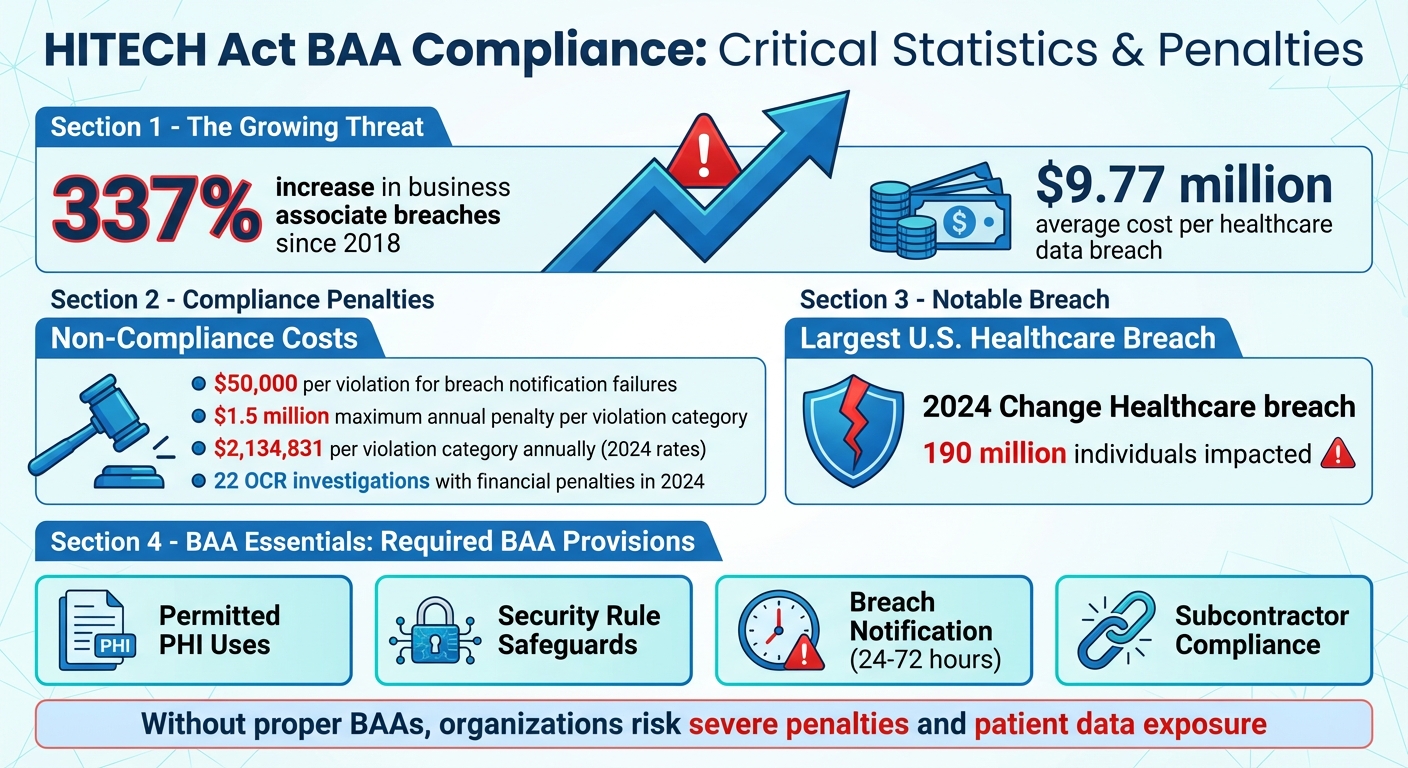
With healthcare data breaches surging by 337% since 2018, robust BAA management is critical for protecting patient data and avoiding costly penalties.
HITECH Act BAA Compliance: Key Statistics and Penalties
What Business Associate Agreements Must Include Under the HITECH Act
Continuing the discussion on shared accountability, let’s dive into the essential provisions a Business Associate Agreement (BAA) must include under the HITECH Act.
A BAA is a legally binding contract required before a vendor can create, receive, or transmit electronic protected health information (ePHI). As mentioned earlier, BAAs ensure vendors take responsibility for safeguarding ePHI and adhering to specific HIPAA regulations [6].
Permitted Uses and Disclosures of Protected Health Information (PHI)
The agreement must clearly outline what a vendor is permitted to do with PHI. It should specify the exact purposes for which PHI can be used - usually limited to the services detailed in the contract - and explicitly prohibit any uses or disclosures beyond those purposes unless required by law. This prevents unauthorized activities, such as using PHI for unapproved sales or marketing.
Security Rule Safeguards and Risk Management Obligations
The BAA must ensure the vendor complies with the HIPAA Security Rule, which requires implementing administrative, physical, and technical safeguards to protect ePHI. Under the HITECH Act, business associates are now directly responsible for meeting these requirements, adding a layer of accountability beyond what was previously enforced solely through contracts.
"The HITECH Act extends certain conditions of HIPAA's civil and criminal penalties to Business Associates, who are now directly required to comply with the safeguards contained in the HIPAA Security Rule. Previously, Business Associates were subjected to HIPAA privacy and security requirements only via contractual agreements with covered entities." – Primerus
If the vendor uses subcontractors to handle ePHI, the BAA must require those subcontractors to sign agreements that meet the same security and privacy standards. This creates a chain of accountability, ensuring consistent protection across your vendor network.
Breach Notification and Reporting Requirements
Beyond usage limitations and security safeguards, the BAA must include provisions for timely reporting of security incidents, including breaches involving unsecured PHI. The vendor must provide details such as:
Strict timelines for breach notifications are essential to avoid penalties for delayed patient alerts. Even if a breach originates with your vendor, your organization is ultimately responsible for notifying affected patients. Failing to comply with the Breach Notification Rule can result in penalties of up to $50,000 per violation, with annual fines for HITECH violations reaching as high as $1.5 million per violation category [1][4].
How to Draft and Maintain Effective BAAs
When drafting Business Associate Agreements (BAAs), it's important to tailor them to the specific risks posed by each vendor. Start with the essential elements - like permitted uses, security measures, and breach notification requirements - and then customize the agreement based on the vendor's level of access and the risks they bring to your organization [8]. This approach ensures compliance while addressing the unique challenges each vendor might present.
Customizing BAAs for Specific Vendor Risks
After covering the required provisions, fine-tune your BAAs to address the specific risks associated with each vendor. Not all vendors have the same level of risk. For instance, a cloud storage provider handling large volumes of patient records will need stronger data encryption and tighter access controls compared to a vendor providing limited administrative services. Your agreement should reflect these differences. If a vendor is responsible for breach notifications, clearly define the timeframe for notification [8]. Additionally, specify whether the vendor will handle patient requests for access or amendments directly, or if they will forward them to you, including exact timeframes for these actions [8].
Including Subcontractor Flow-Down Provisions
To maintain consistent protection of Protected Health Information (PHI), require vendors to establish separate BAAs with their subcontractors. This ensures that subcontractors follow the same PHI protection standards and meet HIPAA's 30-day response requirement for disclosures [7][8][10].
Regular Audits and Updates to BAAs
BAAs should be reviewed annually to stay aligned with changing regulations and emerging threats. Legacy contracts, especially those created before 2013, need updates to include modern subcontractor management practices and breach notification standards. Incorporating recognized frameworks like NIST, as recommended by the 2021 HITECH amendment, can further strengthen these agreements [1][9][10].
Using Censinet RiskOps™ for BAA Enforcement and Vendor Risk Monitoring
As mentioned earlier, managing Business Associate Agreements (BAAs) is a critical part of staying compliant with the HITECH Act. However, when you're working with multiple vendors, this can quickly become a logistical nightmare. That’s where Censinet RiskOps™ comes in, offering a centralized platform designed to streamline BAA management and automate vendor risk monitoring - helping organizations maintain compliance with ease.
Managing BAAs with Censinet RiskOps™
Censinet RiskOps™ takes the hassle out of BAA management by acting as a one-stop repository for all your agreements. Instead of juggling spreadsheets or outdated manual systems, you can store and track every BAA in a single location. The platform not only keeps tabs on execution and renewal dates but also sends automated reminders before any agreements expire, ensuring you never miss a deadline [10].
This system gives your compliance team instant access to up-to-date BAA documentation, which is particularly valuable during audits or regulatory reviews. By replacing manual processes with this streamlined approach, Censinet RiskOps™ makes compliance management far more efficient and stress-free.
Automating Risk Assessments and Vendor Monitoring
Beyond managing BAAs, Censinet RiskOps™ is a game-changer for automating risk assessments. In healthcare, where third-party relationships can be extensive, the platform continuously monitors vendor security postures, reducing the need for manual oversight. This real-time monitoring allows organizations to shift from a reactive stance to a proactive risk management strategy [10].
For healthcare organizations juggling a large number of vendors, this automation not only simplifies BAA enforcement but also strengthens overall risk management practices. It transforms what was once a tedious, reactive process into a forward-thinking, streamlined system.
sbb-itb-535baee
Common BAA Implementation Mistakes and How to Avoid Them
Healthcare organizations often face challenges when implementing Business Associate Agreements (BAAs). With healthcare data breaches costing an average of $9.77 million per incident and business associate breaches surging by 337% since 2018 [10], identifying and addressing common missteps is essential to safeguard sensitive data and ensure compliance.
After discussing the key requirements for BAAs and strategies for effective management, it’s important to focus on the frequent errors that can derail compliance efforts. Below are some of the most common pitfalls and tips on how to avoid them.
Failing to Address Cybersecurity Risks in BAAs
Too often, healthcare organizations treat BAAs as a mere formality instead of using them as a tool to create strong security frameworks. Findings from the Office for Civil Rights (OCR) pilot audits revealed that many organizations skip critical steps, such as conducting thorough security risk analyses, implementing adequate access controls, and preparing robust breach response plans [5].
The consequences of weak cybersecurity can be severe. For instance, a small primary care clinic faced a $150,000 fine after a vendor’s breach exposed thousands of patient records due to insufficient risk analysis and oversight [3].
To bolster cybersecurity measures, consider the following:
Overlooking Subcontractor Compliance
Ensuring the compliance of subcontractors is just as important as monitoring primary vendors. The HITECH Act established a "liability chain", holding subcontractors of Business Associates to the same HIPAA standards as covered entities [5]. However, many organizations fail to maintain visibility into their entire vendor ecosystem, leaving gaps in compliance.
When subcontractor compliance is overlooked, it creates vulnerabilities that can lead to significant risks. To address this:
Inadequate Breach Notification Processes
Failures in breach notification processes can compound compliance issues. Under the HITECH Act, covered entities must notify affected individuals, the Department of Health and Human Services (HHS), and in some cases, the media within strict timeframes - no later than 60 days after the breach [1][5]. For breaches involving 500 or more individuals, immediate notification to HHS is required [1][2][5].
Covered entities are typically responsible for notifying patients in the event of a vendor breach. However, timely notification depends on the vendor promptly sharing all relevant breach details. Many BAAs lack clear notification requirements, leaving organizations struggling to meet deadlines when incidents occur.
To avoid this, include the following in your BAAs:
Conclusion: Strengthening Vendor Risk Management with Effective BAAs
Business Associate Agreements (BAAs) serve as a critical safeguard against the growing risk of vendor-related breaches. With the average cost of a breach climbing to nearly $9.77 million, the stakes for healthcare organizations are higher than ever [10]. The 2024 Change Healthcare breach, which impacted 190 million individuals, is a stark reminder of how a single vendor issue can snowball into the largest healthcare breach in U.S. history [10].
A well-crafted BAA ensures accountability throughout your vendor network. It sets clear security standards, outlines breach notification requirements, and holds subcontractors to the same expectations as primary vendors. However, signing a BAA is just the beginning. To truly mitigate risk and comply with the HITECH Act, BAAs must be reinforced with continuous monitoring and regular audits [1][10][3]. This multi-layered approach strengthens vendor relationships while proactively addressing potential vulnerabilities.
Managing today’s complex vendor ecosystems and rapidly evolving threats requires more than manual processes. Centralized, automated solutions like Censinet RiskOps™ simplify vendor risk management, turning it into a proactive security strategy rather than a reactive compliance task. These platforms streamline oversight, making it easier to stay ahead of risks.
Oversight failures remain a costly issue. In 2024, the Office for Civil Rights resolved 22 investigations with financial penalties, many tied to lapses in business associate management [10]. With HIPAA fines reaching up to $2,134,831 per violation category annually [10], the financial impact of non-compliance far outweighs the cost of investing in robust oversight systems.
FAQs
What key elements should a Business Associate Agreement (BAA) include to comply with the HITECH Act?
A Business Associate Agreement (BAA) lays out the rules for how Protected Health Information (PHI) can be used and shared. It needs to detail the safeguards - both physical and technical - that will keep PHI secure. Another key piece is outlining the breach notification requirements, ensuring any unauthorized access or disclosure is reported promptly.
The agreement should also cover access and amendment rights for PHI, include terms for audits and monitoring, and require subcontractors to follow the same strict standards. To stay compliant and reduce risks, it must align with all HIPAA and HITECH Act regulations.
What steps can healthcare organizations take to ensure their subcontractors comply with HIPAA requirements?
Healthcare organizations can take several steps to ensure their subcontractors comply with HIPAA regulations. Start by requiring all subcontractors to sign Business Associate Agreements (BAAs). These agreements should clearly define their responsibilities for safeguarding sensitive data and maintaining compliance.
Before entering into any agreements, conduct a thorough review of the subcontractor's security protocols and privacy practices. This due diligence helps identify any potential risks upfront. Once a partnership is established, keep tabs on their compliance by performing regular audits or requesting updated compliance documentation.
Contracts should also include clear requirements, such as timely breach reporting, adherence to strict data protection measures, and maintaining strong security controls. Consistent monitoring and open lines of communication are key to building secure and compliant vendor relationships while minimizing potential risks.
What are some common mistakes to avoid when managing Business Associate Agreements (BAAs)?
Avoiding missteps in managing Business Associate Agreements (BAAs) is crucial for staying compliant and safeguarding sensitive information. Here are some common pitfalls to watch out for:
By tackling these challenges head-on, healthcare organizations can strengthen their vendor management processes and ensure compliance with the HITECH Act.
