
Healthcare organizations face relentless cyber threats that disrupt operations and risk patient safety. With ransomware attacks and breaches costing millions, traditional security methods often fall short. Enter self-healing networks: AI-driven systems that detect, respond to, and neutralize threats in real time, minimizing downtime and protecting critical systems. These networks use machine learning, automation, and software-defined networking (SDN) to secure patient records, safeguard connected medical devices, and manage third-party risks - all while ensuring compliance with healthcare regulations like HIPAA.
Key Points:
- Ransomware Defense: Automatically isolates infected systems and restores functionality, reducing breach costs (now averaging $10.93M per incident).
- Medical Device Security: Monitors connected devices and quarantines anomalies without disrupting care.
- Vendor Risk Management: Detects and contains third-party breaches to protect sensitive data.
- Compliance: Aligns with regulations like HIPAA and FDA guidelines, logging evidence for audits.
Self-healing networks reduce response times from months to minutes, ensuring uninterrupted care and stronger defenses against evolving threats.
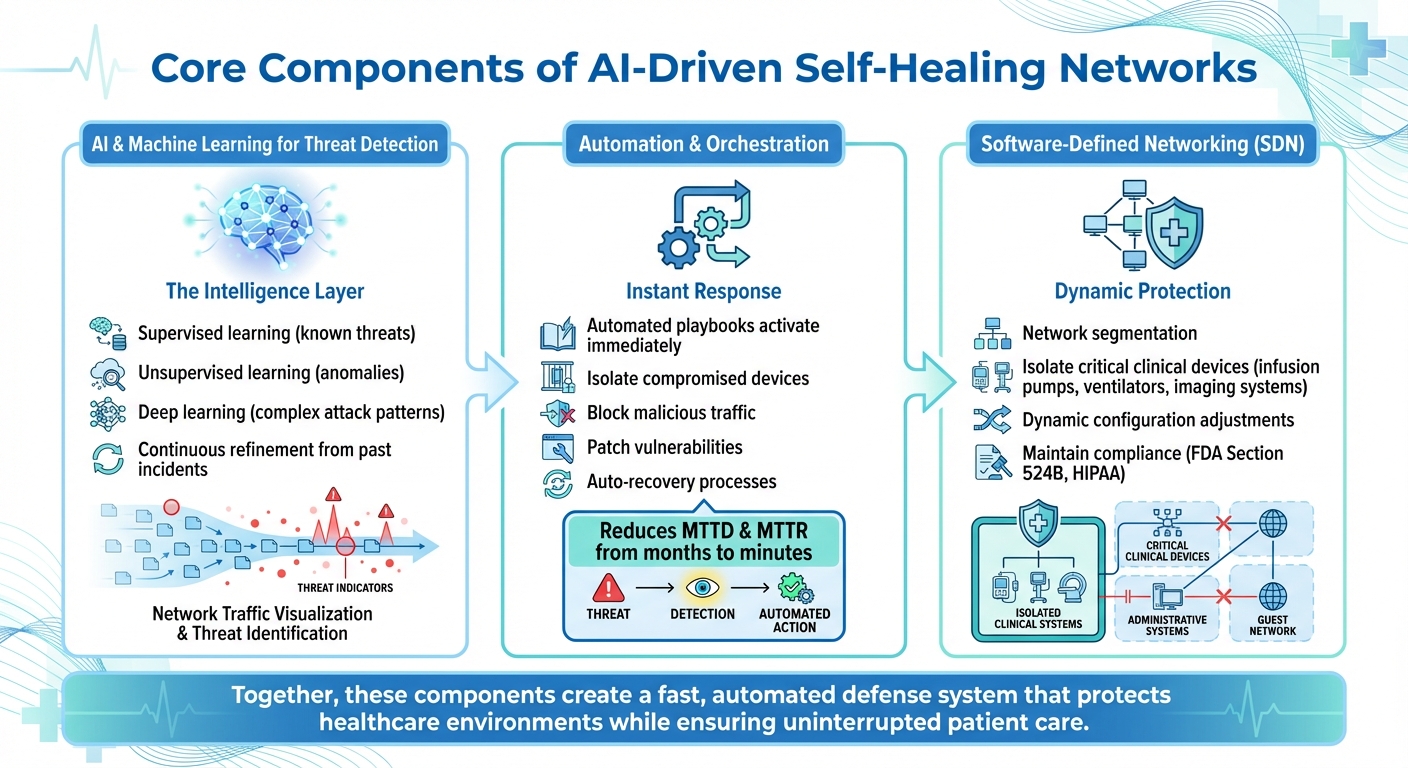
Core Components of AI-Driven Self-Healing Networks
How AI-Driven Self-Healing Networks Protect Healthcare Systems
Self-healing networks are built on three key technologies designed to safeguard healthcare environments. Each plays a unique role in identifying threats, responding instantly, and ensuring secure operations. Together, they create a fast, automated defense system.
AI and Machine Learning for Threat Detection
Machine learning models serve as the brain of self-healing networks, constantly analyzing network traffic to spot unusual activity. These models use supervised learning to identify known threats and unsupervised learning to detect anomalies. Deep learning takes this a step further by employing advanced neural networks to identify intricate attack patterns and previously unknown threats. Over time, these systems refine their detection abilities by learning from past incidents, making them better equipped to counter evolving cyber risks [5][6][7].
Automation and Orchestration in Incident Response
Automated playbooks enable immediate action as soon as a threat is detected. Orchestration frameworks evaluate the severity of each incident and initiate countermeasures like isolating compromised devices, blocking harmful traffic, or patching vulnerabilities - all without waiting for human input. Once the threat is neutralized, automated recovery processes restore regular operations with minimal disruption. This swift response drastically reduces Mean Time to Detect (MTTD) and Mean Time to Respond (MTTR), which is especially crucial in healthcare, where even a brief system outage can impact patient care [1][3][8].
Software-Defined Networking (SDN) Integration
SDN offers the flexibility needed to isolate threats and safeguard critical systems. For instance, the FDA’s 2025 final guidance (Section 524B) requires cybersecurity measures to be integrated into medical device designs, while the HIPAA Security Rule NPRM proposes stricter network segmentation requirements [9]. By treating clinical devices - like infusion pumps, ventilators, and imaging systems - as critical infrastructure, SDN allows healthcare organizations to separate these systems from general IT networks. In the event of a threat, SDN dynamically adjusts network configurations to contain the attack while ensuring essential clinical services remain operational. Advanced SDN setups also enforce segmentation rules and correct configuration drift to maintain compliance [9].
Use Cases for Self-Healing Networks in Healthcare
Self-healing networks tackle some of the biggest cybersecurity challenges in healthcare, such as safeguarding patient records, securing connected medical devices, and managing vendor risks. These systems offer quick, automated responses tailored to the unique threats healthcare organizations face.
Mitigating Ransomware Attacks on EHR Systems
Ransomware attacks targeting electronic health records (EHRs) can cripple healthcare operations. Self-healing networks step in by using AI to detect unusual activity and take immediate action. For example, when anomalies are spotted, the network isolates affected systems, blocks harmful traffic, and restores compromised components - all without manual intervention. This rapid containment is critical, especially in a sector where the average data breach now costs a staggering $10.93 million, reflecting a 53.3% rise over the past three years [15].
Protecting Networked Medical Devices and IoT Endpoints
Connected medical devices like infusion pumps, ventilators, and imaging systems bring unique security challenges. Self-healing networks address this by monitoring device communication patterns to establish normal baselines [1][10][11]. If a device starts behaving abnormally, the system automatically quarantines it, blocks suspicious connections, and alerts the security team. Importantly, this happens without disrupting clinical operations, ensuring patient care continues uninterrupted while threats are neutralized. These targeted device responses work alongside broader network defenses, making them ideal for dynamic healthcare environments.
Managing Third-Party Vendor Breaches
Healthcare organizations rely heavily on vendors for services like billing and cloud storage, creating multiple potential entry points for attackers. Self-healing networks continuously monitor vendor systems to detect and contain threats before they can compromise critical infrastructure [1][14]. When a vendor breach occurs, these networks automatically isolate affected segments, block malicious traffic, and address vulnerabilities. This proactive approach helps organizations maintain HIPAA compliance, even when third-party systems are compromised [1][13][14]. With 90% of hospitals expected to integrate AI-driven agents by 2025, such capabilities are becoming more essential [12]. By bolstering defenses at all points of vulnerability, self-healing networks strengthen overall resilience in healthcare.
sbb-itb-535baee
How to Implement Self-Healing Networks in Healthcare
Rolling out a self-healing network in healthcare requires careful planning, thorough testing, and unwavering attention to governance. Patient safety and regulatory compliance must remain at the forefront of every decision. Once your strategy is in place, the next step is to establish a strong technical framework to support the network.
Building the Technical Foundation
Start by centralizing real-time data from various sources like firewalls, endpoint detection systems, identity platforms, cloud applications, and even legacy systems. This centralized data becomes the backbone for AI-driven anomaly detection. Make sure your network is equipped for segmentation and cloud computing, as these features are essential for enabling swift automated responses to threats.
Creating and Testing Automated Playbooks
Develop automated playbooks to handle multi-step remediation processes. For example, these could include isolating infected devices or blocking malicious traffic. AI plays a critical role here by classifying threats in real time, enabling the network to respond quickly [2].
Before deploying these playbooks fully, validate them in controlled environments. Use methods like shadow mode testing and phased rollouts to simulate real clinical workflows. This approach allows you to pinpoint weaknesses and refine the system without putting patient safety at risk [9].
Governance and Compliance Requirements
Every AI-driven initiative must align with key healthcare regulations such as HIPAA, the FDA's Section 524B device guidance, and the HHS Cybersecurity Performance Goals [9]. To ensure compliance, establish a governance committee that includes clinicians, ethicists, and compliance officers.
"Healthcare is under attack all day long. The data that we hold is the most valuable out there. It is a sacred trust for us to protect it at all costs" [9].
Your AI systems should be configured to automatically log critical evidence, such as control logs, access records, encryption status, and patch histories. These records should be packaged into auditor-ready formats [9]. While AI can be granted autonomy in low-risk areas like revenue cycle compliance, human oversight is essential for functions related to diagnosis, treatment, or any patient-facing outcomes [9].
Lastly, scrutinize every AI vendor carefully. Evaluate their data-handling practices and their commitment to updates. In healthcare, supply-chain security is non-negotiable [9].
Conclusion
Self-healing networks are transforming how healthcare organizations defend against cyber threats. By automating processes like threat detection, response, and recovery, these AI-powered systems shrink detection and response times from months to just minutes [1]. This ensures that critical systems stay functional and patient care remains uninterrupted [4].
The stakes are high - healthcare breaches cost an average of $7.42 million per incident, and the 2024 UnitedHealth breach alone is expected to reach $3.09 billion by the end of 2025 [9]. Self-healing networks play a crucial role in minimizing these financial risks by halting the spread of threats and removing delays caused by manual intervention [1]. These numbers highlight the pressing need for automated and responsive cybersecurity solutions.
Advanced platforms like Censinet RiskOps address these challenges by simplifying compliance and automating remediation. Censinet RiskOps acts as a centralized hub, continuously monitoring security controls and aligning them with standards like HIPAA, FDA, and HITRUST [9]. When issues like encryption lapses, network segmentation gaps, or access control failures arise, the system can self-correct or roll back changes, all while documenting proof for compliance purposes [9].
What sets Censinet RiskOps apart is its ability to prioritize risks based on their potential impact on patient care. By distinguishing minor misconfigurations from critical threats, it ensures that security teams focus on the most urgent issues. The platform also conducts governance checks and validates changes in production environments, reducing complexity without adding to the workload of clinical staff [9].
In a sector where some breaches have gone undetected for up to 279 days [9], healthcare organizations cannot afford to delay. Self-healing networks, supported by tools like Censinet RiskOps, bring the speed, automation, and intelligence needed to safeguard patient data and maintain trust. This isn’t just about upgrading technology - it’s about making a strategic commitment to delivering secure, uninterrupted patient care.
FAQs
How do self-healing networks improve cybersecurity in healthcare?
Self-healing networks are transforming healthcare cybersecurity by leveraging AI-powered automation to identify, respond to, and recover from cyber threats instantly. This approach reduces interruptions to patient care and protects sensitive information, all without needing constant oversight from IT teams.
These networks can take actions like isolating compromised devices, applying updates to fix vulnerabilities, and restoring systems to their proper state. By tackling threats proactively, they support compliance with regulations such as HIPAA, minimize downtime, and lessen the impact of breaches on healthcare services.
How does AI help speed up responses to cybersecurity threats?
AI has transformed the way organizations tackle cybersecurity threats by making real-time threat detection, automated responses, and adaptive learning a reality. It processes and analyzes potential risks much faster than humans ever could, helping businesses contain and address threats almost immediately.
With tools like AI-powered intrusion detection systems and automated patch management, networks can essentially "self-heal", fixing vulnerabilities without needing manual input. This dramatically cuts down response times and strengthens security, which is especially critical in sensitive areas like healthcare.
How do self-healing networks help healthcare organizations stay HIPAA-compliant?
Self-healing networks play a crucial role in supporting HIPAA compliance by leveraging AI-powered automation to identify, contain, and address cybersecurity threats as they happen. This real-time response helps protect sensitive patient information, ensuring its confidentiality, accuracy, and accessibility, all while reducing the risks of human mistakes and delays.
Additionally, these networks maintain comprehensive audit logs, which are essential for meeting regulatory reporting requirements. This capability allows healthcare organizations to show compliance with HIPAA standards more efficiently and simplifies the overall compliance process.
