
X Close Search

How can we assist?

Demo Request

How Vendor Access Impacts Healthcare Cybersecurity

Post Summary

Why does vendor access represent the dominant healthcare cybersecurity risk and what do the statistics show?

74% of healthcare cybersecurity incidents involve third-party vendors, 56.4% of healthcare delivery organizations experienced a third-party access breach in the past year, and 54.3% of those breaches are directly linked to excessive privileged access. Over 80% of all stolen Protected Health Information traces back to third-party vendors. The 2024 Change Healthcare breach affected 192.7 million patients through vendor vulnerabilities; the 2021 Broward Health breach compromised 1.35 million patients from a third-party provider granted broad system access. Despite this threat profile, 59% of organizations fail to monitor third-party access, 53% still rely on manual monitoring, and half lack a complete inventory of their third-party vendors. Two-thirds of healthcare organizations anticipate an increase in third-party breaches over the next two years.

What are the specific risks created by excessive vendor access and fourth-party subcontractor relationships?

Excessive vendor access — where vendors receive permissions beyond what their actual function requires — converts every unnecessary privilege into a potential attack gateway. 54.3% of third-party breaches stem directly from this over-provisioning. Shared credentials instead of individual authentication make it impossible to track who accessed which systems and when, eliminating the audit trail that breach investigations and OCR compliance require. Fourth-party risks arise when primary vendors outsource tasks to subcontractors who gain access to sensitive systems without adequate oversight — third-party involvement in data breaches has nearly doubled from 15% to nearly 30%, with fourth-party blind spots a critical gap that organizations overlook. Vendors may retain access after project completion, creating persistent unauthorized access paths. Healthcare systems' interconnectedness means a single vendor breach can cascade across departments, disrupting EHRs, clinical decision support tools, and medical devices simultaneously.

How should healthcare organizations conduct continuous vendor risk assessments to close access monitoring gaps?

Continuous vendor risk assessment requires maintaining an up-to-date inventory of all vendors including their system access, permissions, and involvement with critical applications such as EHRs and medical devices. Pre-onboarding, vendors must meet baseline security standards demonstrated through certifications including HIPAA, SOC 2, or ISO 27001 and evaluated through standardized security questionnaires covering protocols, incident response strategies, and audit capabilities. Once onboarded, continuous real-time monitoring detects vulnerabilities, unusual behavior, and potential breaches rather than relying on periodic snapshots. Risk prioritization based on clinical impact focuses security team resources where they matter most — vendors with access to infusion pumps, clinical decision support tools, or patient monitoring systems pose greater patient safety risk than those managing administrative systems. Linking vulnerabilities to assets critical to patient care enables proportional resource allocation across the full vendor portfolio.

What does implementing least-privilege access for healthcare vendors require in practice?

Least-privilege access ensures vendors receive only the permissions required to perform their specific tasks — nothing more. This requires multi-factor authentication replacing shared credentials for all vendor accounts, network segmentation limiting vendor access to only the system components their function requires, and zero-trust principles dynamically adjusting access based on identity, device security, and real-time risk levels. Just-in-time provisioning grants access only when the vendor needs it for a specific task and automatically de-provisions access after project completion. Role-based access restrictions should be built into vendor contracts with specificity — billing vendors should not have access to EHRs, and infrastructure vendors should not have access to clinical data repositories. Mapping vendor access to specific critical systems and monitoring for unusual access patterns enables containment before threats spread across interconnected healthcare systems.

What must healthcare vendor governance frameworks include and how should vendor contracts enforce security standards?

Governance frameworks transform vendor management from reactive to proactive by establishing accountability at vendor onboarding. Vendor selection requires standardized security questionnaires evaluating protocols, incident response strategies, and audit capabilities, with only vendors demonstrating adherence to HIPAA, NIST guidelines, or continuous monitoring practices approved. Contracts must include SLAs mandating data encryption, timely breach reporting, audit rights, and penalties for non-compliance. Fourth-party risk clauses must require vendors to enforce equivalent security protocols with their subcontractors including shared risk assessments and breach notification chains. Access control provisions must specify just-in-time provisioning, role-based restrictions, automatic de-provisioning, MFA requirements, and behavioral monitoring — particularly for patient-critical systems. Collaboration with vendors through joint risk workshops, shared threat intelligence, and co-created access policies balances security requirements with operational efficiency.

How does Censinet RiskOps™ address the automation gap that leaves 53% of organizations relying on manual vendor monitoring?

Censinet RiskOps™ enables healthcare organizations to conduct automated vendor risk assessments, maintain continuous real-time visibility into vendor connections, and streamline risk management across the full vendor ecosystem — addressing PHI protection, clinical applications, medical devices, and supply chain risks simultaneously. Against manual monitoring — which provides only periodic snapshots, struggles to manage 1,000-plus vendors, is prone to manual errors and outdated information, and creates siloed visibility — automated RiskOps platforms provide continuous real-time monitoring, repeatable scalable workflows, real-time data accuracy, and centralized transparent visibility for all stakeholders. With resource shortages affecting 45% of organizations and oversight gaps affecting 53%, automation provides the efficiency and scalability needed to stay ahead of evolving vendor risks without proportional staffing increases.

Healthcare cybersecurity is heavily influenced by third-party vendors, with 74% of incidents involving them. These vendors often require access to sensitive systems, making them prime targets for cyberattacks. Poorly managed access can lead to breaches, operational disruptions, and risks to patient care, as seen in high-profile cases like the 2024 Change Healthcare attack affecting 100 million individuals.

Key Takeaways:

Solutions:

By addressing these vulnerabilities with better monitoring, access controls, and governance, healthcare organizations can protect sensitive data and ensure uninterrupted patient care.
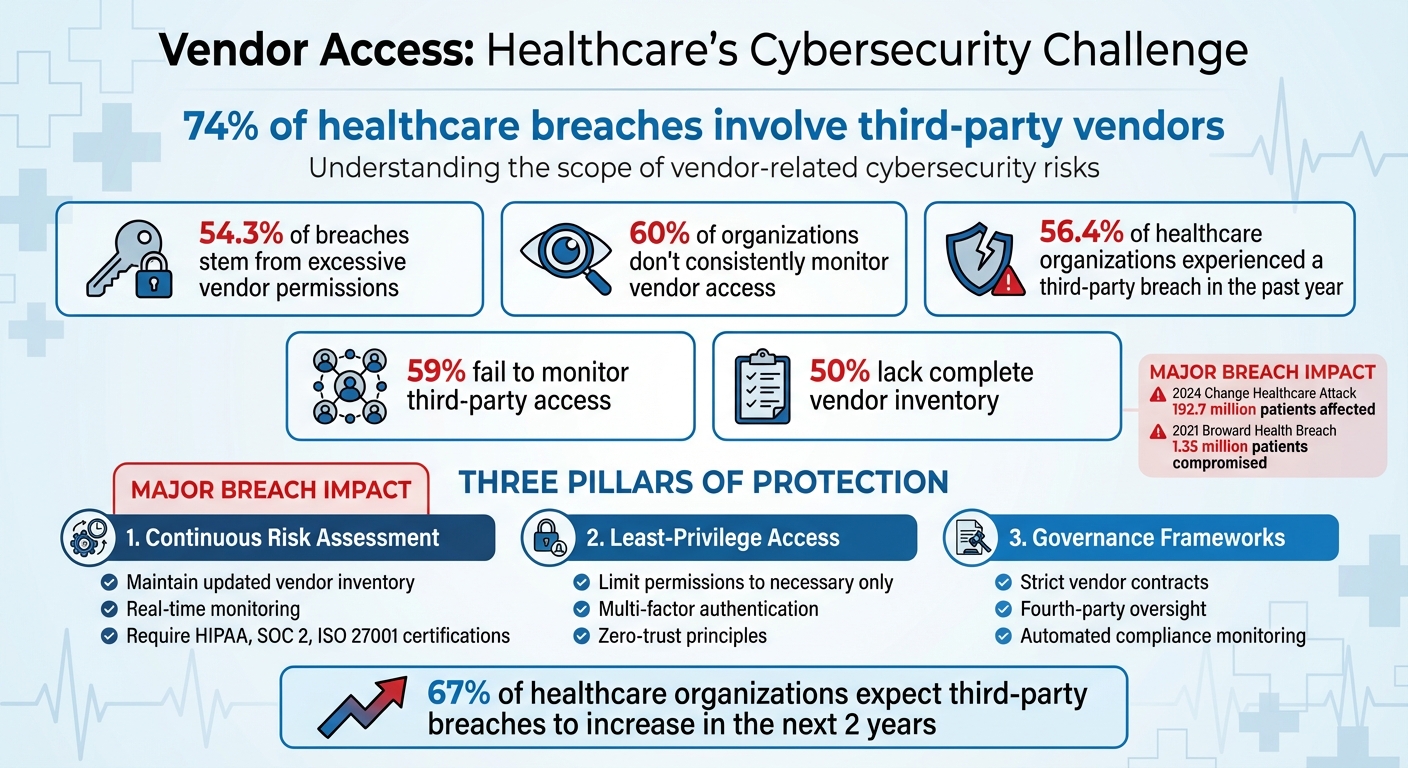
Healthcare Vendor Cybersecurity Statistics and Risk Factors

       
       Healthcare Vendor Cybersecurity Statistics and Risk Factors

HIMSS24 | Creating Cyber Resilience: Your Guide to Vendor Risk Management

sbb-itb-535baee

Challenges of Managing Vendor Access in Healthcare

Managing vendor access in healthcare is no small task. With the growing number of vendors and the intricate web of modern healthcare IT systems, organizations face mounting challenges in addressing vulnerabilities.

Security Gaps from Excessive Vendor Access

One of the biggest hurdles is the risk created by granting vendors too much access. When vendors receive permissions beyond what they actually need, every extra privilege becomes a potential gateway for cyberattacks. Alarmingly, 59% of organizations fail to monitor third-party access, leaving critical blind spots for IT teams to address[3]. These teams often spend countless hours trying to identify and mitigate vulnerabilities caused by such gaps. Shared credentials, instead of individual user authentication, further muddy the waters. This practice makes it nearly impossible to track who accessed systems and when. Adding to the challenge, healthcare organizations must also navigate the risks posed by subcontractors - commonly referred to as fourth-party access.

Managing Fourth-Party Risks

Fourth-party risks amplify the complexities of vendor management. When a primary vendor outsources tasks to subcontractors, these third parties may gain access to sensitive systems and data without adequate oversight. As Maria Phillips, Senior Counsel for Privacy & Compliance at Imprivata, explains:


"Third-party involvement in data breaches has nearly doubled this year from 15 percent to nearly 30 percent... A critical gap remains that many organisations overlook: fourth-party risk."


Without a thorough inventory of vendors and their subcontractors, organizations struggle to monitor and control downstream access, leaving them exposed to hidden vulnerabilities.

Effects on Patient Care and Operations

The consequences of vendor access breaches go far beyond stolen data - they can disrupt patient care and essential operations. Ransomware attacks, for instance, can cripple Electronic Health Records and decision support tools, cutting off providers from critical patient information. This interruption increases the likelihood of medication errors, misdiagnoses, and delayed treatments. In some cases, system outages force hospitals to halt email communications or even divert emergency patients due to lost access to vital health records. Because healthcare systems are so interconnected, a single vendor breach can cascade across departments, causing life-threatening delays in treatment.

Healthcare organizations face critical challenges in protecting sensitive data from vendor-related breaches. With 56.4% of healthcare delivery organizations experiencing third-party access breaches in the past year and 54.3% of these incidents linked to excessive privileged access, it’s clear that stronger defenses are urgently needed[6].

Conducting Continuous Vendor Risk Assessments

Proactive risk assessment is essential for addressing these vulnerabilities. Unfortunately, many healthcare organizations fall short - half lack a complete inventory of third-party vendors and don’t consistently monitor vendor access to sensitive data. This lack of visibility creates opportunities for undetected threats to take hold[1].

To close these gaps, organizations should maintain up-to-date records of vendors, detailing their system access, permissions, and involvement with critical applications like EHRs or medical devices. Before onboarding, vendors should meet baseline security standards by providing certifications such as HIPAA, SOC 2, or ISO 27001. Once approved, continuous monitoring is necessary to detect vulnerabilities, unusual behavior, or potential breaches in real time[8][5].

A key strategy is risk prioritization based on clinical impact. Not all vendor relationships carry the same level of risk. For example, vendors with access to infusion pumps or clinical decision support tools pose a greater threat to patient safety than those managing administrative systems. Security teams can focus their efforts on high-risk areas by linking vulnerabilities to assets critical to patient care[5].

Applying Least-Privilege Access Controls

Excessive access remains one of the most significant risks in vendor security. A glaring example is the 2021 Broward Health breach, where a third-party provider with broad access compromised the data of 1.35 million patients[7].

Implementing least-privilege access controls ensures vendors are granted only the permissions they need to perform their tasks - nothing more. This approach incorporates multi-factor authentication, network segmentation, and zero-trust principles, dynamically adjusting access based on identity, device security, and real-time risk levels[5].

The importance of limiting access is underscored by the Change Healthcare breach in 2024, which affected 192.7 million patients due to vendor vulnerabilities. By restricting access, organizations can significantly reduce the potential damage from breaches[4][7].

However, enforcement remains a challenge. Many healthcare organizations still rely on shared credentials instead of individual authentication, making it difficult to track access activity. Mapping vendor access to critical systems and monitoring for unusual patterns can help contain threats before they spread. Additionally, automation can simplify risk management across complex vendor networks[7].

Using Automation for Risk Management

Effective risk management in today’s healthcare environment requires speed and scale, something manual processes simply can’t provide. Despite this, 53% of organizations still rely on manual monitoring for third-party access, leaving them ill-equipped to detect and respond to threats quickly[6].

Automation offers a solution. Platforms like Censinet RiskOps enable healthcare organizations to conduct automated risk assessments, maintain real-time visibility into vendor connections, and streamline risk management processes. These tools are specifically designed for healthcare, addressing risks tied to patient data, PHI, clinical applications, medical devices, and supply chains - all while easing the workload on security teams[5][6].


Feature
Manual Monitoring
Automated RiskOps™ Platforms


Periodic snapshots
Continuous, real-time monitoring


Difficult to manage 1,000+ vendors
Repeatable workflows for all vendors


Prone to manual errors and outdated info
Real-time data and automated updates


Siloed; lack of transparency
Centralized; transparent for all stakeholders


Automation doesn’t just save time - it enables faster threat detection and containment while boosting compliance confidence. With two-thirds of healthcare organizations expecting a rise in third-party breaches over the next two years[6], automated platforms provide the efficiency and scalability needed to stay ahead of evolving risks, all without compromising patient care.

Building Governance Frameworks for Vendor Risk Management

Governance frameworks transform vendor management from a reactive process into a proactive shield. With over 80% of stolen protected health information tracing back to third-party vendors [7], healthcare organizations must implement structured policies that establish accountability right from vendor onboarding. John Riggi of the American Hospital Association highlights that a hospital's security is only as strong as its weakest vendor, emphasizing the need for comprehensive third-party oversight. This includes strict access controls and leveraging threat intelligence to combat ransomware risks that could jeopardize patient safety [1][2]. A structured framework ties earlier risk evaluations to actionable measures in contracts and vendor collaboration.

Setting Vendor Selection and Contract Requirements

Vendor contracts act as a critical frontline defense against cybersecurity threats. To ensure this, organizations should define clear security standards during vendor selection. This involves using standardized questionnaires to evaluate a vendor’s security protocols, incident response strategies, and audit capabilities. Only vendors with a demonstrated cybersecurity track record - such as adherence to HIPAA, NIST guidelines, or continuous monitoring practices - should be considered [1][6].

Contracts play a pivotal role in enforcing security measures. These agreements should include:

Working with Vendors on Risk Management

Beyond contracts, collaboration with vendors is a key element of robust risk management. Healthcare organizations should engage vendors through joint risk workshops, share threat intelligence, and co-create access policies that strike a balance between security and operational efficiency. Tools like Censinet RiskOps™ enhance this collaboration by providing real-time visibility and automating the enforcement of least-privilege access across vendor networks [1][5].

Centralized and cross-functional oversight ensures standardized policies and reduces reliance on manual monitoring. This approach addresses common challenges such as resource shortages (affecting 45% of organizations) and oversight gaps (impacting 53%). With two-thirds of healthcare delivery organizations expecting an increase in third-party breaches over the next two years [6], combining rigorous contract terms with collaborative vendor relationships is essential. When integrated with continuous risk assessment and least-privilege access controls, these governance frameworks strengthen cybersecurity across vendor ecosystems and reduce vulnerabilities in healthcare operations.

Conclusion: Improving Cybersecurity Through Better Vendor Access Management

Healthcare organizations are grappling with a stark challenge: more than 56% of healthcare delivery organizations reported a third-party breach in the past year, with 54% of those breaches tied to excessive privileged access [6]. Addressing this issue requires putting three key defenses into action - continuous monitoring, least-privilege access controls, and strong governance frameworks.

Real-time monitoring plays a crucial role in closing security gaps that can delay breach detection and increase risks to patients. Alarmingly, only 40% of organizations actively monitor third-party access to sensitive data [5]. This lack of oversight leaves systems vulnerable to unauthorized access. Automated tools can help by spotting threats early across IT systems, IoT devices, and clinical environments, minimizing disruptions to patient care.

On top of monitoring, robust access controls are vital. Implementing least-privilege access ensures vendors only have the permissions they need, preventing unnecessary overreach. Many vendors retain access they no longer require [5]. By dynamically adjusting permissions based on identity, device security, and real-time risk factors, healthcare organizations can minimize the impact of breaches while staying compliant with HIPAA’s access control standards [5].

These efforts are further strengthened by governance frameworks that prioritize accountability. Contracts should mandate certifications like HIPAA, SOC 2, and ISO 27001, and include breach notification protocols [8]. Tools such as Censinet RiskOps™ simplify ongoing risk assessments and promote collaboration between healthcare organizations and their vendors [6]. Together, these strategies align with industry standards to protect sensitive patient data and ensure care continuity.

The risks go far beyond financial penalties or revenue loss. As John Riggi from the American Hospital Association puts it, healthcare security is "only as secure as the weakest link" in vendor networks [1]. With two-thirds of healthcare organizations anticipating an increase in third-party breaches [6], implementing layered security measures - combining continuous monitoring, restricted access, and rigorous governance - is essential to safeguarding patient data and maintaining uninterrupted care delivery.

FAQs

What vendor access should be restricted first?

Restricting vendor access should start with high-risk vendors - those who hold extensive permissions, handle sensitive data, or have access to critical systems. By limiting these access points, you can lower the risk of security breaches and minimize potential disruptions to operations.

How can we discover and track fourth-party access?

Healthcare organizations can keep track of and evaluate fourth-party access by using tools designed for continuous monitoring and risk assessment. Automated solutions, such as Censinet RiskOps™, play a key role in spotting vulnerabilities, monitoring vendor activities, and ensuring compliance throughout the third-party network. These tools provide a streamlined way to handle risk effectively.

What should vendor contracts require for cybersecurity?

Vendor contracts in healthcare must prioritize security measures to protect sensitive data. These should include encryption protocols, multi-factor authentication, and rapid breach notification requirements. Additionally, contracts should clearly outline security responsibilities between parties.

Key elements to incorporate are audit rights to verify compliance, liability clauses to address accountability, and adherence to HIPAA regulations and other applicable laws. By addressing these areas, healthcare organizations can strengthen their cybersecurity posture and mitigate risks effectively.

Related Blog Posts

{"@context":"https://schema.org","@type":"FAQPage","mainEntity":[{"@type":"Question","name":"What vendor access should be restricted first?","acceptedAnswer":{"@type":"Answer","text":"<p>Restricting vendor access should start with high-risk vendors - those who hold extensive permissions, handle sensitive data, or have access to critical systems. By limiting these access points, you can lower the risk of security breaches and minimize potential disruptions to operations.</p>"}},{"@type":"Question","name":"How can we discover and track fourth-party access?","acceptedAnswer":{"@type":"Answer","text":"<p>Healthcare organizations can keep track of and evaluate fourth-party access by using tools designed for continuous monitoring and risk assessment. Automated solutions, such as <strong>Censinet RiskOps™</strong>, play a key role in spotting vulnerabilities, monitoring vendor activities, and ensuring compliance throughout the third-party network. These tools provide a streamlined way to handle risk effectively.</p>"}},{"@type":"Question","name":"What should vendor contracts require for cybersecurity?","acceptedAnswer":{"@type":"Answer","text":"<p>Vendor contracts in healthcare must prioritize security measures to protect sensitive data. These should include <strong>encryption protocols</strong>, <strong>multi-factor authentication</strong>, and <strong>rapid breach notification requirements</strong>. Additionally, contracts should clearly outline <strong>security responsibilities</strong> between parties.</p> <p>Key elements to incorporate are <strong>audit rights</strong> to verify compliance, <strong>liability clauses</strong> to address accountability, and adherence to <strong>HIPAA regulations</strong> and other applicable laws. By addressing these areas, healthcare organizations can strengthen their cybersecurity posture and mitigate risks effectively.</p>"}}]}

Key Points:

Why does vendor access represent the dominant patient safety risk in healthcare cybersecurity and what systemic factors sustain it?

  • 74% of incidents involving vendors establishing third-party access as the primary attack vector — The near-three-quarters majority of healthcare cybersecurity incidents involving third-party vendors reflects that attackers have systematically identified vendor access as the highest-return entry path to healthcare systems. Vendors have legitimate credentials, often elevated system access, and less rigorous security controls than the healthcare organizations they serve — creating the asymmetric vulnerability that threat actors exploit.
  • Over 80% of stolen PHI tracing to third-party vendors establishing vendor access as the PHI exposure mechanism — The concentration of PHI theft in third-party vendor relationships reflects that attackers seeking PHI specifically target vendor access paths rather than direct organizational intrusion because vendor credentials provide authenticated access that bypasses the perimeter controls protecting direct organizational entry points.
  • 192.7 million patients affected by the Change Healthcare breach — the largest single healthcare breach in history — The Change Healthcare 2024 breach's scale — 192.7 million affected patients through vendor vulnerabilities — establishes that a single inadequately secured vendor relationship can create patient harm, regulatory exposure, and operational disruption at a scale that no internal control failure has ever produced. This breach demonstrates that vendor access risk is not a marginal compliance concern but a catastrophic organizational risk.
  • 1.35 million patients compromised at Broward Health through broad third-party provider access — The Broward Health breach resulting from a third-party provider with broad system access illustrates the specific mechanism of 54.3% of third-party breaches — excessive privilege granted to vendors who do not require comprehensive access to perform their function. A vendor granted broad access represents a single credential compromise that can reach the entire connected data environment rather than the contained segment their function requires.
  • John Riggi AHA: "A hospital's security is only as strong as its weakest vendor" — The American Hospital Association's framing of vendor security as the binding constraint on organizational security posture captures the systemic nature of vendor access risk — the hospital with the strongest internal controls but one inadequately secured vendor relationship has effective security bounded by that vendor's weakest control. No amount of internal security investment overcomes the vendor access gap if vendors are not held to equivalent standards.
  • Two-thirds anticipating increased third-party breaches over the next two years establishing that the threat is escalating — The anticipation that two-thirds of healthcare organizations expect third-party breach frequency to increase reflects that the structural factors driving vendor access risk — growing vendor dependency, expanding digital health ecosystems, and sophisticated threat actor targeting of vendor relationships — are intensifying rather than stabilizing. Current vendor access management programs that are barely adequate today will be inadequate tomorrow.

What are the operational and patient safety consequences of vendor access breaches that extend beyond data exposure?

  • EHR and clinical decision support disruption creating medication errors and diagnostic failures — Ransomware attacks exploiting vendor access can disable EHRs and clinical decision support tools, cutting off providers from critical patient information during active care delivery. This disruption increases the probability of medication errors through loss of dosage history, misdiagnoses through loss of diagnostic context, and delayed treatments through loss of clinical protocol access — patient harm consequences that are as direct as any security failure can produce.
  • Emergency patient diversion creating care delays for the most critically ill — System outages following vendor breaches have forced hospitals to divert emergency patients to alternative facilities — removing critically ill patients from the care of providers who know their history and sending them to unfamiliar facilities that must begin clinical assessment from scratch. Care delays during emergency diversion directly increase patient mortality risk for time-sensitive conditions including cardiac events, stroke, and trauma.
  • Email and communications disruption impairing coordinated clinical response — Vendor breach-induced system outages can force hospitals to halt email communications across clinical departments, impairing the coordinated clinical response that complex patient care requires. Care teams that cannot communicate securely about patient status must revert to paper-based workflows that introduce delays, transcription errors, and coordination failures in environments designed for digital communication.
  • Cascade across interconnected departments amplifying single-vendor breach impact — Healthcare systems' interconnectedness — where EHRs, pharmacy systems, imaging platforms, and billing infrastructure share network access and authentication — means a single vendor breach accessing one system can cascade across connected departments. An attacker entering through a billing vendor's access path may reach clinical systems through shared network segments that the vendor's access was never intended to reach.
  • Fourth-party breach notification chains failing when vendor subcontractors are undocumented — When a primary vendor's subcontractor experiences a breach, healthcare organizations may not learn about it through their direct vendor relationship because the subcontractor is unknown to the healthcare organization and the breach notification chain has not been established. Fourth-party breach notification requires contractual flow-down provisions that extend breach reporting obligations through the full vendor supply chain — provisions that 30% of organizations have not established.
  • Ransomware monetization targeting healthcare specifically because of clinical availability dependency — Ransomware operators target healthcare organizations through vendor access specifically because clinical availability dependency — the operational requirement to maintain continuous clinical system access — creates coercive pressure to pay ransom that organizations in other sectors do not face at the same intensity. A healthcare organization cannot accept extended EHR downtime the way a retailer can accept website downtime, giving ransomware operators leverage that makes healthcare the highest-ransom-payment sector.

How should continuous vendor risk assessment programs be designed to address the monitoring gap affecting 59% of healthcare organizations?

  • Complete vendor inventory as the monitoring prerequisite — Continuous monitoring cannot cover vendors that are not inventoried. Half of healthcare organizations lack a complete inventory of their third-party vendors — meaning their monitoring programs systematically exclude the vendors they do not know they have. Complete vendor inventory including system access, permissions, and involvement with critical applications is the non-negotiable foundation for any monitoring program.
  • Pre-onboarding security baseline requiring certifications before access is granted — Requiring vendors to meet baseline security standards — demonstrated through HIPAA compliance documentation, SOC 2 Type II reports, ISO 27001 certification, or equivalent evidence — before any system access is granted establishes security qualification as a market access prerequisite rather than a post-onboarding audit activity. Vendors who cannot demonstrate baseline security standards before onboarding should not receive access regardless of business relationship value.
  • Clinical impact prioritization directing monitoring resources to highest-consequence vendor relationships — Not all vendor access carries equivalent patient safety risk. Vendors with access to infusion pumps, ventilators, cardiac monitoring systems, and clinical decision support tools represent patient safety risks that administrative system vendors do not. Risk prioritization frameworks that link vendor access to specific clinical functions — and weight monitoring intensity to clinical consequence rather than access scope — direct limited security team resources to the highest-consequence risk.
  • Real-time behavioral monitoring detecting the unusual access patterns that annual reviews miss — Annual vendor assessments establish compliance at a point in time; they cannot detect the unusual access patterns — off-hours access, large data transfers, access to systems outside the vendor's functional scope — that indicate active exploitation between assessment cycles. Real-time behavioral monitoring identifies these patterns as they occur, enabling containment before they produce breach events rather than confirming them during post-incident forensic review.
  • Continuous monitoring versus periodic snapshots as the fundamental monitoring approach difference — The operational difference between continuous monitoring and periodic snapshots is not merely timing — it is whether the monitoring program can detect threats that occur between assessment cycles. Vendors that pass annual assessments are not necessarily compliant between those assessments; their security posture can deteriorate, their systems can be compromised, and their access can be exploited during the 364 days between reviews that periodic monitoring does not cover.
  • 53% still relying on manual monitoring — the scalability wall that automation addresses — The 53% of organizations still using manual monitoring for third-party access face a scalability constraint that grows more severe as vendor portfolios expand. Manual monitoring of 500 vendors requires five times the staff effort of manual monitoring of 100 vendors; automated continuous monitoring of 500 vendors requires the same infrastructure as monitoring 100. The scalability wall that manual monitoring creates is the structural reason that vendor portfolios grow while monitoring coverage does not.

What does implementing effective least-privilege access controls for healthcare vendors require and how do common failures create breach exposure?

  • Least privilege as the foundational access control principle limiting breach blast radius — Least-privilege access ensures that a compromised vendor credential can only reach the systems and data that credential was authorized to access — limiting the breach blast radius to the vendor's legitimate access scope rather than the full network accessible from their entry point. The Broward Health breach, where a third-party provider with broad access compromised 1.35 million patient records, illustrates exactly what over-provisioned access enables when credentials are compromised.
  • Shared credentials eliminating audit trail accountability for vendor access activity — Healthcare organizations using shared vendor credentials — where multiple vendor employees access systems through a single shared account — cannot attribute specific access events to specific individuals during breach investigations. When OCR investigates a PHI breach, the absence of individual attribution eliminates the ability to determine who accessed which records, when, and why — a documentation gap that frequently results in the maximum applicable penalty for failure to implement required access controls.
  • Just-in-time provisioning eliminating persistent access that creates ongoing exposure — Just-in-time access provisioning grants vendor access only for the duration of the specific task requiring it and automatically de-provisions access upon completion. This approach eliminates the persistent vendor access paths that remain active long after the projects requiring them are complete — the stale credentials that attackers discover and exploit months or years after vendor relationships have concluded but access was never revoked.
  • Zero-trust architecture dynamically adjusting vendor access based on continuous risk signals — Zero-trust principles applied to vendor access continuously evaluate each access request against identity verification, device security posture, behavioral baselines, and real-time risk signals rather than trusting access based on previous authentication alone. A vendor account demonstrating unusual access patterns — accessing records outside its functional scope, accessing systems at unusual hours, or exhibiting data transfer volumes inconsistent with normal behavior — should trigger access restriction rather than continuous trust based on prior authorization.
  • Network segmentation containing vendor access to functional necessity — Network segmentation ensures that vendor access reaches only the specific system segments their function requires — billing vendors reach billing infrastructure but cannot traverse to clinical records; device management vendors reach device management platforms but cannot access the broader clinical network. Without segmentation, vendor access credentials that authenticate to one system provide a network entry point from which lateral movement can reach the full connected environment.
  • Role-based access in contracts requiring specific system scope definitions — Vendor contracts must specify access scope with sufficient precision to enable enforcement — naming the specific systems, data categories, and functional capabilities the vendor may access rather than granting broad access to categories of systems. Contracts specifying only that a vendor may access "clinical systems" provide insufficient precision for access control implementation; contracts specifying that a billing vendor may access the billing module of the EHR but not clinical notes, imaging, or laboratory results provide the precision that least-privilege implementation requires.

What governance framework elements convert vendor contract requirements into operationally enforced security standards?

  • Vendor selection as a security qualification process rather than a procurement decision — Governance frameworks that treat vendor selection as a security qualification process — evaluating vendors against standardized security questionnaires before commercial discussions advance — establish security as a prerequisite rather than a post-selection negotiation topic. Vendors who have not demonstrated HIPAA compliance, NIST alignment, or equivalent security standards before selection cannot credibly commit to these standards in contract language that must be operationally enforced.
  • SLA security provisions converting contract language into enforceable performance obligations — SLAs mandating specific security measures — data encryption standards, breach notification timelines, audit response obligations, and penalties for non-compliance — convert security requirements from aspirational contract language into enforceable performance obligations with defined consequences. Without SLA-level precision and penalties, contract security clauses become unenforceable statements of intent that vendors can satisfy nominally while failing substantively.
  • Fourth-party flow-down clauses extending governance through the full vendor supply chain — Fourth-party flow-down provisions requiring primary vendors to enforce equivalent security protocols with their subcontractors — including shared risk assessments and breach notification chains — extend governance accountability through the full vendor supply chain. Without explicit flow-down requirements, primary vendor compliance does not ensure subcontractor compliance, and the healthcare organization's governance framework terminates at the first vendor tier while their PHI flows through the entire supply chain.
  • Audit rights enabling verification that contract security obligations are operationally fulfilled — Audit rights in vendor contracts — enabling the healthcare organization to verify that documented security controls are operationally active through direct inspection, third-party assessment review, or automated monitoring access — convert compliance attestation from a self-reporting exercise into an independently verifiable obligation. Vendors whose security controls exist only in documentation but not in operational reality cannot be identified without audit rights that enable independent verification.
  • Joint risk workshops and threat intelligence sharing building vendor security capability — Governance frameworks that include joint risk workshops, shared threat intelligence, and collaborative access policy development build vendor security capability rather than only assessing it. Vendors who understand the specific threat landscape their access paths face — and who have participated in developing the access policies they are required to follow — are more likely to implement those policies effectively than vendors who receive compliance requirements without context or collaboration.
  • Centralized cross-functional oversight eliminating the siloed monitoring that creates compliance gaps — Centralized vendor risk governance with cross-functional representation — IT security managing technical controls, procurement managing contract terms, compliance managing regulatory requirements, and clinical operations managing patient safety implications — ensures that security, contractual, regulatory, and clinical dimensions of vendor access risk are evaluated together rather than independently. Siloed governance creates the gaps between contractual requirements and technical implementation that vendor access breaches frequently exploit.

How does Censinet RiskOps™ address the vendor access monitoring, assessment automation, and governance support requirements that 53% of manual-monitoring organizations cannot satisfy?

  • Continuous real-time vendor monitoring replacing the periodic snapshots that leave 364-day blind spots — Censinet RiskOps™ provides continuous real-time visibility into vendor connections and access activity — replacing the periodic assessment snapshots that leave organizations blind to vendor security posture changes between annual reviews. This continuous monitoring converts the 364-day vulnerability window of annual assessments into a continuously maintained risk picture that detects deteriorating vendor posture in real time.
  • Automated vendor risk assessments at portfolio scale addressing the 1,000-plus vendor management challenge — Automated risk assessment workflows provide repeatable, scalable vendor evaluation across portfolios of any size — addressing the scalability wall that manual monitoring creates when vendor portfolios grow beyond the capacity of available security staff to assess individually. Healthcare organizations managing hundreds of vendors across clinical applications, medical devices, and supply chain infrastructure cannot sustain manual assessment cadences without automation.
  • Healthcare-specific risk assessment covering PHI, clinical applications, medical devices, and supply chains — Censinet RiskOps™ is designed specifically for healthcare — addressing the risk dimensions that generic vendor management platforms do not cover: PHI protection obligations, clinical application security requirements, medical device vulnerability management, and supply chain fourth-party risk. This healthcare specificity ensures vendor assessments evaluate the risks that matter for patient safety and HIPAA compliance rather than applying general enterprise IT assessment criteria to clinical environments.
  • Real-time risk scoring and vendor security posture alerts enabling proactive response — Real-time risk scoring that alerts security teams to changes in vendor security posture — new vulnerabilities, certification lapses, unusual access patterns, or deteriorating security ratings — enables proactive response before those changes produce breach events. Organizations using manual monitoring discover vendor security deterioration during the next scheduled review cycle; organizations using Censinet RiskOps™ discover it as it happens.
  • Collaboration infrastructure connecting healthcare organizations and vendors in shared risk management — Censinet RiskOps™ enhances vendor collaboration by providing real-time shared visibility and automating the enforcement of least-privilege access across vendor networks — converting the joint risk workshop and shared threat intelligence activities that governance frameworks require from coordination-intensive manual processes into platform-supported workflows that maintain collaboration efficiency at portfolio scale.
  • Addressing the 45% resource shortage and 53% oversight gap simultaneously through automation — Resource shortages affecting 45% of healthcare organizations and oversight gaps affecting 53% represent two dimensions of the same operational constraint: insufficient staff capacity to monitor vendor access at the scale that modern healthcare vendor ecosystems require. Censinet RiskOps™ addresses both dimensions simultaneously — automation reduces the staff capacity required per vendor assessment while centralized visibility reduces the oversight gaps that fragmented monitoring creates.
Censinet Risk Assessment Request Graphic

Censinet RiskOps™ Demo Request

Do you want to revolutionize the way your healthcare organization manages third-party and enterprise risk while also saving time, money, and increasing data security? It’s time for RiskOps.

Schedule Demo

Sign-up for the Censinet Newsletter!

Hear from the Censinet team on industry news, events, content, and 
engage with our thought leaders every month.

Terms of Use | Privacy Policy | Security Statement | Crafted on the Narrow Land