
Checklist for Post-Incident Supply Chain Recovery
Post Summary
When healthcare supply chains face disruptions - like cyberattacks or natural disasters - a clear recovery plan is essential to protect patient safety and meet compliance standards. This guide outlines a structured, step-by-step approach to restore operations effectively. Key focus areas include:
- Immediate Stabilization: Assess impact, safeguard critical supplies, and establish governance.
- Supply Restoration: Prioritize life-saving items, evaluate suppliers, and secure alternatives.
- Systems and Data Recovery: Rebuild systems from clean backups and validate data accuracy.
- Third-Party Risk Reassessment: Reevaluate vendor performance and tighten contractual terms.
- Continuous Improvement: Conduct post-incident reviews, update protocols, and refine metrics.
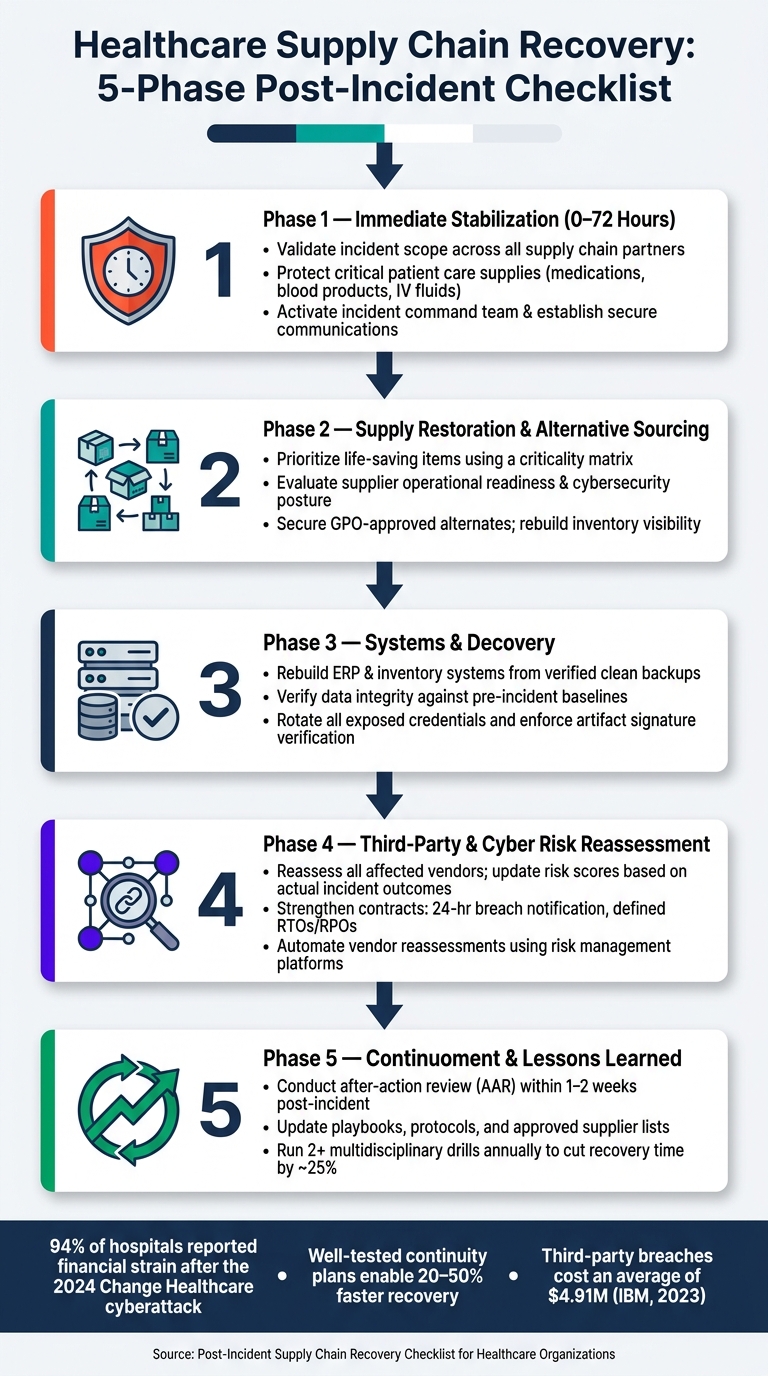
Healthcare Supply Chain Recovery: 5-Phase Post-Incident Checklist
How to Build a Crisis Response Plan for Supply Chain | Supply Chain & Logistics Crisis Management
sbb-itb-535baee
Immediate Stabilization and Impact Assessment
The first 24–72 hours following a supply chain disruption are critical for setting the stage for recovery. This phase focuses on stabilizing operations and understanding the scope of the disruption. Here’s how to approach it step by step.
Validate Incident Status Across the Supply Chain
Start by determining which partners are affected and the extent of the disruption. Prioritize based on patient care - issues with a sterile implant supplier, for instance, carry far greater risks than delays in office supplies. Use multiple communication channels like phone calls, portals, alerts, and logs to confirm the impact. Document findings in an incident matrix that includes each partner, the affected system, the last-known-good status, and any workarounds in place.
Tools like Censinet RiskOps™ can help simplify third-party vendor risk management and provide better visibility into vendor vulnerabilities.
Once the scope is clear, shift your focus to safeguarding clinical operations.
Protect Patient Safety and Critical Operations
Clinical continuity must take precedence. Identify supplies that are critical to patient care, such as medications, blood products, IV fluids, sterile kits, and implantable devices. Pay special attention to high-stakes areas like emergency rooms, ICUs, operating rooms, pharmacies, dialysis centers, and oncology departments. Assess risk using inventory levels - if critical supplies are down to less than two days and restocking is uncertain, escalate the issue immediately.
Activate pre-approved substitution protocols in collaboration with Pharmacy and Therapeutics (P&T) committees and clinical leaders. Ensure any substitutions or exceptions are reviewed and approved at the leadership level, avoiding ad hoc decisions at individual units. Regularly revisit these temporary measures to ensure they don’t become long-term practices.[2][4]
Set Up Governance and Communication
Form a supply chain incident command team that includes representatives from key areas: supply chain, clinical operations, pharmacy, nursing, IT/cybersecurity, legal/compliance, finance, and communications. Assign specific decision-makers for operational management, clinical prioritization, and external coordination.
If standard communication tools are compromised, switch to secure alternatives like encrypted messaging, emergency phone trees, or radio systems. During the first 24 hours, provide concise updates every 4–6 hours, detailing what is known, what remains uncertain, and what immediate actions are required. Document all decisions, particularly those involving substitutions and escalation processes, to ensure compliance and support future audits.[3][5]
With governance in place, begin evaluating the broader impact of the disruption.
Assess Operational and Financial Impact
Connect supply chain issues to their effects on clinical services. For example, a portal outage might slow replenishment for outpatient facilities, while a shortage of surgical kits could delay procedures and create backlogs. Track key metrics like canceled procedures, stockouts, manual work hours, and delivery delays to measure operational fallout.
On the financial side, monitor costs associated with emergency procurement, expedited shipping, overtime, wasted inventory, and revenue losses due to postponed procedures. The 2024 Change Healthcare cyberattack highlighted how quickly financial impacts can escalate - 94% of hospitals surveyed reported financial strain, with 60% describing it as severe.[2][4]
A 72-hour snapshot of financial and operational impacts can guide emergency sourcing decisions effectively.
Verify Supply Chain Data Integrity and Access
After a cyber incident, assume data may be compromised until proven otherwise. Critical records such as item masters, inventory counts, demand forecasts, and vendor details could be inaccurate or missing. Cross-check current data against trusted offline sources like recent purchase orders, receiving logs, physical inventory counts, or printed reports.
Be alert for signs of tampering, such as unexpected changes in units of measure, altered reorder thresholds, duplicate vendor records, or missing transactions. Ensure that essential users can access systems like ERP, WMS, and inventory platforms, and confirm that credential resets haven’t caused access delays. Validate system uptime and the reliability of data before processing orders. If there’s lingering doubt about data accuracy, switch to manual reconciliation using spreadsheet exports and controlled approvals until confidence is restored.[3][5]
Supply Restoration and Alternative Sourcing
Once stabilization efforts are in place and you've completed your impact assessment, the next critical step is to get your supply chain back on track. This involves restoring the flow of supplies while maintaining strict standards for quality, compliance, and cybersecurity.
Prioritize Supplies and Services for Restoration
Start by using a criticality matrix to rank supplies based on their impact on patient safety. Leverage data like the procedure volumes from the last 30–90 days and current stock levels. Focus first on life-saving items such as ventilator circuits, high-alert medications, and blood products. Next, address time-sensitive procedure supplies like oncology drugs and cath lab essentials. Finally, ensure infection prevention materials, such as PPE and sterilization supplies, are accounted for.
Avoid relying too heavily on past purchasing trends. Instead, consult briefly with clinical leaders in key areas like the ED, ICU, OR, and oncology to validate your priorities. This ensures your decisions align with actual clinical needs. Don't forget to include essential services like sterile processing, courier logistics, and IT hosting for inventory systems, as these are critical for maintaining supply continuity.
Engage and Evaluate Suppliers
Begin by confirming the operational readiness and cybersecurity measures of your key suppliers. For operations, ask about production capacity, lead times for critical items, safety stock availability, and allocation policies. On the cybersecurity side - especially if ransomware or vendor breaches are involved - check for any incident history, containment measures, and evidence of system hardening, such as multifactor authentication and network segmentation.
Request detailed documentation, including updated business continuity and disaster recovery plans, SOC 2 or ISO 27001 certifications, and written backup logistics plans. Platforms like Censinet RiskOps™ can help streamline this process, making it easier to collect and validate information across multiple vendors. Additionally, collaborate with your Group Purchasing Organization (GPO) to gather market intelligence on manufacturer status and identify secondary suppliers already under contract.
Secure Alternate Sources
Once you've assessed your primary suppliers, secure alternative sources to maintain uninterrupted supply flow. Check your GPO and framework contracts for pre-approved substitutes that include clauses for emergency use, pricing consistency, and fast onboarding. If these options fall short, conduct a rapid vendor review to verify FDA approvals, quality certifications, and minimum cybersecurity standards - like secure portals and encrypted data exchange - before placing new orders.
For high-risk categories such as implants or medications, involve your Pharmacy & Therapeutics (P&T) committee or value analysis team to ensure clinical equivalency. Use short-term contracts (e.g., 90 days or less) with volume caps and review points to avoid long-term dependencies. Document any deviations from standard formulary or contract terms for later compliance and financial audits.
Rebuild Inventory Visibility
If your ERP or inventory systems are compromised, implement a "minimum viable visibility" approach. Within the first 24–72 hours, deploy standardized spreadsheet templates to track inventory in critical areas like the OR core, ED, and ICU. Conduct daily or twice-daily physical counts of your top 100–200 critical items. Centralize this data in a shared dashboard or even on a visible whiteboard for leadership oversight.
As IT systems come back online, transition from manual tracking to temporary cloud tools or inventory modules. Once your primary system is restored, conduct a focused reconciliation by temporarily halting transactions, performing targeted cycle counts, and updating system quantities based on validated records. Maintain dual tracking during the transition to catch any discrepancies. A 2022 Kaufman Hall survey of 100 U.S. hospital executives revealed that 99% faced challenges in obtaining needed supplies, with 96% resorting to new or additional suppliers - highlighting why interim visibility is essential [1].
Align with Enterprise Incident Response
Supply restoration efforts must align with the broader enterprise incident response plan. This ensures supply chain recovery integrates seamlessly with overall organizational recovery. Establish a dedicated Supply Chain Recovery Cell that reports directly to your hospital's incident command structure, typically under the Hospital Incident Command System (HICS). Include representatives from supply chain, clinical operations, IT, finance, and compliance teams.
Coordinate supply chain milestones with IT recovery steps. For instance, begin partial ordering via EDI when your ERP is in read-only mode, move to full EDI when functionality is fully restored, and complete inventory reconciliation before resuming normal elective procedures. Decisions about reopening satellite clinics or increasing surgical volumes should account for both IT readiness and confirmed supply availability. Reconnecting to external vendor IT systems - like EDI links or API integrations - should only happen after your Chief Information Security Officer (CISO) confirms that cybersecurity requirements are met by all parties. Document every recovery step, supplier communication, and sourcing exception for post-incident reviews, insurance claims, and regulatory reporting.
Systems, Data, and Process Recovery
Once supply restoration begins, the next step is to rebuild your digital infrastructure using clean backups. This approach helps eliminate any lingering vulnerabilities or blind spots.
Restore and Validate Supply Chain Systems
When recovering essential platforms like ERP, inventory management, or e-procurement systems, supported by automated vendor risk assessments, always rebuild from verified, clean backups. Avoid patching compromised systems, as it can leave lingering doubts about potential alterations. Yukti Singhal, Product Lead at Safeguard, emphasizes this point:
"A clean rebuild from verified inputs eliminates uncertainty." [6]
Before starting the rebuild, clear build caches and remove intermediate artifacts. Pin dependencies to verified versions listed in updated lockfiles. Once your systems are back online, validate them against pre-incident baselines. Check for any unauthorized changes to networks or file systems to ensure the environment is secure and reliable.
This rebuilt infrastructure is critical for maintaining data integrity and implementing strong access controls.
Verify Data Quality and Integrity
Ensuring data integrity is a top priority during recovery. Compare software bill of materials (SBOMs) from before and after the incident to identify any new dependencies, mismatched hashes, or provenance issues. Use centralized inventory tools to query your supply chain database and pinpoint any compromised versions. Pay particular attention to data records affected during the exposure window - the time between the initial breach and its detection - which, according to industry data, can last for weeks or even months [6].
Reinforce Access Controls and Monitoring
Rotate all credentials that may have been exposed, including API keys, service account tokens, database credentials, and SSH keys. This step is crucial to prevent unauthorized access. Safeguard highlights the importance of this measure:
"Supply chain attacks frequently include credential harvesting, and compromised credentials enable persistent access even after the malicious component is removed." [6]
After rotating credentials, strengthen your build pipelines by implementing artifact signature verification. This ensures that all components and data inputs are sourced from trusted, verified origins, further securing your recovery process.
Third-Party and Supply Chain Cyber Risk Reassessment
After restoring systems, it's crucial to evaluate the ongoing risks posed by vendors involved in the incident. Building on system recovery and data integrity, this step focuses on identifying and addressing vulnerabilities in third-party relationships. According to Ponemon research, 54% of healthcare organizations experienced breaches linked to third parties in the last two years, yet only 36% conducted vendor assessments annually or more often. A reassessment after an incident provides a chance to address these gaps.
Reassess Affected Vendors and Products
Start by categorizing vendors based on their level of exposure. Prioritize those directly involved in the incident, those technically connected (e.g., shared credentials, data feeds, or integrations), and those critical to operations during the disruption, such as emergency logistics providers or backup distributors. Evaluate each vendor's performance during the incident, including detection speed, containment effectiveness, operational reliability, and previous risk ratings (e.g., SOC 2/HITRUST, BAAs). For vendors impacted by the incident, request updated documentation like a SOC 2 Type II report, a recent penetration test summary, and a detailed remediation plan with timelines.
Update Risk Ratings and Segmentation
Use the reassessment findings to update each vendor's risk score, basing the new ratings on actual incident outcomes rather than pre-incident assumptions. Vendors that showed poor communication, lacked transparency, or struggled to contain the issue should be moved to higher-risk tiers. Tighten oversight by implementing more frequent reviews, stricter segmentation, and scheduled tabletop exercises. Conduct scenario-based impact analyses, such as evaluating the effects of a vendor outage lasting 7, 14, or 30 days, to ensure criticality ratings align with real-world risks to supply chains and patient safety. IBM's 2023 Cost of a Data Breach report highlights the urgency, noting that breaches involving third parties cost an average of $4.91 million and take 273 days to identify and contain. These figures emphasize the importance of stronger oversight.
Once risk ratings are updated, enforce stricter contractual terms and onboarding controls to prevent future incidents.
Strengthen Contracts and Onboarding Controls
Incidents often reveal weaknesses in vendor contracts. Replace vague terms with clear requirements, such as mandatory notification within 24 hours of a confirmed incident, updates every 48–72 hours until containment, and a full root cause analysis within 30 days. Contracts should also define recovery time objectives (RTOs), recovery point objectives (RPOs), and baseline security measures like multi-factor authentication, encryption, tested backups, and vulnerability management SLAs. For high-impact vendors, consider requiring joint incident response drills that simulate supply chain disruptions to ensure preparedness.
Use Automated and Collaborative Risk Management Tools
Manually managing reassessments across numerous vendors can be inefficient and error-prone. Tools like Censinet RiskOps™ simplify the process by automating post-incident vendor assessments. These tools allow you to tag affected vendors, send targeted post-incident questionnaires, and automatically update risk scores based on responses. Collaborative features let health systems and vendors track remediation tasks, upload evidence, and communicate in real time, cutting down on the inefficiencies of email chains. Integrations with GRC and ticketing systems ensure that findings are seamlessly incorporated into your enterprise risk register, keeping governance teams informed without extra manual work.
Align with Enterprise Governance
Managing third-party supply chain risks should be part of a broader enterprise strategy. Map vendor risks to categories like clinical, operational, regulatory, and financial, and report significant updates to key committees, such as the Enterprise Risk Management Committee, Information Security Governance Committee, and Supply Chain Council. According to the Health Industry Cybersecurity Supply Chain Risk Management Guide, 60–70% of typical healthcare IT spending goes to external suppliers, meaning a large portion of cyber risk lies outside direct organizational control. Elevating these risks to the governance level ensures a post-incident review contributes to long-term resilience. Document these updates in your enterprise risk register to maintain consistency across recovery efforts and reinforce continuous improvement in healthcare supply chain management.
Continuous Improvement and Lessons Learned
The final step in recovery is about transforming past incidents into actionable, long-term improvements. This involves refining plans, enhancing training, updating metrics, and integrating lessons into everyday operations.
Run Structured Post-Incident Reviews
Hold an after-action review (AAR) within one to two weeks of the incident. Gather key teams, including supply chain, clinical operations, IT, cybersecurity, pharmacy, procurement, finance, legal, and risk management. Focus the discussion on four critical questions: What happened? What worked? What failed? What needs to change?
Support the discussion with data - incident timelines, order fill rates, backorder durations, vendor response times, and costs like expedited shipping or emergency purchases. Assign clear corrective actions with specific owners, deadlines, and measurable success criteria. This level of accountability ensures that identified gaps lead to meaningful updates in your response plans.
Update Plans and Protocols
After the review, revise all relevant response documents. This includes incident response playbooks, continuity-of-operations plans, emergency purchasing procedures, clinical substitution protocols, approved supplier lists, and escalation workflows. Pay special attention to eliminating single-source dependencies.
Ensure all updates are version-controlled and approved by leadership. This step makes the changes enforceable and auditable, rather than just theoretical improvements.
Improve Training and Exercises
Standard training often falls short. Incorporate realistic supply chain scenarios into tabletop exercises. For example, simulate a ransomware attack affecting ordering systems, a distribution center outage, or a cyber incident at a third-party logistics provider. Use role-specific scenarios - like inventory dashboards showing depletion or clinician notifications about missing supplies - to test decision-making under pressure.
Conduct at least two multidisciplinary drills annually. These exercises can cut recovery time by roughly 25%. After each drill, hold a mini-AAR to capture insights and feed them back into your plans.
Refine Metrics and Reporting
Monitor these key metrics to measure resilience:
| Metric | What It Measures |
|---|---|
| Time to identify supplier disruption | Speed of detection |
| Time to activate contingency plans | Readiness to respond |
| Time to restore critical product availability | Recovery efficiency |
| % of critical items with alternate sourcing | Sourcing reliability |
| % of high-risk vendors with active remediation plans | Vendor risk management |
| Emergency procurement and expedited shipping costs | Financial impact of disruptions |
Review these metrics regularly, not just after an incident. Present them at risk or quality committee meetings to show leadership how lessons learned are driving measurable improvements. Incorporate these metrics into daily workflows to ensure ongoing risk management.
Build Continuous Risk Management Into Daily Practice
One of the biggest pitfalls after an incident is documenting lessons learned but failing to act on them. To avoid this, treat the follow-up as an ongoing improvement program. Use a remediation register, schedule regular leadership reviews, and track the closure of action items.
Tools like Censinet RiskOps™ can simplify this process by centralizing vendor risk data, automating reassessments, and tracking remediation tasks. By providing a shared view of risk across procurement, clinical, IT, and security teams, such platforms help ensure that corrective actions don’t lose momentum once the immediate crisis is over [7][8].
Conclusion
Recovering from supply chain disruptions isn't just about getting operations back on track - it directly impacts patient safety. Every step in the recovery process, from stabilizing operations to implementing long-term fixes, plays a role in safeguarding patient care.
Taking a structured, step-by-step approach is the best way to ensure both patient safety and operational continuity. Skipping steps or rushing phases - like reactivating ordering systems without first verifying data accuracy - can lead to new risks and additional setbacks. Health systems with well-documented and tested continuity plans recover 20–50% faster than those relying on improvised responses [1].
In the U.S., supply chain disruptions are now a persistent challenge for healthcare organizations, requiring a coordinated effort across multiple departments. Success hinges on collaborative governance that includes clinical leaders, IT, cybersecurity, finance, and key suppliers. This teamwork ensures a faster, more effective recovery.
Another critical focus is vendor management, particularly cybersecurity and contractual standards. After any major disruption, it's essential to reassess vendor risk ratings, tighten contract terms, and confirm that critical suppliers meet your security and continuity standards. Tools like Censinet RiskOps™ can help healthcare organizations maintain oversight and control over their vendor networks.
The most resilient organizations don't just bounce back - they get better. Use this checklist as a guide to strengthen your recovery process. Within the next 30 days, consider running a tabletop exercise, updating a critical plan, or mapping out key suppliers to identify areas for improvement. Taking proactive steps now can help minimize the impact of future disruptions.
FAQs
Who should be on a supply chain incident command team?
A supply chain incident command team needs to bring together experts from several key areas to ensure an effective response. This team should include:
- Incident response lead: Oversees the entire process and ensures coordination across all roles.
- IT security experts: Handle technical aspects and safeguard against potential cyber threats.
- Legal and compliance officers: Address regulatory concerns and ensure all actions comply with the law.
- Clinical leadership: Provide insights on how incidents may impact patient care and clinical operations.
- Supply chain managers: Focus on logistics, procurement, and maintaining supply flow.
- Public information or crisis communication representatives: Manage communication with the public and stakeholders to maintain trust and transparency.
To keep operations running smoothly, assign backups for each role. This ensures the team remains functional even if a primary member is unavailable.
What are the first supplies to restore after a disruption?
When restoring systems, start with the essentials: electronic health records (EHR) and inventory management systems. Use backups that have been thoroughly tested and verified to avoid complications. A phased approach works best - begin with non-critical systems and gradually move to mission-critical ones. This method helps ensure recovery runs smoothly while keeping disruptions to operations at a minimum.
How do we verify ERP and inventory data after a cyberattack?
To ensure your ERP and inventory data are accurate following a cyberattack, start by confirming that your asset management software is up-to-date and provides an accurate picture of your inventory, including network diagrams and system dependencies. Run vulnerability scans on essential systems to identify potential risks and validate the integrity of your backups. Leverage monitoring tools to spot any unusual activity or irregularities.
Additionally, conduct regular audits of your suppliers and warehouses. Cross-check physical inventory counts with your digital records to pinpoint and address any discrepancies quickly. This thorough approach helps restore confidence in your data and minimizes operational disruptions.

