
2025 FDA Cybersecurity Labeling: Key Updates
Post Summary
The FDA's 2025 cybersecurity labeling guidance introduces stricter requirements for medical device manufacturers to enhance patient safety. Key updates include:
- Mandatory Cybersecurity Labeling: Devices must now include 14 specific cybersecurity elements, such as system diagrams, Software Bill of Materials (SBOM), and vulnerability reporting details.
- Lifecycle Security Maintenance: Manufacturers are required to provide updates and patches throughout a device's entire lifecycle, including clear end-of-support timelines.
- Vulnerability Reporting: Coordinated Vulnerability Disclosure (CVD) plans are now mandatory, ensuring faster response to security threats.
These changes aim to prevent devices from being classified as "misbranded" under the FD&C Act, which could lead to market recalls. Healthcare organizations must also adjust their processes to integrate these updates into their risk management systems.
Bottom line: The FDA is making cybersecurity a core focus for medical device safety, requiring manufacturers and healthcare providers to prioritize transparency and proactive risk management.
A Quick Primer on FDA's Final Guidance for Cybersecurity in Medical Devices

sbb-itb-535baee
Key Updates in the 2025 FDA Cybersecurity Labeling Guidance
The 2025 guidance applies to any premarket submission for a qualifying cyber device and highlights three major updates: connectivity disclosure, lifecycle security maintenance, and vulnerability reporting. These changes address the growing cybersecurity risks in healthcare and emphasize the FDA's focus on patient safety.
Expanded Connectivity and Device Disclosure Requirements
Manufacturers now need to detail all physical and logical interfaces (like network ports, wireless protocols, and default-enabled settings) and include system diagrams that outline data flows, trust boundaries, and security controls [4]. Additionally, a machine-readable Software Bill of Materials (SBOM) is required, listing all software components - whether commercial, open-source, or off-the-shelf - aligned with NTIA standards [2]. The guidance specifies 14 elements that cybersecurity labeling must cover, ensuring clarity. Manufacturers also have to define their responsibilities versus those of healthcare organizations, such as outlining network protection measures and patch management expectations [4].
Security Maintenance and Support Lifetime Expectations
The updated guidance raises the bar for maintaining device security throughout its lifecycle. In line with section 524B(b) of the FD&C Act, manufacturers are expected to establish robust processes to ensure security from the design phase through decommissioning. This includes making postmarket updates and patches available for both the device and its related systems [2]. The FDA's Total Product Life Cycle (TPLC) approach underpins this requirement, emphasizing long-term security planning. A helpful tool in this context is the Predetermined Change Control Plan (PCCP), which allows manufacturers to pre-authorize specific security updates. This ensures patches can be applied to devices already in the market without requiring a new submission [3].
Vulnerability Reporting and Incident Communication
Another critical update focuses on improving vulnerability reporting. Manufacturers are now required to integrate Coordinated Vulnerability Disclosure (CVD) procedures into their postmarket cybersecurity management plans [2]. This involves submitting a formal plan to monitor, identify, and address vulnerabilities promptly, along with clear methods for reporting and sharing security advisories with users. Labeling must also include forensic logging details, such as supported log formats (e.g., JSON or syslog) and compatibility with Security Information and Event Management (SIEM) systems, to support integration into hospital-wide security frameworks [4]. Devices lacking sufficient cybersecurity labeling may be classified as "misbranded" under section 502(f) of the FD&C Act, which could lead to their removal from the market [3].
2023 vs. 2025 Cybersecurity Labeling Standards: A Comparison
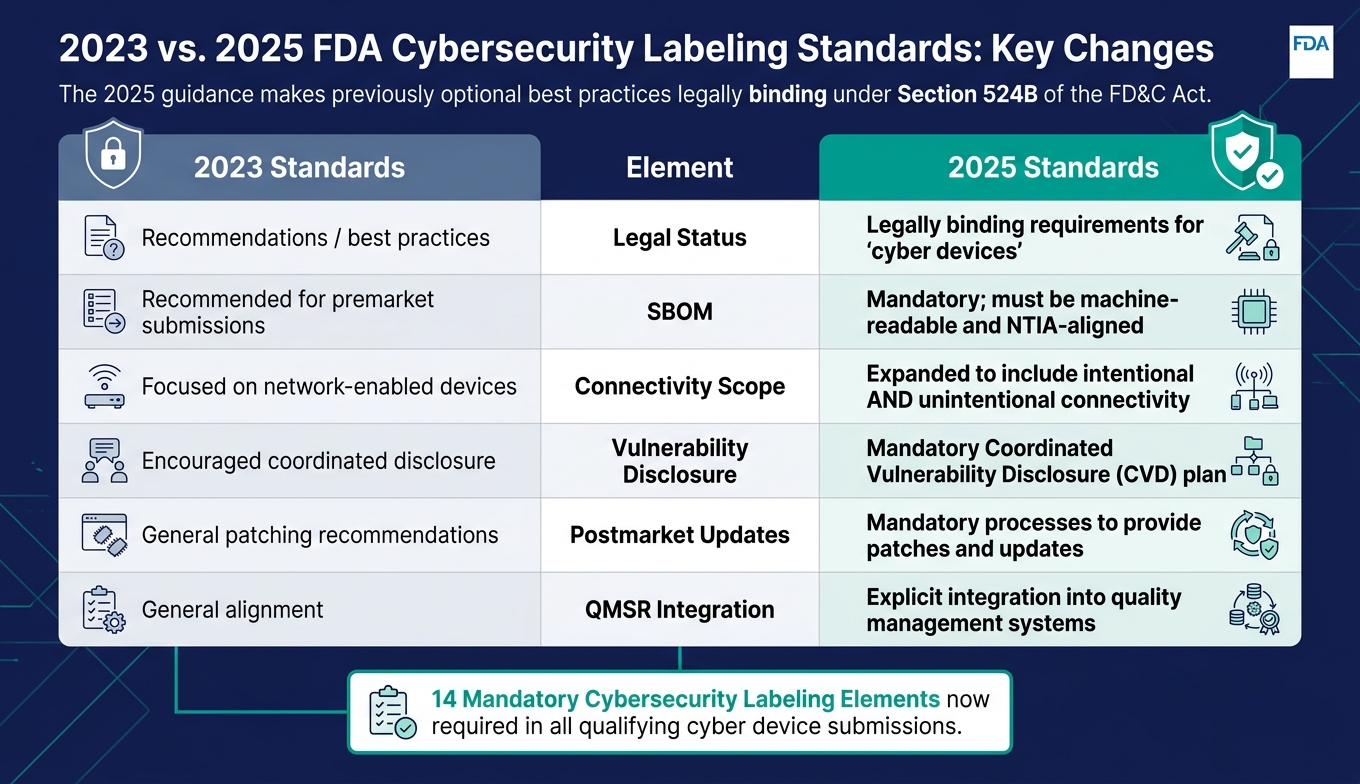
2023 vs. 2025 FDA Cybersecurity Labeling Standards: Key Changes
The 2025 guidance builds on the September 27, 2023 version, incorporating updates finalized in March 2024. Understanding the differences between these versions can help manufacturers identify areas where their documentation and processes need adjustments. This is particularly vital when addressing critical medical device security risks that can impact patient safety.
Structural Changes in the Guidance
One of the most notable updates is the incorporation of Section 524B of the FD&C Act, which makes cybersecurity requirements legally binding for "cyber devices" [1][5]. Unlike the 2023 guidance, which relied on general safety authority, the 2025 version is firmly grounded in statutory mandates.
A new section, "Cyber Devices" (Section VII), consolidates manufacturer obligations under the 2022 FD&C Act amendments [1][6]. Additionally, "Postmarket Management Plans" have been renamed "Cybersecurity Management Plans" to align with the terminology in the Food and Drug Omnibus Reform Act (FDORA) [5]. The 2025 guidance also integrates these cybersecurity requirements into the Quality Management System Regulation (QMSR), embedding them within a manufacturer’s overall quality framework rather than treating cybersecurity as a standalone concern [1].
Beyond these structural updates, the guidance revises and clarifies several content-specific elements to better define manufacturer responsibilities.
Content-Level Changes
What was optional in 2023 has become mandatory under Section 524B. The table below highlights the key changes:
| Element | 2023 Standards | 2025 Standards |
|---|---|---|
| Legal Status | Recommendations/best practices | Legally binding requirements for "cyber devices" [5] |
| SBOM | Recommended for premarket submissions | Mandatory; must be machine-readable and NTIA-aligned [2][5] |
| Connectivity Scope | Focused on network-enabled devices | Expanded to include intentional and unintentional connectivity [6] |
| Vulnerability Disclosure | Encouraged coordinated disclosure | Mandatory plan for coordinated vulnerability disclosure (CVD) [2] |
| Postmarket Updates | General patching recommendations | Mandatory processes to provide patches and updates [2] |
| QMSR Integration | General alignment | Explicit integration into quality systems [1] |
The 2025 guidance expands the connectivity scope, clarifying that "the ability to connect to the internet" includes devices with unintentional connectivity. This broader definition increases the number of devices classified as "cyber devices", subjecting more manufacturers to Section 524B requirements [6].
"FDA also considers the 'ability to connect to the internet' to include devices that are able to connect to the internet, whether intentionally or unintentionally, through any means (including at any point identified in the evaluation of the threat surface of the device and the environment of use)." - Food and Drug Administration [6]
Another update involves documentation requirements for device modifications, which now distinguish between changes that could affect cybersecurity and those that do not [1]. This clearer guidance helps manufacturers determine whether a modification necessitates a new premarket submission or if existing documentation is sufficient.
How the Updated Labeling Requirements Affect Manufacturers and Healthcare Organizations
Labeling as a Risk Management Tool
The 2025 guidance takes a new approach, treating cybersecurity labeling as a safety control rather than a mere formality. This means labeling must now be embedded into the Secure Product Development Framework (SPDF) and managed throughout the Total Product Life-Cycle (TPLC). In other words, manufacturers can no longer treat labeling as a final checkbox before submission.
This change brings major compliance challenges. The FDA now requires manufacturers to include 14 specific cybersecurity elements in device labeling. These range from system architecture diagrams and network port lists to forensic logging formats and End-of-Support (EOS) dates [4]. Missing or inaccurate information in the cybersecurity section of a 510(k) submission can halt progress during the eSTAR technical screening process [2]. It's clear: getting labeling right from the outset is essential.
To avoid setbacks, manufacturers should address labeling requirements during threat modeling, not after development. Clearly outlining which security responsibilities fall to the manufacturer (like issuing patches) versus the operator (such as setting up network segmentation) helps eliminate confusion for everyone involved [4].
These updated labeling rules don’t just impact manufacturers - they also influence how healthcare organizations handle device security.
Impact on Healthcare Delivery Organizations
As manufacturers adapt their processes, healthcare organizations must also adjust their operations to make the most of these updates. The new labeling standards directly affect how IT teams manage device security. For example, the required "Supporting Infrastructure Requirements" section helps IT administrators define minimum network protections, while the mandated list of network ports and interfaces aids in configuring firewalls and isolating devices within segmented networks [4].
A major change is the inclusion of a machine-readable SBOM (Software Bill of Materials). Healthcare delivery organizations (HDOs) are now expected to integrate SBOM data into their vulnerability management systems to monitor risks tied to third-party and open-source components [4][2]. Additionally, manufacturers must specify log formats - such as JSON, syslog, or CEF - so that device-generated audit logs can be seamlessly incorporated into SIEM systems [4].
Another critical update involves EOS dates. Manufacturers are now required to clearly state when security support ends and how risk management shifts to HDOs after that point [4]. This information enables healthcare organizations to plan for device replacements as part of their long-term capital strategies, rather than being caught off guard by unsupported devices.
"Labeling that does not include sufficient information to explain how to securely configure or update the device may limit the ability of end users to appropriately manage and protect the medical device system." - FDA [7]
Failing to meet these labeling standards has serious repercussions. Devices with inadequate cybersecurity instructions can be deemed "misbranded" under sections 502(f) and 502(j) of the FD&C Act, which can lead to recalls or enforcement actions [3][7].
How Censinet Supports Cybersecurity Labeling and Risk Management
Meeting the 2025 FDA cybersecurity labeling requirements presents a dual challenge: managing extensive documentation and adapting operations. Healthcare organizations and manufacturers must handle growing amounts of structured data, including machine-readable SBOMs, connectivity disclosures, and end-of-support timelines. Censinet RiskOps™ is specifically designed to simplify these hurdles.
Organizing Labeling Data with Censinet RiskOps™
Censinet RiskOps™ offers practical tools to help healthcare organizations efficiently manage and operationalize the FDA's required labeling elements.
The platform centralizes essential data like SBOMs in machine-readable formats such as CycloneDX or SPDX, which are now mandatory under Section 524B(b) of the FD&C Act [8]. Instead of juggling these files manually or across disparate systems, Censinet RiskOps™ consolidates them alongside other critical details, including connectivity interface disclosures, network port documentation, hardening guidance, and supported configurations.
Labeling data is constantly evolving. Devices receive patches, software updates alter components, and support timelines shift - all of which require continuous updates to associated documentation. By embedding labeling management into third-party and enterprise risk workflows, Censinet RiskOps™ helps healthcare organizations keep track of device-specific risks stemming from labeling gaps. This centralized system simplifies the process and sets the stage for quicker risk assessments.
Faster Risk Decisions with Censinet AI
Reviewing cybersecurity labeling across numerous devices can be a tedious process. Censinet AI™ speeds up risk assessments by automating security questionnaires, summarizing evidence, and generating clear, concise risk reports. With its human-in-the-loop design, risk teams can set rules and thresholds for reviews, ensuring everything stays on track. This approach enables healthcare organizations to process SBOM data more efficiently, validate end-of-support disclosures, and pinpoint missing labeling elements. The result? Faster, well-documented risk decisions that directly enhance patient safety.
Conclusion: Key Takeaways from the 2025 FDA Cybersecurity Labeling Updates
The FDA's finalized guidance, released on June 27, 2025[1], positions cybersecurity as a core component of device safety, emphasizing its integration from the design stage through the entire product lifecycle[3].
For manufacturers, the stakes couldn't be higher. Devices with inadequate cybersecurity labeling could be deemed "misbranded", leading to recalls, market withdrawals, or even criminal charges[3]. The FDA is also stepping up enforcement with a dedicated cybersecurity section in its Compliance Program Manual (#7382.850), effective February 2, 2026. This signals a more structured and rigorous approach to inspections[3].
Healthcare delivery organizations stand to benefit from greater transparency. The updated requirements mandate essential tools like SBOMs (Software Bill of Materials), connectivity disclosures, and support timelines. These elements provide critical insights for evaluating device risks before they are deployed in clinical environments, enabling more precise risk management.
Managing the influx of labeling data poses its own challenges. Platforms like Censinet RiskOps™ tackle this by centralizing documentation and using Censinet AI™ to streamline assessments. This ensures that risk teams can make quick, well-documented decisions without sacrificing accuracy. By simplifying data management and decision-making, tools like these help manufacturers and healthcare providers turn compliance into improved patient safety.
"FDA's cybersecurity requirements make cyber resilience a central element of medical device safety and quality." - Exponent [3]
FAQs
What qualifies as an FDA “cyber device” in 2025?
In 2025, the FDA defines “cyber devices” as medical devices that meet the following criteria:
- Include software: The device relies on software for its functionality.
- Connect to the internet or other networks: This connection can be direct or indirect.
- Are vulnerable to cybersecurity threats: The device has features that could expose it to potential security risks.
These criteria aim to pinpoint devices that need stronger cybersecurity measures to protect both patient safety and sensitive data.
What are the 14 required cybersecurity labeling elements?
The 14 required cybersecurity labeling elements cover a wide range of critical information to ensure device security and transparency. These elements include:
- Device instructions, specifications, and system architecture details to provide clarity on how the device operates and is built.
- Network ports, interfaces, and infrastructure requirements for understanding connectivity and compatibility.
- A machine-readable SBOM (Software Bill of Materials), update processes, and version control to track software components and maintain security updates.
- Event detection, response procedures, and forensic logging to monitor and handle security incidents effectively.
- Backup, restore, and secure decommissioning methods to safeguard data and ensure proper disposal of devices.
- Secure configurations, risk warnings, and end-of-support processes to keep users informed about potential risks and device lifecycle management.
- Features for critical functionality protection and SIEM (Security Information and Event Management) compatibility to enhance security integration and protect essential operations.
These elements collectively aim to provide comprehensive guidance for maintaining device security throughout its lifecycle.
How should hospitals use SBOMs and EOS dates in risk management?
Hospitals can benefit greatly from using Software Bill of Materials (SBOMs) to monitor software components and their end-of-support (EOS) dates. This proactive approach helps tackle risks such as outdated software and potential security vulnerabilities. By integrating SBOM data into cybersecurity workflows, hospitals can maintain stronger security measures and stay compliant with regulations.
SBOMs also make it easier to perform vulnerability assessments, address issues quickly, and make informed decisions - especially critical for devices with long lifecycles. This reduces the risks associated with running obsolete software, ensuring a safer and more efficient healthcare environment.

